What Grade Is Algebra 1? What the Data Says About Timing and Readiness
reviewed by Jhover S. Quirante
Updated on September 16, 2026
Key Points:
Your child’s classmates are taking Algebra 1 in 8th grade, while your school schedules it for 9th grade. Is your child falling behind, or are those students simply ahead? If you’re trying to figure out what grade is Algebra 1, the answer is less straightforward than it seems.
What Grade Is Algebra 1, According to National Data?
There’s no single grade when students take Algebra 1 in the U.S. However, data show that Algebra 1 is available much more widely in high school.
Middle School vs. High School Algebra 1 Enrollment
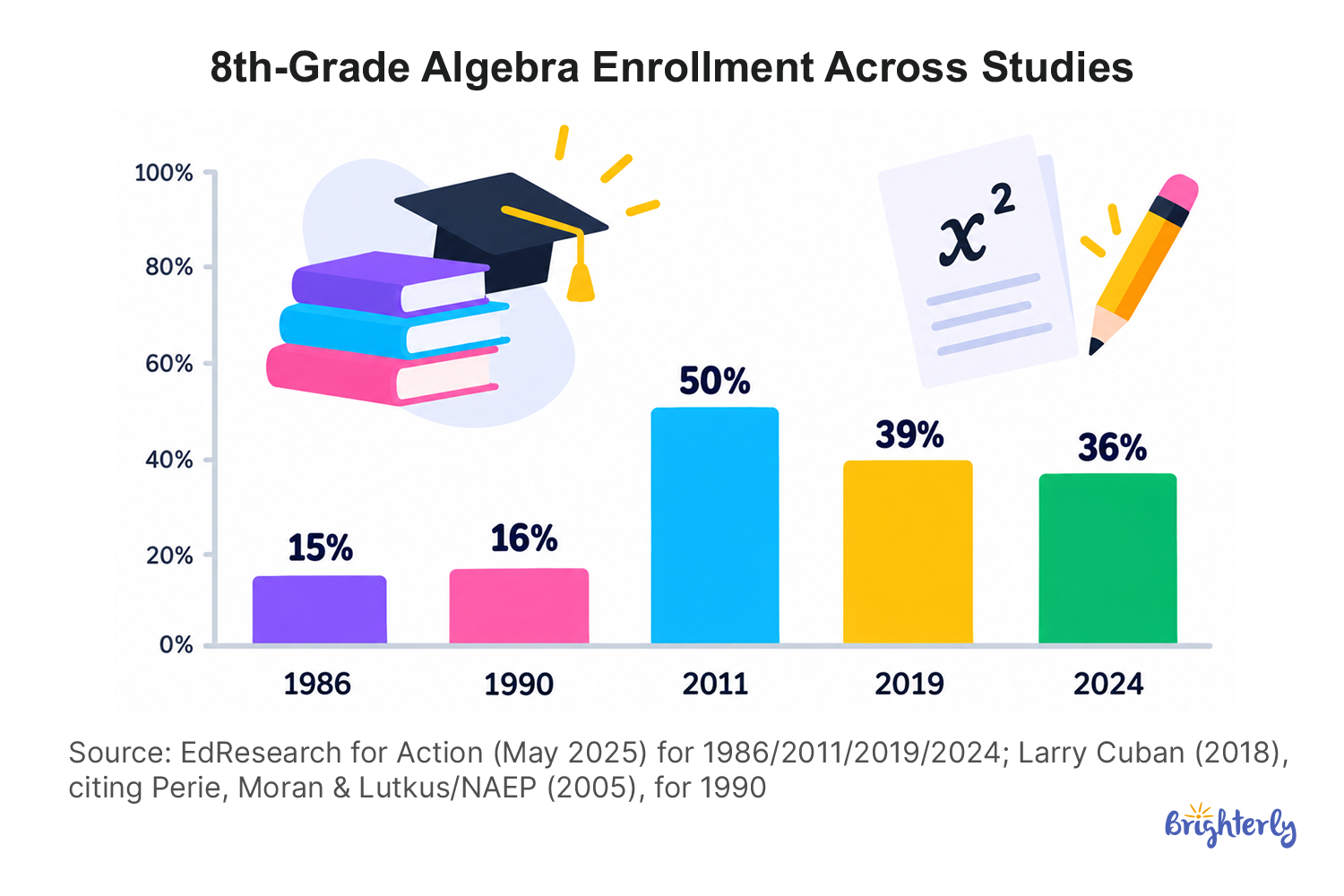
According to the U.S. Department of Education, 39% of public middle schools serving grades 7 or 8 didn’t offer Algebra 1 at all, though more than 80% of high schools did. And even where middle school Algebra is available, relatively few students take it: only about 26% of public 7th and 8th graders were enrolled in Algebra 1 in 2020–21 (EdResearch for Action, May 2025).
A more recent 2025 NWEA study of 162,000 8th graders across 22 states has shown that 58% of schools offered Algebra by 8th grade.
Together, these numbers should give you a more useful answer to “What grade level is Algebra 1?”: your child may have the option to take it in middle school, but early access depends heavily on the school they attend.
Why the Grade Level Varies by State and District
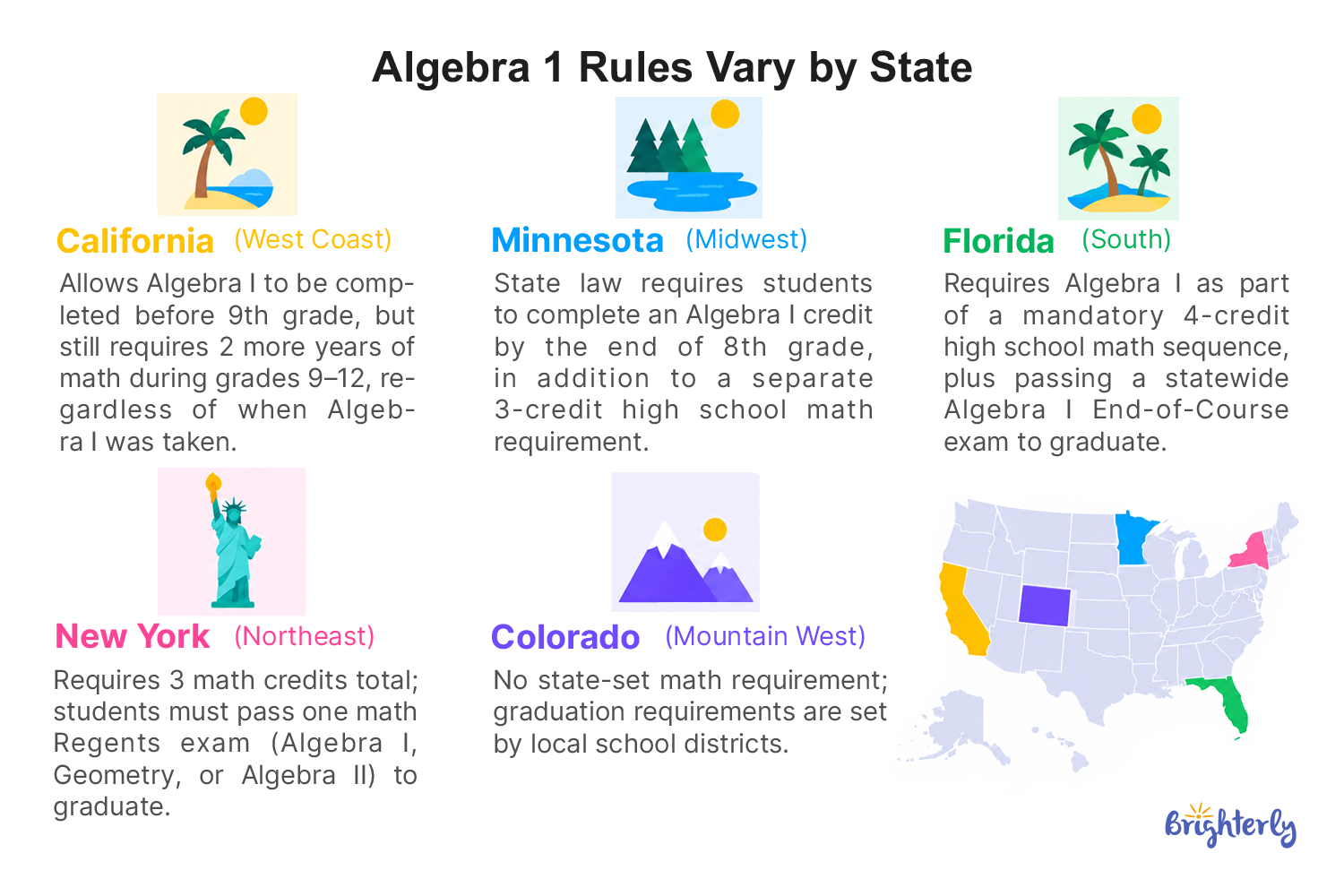
Where kids go to school also makes a difference. States and districts follow different rules for when students can take Algebra 1:
- Minnesota requires an Algebra 1 credit by the end of 8th grade.
- California allows students to complete Algebra 1 or Math 1 before 9th grade. Even in this case, it requires two years of high school math.
- Florida requires Algebra 1 as part of its four-credit high school math sequence and requires students to pass the statewide Algebra 1 End-of-Course exam.
- New York requires three math credits and one passing math Regents exam in Algebra 1, Geometry, or Algebra 2.
- Colorado leaves high school graduation requirements to local districts.
This is the reason why, in 2007, the share of 8th graders taking Algebra 1 ranged from 21% in North Dakota to 59% in California.
So if another child is taking Algebra 1 earlier than yours, it doesn’t mean your child is behind. Start by checking what grade Algebra starts in your school and how students qualify for it. And if you’re unsure whether your child is ready or not, an Algebra 1 practice test can help spot skills that need more practice.
Not sure if your child is ready for Algebra 1?
Book a free demo to check their current level and receive a customized learning plan.


Explore Brighterly Learning Experience
Learn exactly how Brighterly helps students thrive through expert sessions, online tools, and proven feedback from thousands of satisfied parents
Does Taking Algebra 1 Early Actually Help?
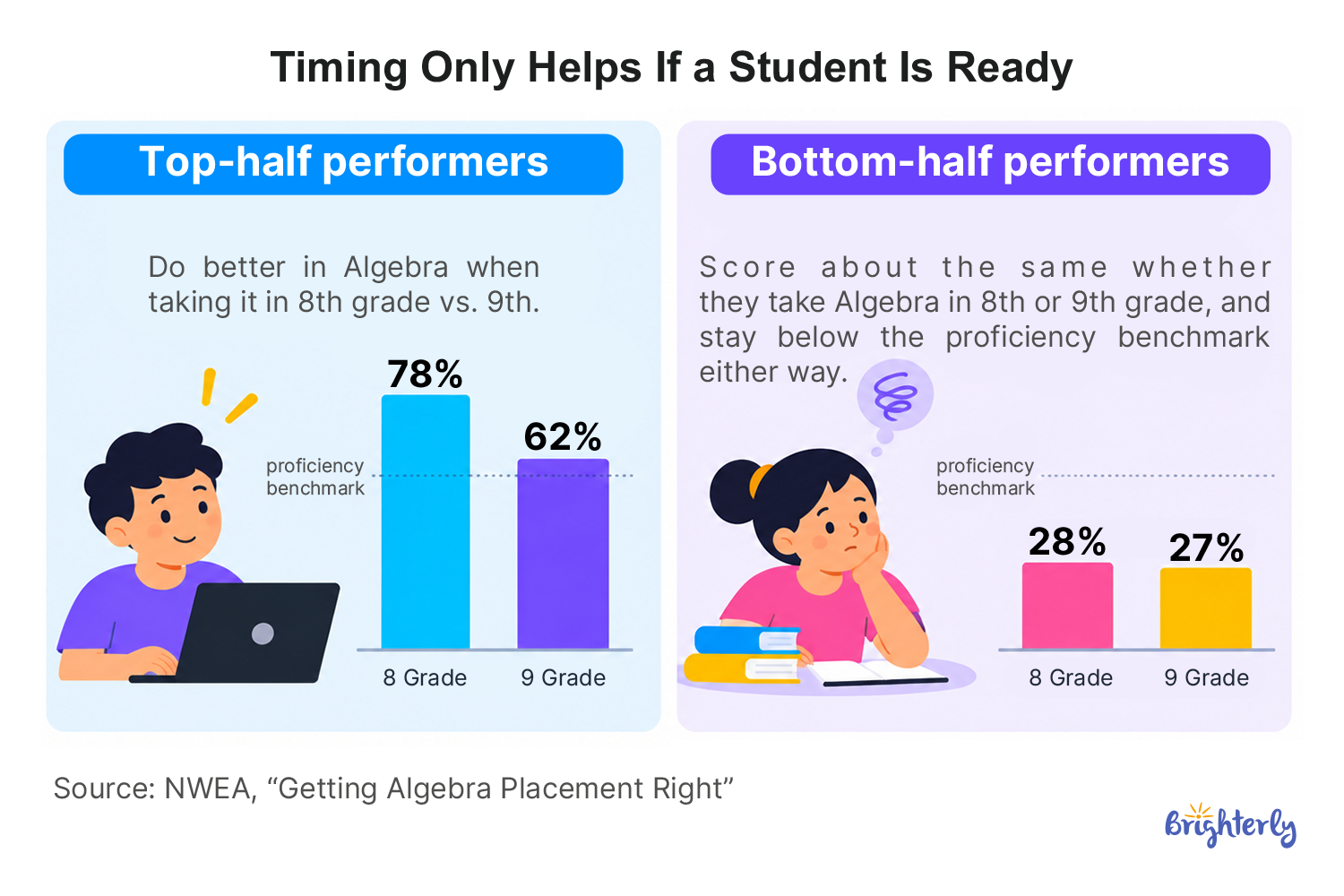
An August 2026 NWEA study showed that students with stronger math skills really performed better when they took Algebra in 8th grade instead of waiting until 9th. The benefit was largest for the highest-performing 10%: they scored 5 points higher, which is equal to roughly two-thirds of a year of additional math growth.
Recent research also suggests that simply putting more students into Algebra early may not produce the same benefits. A 2024 Oregon study found that students placed into 8th-grade Algebra performed better in math and English than similar students who just missed their school’s placement cutoff.
However, the positive effect on math scores was smaller at schools where 8th-grade Algebra was more widely available. The researchers suggest that access to higher-achieving classmates and more experienced math teachers may explain some of the advantages.
Students who aren’t quite ready for Algebra may still do well with enough support. A 2024 study by Dee & Huffaker followed 9th graders who were below grade level but took Algebra 1 anyway. Their teachers received extra training and coaching, with more time to plan for students coming into the class with different levels of math preparation.
By 11th grade, these students scored about 0.2 standard deviations higher in math and were 14 percentage points more likely to have passed Algebra 2. They were also 13 percentage points more likely to stay enrolled through 12th grade.
The first year was still difficult: half initially failed Algebra 1 and needed a retake or bridge class. But their longer-term results were stronger than those of students assigned to remedial math. So it seems like for students who aren’t fully prepared, support may matter more than simply waiting another year.
Why 9th-Grade Success Predicts High School Graduation
What happens during freshman year can tell parents a surprising amount about a child’s path through high school. In Chicago Public Schools (CPS), for instance, course performance in 9th grade has been strongly associated with whether students graduate four years later.
The Chicago “On-Track” Research: What One Failed Course Can Cost
The University of Chicago Consortium has studied 9th-grade performance in Chicago public schools for years. In its Hidden Risk report, researchers looked at how students’ freshman-year grades related to their chances of graduating.
They found that even one failed course mattered: roughly 9 in 10 students who passed every course in 9th grade graduated within four years, compared with about 7 in 10 students who failed one course, including a non-core course.
Public schools in Chicago also use a “Freshman OnTrack” measure based on the credits students earn and whether they fail core courses. The Consortium still identifies freshman grades and attendance as strong predictors of high school graduation in its 2025 overview of the initiative.
For parents, this means that freshman grades are worth watching even when a child has always done well in school.
Algebra 1: The Numbers Behind the “Gatekeeper” Label
Algebra 1 is often called a “gatekeeper” because students need it before they can move on to courses such as Geometry and Algebra 2.
And, unfortunately, Algebra 1 failure isn’t rare. In Chicago, about 18% of students fail freshman Algebra 1. National data also show how closely Algebra 1 failure is tied to high school completion: among students who failed the course in 9th grade, only 48.8% received a high school diploma through early, on-time, or summer graduation.
That doesn’t mean failing Algebra 1 determines whether a student will graduate, but it can be an important warning sign. The earlier a student gets help, the more time they have to recover the credit and get their math sequence back on track.
How to Know if Your Child Is Ready for Algebra 1
Before Algebra 1, children should be comfortable with the math the course builds on. So look at how your kid handles everyday pre-Algebra work like:
- fractions, decimals, and percentages
- ratios and proportions
- positive and negative numbers
- multi-step word problems
- patterns and relationships between quantities
Some schools start working on these foundations well before Algebra 1. Los Angeles, for example, has introduced pre-Algebra in 7th grade to give students more time to prepare for 8th-grade Algebra (NWEA, August 2026).
Test scores can give you a starting point, but don’t treat one number as the answer. NWEA uses a spring 7th-grade MAP Growth math score of about 237 as a readiness benchmark, but this doesn’t mean it’s a universal cutoff. Schools can consider other evidence and adjust their benchmarks based on the support available to students.
And even if your child seems ready, Algebra 1 may not automatically appear on their schedule. NWEA found that nearly 1 in 4 students who met its readiness benchmark weren’t enrolled in 8th-grade Algebra even when their school offered it. If that happens, ask how your school decides who gets in. Wake County, North Carolina, for example, used 7th-grade test scores to recommend 8th-grade Algebra for students with at least a 70% predicted chance of passing the Algebra 1 End-of-Course exam.
If you want an objective picture of your child’s skills, a diagnostic math test can highlight what they know and what still needs practice. This is especially useful when grades look fine but earlier topics, like fractions or negative numbers, are still causing trouble. Closing learning gaps before or alongside Algebra can make the new material easier to manage.
What Happens if a Student Struggles or Fails Algebra 1?
If a child starts struggling with Algebra 1, it’s worth getting extra help while they’re still taking the course.
A 2021 long-term Chicago study shows that additional Algebra instruction can help, but how that support is provided matters. The program gave 9th graders with weaker math skills a second Algebra class alongside their regular one. Among students who started high school in 2003, the share who eventually earned a college degree increased from about 12% to 17%.
But the results weren’t the same everywhere. The strongest results came from schools where students stayed in classes with peers at a similar math level. When the extra Algebra class also meant being grouped with much lower-performing students, researchers found no clear benefit.
Tutoring is another good option. A 2025 EdResearch for Action review of 21 randomized trials found that math tutoring improved achievement by an average of about 10 percentile points. Additionally, a 2023 study published in the American Economic Review found similar benefits for Chicago 9th graders: students who received high-impact tutoring scored higher on their Algebra end-of-course exams than those who spent the same class time taking a second Algebra course.
The right kind of support depends on whether a student is struggling with Algebra 1 or has already failed the course. If they’re still taking Algebra 1, ask the teacher which topics are causing the most trouble and what extra support the school offers. If they’ve already failed, talk to the school counselor about the options for earning the credit, such as retaking the course, summer school, or credit recovery.
Once you know which concepts are causing trouble, math intervention programs or personalized math lessons can give the student more time to work through them.
Brighterly tutors use 1:1 lessons to find out where the problem starts: fractions, negative numbers, ratios, and other Algebra 1 skills. They then create a personalized math program that focuses on what the student needs to work on instead of going over everything.
See what your kid needs help with
Check their math skills to see what they understand well and where they’re getting stuck.
What Comes After Algebra 1?
Algebra 1 is usually followed by Geometry, followed by Algebra 2. From there, students may move into Precalculus, Statistics, or another advanced math course. Schools with integrated math programs organize these subjects differently, so course names may differ.
A 2025 AERA Open study found that the most common course sequence is:
- Algebra 1 in 9th grade
- Geometry in 10th grade
- Algebra 2 in 11th grade
Students who study Algebra 1 in eighth grade can then proceed to Geometry in ninth grade and Algebra 2 in tenth grade, which leaves them with two more years of study in advanced math.
Note: Brighterly’s guide to what 9th graders learn in math can help you see where Algebra and Geometry typically fit in 9th grade.
Why Algebra 1 Timing Matters for College Prep
Algebra 1 timing matters for college prep because it affects which math courses a student can take before graduation. This is especially worth thinking about for students interested in STEM, where taking more advanced math in high school can be useful preparation.
High school math courses usually build on one another. A 2017 California RAND study found that students who took Algebra in 8th grade were more likely to reach later math courses sooner:
- Geometry in 9th grade: nearly 30 percentage points more likely
- Algebra 2 in 10th grade: almost 20 percentage points more likely
- Trigonometry or Precalculus in 11th grade: 15 percentage points more likely
Reaching those courses, of course, also depends on what the high school offers. In 2021–22, 48% of U.S. public high schools offered Calculus, and 67% offered advanced mathematics. So it’s worth checking the school’s course catalog beforehand to see which advanced classes are available and what students need to take first.
For college planning, look at the whole math sequence. Start with questions like:
- What math class is your child taking now?
- When can students at the school take Algebra 1?
- How does the school decide who is ready to take it early?
- Which classes come after Algebra 1, and what are their prerequisites?
- Does the high school offer Precalculus, Calculus, Statistics, or other advanced math?
- Which courses would your child need to take each year to reach those classes before graduation?
- Are any of those advanced courses useful or expected for the college programs your child is considering?
- Is your child ready for the next course in that plan?
With those answers, you can plan around the math your child may need by graduation and decide where Algebra 1 fits.
Conclusion
There’s no universally right grade when Algebra 1 is taught. What matters more is whether your child is ready when they take it and gets support if they struggle. Check your school’s Algebra course sequence before high school. Pay attention to how your child handles the course. Plan whether later math classes matter for their college goals.



The top online English speaking classes for kids in 2026 include italki, Cambly Kids, Novakid, 51 Talk, and Break into English. These platforms provide 1-to-1 English tutoring but vary in price and structure. If you’re looking for group or conversational classes, then WuKong, Outschool, and Novakid are great options, while self-paced apps like LingoKids or […]

Sep 16, 2026
Math & reading from 1st to 12th grade
Looking for homework support for your child?

Choose kid's grade

Math & Reading for Grades 1–12
Build real confidence for your child with a Brighterly math or reading tutor.