What Is Pre-Calculus? A Clear Breakdown for Students and Parents
reviewed by Camille Ira B. Mendoza
Updated on September 18, 2026
Key points:
- Pre-calculus is a bridge course between Algebra 2 and Calculus that students take in 11th or 12th grade.
- What do you learn in pre calculus? It covers functions, trigonometry, complex numbers, sequences, conic sections, and an introduction to limits.
- Pre-calculus makes the transition to calculus easier, opens opportunities to pursue STEM careers, and provides a solid foundation for ACT and SAT testing.
- A small review of Algebra 2 basics can make the transition much smoother, while 1:1 precalculus tutoring can help close gaps in a low-pressure way.
Even though pre-calculus may feel like a mystery course, it’s the last checkpoint before calculus. It teaches concepts and skills related to functions, trigonometry, complex numbers, conic sections, sequences and series, and limits.
This guide shows what to expect from and how to help students prepare for it.
What Is Pre-Calculus?
Pre-calculus is a math course that children take in high school, extending Algebra 2 skills that include functions and graphs, exponents, and equations, and introducing trigonometry, complex numbers, and limits.
Importantly, pre-calculus, or “pre cal” as some call it, is a bridge that connects algebra and calculus. It’s not necessarily repeating the material but showing how to turn the knowledge into tools for calculus, physics, and even college-level STEM courses.
Explore Brighterly Learning Experience
Learn exactly how Brighterly helps students thrive through expert sessions, online tools, and proven feedback from thousands of satisfied parents
What Grade Do Students Take Pre-Calculus?
Students often take pre-calculus in 11th or 12th grade, once they finish Algebra 2. The major factor in the question “what grade is pre calculus usually taken” is the math sequence. The typical one looks like this: Algebra 1 – Geometry – Algebra 2 – Pre-Calculus – Calculus.
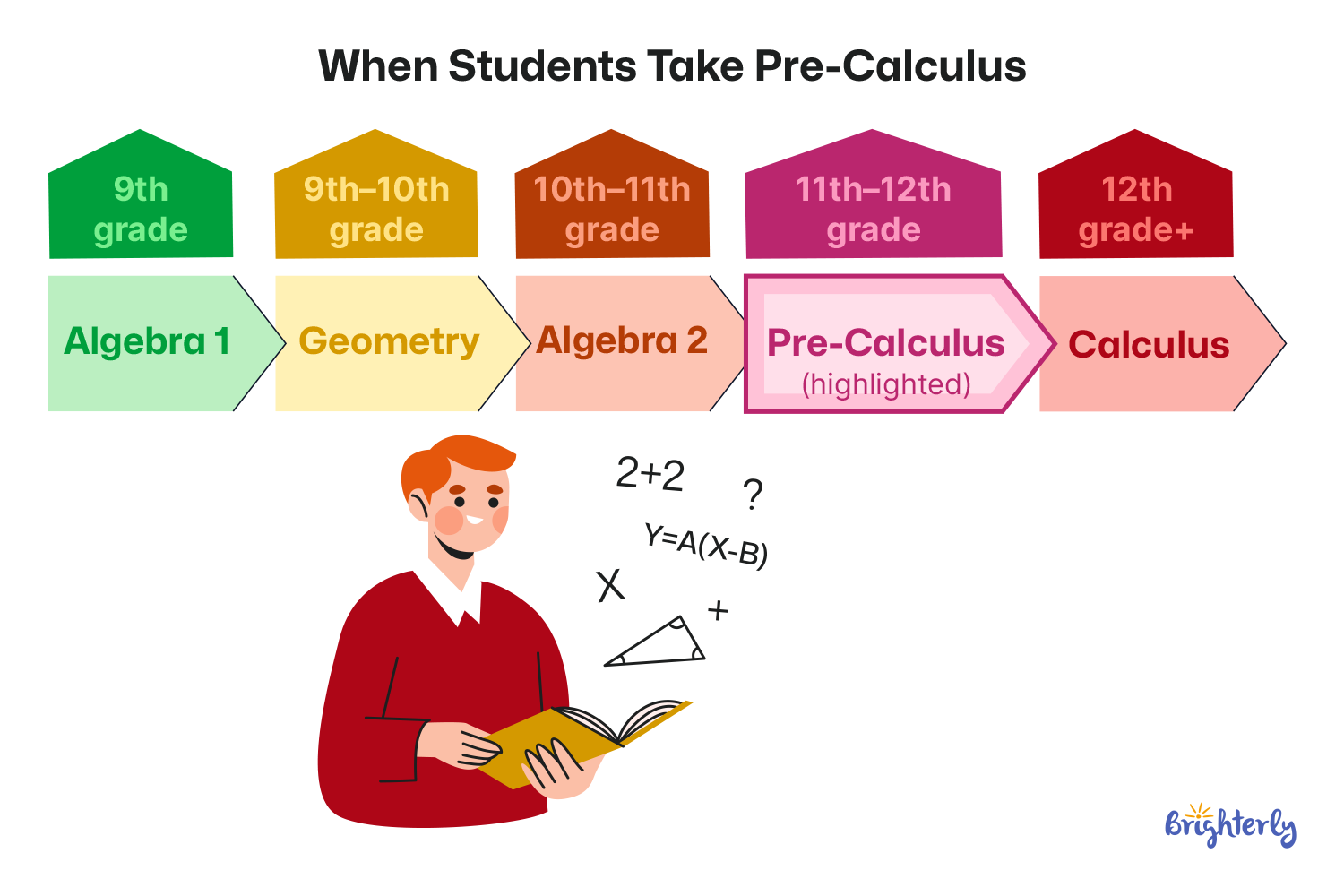
Nevertheless, as schools vary, some children can move a year ahead, taking precalculus as sophomores thanks to advanced math tracks. Others take it right before graduation.
Note. Reflecting how it can be, the math department of one of San Francisco’s high schools defines (as of September, 2025) passing Algebra 2 B as a prerequisite for Pre-Calculus and Geometry or Advanced Math as a prerequisite for Pre-Calculus AH and BH.
Is Pre-Calculus the Same as Algebra 2 or Calculus?
No, pre-calculus is not the same as Algebra 2 or calculus, as each has different goals and topics. Algebra 2 builds the algebra toolkit, while pre-calculus sharpens and extends it, adding trigonometry. In turn, Calculus allows students to apply all of these concepts to learn about change and motion. So, they are different; look at how, in particular:
|
Algebra 2 |
Pre-Calculus |
Calculus |
|
|
Focus on |
Solving equations, polynomials, core function types |
Deeper work with functions, adding trigonometry, preparing for calculus |
Learning rates of change, using limits and derivatives |
|
Typical topics |
Quadratics, exponents, logs, rational expressions |
Trigonometric identities, unit circle, complex numbers, sequences, conics |
Limits, derivatives, integrals, applications of change |
|
Prepares for |
Pre-calculus and general problem-solving |
Calculus, STEM coursework, standardized test math |
College-level math, STEM subjects, engineering, physical sciences |


Help your child deal with math gaps
Our tutors help target specific topics via personalized lessons
What Do You Learn in Pre-Calculus?
Within the pre-calculus course, children learn complex functions, trigonometry, and analytical geometry. In particular, you can break them into six main topic areas: functions and graphs, trigonometry and the unit circle, complex numbers, sequences and series, conic sections, and introduction to limits.
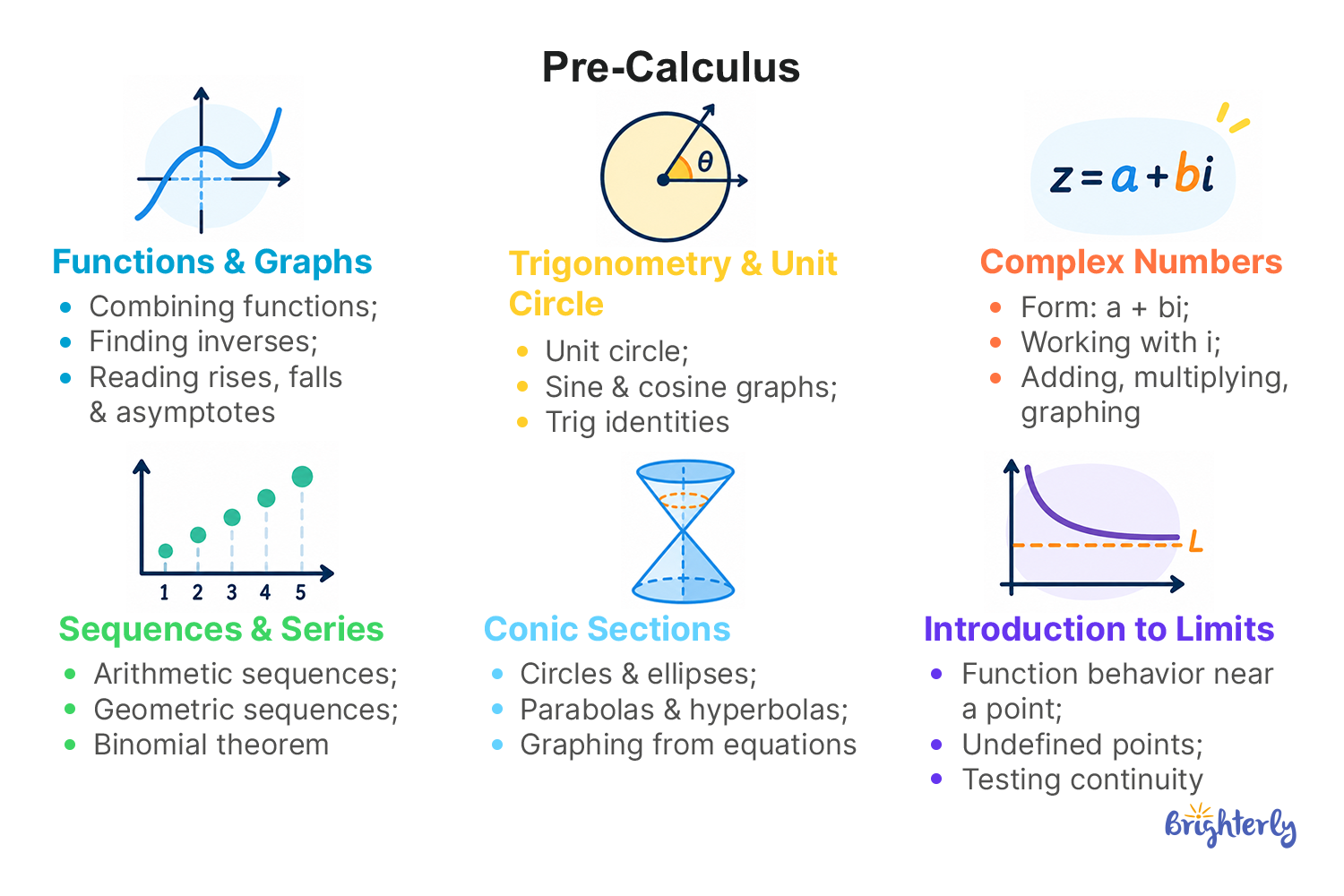
These precalc topics help bridge basic algebra and advanced calculus.
Pre-calculus bridges basic algebra and advanced calculus by teaching complex functions, trigonometry, and analytical geometry.
Functions and Graphs
In pre-calculus, students go deeper into functions and graphs than in Algebra 2. They will learn:
- Combining functions
- Finding inverses
- Analyzing the behavior of a graph
- Understanding rises, falls, and asymptotes of graphs
This group of precalculus concepts and skills gets the most classroom time, as it brings the foundation for everything else in precalculus.
Trigonometry and the Unit Circle
In regard to trigonometry, it’s one of the biggest shifts compared to Algebra 2 topics. The children learn the following topics:
- Unit circle
- Sine and cosine graphs
- Trigonometric identities
These equations allow children to simplify and solve trig expressions. Because this topic is new, kids may struggle at first unless they see repeating patterns.
Note. If they still fail after several weeks, you may want to ask for professional help from a trigonometry tutor.
Complex Numbers
Complex numbers are numbers that are written in the form a + bi, where a and b are real numbers, while i is the imaginary unit. So, students start to work with i, or the imaginary unit, and learn to add, multiply, and graph the complex numbers.
Complex numbers frequently appear in later math and engineering courses, so it’s a crucial part if the students plan to develop in the related sphere.
Sequences and Series
The sequences and series part includes learning patterns of numbers, in particular, sequences and series, and how to describe, sum, and predict them. The major types they learn are arithmetic patterns, geometric patterns, and the binomial theorem.
This group of concepts is more abstract compared to the previous ones. Yet, sequences and series are necessary for later calculus learning, defining how students handle and approach infinite processes.
Conic Sections
What does precalculus cover in relation to conic sections? Circles, ellipses, parabolas, and hyperbolas. The significant part of conic sections refers to quadratic equations. The pre-calculus course teaches students to analyze, graph, and translate these geometric curves that are defined by these equations.
Introduction to Limits
Usually, at the end of the pre-calculus course, students learn limits. In particular, they learn what happens to a function as it approaches a certain value. They focus on describing function behavior, handling undefined points, and testing continuity.
What is precalc limits exactly? Look at it as a light preview that eases the transition to calculus, which, in its turn, puts limits at the center.
Why Does Pre-Calculus Matter for Calculus and Beyond?
Pre-calculus matters for Calculus and beyond, as it provides a mathematical bridge that connects algebra and geometry to the advanced studies in calculus or specific sciences.
First of all, pre-calculus prepares students for calculus as it allows them to master the language of functions, advanced trigonometry, and deepen algebraic fluency.
In regard to preparation for certain subjects, pre-calculus is also important.
For instance, students who seek to get STEM prerequisite skills or advance in engineering, computer science, and physical science would benefit from it:
- Engineering often needs the mastery of functions, trigonometry, and analytical geometry.
- Physics problems involve periodic motion
- Computer science work may require functions and sequences;
- Economic models require exponential growth to be built upon.
That’s the reason why colleges and counselors see it as an important skill-building course.
Another thing is that pre-calculus overlaps with SAT/ACT math sections more than any earlier course. Function questions, trig basics, unit circle problems, and graph interpretation all make use of pre-calculus material. A solid knowledge of these concepts can make test prep easier.
How Can Students Prepare for Pre-Calculus?
Students can prepare for pre-calculus by reviewing and strengthening their core algebra and trigonometry foundations. Besides, they should develop decent and disciplined study routines.
As a parent or a student, you can use the following checklist in preparation for pre-calculus:
- Review function notation and how to read a graph (including domain, range, and basic transformations).
- Revisit the unit circle and basic angle measures (as trigonometry is in the first part of the course).
- Practice factoring, exponents, and logarithms from Algebra 2 (as they show up constantly).
- Refresh knowledge of solving systems of equations and working with rational expressions.
- Take a diagnostic test to spot algebra gaps before they turn into struggles that need an Algebra 2 tutor.
The preparation shouldn’t be a summer-long project; a few sessions can be enough, especially if a student is confident with the majority of topics. Yet, if they feel confusion or have doubts, then extra practice with Algebra 2 worksheets or precalculus worksheets may be a good idea to target specific topics.
At Brighterly, a tutoring platform, we offer math diagnostic tools as well as 1:1 math classes that put students’ needs and goals at the center of learning.
We first identify the gaps and then develop specific plans to match students’ pace and preferences. It may be a low-pressure way to prepare a child for pre-calculus.
Improve your child’s math skills and confidence
Let our tutors identify pre-calculus gaps and customize relevant learning plans
Conclusion: What Is Pre Calc?
Pre-calculus is a crucial subject that turns the skills students learn in Algebra 2 into tools ready for calculus. It’s all about layers of trigonometry, complex numbers, and a first look at limits. Students meet it in 11th and 12th grades, but that doesn’t mean they find it easy.
Often, a review is a great idea before the start of the course, as well as a diagnostic test. It’s when you see whether your kids have gaps that can be crucial for the next level of math.
If your child feels shaky before or during Pre-calculus, then tutoring may be a decent solution. You can resort to Brighterly’s 1:1 high school tutors that offer personalized plans around gaps and focus on kids’ needs to make them confident in math.
Frequently Asked Questions
Is Pre-Calculus Hard?
Students may find pre-calculus hard, as it shifts the learning considerably; students move away from simple memorization to using core concepts on new problems that are unfamiliar. One of the reasons is that students use logic and critical thinking instead of following rules or algorithms. Another is that the course includes different subjects all at once, which can be overwhelming. On the other hand, students may have a weak foundation in algebra or geometry or find it hard to remember formulas.
Do You Need Pre-Calculus To Take Calculus?
You do not need a formal pre-calculus course to take calculus, yet it’s necessary for you to know the core math topics it covers. In that way, pre-calculus helps, as it builds a foundation in algebra and trigonometry and prevents struggles as it presents new topics gradually. Yet, if you want to skip it, then you should focus on essential pre-calculus topics like trigonometry, algebra, and functions. In this regard, you can learn via self-study, calculus tutoring, or checking prerequisites.
What Comes Before Pre-Calculus?
Before pre-calculus, students learn courses such as Algebra and Geometry within the standard math sequence. Yet, a student should take into account other prerequisite knowledge. For instance, from Algebra 1, a student should know basic variables, linear equations, and simple functions. From Geometry, they should learn shapes and angles, proofs, and spatial reasoning, while from Algebra 2, they should learn advanced equations, polynomials, logarithms, and complex numbers. From trigonometry, if it’s integrated into the end of Algebra 2, children should know triangles and wave functions.
How Long Does a Pre-Calculus Course Take?
A pre-calculus course takes one full academic year in high school, or if in college, one 12 – 16 week semester. Nevertheless, the exact time depends on the learning format and schedule. In high school, a two-semester precalculus program takes 36 weeks. If a student decides to learn pre-calculus via a self-paced approach, it may take 8 to 12 weeks if they study 6-8 hours per week. Lastly, a bootcamp that takes 2-3 weeks with several hours each day is also an option.
Can You Skip Pre-Calculus and Go Straight to Calculus?
Yes, you can skip pre-calculus and go straight to calculus if you have solid algebra and trigonometry knowledge and skills, and if your school permits it. Yet, there are certain risks that include a steep learning curve and GPA impact. If you decide to skip, you should ensure you master advanced algebra and trigonometry, have a solid self-study plan, and have a 12th-grade math tutor to turn to.
What’s the Difference Between Pre-Calculus and Trigonometry?
The difference between pre-calculus and trigonometry lies in the scope, topics, and relationship with the curriculum. Pre-calculus is a broad math course that prepares for calculus, while trigonometry is a special subject that focuses on studying relationships between angles and sides of triangles. In particular, pre calc topics include functions, sequences, series, limits, etc. Pre calc feels like a continuation of advanced algebra, while trigonometry introduces entirely new concepts.




Depending on what state you reside in, your child’s school will have different device use rules, screen-time caps, and AI policy — all constantly changing and hard to keep up with. Find out what you need to know about the use of technology in schools as of September 2026 and what it could mean for […]

Sep 16, 2026
Math & reading from 1st to 12th grade
Looking for homework support for your child?

Choose kid's grade

Math & Reading for Grades 1–12
Build real confidence for your child with a Brighterly math or reading tutor.