Is Calculus Hard? When Students Take It & Why It Matters for College
Updated on October 23, 2026
Key Points
Is Calculus hard? The answer to this question depends on the child, but most high school students do find Calculus one of the hardest courses, and not just among math-related ones. Find out the reasons why your child may have trouble with Calculus, when they take it, why it matters for college, and what you can do to help if your child struggles with this course.
Is Calculus Hard?
Calculus difficulty is subjective and depends on the student, yet for many high schoolers, calculus is hard. For example, College Board’s May 2025 AP Calculus AB score distribution shows that only 64.2% of test takers scored 3 or higher, with 3 being the passing score. This means that 35.8% of test takers scored 1 or 2, failing the exam.
Explore Brighterly Learning Experience
Learn exactly how Brighterly helps students thrive through expert sessions, online tools, and proven feedback from thousands of satisfied parents
Why Do Students Find Calculus Hard?
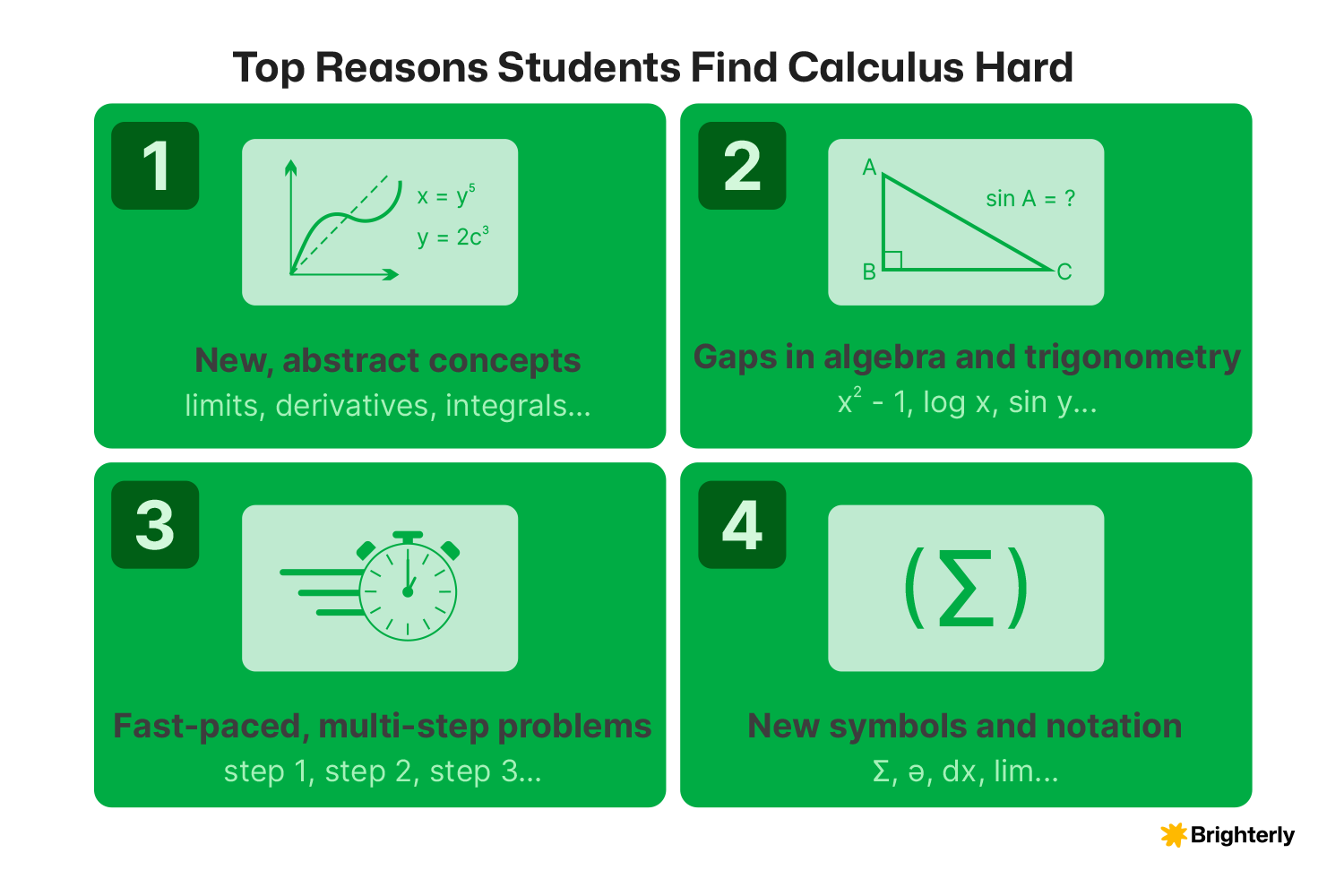
Students usually find Calculus hard due to the course requiring strong abstract thinking skills, having learning gaps in earlier math (Algebra and Trigonometry), and struggling with the course’s fast pace. For example, answering the question, “Why is calculus so hard?” the University of Manitoba Department of Mathematics points out three main reasons:
- Many facts to memorize, including everything learned before in math classes
- New technical skills to master, which require lots of practice
- Abstract thinking, which requires mastery of facts and skills
New, Abstract Concepts Like Limits and Derivatives
One reason the answer to the question, “Is Calculus hard to learn?” is “Yes” is that, unlike pretty straightforward Algebra, Calculus requires students to think about how things change and about values that get extremely close to a certain number. For example, concepts like limits and derivatives don’t have many direct real-world parallels, so students have to build their understanding from the ground up. Besides, Calculus learners need to learn new notation, such as dy/dx and the integral sign.
Gaps in Algebra and Trigonometry
If you ask, “How hard is Calculus?”, it heavily depends on the math knowledge and skills your child already has before they enter a Calculus class, including Algebra and Trigonometry. Calculus requires students to factor, simplify fractions, and manage exponents, which they learn in Algebra, while Trigonometry teaches them functions that show up constantly in Calculus when it comes to derivatives and integrals.
Note: To find out if your child has knowledge gaps in math before they take Calculus class, you can use a diagnostic math test that shows which Algebra and Trigonometry skills your student needs to work on more.
Fast-Paced, Multi-Step Problems
While Calculus requires skills in solving multi-step problems, it also moves quite fast as a course. This fast pace might be difficult to keep up with, especially accounting for the fact that each topic in Calculus builds on previous ones — a student won’t be able to solve a multi-step problem if they don’t have the knowledge of how to handle one of its steps. So, if a student misses one topic or simply doesn’t understand it fast enough, they will inevitably struggle as the course moves on.
Calculus with a professional personal tutor
Our tutors teach Calculus according to the student’s needs and learning pace. 

When Do Students Typically Take Calculus?
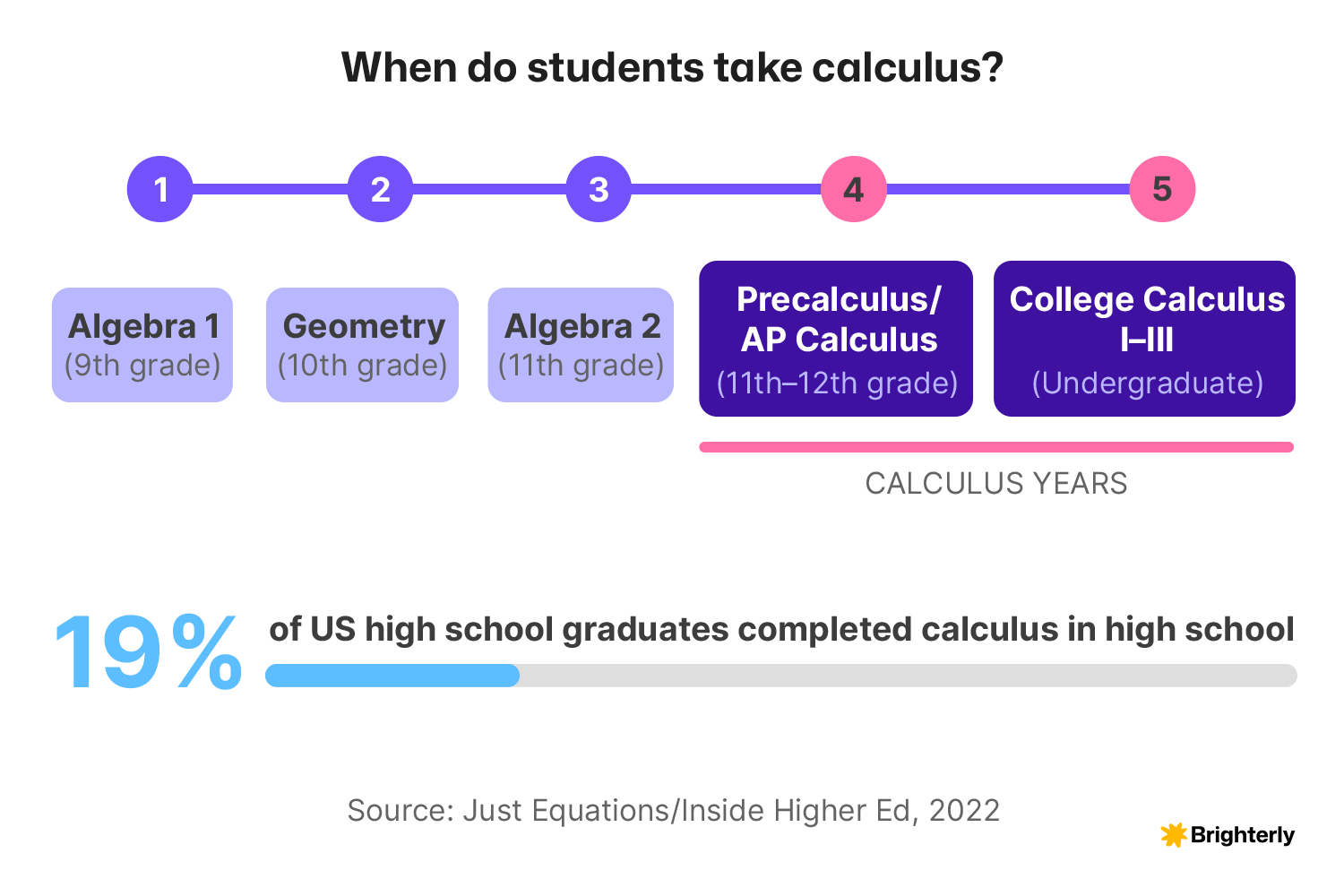
Most students start Calculus in high school, right after the usual sequence of math classes, following Algebra 1, Geometry, Algebra 2, and Precalculus. However, as Calculus is not a mandatory subject in most U.S. schools, some students choose to wait till college to take it.
Calculus in High School (AP Calculus AB and BC)
In high school, Calculus is usually called AP Calculus AB or AP Calculus BC — the former matches the 1st semester of a college Calculus course (Calculus 1), while the latter covers 2 college Calculus semesters (Calculus 1 and Calculus 2).
Note: For more information on what AP classes involve, check out Brighterly’s guide.
If you’re wondering whether your student should start Calculus in high school, the MAA’s September 2018 summary of research by Philip Sadler and Gerhard Sonnert found that, for most students, taking high school Calculus results in better college Calculus performance, improving the grade by about half a point.
*MAA’s September 2018 summary and all the other research and reports mentioned below are still the most relevant pieces of information available as of October 2026, with no newer data contradicting them.
Despite the benefits of starting Calculus in high school, Dr. Dominique Padurano, founder of the college counseling firm Crimson Coaching, shares a concern to consider in this case:
“If a student finds the subject so difficult that it’s pulling down the overall GPA or taking time away from sleep, extracurriculars, social activities, or other coursework, the admissions benefit might not outweigh the costs of taking calculus in high school.”

Calculus in College
College is where most STEM majors take the Calculus 1 course. If you’re wondering, “Is Calculus 1 hard?” it depends on the student’s overall math background, including whether they have taken Calculus in high school. For example, BestColleges’ February 2022 article notes that over 75% of students in introductory college Calculus had also taken it in high school, which means that most students have a competitive advantage over their peers with no Calculus experience.
This BestColleges’ data complements the MAA 2018 summary in terms of proving the benefits of early Calculus exposure in high school, especially if the student is aiming for a STEM college specialty.
So, before questioning, “Is college Calculus hard?”, consider focusing on building a foundation necessary to succeed both in high school and college Calculus — start by checking out Brighterly’s Calculus for beginners guide.
Why Calculus Matters for College
Taking Calculus matters for college because it signals rigor to admissions officers in general. Besides, for students aiming at STEM-related fields, like science and engineering programs, Calculus matters as it can be a mandatory subject colleges require for these majors.
College Admissions and Course Rigor
According to the Just Equations report, covered by Inside Higher Ed in February 2022, fewer than 5% of surveyed private institutions require Calculus for all or most of their majors, while 21% require it only for engineering, physical science, math, technology, or business applicants. However, even though Calculus is rarely a mandatory requirement, admissions officers still value it — a 2021 survey by Just Equations and NACAC, reported by Open Campus in February 2023, shows that 79% of admissions officers believe that students who take Calculus are more likely to succeed in college.
Dr. Dominique Padurano frames the importance of Calculus for college while addressing both college admissions and course rigor:
“While most elite institutions don’t require high school calculus, there’s a benefit to taking and doing well in the course for highly selective college admissions.”
STEM Majors and Career Readiness
Measure Figure Source U.S. high school graduates who took Calculus 19% U.S. high schoolers who take Calculus (alternate estimate) Just over 20% STEM majors who also took Calculus in high school Over 75% AP Calculus AB: scored 3 or higher (286,722 test takers) 64.2% AP Calculus BC: scored 3 or higher (160,954 test takers) 78.6%
How to Make Calculus Easier
To make Calculus easier, you can focus on strengthening the foundation Calculus builds on, like Algebra and Trigonometry, while practicing consistently and seeking help from a professional tutor if the struggles with the course are too hard to handle alone.
Strengthen Algebra and Trigonometry First
First, review your Calculus prerequisites before actually starting the course. The prerequisites include factoring, fractions, exponents, functions, the unit circle, and trig identities. If the students already had trouble with Precalculus, focus on filling those learning gaps.
Practice Consistently Instead of Cramming
Instead of trying to simply memorize without understanding, focus on consistent, regular practice. For Calculus practice, students can use limits worksheets, derivative drills, and integration practice problems, finishing each practice week with calculus review worksheets to find weak spots.
Get Extra Support From a Tutor
If the child is struggling with Calculus due to lasting math gaps, consider getting an algebra tutor or a trigonometry tutor to fill in those gaps. To stop worrying about “How hard is it to learn Calculus on your own?”, let professional private Calculus tutors on Brighterly guide and support your child.
Compare our pricing plans with average tutoring rates to find the right fit for your family.
1-on-1 Calculus support for high schoolers
Make Calculus easier for your child by getting professional study help.
Calculus vs. Other Math Courses
Course What it’s about How it compares to Calculus Algebra Solving unknowns using fixed rules Calculus uses algebra as a tool to solve bigger problems Geometry Studying shapes and proofs Calculus measures change and area using geometric functions Trigonometry and Precalculus Building function and trig skills Functions, graphs, exponents, logarithms, and trig are necessary in Calculus.
Conclusion
The answer to “How hard is Calculus in college or in high school?” usually depends on the student’s math background, their practice habits, and the support they get in learning. Whether a student decides to take Calculus in high school or in college, steady practice and the right professional tutoring can help turn a hard subject course into a manageable and interesting one.
Looking for help with Calculus? Book a free lesson at Brighterly today to test our personalized approach.
Frequently Asked Questions
Is Calculus Required to Get Into College?
Whether Calculus is required to get into college depends on the college itself and the major a student is planning to take. In general, most U.S. colleges require just Algebra 1, Geometry, Algebra 2, and Precalculus. However, according to a December 2024 Hechinger Report survey review, nearly 74% of admissions officers consider AP Calculus one of the top courses for academic weight, and about 89% see it as a sign that a student is ready for college.
What Math Do You Need Before Calculus?
The math you need before Calculus includes Algebra 1, Geometry, Algebra 2, and Precalculus, which includes Trigonometry. These math courses give students the necessary knowledge and skills they’ll need when they move on to Calculus. Without these math courses that come before Calculus, mastering it isn’t possible.
Is Calculus Harder Than Algebra or Trigonometry?
In general, most students consider Calculus harder than Algebra or Trigonometry, since Calculus requires skills and knowledge built before in both Algebra and Trigonometry, plus the development of new skills and knowledge. Also, while in Algebra and Trigonometry, students sometimes can just memorize rules and formulas to pass, Calculus requires them to know why a certain formula or rule works.
Do You Need Calculus for Med School?
Whether you need Calculus for med school depends on the school you’re planning to enroll in. Some med school programs focus on Biology, Chemistry, Physics, and English, while others require or recommend Calculus or Statistics. To know whether you need Calculus for sure, check your chosen school’s published requirements or review the MSAR (Medical School Admission Requirements) database.
Is AP Calculus the Same as College Calculus?
No, AP Calculus is not exactly the same as college Calculus. Although AP Calculus covers the same core topics as college Calculus, the pace, depth, and focus often differ between the two. For example, AP Calculus usually spreads over a full high school year, while college Calculus condenses the same course into 14-16 weeks. Also, while college Calculus usually focuses on theoretical proofs and rigorous problem sets, AP Calculus usually includes test-prep strategies and mandatory graphing calculators.
Can a Tutor Help If Calculus Feels Too Hard?
Yes, a tutor can help if Calculus feels too hard. For example, Brighterly tutors can help a student struggling with Calculus identify and fill the gaps that cause frustration, explain complex concepts through personalized step-by-step instructions, create targeted practice, and provide customized live feedback.
Is Calculus the Hardest Form of Math?
No, calculus is not the hardest form of math — even though students frequently find it hard, it’s actually just an introductory course that comes before higher-level math. As students move past standard Calculus courses into pure math or specialized applied fields, math becomes increasingly more abstract, rigorous, and complex, which makes it harder than Calculus.
Is It Common to Fail Calculus?
Yes, it’s quite common to fail calculus. For example, according to May 2025 College Board score distribution data, about 36% of AP Calculus AB test takers scored below 3, which basically means failing, since 4-5 is the goal score and 3 means passing.




Outschool vs Brighterly isn’t a choice between identical tools. Brighterly is a platform that finds your child a regular 1:1 tutor for math, reading, or writing. Outschool is a marketplace where you can pick from thousands of group classes and private teachers. Here’s what you can expect from each, including how much lessons cost. Outschool […]

Oct 23, 2026
Math & reading from 1st to 12th grade
Looking for homework support for your child?

Choose kid's grade

Math & Reading for Grades 1–12
Build real confidence for your child with a Brighterly math or reading tutor.