What Are AP Classes? Everything Parents Need to Know
reviewed by Marvi M. Andres
Updated on October 1, 2026
Key Points:
- What are AP classes is defined by the College Board and implies standardized high school courses that present introductory university-level material in arts, humanities, STEM, and career-focused programs.
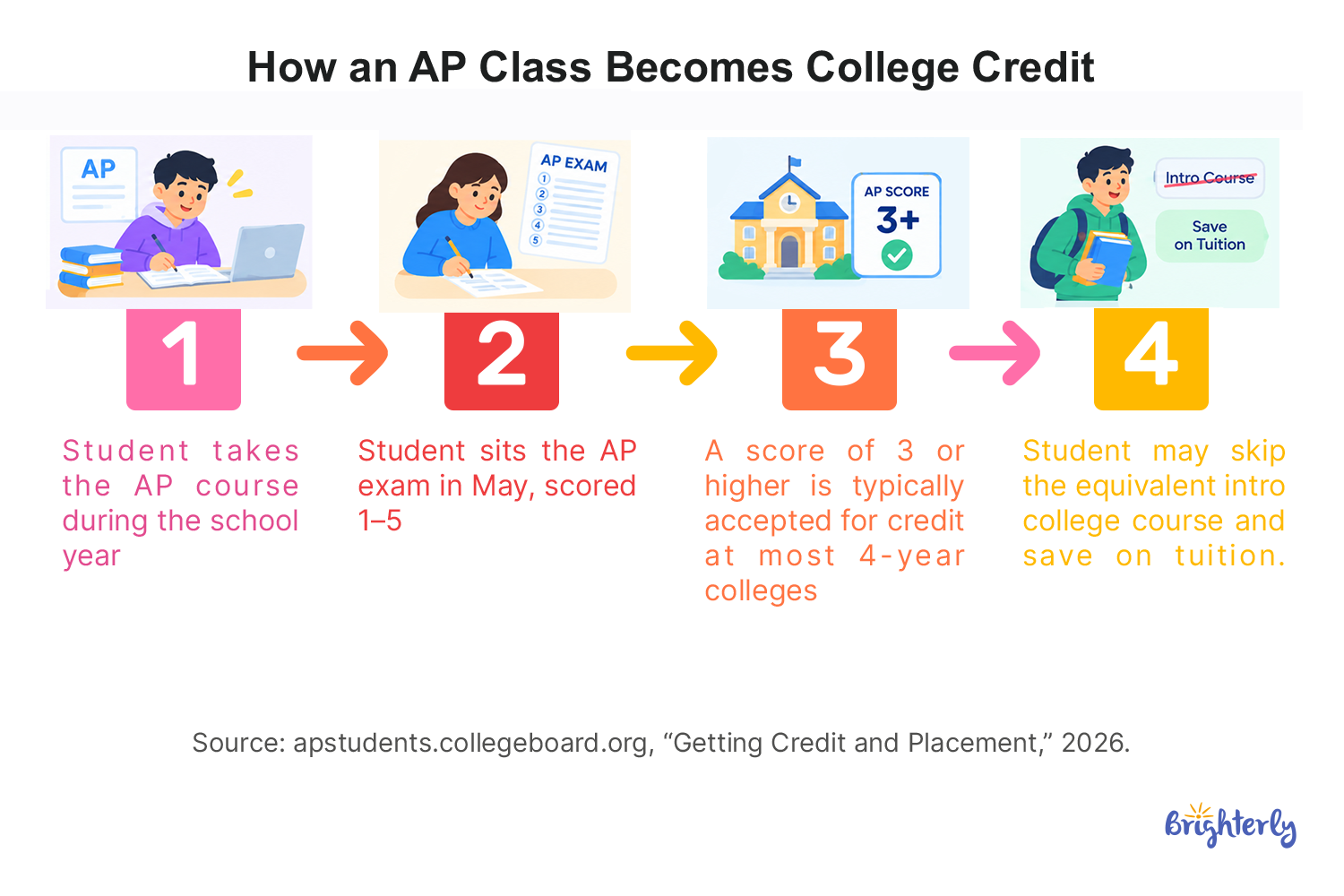
- Scoring a 3 or higher on an AP exam often enables students to earn college credit and bypass introductory university courses, saving significantly on overall higher education tuition costs.
- Admissions committees evaluate course rigor relative to what a high school offers, so taking AP classes proves academic ambition and improves weighted class rank.
- Base 2026-2027 exam fees are $99 for the US and $129 for international schools, with a $37 College Board fee reduction for eligible low-income students, along with additional state and district subsidies.
- Success in fast-paced AP courses depends on early mastery of core reading, writing, and math skills, which can be strengthened with personalized 1:1 tutoring prior to enrollment.
Feeling overwhelmed and confused about making the right academic choice, affecting your child’s future, is normal. What are AP classes, how they work and are graded, details on costs, other important pros and cons, and how many AP courses your child should take without burnout or damaging their GPA – find your answers here.
What Is an AP Class, Exactly?
Advanced Placement (AP) classes are high school courses that present introductory college-level material in math, science, English, history, foreign languages, and arts, according to standards established by the College Board in the United States and Canada. AP classes are administered each May, determining whether or not a student can earn college credit.
Who Created the AP Program?
The AP program grew out of post-World War II education initiatives funded by the Ford Foundation. Gordon Chalmers, president of Kenyon College, along with other educators, developed the original system, striving to enable high school seniors to study college-level material and, thus, get university credit after passing achievement exams.
Conducted by reps from three prep schools (Andover, Exeter, and Lawrenceville) and three universities (Harvard, Princeton, and Yale), this group published a report in 1952, featuring their recommendations that the College Board further officially took administration of in 1955 after successful pilot programs.
What AP Classes Are There in 2026?
The College Board offers 42 standard AP courses in 7 main subject areas, along with introductory launches in career-focused programs (AP Career Kickstart).
- Arts: 2-D/3-D art and design, drawing, art history, music theory.
- English: English language and composition, English literature and composition.
- History and social sciences: African American studies, comparative government and politics, European history, human geography, macroeconomics, microeconomics, psychology, US Government and politics, US history, world history (modern).
- Math and computer science: Calculus AB, Calculus BC, Computer Science A, Computer Science Principles, precalculus, statistics.
- Sciences: biology, chemistry, environmental science, physics 1 (algebra-based), physics 2 (algebra-based), physics C (electricity and magnetism), physics C (mechanics).
- World languages and cultures: Chinese language and culture, French language and culture, German language and culture, Italian language and culture, Japanese language and culture, Latin, Spanish language and culture, Spanish literature and culture.
- AP Capstone diploma program: AP Seminar, AP Research.
- AP Career Kickstart: business with personal finance, cybersecurity, and networking.
What Are the Hardest AP Classes?
Although the difficulty of an AP class depends on an individual student’s strengths and prior academic preparation, the nationwide exam pass rates and student feedback show some consistent trends. The hardest AP classes feature abstract theoretical concepts and extensive synthesis of historical and textual material.
- AP Physics C: Electricity and Magnetism (as well as Mechanics)
- AP Chemistry
- AP Physics 1
- AP Calculus BC
- AP US History and AP European History
What Are the Easiest AP Classes?
In contrast, courses generally considered ‘easier’ contain more intuitive concepts and lighter reading or math requirements, resulting in higher overall pass rates.
- AP Psychology
- AP Human Geography (frequently taken as an introductory AP course by 9th and 10th graders)
- AP Environmental Science
- AP Computer Science Principles
- AP Chinese, Spanish, French Language and Culture – for native or heritage speakers.
Explore Brighterly Learning Experience
Learn exactly how Brighterly helps students thrive through expert sessions, online tools, and proven feedback from thousands of satisfied parents
How Do AP Classes Work?
How AP Classes Are Graded
AP classes have two separate types of grades:
- High school course grades (transcripts). The letter grade in the class is set by the high school teacher based on coursework and tests during the year. To reward taking college-level work, high schools frequently assign extra weight to AP classes – see how weighted Grade Point Average (GPA) works.
- Official AP exam scores are separate from the grade a student gets in the AP course and are composed as follows:
- Section scoring (raw points). MCQs (Multiple-Choice Questions) are scored electronically by computer, without penalty for incorrect or blank answers, showing the total number of correct answers. Plus, most FRQs (Free-Response Questions) and performance tasks are graded by hand by college professors and experienced AP teachers.
- Calculating the composite score. Raw points are then multiplied by particular weighting factors and added together to form a composite score.
- Conversion to the 5-point scale. The College Board employs statistical score-setting processes to convert the composite score into the following final scaled scores:
|
AP score |
Official recommendation |
Equivalent college grade |
Credit eligibility |
|
5 |
Extremely well qualified |
A+ or A |
Widely accepted |
|
4 |
Very well qualified |
A-, B+, or B |
Widely accepted |
|
3 |
Qualified |
B-, C+, or C |
Accepted by many colleges |
|
2 |
Possibly qualified |
– |
Rarely accepted |
|
1 |
No recommendation |
– |
No credit granted |
What Are the Costs for All the AP Classes in 2026?
As of October 2026, the College Board sets standardized exam pricing for all subjects in 2026-2027 at the $99 fee per exam in the US, US Territories, Canada, and DoDEA schools, and $129 for international schools outside the US and Canada, additionally offering a $37 fee reduction for eligible low-income students.
Many state programs and local school districts suggest extra subsidies that can reduce the cost even further. However, adding an exam after the fall registration deadline will cost you an extra $40, and for canceling an ordered exam or failing to sit for the test, expect to pay $40 as well. If your high school doesn’t offer a particular AP class, you can take accredited AP courses through approved online providers.


Want to prepare your child for AP?
Build strong academic habits with Brighterly before your child takes on college-level coursework.
What Are the Benefits of AP Classes?
Earning College Credit and Saving on Tuition
The College Board states that in 2025-2026, average published tuition and fees are $11,950 per year at public four-year colleges for in-state students and $45,000 at private nonprofit four-year colleges. Depending on the college’s AP credit policy and how many credits your student earns, AP credit can reduce the number of courses they need to take.
Graduating a semester or a full year early also saves on tuition as well as room and board expenses. Plus, students who use AP credits to fulfill mandatory general education requirements can further free up room in their college schedules for a double major, pursue minor programs, complete study-abroad terms, or merely take lighter course loads.
Building a Stronger College Application
College admissions officers evaluate applications holistically, placing high emphasis on the rigor of a student’s high school curriculum relative to what their school offers. Thus, enrolling in AP classes signals to admissions committees that a student strives for academic challenges, and if they perform well, AP classes raise a student’s weighted GPA and improve overall class rank. What are AP classes in high school, as well as their grading standards, can vary between districts, yet AP exam scores compose a nationwide standardized criterion.
Building Confidence and Stronger Foundational Skills
AP courses train students in advanced critical thinking, time management tips for high schoolers, and complex analysis, helping them move from secondary education and more easily comply with university-level expectations. Given that AP courses demand higher-level reading comprehension strategies for teens, analytical writing, structured lab work, and independent problem-solving, experiencing this depth still in high school builds strong study habits, reducing further culture shock often felt during the freshman year of college.
Developing the above-mentioned academic skills early in middle and high school makes further handling AP-level coursework much easier. For that, have your child first take our free math diagnostic test on Brighterly (grade- and topic-classified) to have a general understanding of their level. If need be, let our high school math tutors define – and then help master – what exactly your child is expected to know prior to AP classes.
Our personalized lessons on Brighterly start at $17.70/lesson (2 lessons per week, 12-month plan, 20% discount as of October 2026).
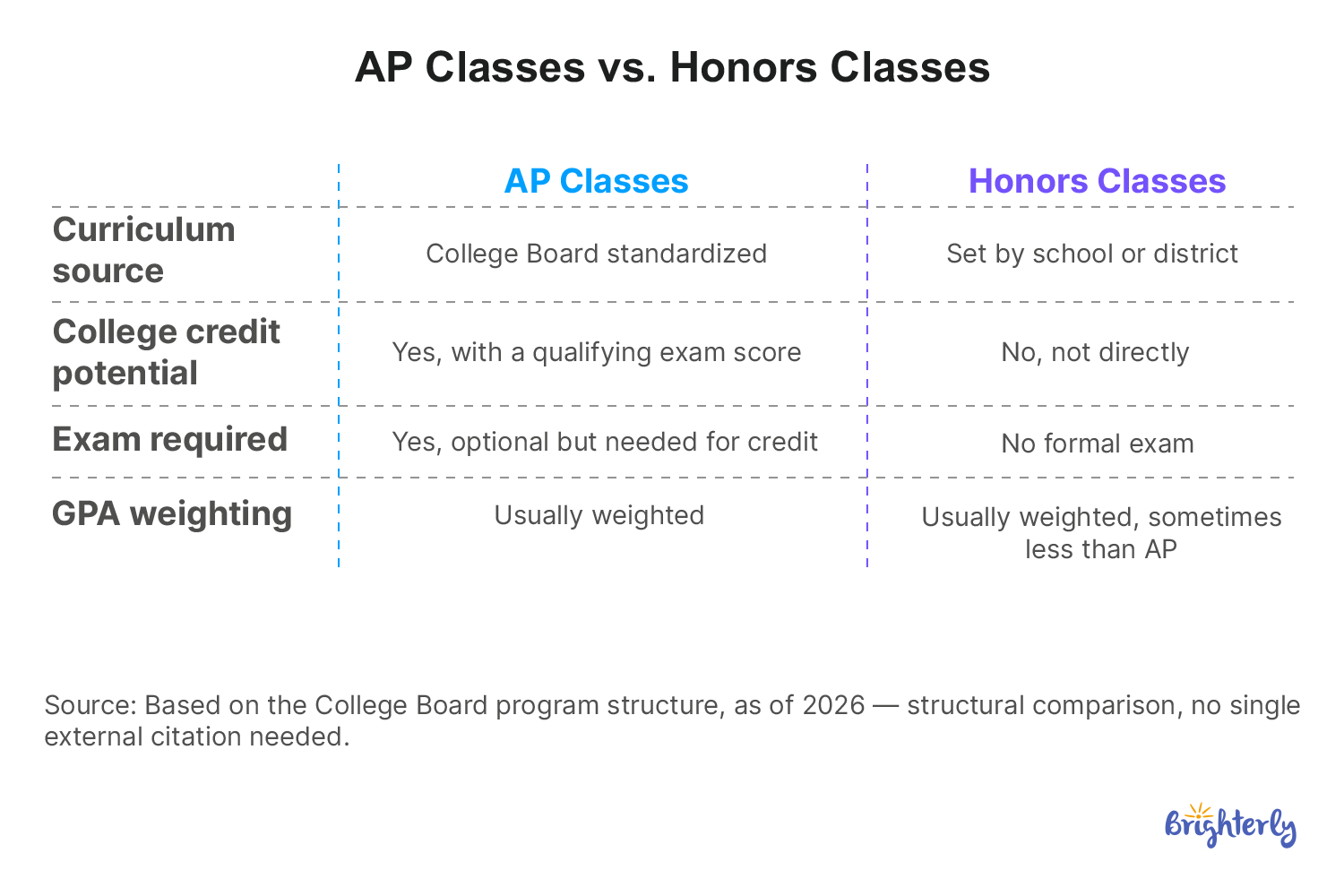
AP Classes vs. Honors Classes: What’s the Difference?
How Many AP Classes Should Your Child Take?
Although the College Board states that there’s no particular number that’s right for every student, a reasonable approach, however, is to consider your child’s academic preparation, interests, school offerings, and future plans, and take as many AP courses as your child can handle successfully without sacrificing anything.
Regarding what are some AP classes in high school best for your child and how many exactly to take, remember that even for competitive college admissions, more AP classes aren’t automatically better. Yale’s current admissions guidance, for instance, says it doesn’t look for a particular number of advanced courses and evaluates course rigor in the context of what the student’s high school offers.
Are AP Classes College Level Worth It? The Trade-Offs to Know
AP classes are generally worth taking if you choose them selectively according to your student’s individual strengths and capacity, given the importance of balancing academic challenge and personal well-being and transcript health. Remember that enrolling in too many AP classes simply to inflate course count can backfire if it leads to lower grades or weakened focus on extracurriculars.
Common Challenges Parents Should Know About
- AP courses involve significantly more independent reading and writing practice, and problem sets than standard or honors classes – balancing them along with sports or part-time jobs can be tough.
- The pacing of AP courses is rapid, requiring students to digest college-level concepts on tight deadlines. So if your child overcommits or falls behind, the pressure to maintain high grades can cause physical tiredness and emotional anxiety.
- Earning a grade lower than a ‘C’ in an AP class can hurt a student’s unweighted cumulative GPA and overall transcript record – avoid overly demanding AP classes in your child’s weak subject area.
- Not all colleges grant credit for every AP exam score, let alone that highly selective institutions often demand a score of 4 or 5.
- Taking the AP exam costs $99 (or $129 internationally) per test, so if your child takes multiple exams in several years, these test fees can accumulate quickly.
Want your child ready for AP classes?
Strengthen foundational skills and build confidence with Brighterly before advanced classes begin.
What Are the Best AP Classes to Take: Help Your Child Choose
- Review recent grades in prerequisite subjects. Consistent high performance in standard or honors classes means readiness for advanced material.
- Select subjects that connect directly to prospective college majors. For instance, if your child plans to study computer science, prioritize AP Computer Science and AP Calculus.
- Consider weekly time commitments for sports, music, clubs, and out-of-school jobs – your child’s schedule must have enough open time to handle the workload.
- Speak with current teachers and school counselors. They can share insights into your child’s homework volume and whether or not your student has particular study habits for success.
- Opt for one or two AP classes for initial enrollment – let your child first experience advanced coursework.
Conclusion
Figuring out what exactly is AP in high school and deciding to enroll in AP classes is ultimately a strategic decision. However, don’t strive for an arbitrary course count altogether. Focus on building strong foundational skills first and choose subjects that spark genuine interest in your child. In addition to thoughtful scheduling, book a free lesson with Brighterly to get your student better prepared for advanced studies and have ongoing personalized support.
Frequently Asked Questions
What Does AP Stand For?
AP stands for Advanced Placement. AP features a standardized curriculum developed and maintained by the College Board that enables high school students in the United States and Canada to take introductory college-level courses and potentially earn university credit prior to graduating.
Do Colleges Require AP Classes?
No, colleges do not require students to take AP classes. However, higher education institutions evaluate applications from all sides and, therefore, pay close attention to the rigor of a student’s high school curriculum in relation to what their school offers. Enrolling in AP classes means to admissions committees that a student strives for academic challenges.
Can a Student Self-Study for an AP Exam?
Yes, a student can self-study for an AP exam. If your high school doesn’t offer a particular AP class, your student can take the course through an authorized online provider. They can also prepare on their own without taking the AP course at all. The official AP exam is separate from the high school course, so a motivated student can study independently and arrange to take the exam at a school or testing center that administers it.
What Score Do You Need to Pass an AP Exam?
A score of 3 (or higher) is generally considered a qualifying or ‘passing’ one on the College Board’s 1-to-5 scale. According to the College Board’s official scale, a score of 3 means a student is ‘qualified’ – equivalent to a college grade of B-, C+, or C. Scores of 4 (‘very well qualified’) and 5 (‘extremely well qualified’) are considered widely accepted for credit in higher education institutions.
Is There Financial Help If the Exam Fee Is Too Expensive?
Yes, financial assistance is available. The standard AP exam fee is $99 for the US or $129 for international schools. However, the College Board offers a $37 fee reduction per exam for eligible low-income students, ultimately lowering the base cost to $62. Moreover, many state programs and local school districts suggest extra subsidies that can reduce the cost even further.
What Happens If a Student Fails an AP Exam?
A score of 1 or 2 doesn’t necessarily mean that a student failed the AP course itself, given that AP exam scores are separate from high school course grades.
- A score of 1 or 2 may not earn college credit or enable the student to skip an equivalent introductory course.
- The AP exam score doesn’t change the student’s high school course grade or GPA because the exam is separate from the course.
- A low AP exam score doesn’t automatically affect a student’s high school transcript. Plus, students can choose how to report AP scores, although different colleges may have different policies.

The new learning experience brings 1-on-1 tutoring, independent practice, and AI-supported learning closer together. [Las Vegas, Nevada] — Brighterly, a K–12 learning platform helping kids build strong foundations in math and reading by combining 1-on-1 tutoring sessions with new self-practice tools. The latest update introduces gamified Math and Reading Practice. The development marks a broader […]

Sep 25, 2026
Math & reading from 1st to 12th grade
Looking for homework support for your child?

Choose kid's grade

Math & Reading for Grades 1–12
Build real confidence for your child with a Brighterly math or reading tutor.