Math Fact Fluency Explained: A Grade-by-Grade Guide for Parents
reviewed by Jessica Kaminski
Updated on October 8, 2026
Key Points
- Math fact fluency implies recalling basic facts quickly and accurately, allowing kids to free up their working memory.
- Thanks to math fact fluency, in later math, kids may focus on solving multi-step problems, fractions, and long division, and not on the arithmetic inside them.
- To improve math fluency at home, you can focus on number sense, simple strategies, and games to practice regularly, or address a professional math tutor for a more complex approach.
- If your kid still counts on fingers for basic facts or struggles with homework, then you may want to consider extra support, for instance, tutoring.
Does your child still count on their fingers? Or do they understand long division but freeze on 7 × 8? This pause is what math fluency is about, and it can be a worry for parents.
This guide shows what math fact fluency is about, what to expect from Kindergarten to 5th grade, and why number sense, strategies, and practice are so important for building math fluency at home.
What Is Math Fact Fluency?
Math fact fluency is an ability of a student to recall basic arithmetic operations or facts quickly, efficiently, flexibly, and with little effort. A fluent student would see 6+7 and would know it’s 13 without stopping to count.
What are math facts? They refer to single-digit addition, subtraction, multiplication, and division combinations. For students, they are the skills on which later, more advanced math builds.
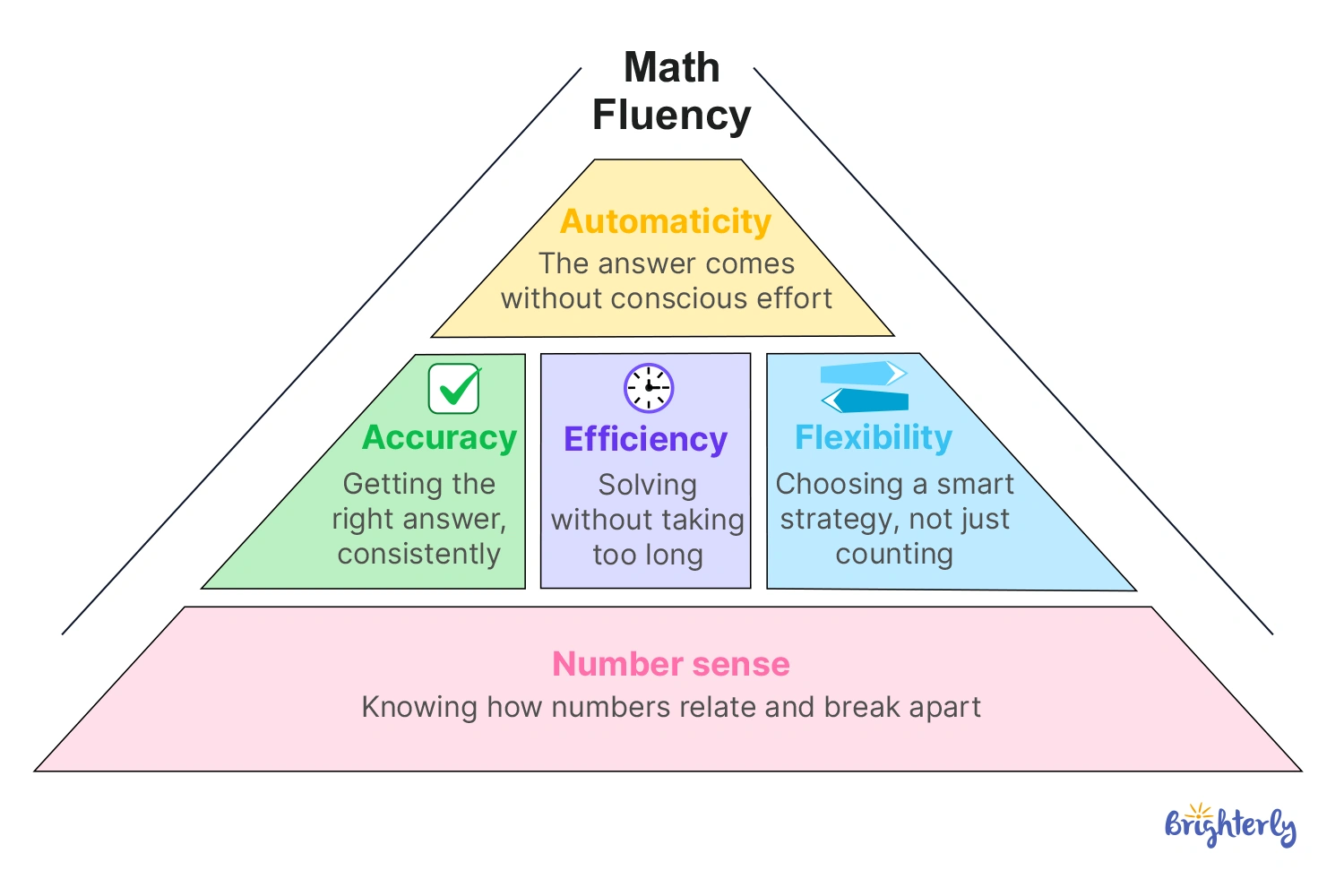
Basic fact fluency is concerned with three crucial parts:
- Accuracy. It means students get a correct answer consistently.
- Efficiency. It implies solving a problem without excessive time.
- Flexibility. It’s about choosing the best strategy with number relations understanding in mind, and not counting solely on memorization.
In math fluency, the end goal is achieving automaticity, when the answer comes to the student’s mind without conscious effort. And the key to such automaticity is number sense, when a child understands and feels how numbers relate and break.
Note. Keep in mind that memorizing and fluency are not the same things. A child can recite a times table in order but still freeze on 7 × 6 out of order.
Explore Brighterly Learning Experience
Learn exactly how Brighterly helps students thrive through expert sessions, online tools, and proven feedback from thousands of satisfied parents
Why Math Fact Fluency Matters
Math fact fluency matters because of working memory and how a child uses it to process information when solving math. Finding a solution to a multi-step problem would require a kid to take up space that the steps and every fact need.
Why is math fact fluency important, then? Fluency ensures automaticity, allowing a kid to keep their attention on the bigger problem or the goal and not each step.
The math fact fluency research proves this point. In particular, the 2023 survey by EdWeek underlines that fluency is important for kids, with 73% of K-12 educators claiming it’s fundamental for working on higher-order skills or more conceptual problems.
The other areas where you can see the importance of math fact fluency are:
- Homework. Once a kid is fluent, their homework goes faster as they spend minutes thinking, not on arithmetic operations.
- Later learning. As a kid goes through basic facts automatically, fractions, long division, and algebra become easier in the future.
- Confidence. Getting math fluency helps kids feel capable: counting on fingers stops becoming a habit, and kids don’t think they are bad at math.


Improve Kids’ Confidence Before the Next Grade
Our tutors personalize lessons based on kids’ needs, goals, and math gaps
What Math Fact Fluency Looks Like by Grade
Math fact fluency changes by grade and follows a clear ladder, where each grade is like a step, building on the one before. The math fact fluency benchmarks usually reflect the national standards, the Common Core State Standards, for elementary math. Even though states and districts vary a bit, the general picture for math fluency is the following:
Kindergarten
At this age, kids count on fingers, and that’s okay. In terms of fluency, the standard is that kids add and subtract within 5 fluently. It includes using pairs that make 5, for instance, 1 and 4.
First Grade
For first graders, the standard for fluency is that they can add and subtract within 10. In this grade, kids learn to “make 10” (9 + 3 becomes 9 + 1 + 2) and to use doubles. For instance, 6 + 6 = 12, so 6 + 7 will be 13. That’s why it’s the grade when a child should start recalling facts within 10 without counting.
Second Grade
This grade becomes the year of addition and subtraction fluency. Children add and subtract within 20 using mental strategies. At the end of the second grade, they know all sums of two one-digit numbers from memory.
Third Grade
The third grade brings multiplication and division. A kid learns to multiply and divide within 100, and by the end of the year knows products of two one-digit numbers from memory. As the number of facts grows fast during this grade, parents may find fluency gaps. Knowing patterns and the commutative property helps a lot in this grade.
Fourth and Fifth Grade
At these grades, for students, facts begin to transform from topics into tools. They start using them for multi-digit multiplication, long division, and fraction problems. For instance, when a kid practices long division, they may get stuck working out 7 × 8 even though they understand the following steps. In that case, they will need that fluency to go further more easily.
Here is the whole dropdown of math fact fluency by grade level:
|
Fluency benchmark |
What you see at home |
|
|
Kindergarten |
Add and subtract within 5 |
A kid uses objects and fingers; knows pairs that make 5 |
|
1st grade |
Add and subtract within 10; strategies to use are “make 10” and doubles |
Starts to recall facts within 10 with no counting |
|
2nd grade |
Adding and subtracting within 20 fluently; a kid knows all one-digit sums from memory |
Answers single-digit sums while using no finger counting |
|
3rd grade |
Multiplication and division within 100; knows all one-digit products from memory |
Uses patterns and strategies; may need regular practice on new facts |
|
Applies facts to solve multi-digit and fraction problems |
Focuses on the procedure and end goal, not the arithmetic |
How to Build Math Fact Fluency at Home
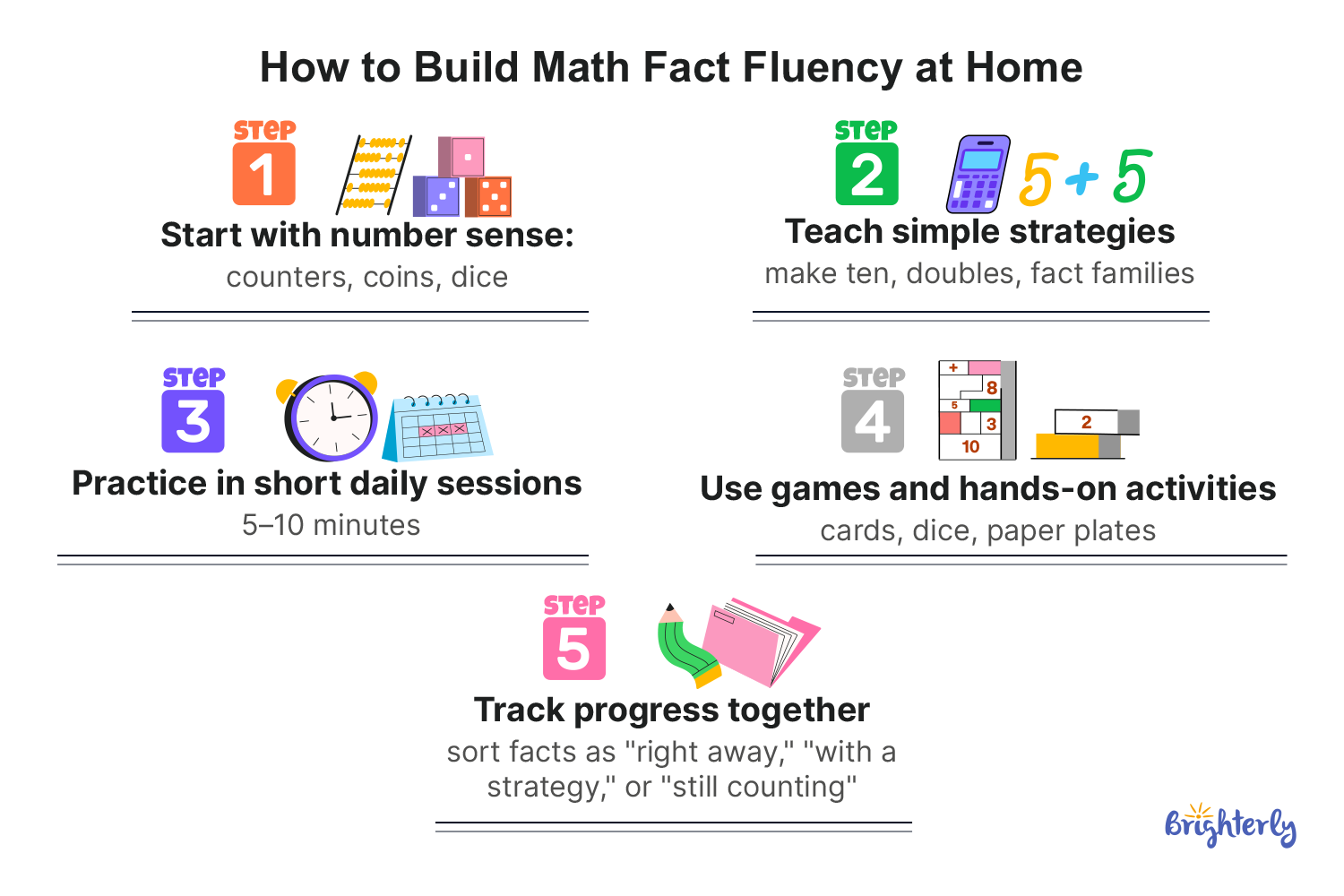
To build math fact fluency at home, a parent should focus on the things that will allow development of accuracy, efficiency, and flexibility. They refer to improving kids’ number sense, teaching simple strategies, making practice consistent and regular, using engagement for better retention, and tracking progress.
Start With Number Sense
You should first master the basics. First, make kids understand, then practice, then automate. In this regard, before your kid memorizes 7+8, make sure they are fluent in understanding and recognizing 7 and 8.
There, you can use counters, coins, and dice to show numbers as groups. Besides, you can ask questions like “What two numbers make 10 or 9?” and then practice them using hands-on activities.
Teach Simple Strategies (Make Ten, Doubles, Fact Families)
One of the answers to how to build math fact fluency questions is using simple strategies. They mean to replace rote memorization with flexible number sense. The main techniques in this regard are:
- Make ten. It helps to anchor calculations around the number 10. For instance, to solve 8 + 7, move 2 from 7 to 8. Now you have 10 + 5 = 15.
- Doubles. Doubles and near-doubles allow using visual patterns and number twins that are easy to commit to automatic memory. Under this strategy, kids first memorize core doubles (like 3 + 3 = 6) and then apply them for near doubles (or doubles-plus-one), like 3+4=7.
- Fact families. This strategy implies connecting inverse operations. Under it, you teach kids that knowing one fact unlocks four equations. For instance, a group set of 3,4 and 12 works for teaching multiplication and division, and unlocks 3 × 4 = 12; 4 × 3 = 12; 12 ÷ 3 = 4; 12 ÷ 4 = 3.
Note: To practice these strategies, you can use free math worksheets at home. They can also work in pairs with mental math activities.
Practice in Short, Daily Sessions
Another tip for parents to follow is creating a routine that ensures consistent practice. In this regard, a good rule is to devote five to 10 minutes a day to practicing. Up to 10 minutes a day is better than an hour on Sunday.
Why use short sessions? They keep your kids’ attention high. So, you can work on 3-5 new facts at that time and mix them in with the facts your child already knows. In case of a kid’s frustration, you can return to the same problem the next day.
Use Games and Hands-On Activities
Kids may disengage. So, use games and hands-on activities to help them retain information and ensure the repetition of the materials.
You can try these math fact fluency activities at home:
- Card war. In this game, a player flips two cards and adds or multiplies them. The higher answer wins the round.
- Dice races. A player rolls two dice. They say the sum and race another player to answer first.
- Paper plate equations. In this game, you write numbers and operational symbols on paper plates. Then, you scatter them on the floor. Next, call out an equation so a kid can run and line up the plates in order.
Note: For other game ideas, please check this article.
You can combine games or any explanation with visual models or charts. That’s how to teach math fact fluency if kids struggle with new information or focus. At the same time, games and practice can surely benefit from division or multiplication worksheets.
Track Progress Together
Parents should track their kids to see if certain areas need more practice for better fluency. A good strategy is to try a math fact fluency assessment at home every 2-4 weeks.
To do a test at home:
- Give a kid 15-25 mixed facts from a set you practiced.
- Put a clock away and let a kid solve facts.
- Based on the results, sort each fact into one of three groups: that a kid answered instantly, answered with a strategy, or still counted out.
- After the test, you can compare the results with previous ones and take the facts that “still counted” to the next test.
Note. According to a 2023 National Council of Teachers of Mathematics article, timed tests do not assess fluency. So, try assessments regularly, use free math tests, or target specific facts or topics.
Common Signs Your Child Needs More Support With Math Facts
The common signs that a child needs support come from patterns that repeat. These patterns refer to how kids count, answer, do homework, and feel about solving facts. The common signs are:
- Finger counting. Your child still uses fingers to count up from one for facts they should know, especially after 2nd grade.
- Varied answers. If a child gets 7 × 6 right one day and then gets it wrong another day, it’s a common sign.
- Homework takes too long. If a basic arithmetic homework takes an hour instead of 10-20 minutes, it may be a sign.
- Frustration or avoidance. When your kid disengages frequently or says directly that they can’t do the task.
- Issues with multi-digit problems. Your kid knows the steps for long division but makes mistakes on multiplication.
- You’re unsure how to help. Schools now teach strategies that are different from what parents usually taught before; besides, at home, you may need a targeted approach.
When several of these signs occur at once, they point to a bigger gap. In this regard, Brighterly’s personalized math tutoring for kids may be a helping hand.
According to a 2026 article on Meta-Analysis of Mathematics Fact Fluency Interventions, when you focus on foundational fluency skills and target suitable operations, you can improve instructional impact and efficacy. Our tutors identify needs first and then provide customized lessons to target specific needs.
Prevent Kids From Math Struggles
Let our tutors meet their math needs and preferences with personalized lessons
Online Math Program for Math Fact Fluency
When kids aim for fact fluency math, sometimes they need more structure or a different explanation. That’s when and where our customized online math program often comes in.
Firstly, we pay specific attention to kids’ needs, from learning goals to styles and struggles. Secondly, we put interaction at the center. As a result, kids are engaged and get practice targeted to their needs, pace, and goals.
What are other benefits of such a program?
Independent Practice in the Brigtherly App
After each lesson, you get an AI-generated summary of key takeaways. Besides, we bring you activity recommendations to practice at home.
You can use these suggestions and turn them into a 5- to 10-minute routine or pair them with worksheet practice. Moreover, we send you an update on what your kids learned and what still needs your attention.
Quality Tutors and Curriculum
Our lessons are one-on-one, where certified K-12 teachers follow a plan personalized to your kids’ preferences. How do we customize it?
- First, your kid takes a free diagnostic test.
- Next, our tutor builds a plan but ensures it aligns with national standards.
For instance, if your kid struggles with multiplication facts, the tutor would go back to the strategy behind them. It may refer to arrays, counting, or fact families, yet our tutor would adjust pace and explanation so a kid gains confidence.
Conclusion
Math fact fluency is what gives your child space to think and prepares them for further math. With it, they automate how they think and can put their attention on fractions, word problems, and new ideas.
To improve math fluency at home, focus on number sense, teach strategies, practice having routines, and play games. If you see signs that kids struggle, don’t wait too long to provide tutoring support.
Try Brighterly to check if personalized lessons will suit.
Frequently Asked Questions
Is Memorizing Math Facts The Same as Being Fluent?
No, memorizing math facts is not the same as being fluent. Memorization supports recall, yet it means simply storing answers and rote repetition. Fluency is far broader and includes accuracy, efficacy, and flexibility. It allows getting the right answer, solving it quickly, and doing it all with an understanding of number relationships.
Are Timed Tests Good or Bad for Building Math Fact Fluency?
Timed tests are rather bad for building math fact fluency despite having both advantages and disadvantages. On the one hand, they help build automaticity and speed for students; on the other hand, they can trigger stress and block working memory among anxious students. Importantly, the National Council of Teachers of Mathematics (2023) states that timed tests are not best for assessing fluency due to negative effects.
How Long Does It Take for a Child to Become Fluent in Math Facts?
Every child moves at a different pace. Yet, it’s clear that fluency grows over weeks or months of regular practice. In this regard, a kid may need from 2 to 20 weeks to master specific and basic math facts. Mastering addition and subtraction may take up to 8 weeks, while multiplication and division may take much longer.
What’s The Difference Between Math Fluency and Math Fact Fluency?
The difference lies in the scope of the concepts, as math fluency is a broad ability to choose and carry out mathematical procedures across all topics. Instead, math fact fluency targets automatic recall of single-digit arithmetic operations.
Can an App Alone Build Math Fact Fluency, or Does a Child Need a Tutor Too?
An app is unlikely to build math fact fluency alone, as it gives a child steady repetition, but won’t show why a fact works. A tutor helps, as they will see the gaps that a kid has and provide the right explanations and teaching strategies that suit learning needs.
Is it Too Late to Build Math Fact Fluency in 4th or 5th Grade?
No, it’s not too late to build math fact fluency in 4th or 5th grade. Even though kids master foundational facts earlier, in 4th and 5th grade, it’s high time they build their fluency. In these grades, fluency helps to free up working memory for complex tasks like fractions, long division, and multi-digit multiplication.



Feeling overwhelmed and confused about making the right academic choice, affecting your child’s future, is normal. What are AP classes, how they work and are graded, details on costs, other important pros and cons, and how many AP courses your child should take without burnout or damaging their GPA – find your answers here. What […]

Oct 01, 2026

A failing grade means a student’s work falls below the passing standard for an assignment or course. Schools use different cutoffs, so check your child’s grading policy before interpreting a low score. The guide below explains letter grades, GPA, school differences, and what parents can do to handle a poor mark. What Is a Failing […]

Oct 07, 2026
Math & reading from 1st to 12th grade
Looking for homework support for your child?

Choose kid's grade

Math & Reading for Grades 1–12
Build real confidence for your child with a Brighterly math or reading tutor.