Weighted GPA: How It Works and Why AP Classes Count More
reviewed by Camille Ira B. Mendoza
Updated on October 19, 2026
Key Points:
A weighted GPA is a calculation that gives extra bonus value to such difficult courses as honors, AP, and IB. Here’s why it can go above 4.0, the actual grade-to-points conversion, how you can calculate your own number by hand (a real worked example included), and what happens to that number once a college looks at it.
What Is a Weighted GPA?
A weighted Grade Point Average (GPA) is a numerical metric designating a student’s academic performance that accounts for the difficulty level of the particular completed courses that high schools define as more rigorous than the standard curriculum:
- Honors courses,
- Advanced Placement (AP) classes,
- International Baccalaureate (IB) courses,
- Dual enrollment (or college-level) classes taken during high school.
GPA Weighted vs. Unweighted: The Core Difference
An unweighted GPA looks only at your letter grades (A, B, C, etc.) and counts them the same way for every class. It doesn’t matter if a class is easy or difficult – an A always equals 4.0 points, a B corresponds to 3.0 points, etc.
A weighted GPA considers both your letter grades and how hard the classes are. If you take a regular class, an A is worth 4.0 points; yet if you take an advanced one, the school rewards your extra work in a tougher class by making an A worth 5.0 points.
Why a Weighted GPA to 4.0 Scale Shift Occurs
When high schools created harder courses that demand much more time and deeper studying, they needed a way to show that difference on a transcript. If the scale stopped at 4.0, a student taking the hardest classes and getting top grades would look identical to the one taking the easiest classes and getting top grades. That’s why schools extend the numbers past 4.0 and colleges, thus, can spot students who chose to push themselves academically.
Is your child ready for harder classes?
Help your child build the skills and confidence needed for challenging coursework. 

Explore Brighterly Learning Experience
Learn exactly how Brighterly helps students thrive through expert sessions, online tools, and proven feedback from thousands of satisfied parents
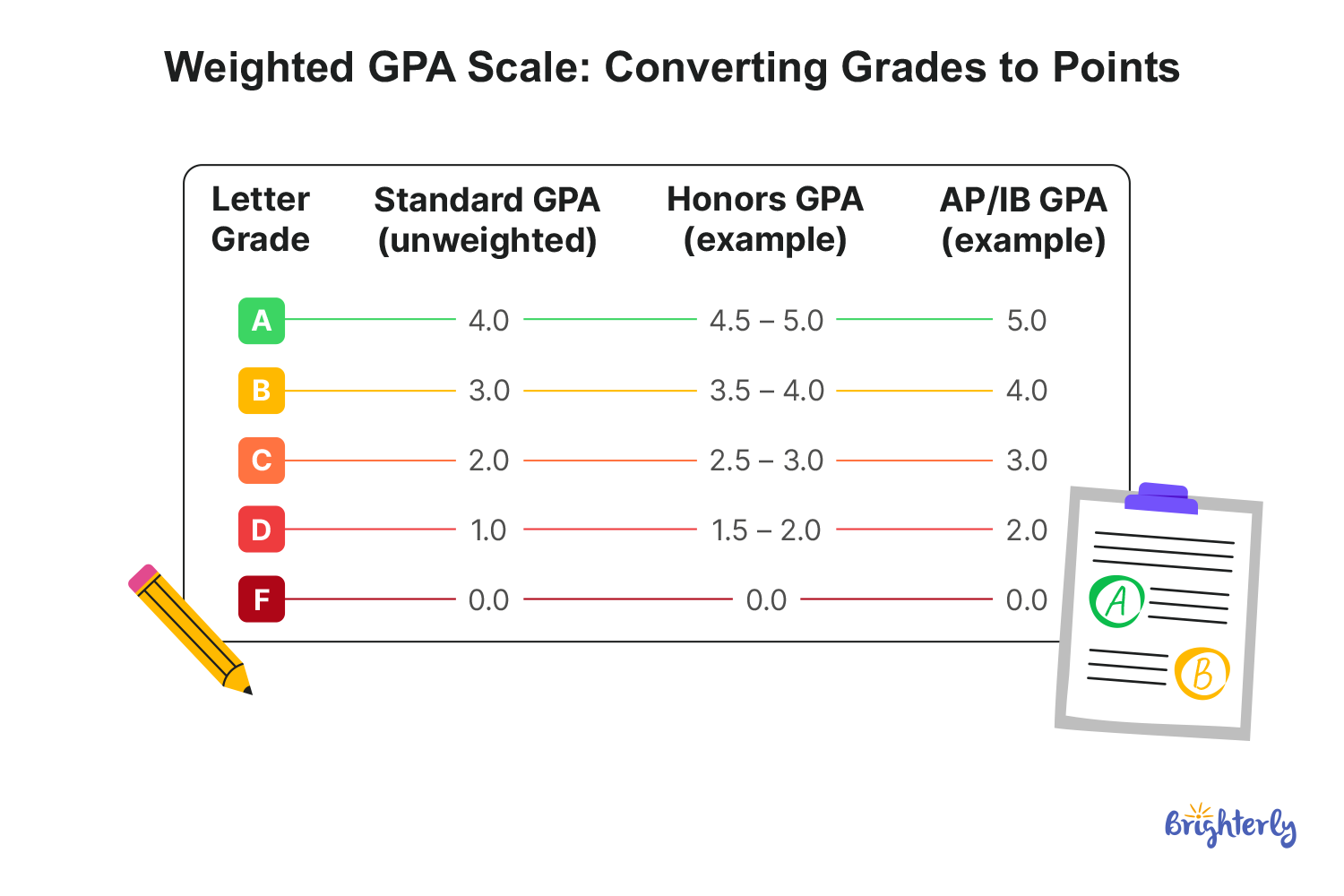
Weighted GPA Scale: Converting Grades to Points
How Many Extra Points Do AP and Honors Classes Add?
No nationwide rule applies to how many extra points AP and Honors classes add because the amount varies by school and district. In general, mind that the values in the weighted GPA converter above depend on the particular policies of every school district: some add 0.5 points for Honors and 1.0 point for AP/IB courses, yet others employ different weighting systems or don’t weight advanced courses at all.
How to Calculate Your Weighted GPA
The Formula Step by Step
- List all your classes and grades. Note every course that you completed during the grading period, along with the final letter grade you earned.
- Determine the course type – a standard course, an honors course, an AP, or an IB course.
- Assign grade points using your school’s scale. Confer your school’s official grading policy to convert each letter grade into its corresponding grade point value and include the correct extra bonus points.
- Multiply grade points by class credits. For every class, multiply the assigned grade points by the number of credit hours that class is worth.
- Add all your total grade points together. Sum up the final grade points that you counted for every class to figure out your total earned grade points.
- Add up your total credit hours. Sum up the credit hours for all the classes included in the calculation.
- Divide – here’s how to find your weighted GPA: Divide your total earned grade points by your total credit hours, and the resulting number is your final weighted GPA.
How Do I Calculate My Weighted GPA? Worked Example
Presuming a student takes a mix of standard, honors, and AP courses, and assuming a common district scale where honors classes get a +0.5 bonus, and AP classes receive a +1.0 bonus, plus each course’s worth 1.0 credit hour, the example is:
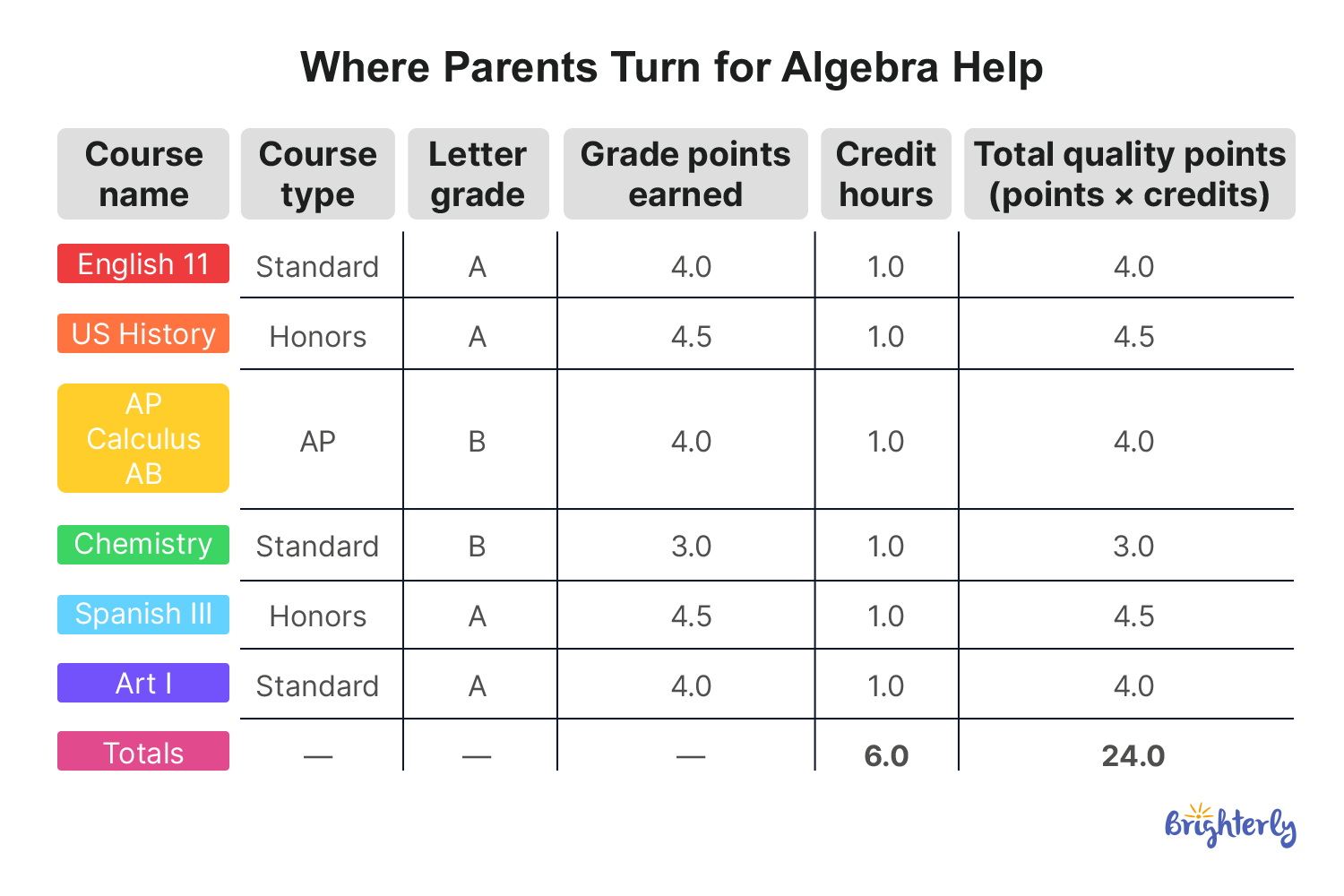
How to get weighted GPA step by step – example explained:
- Sum the total quality points: 4.0 + 4.5 + 4.0 + 3.0 + 4.5 + 4.0 = 24
- Sum the total credit hours: 1.0 + 1.0 + 1.0 + 1.0 + 1.0 + 1.0 = 6.0
- Divide quality points by credit hours: 24.0 / 6.0 = 4.0
So, in this hypothetical example, the student’s final weighted GPA is 4.0.
What Is a Good Weighted GPA Scale?
Average Weighted GPA Among US High Schoolers
The average high school GPA in the US was 3.11, according to the latest (2019) nationally representative National Center for Education Statistics (NCES) High School Transcript Study (NCES hasn’t conducted a newer HSTS since then). On a traditional 4.0 scale, according to the College Board, a 3.0 GPA is approximately a B average, 3.5 is between a B+ and A− average, and 4.0 constitutes straight As.
The College Board also notes that there’s no uniformity in how high schools calculate GPA for advanced courses, so a weighted GPA max depends on every school and district. Yet, given that weighted GPAs add even more points, as practical guidance only, consider 4.0 or higher a strong, good weighted GPA and 4.5+ a very strong one.
What Selective Colleges Typically See
At highly selective colleges, competitive applicants usually have GPAs near the top of their school’s scale and take challenging courses. The 2025-26 Common Data Set data show that about 72-75% of enrolled first-year students at Harvard, Princeton, and Columbia had a 4.0 unweighted GPA, and another approximately 20-24% had GPAs between 3.75 and 3.99.
How Colleges Recalculate Weighted GPA for Admissions
Why Colleges Don’t Just Use Your Transcript Number
Colleges get applications from thousands of high schools, and nearly every school employs its own unique formula to calculate GPAs and assign bonus weights. Given that students often ask, ‘What scale is a weighted GPA on?’, and that one school might use a 5.0 scale, another a 6.0 scale, and yet another a totally different system, colleges can’t use the weighted GPA from a transcript to compare students fairly – that’s why admissions offices rebuild or adjust college weighted GPA.
Furthermore, many universities don’t consider non-academic electives (like physical education or art) and calculate a GPA using only core academic subjects – math (including Algebra and Linear Algebra, Calculus, Geometry, etc.), science, English, history, and foreign language. To define weighted GPA in college, some admissions teams often remove local weighting completely or apply their own institutional scale so that every applicant is measured against a common starting point.
Note: Get some extra practice for free on Brighterly with printable worksheets for Algebra 1, Algebra 2, Algebra Equations, and high school Geometry.
How Different College Systems Recalculate GPA
College How is GPA handled for admission What happens to the weighted GPA University of California UC calculates its own UC GPA from A-G courses completed from the summer after 9th grade to the summer after 11th grade. Grades are converted to points (A=4, B=3, C=2, D=1), with no plus/minus distinction. UC adds 1 honors point per semester of eligible honors-level coursework, with a maximum of 8 honors points between 10th and 11th grades and no more than 4 from 10th grade, thus producing a weighted and capped GPA. University of Michigan Michigan employs its own recalculation method that converts an unweighted GPA using a 4.0 range and focuses on traditional academic courses: English, math, science, social studies, and two years of the same world language. Advanced courses are not converted into extra GPA points in this recalculated GPA. However, Michigan separately considers the difficulty of the courses taken. Yale University Yale says it does not recalculate or reweight GPAs into a common scale, but admissions officers review the transcript in its original context. The original GPA isn’t simply converted with an unweighted or weighted GPA chart. Yale considers the courses taken, where they were taken, and how the student performed in them.
What Recalculation Means for Your Application
When colleges rebuild your average weighted GPA from high school, removing local padding and standardizing the numbers, the resulting figure changes how your academic record is evaluated in the admissions process:
- Your GPA reported in your transcript may change. So if you’ve ever wondered, ‘how do I know if my GPA is weighted or not’, look at how colleges ultimately recalculate your grades and whether or not they changed.
- Performance in core classes gets the most attention, and electives no longer hide a weak grade in a core subject.
- The same starting point for all applicants. Given that admissions officers employ their internal metric to judge everyone on the same initial index, recalculation ensures that a student from a school with extreme grade inflation or unusual weighting systems is evaluated fairly against a student from a school with strict, unweighted grading.
Want stronger grades in core classes?
Give your child personalized one-on-one support to improve skills in math and reading.
Is a 4.0 GPA Scale Weighted or Unweighted?
A standard 4.0 scale is traditionally unweighted, but it’s about how you use it and how maximum grades are assigned:
- Unweighted 4.0 scale – the highest possible grade point for any class (be it standard, honors, or AP) is a 4.0 (an A), and all classes are treated with equal weight: an A in an easy elective counts the same as an A in a difficult advanced course.
- Weighted 4.0 scale (or beyond 4.0) – in schools that employ weighted grading, the baseline scale uses 4.0 as the maximum for standard classes, but it extends past 4.0 (often up to 5.0 or higher) for advanced courses. What is a good cumulative weighted GPA then? In this context, you can finish a grading period with a cumulative GPA that exceeds 4.0 because of the extra bonus points earned in rigorous classes.
Getting the Most Out of Your Weighted GPA
Choosing Course Rigor Wisely
For maximizing your weighted GPA, balance advanced coursework and your personal capacity to succeed:
- The core strength. Prioritize weighted courses in your intended major or strongest subjects, yet limit advanced classes to two subject areas per semester until you adjust to the workload (these time management tips should help).
- The balanced progression. Plan your remaining semesters term by term: start with 1-2 advanced courses in sophomore year, increase up to 3-4 during junior year, and stabilize in senior year.
- Workload management. Quality is more important than quantity. A struggling grade in an overloaded schedule harms your transcript more than a strong grade in a standard class. So, review syllabi prior to registration to check the weekly homework hours for every advanced course.
When a Regular Class Is the Smarter Choice
Choosing a standard, unweighted class instead of an honors or AP course is frequently the smartest strategy, especially if an advanced workload threatens to compromise your foundational understanding. If you repeatedly encounter gaps in foundational subjects like 10th grade math (with quadratic functions, polynomials, coordinate geometry, etc.), our specialized high school math tutors on Brighterly can help you improve and get better prepared.
Our math program features 1:1 online instruction according to high school requirements and US state standards and can help you master complex problem-solving and clarify foundational misunderstandings. Meanwhile, you can also figure out your current level with our free practice tests for Algebra 2, Calculus, SAT, and many others.
Conclusion
Now that you understand how weighted GPAs work and how colleges recalculate them, you can better plan your high school studies. Balance your course rigor wisely and protect your foundational skills in core subjects to provide a strong academic record to admissions committees. If you want to strengthen your core math skills, book a free demo with Brighterly, and use our free tests to clarify where exactly to focus your further practice focus on.
Frequently Asked Questions
Can a Weighted GPA Go Higher Than 5.0?
Yes. Although many high schools cap their weighted GPA scales at 5.0, the possible weighted GPA max depends on the particular school district (some high schools use scales that extend to 5.5, 6.0, or even higher). Besides, given that it’s an average calculated during multiple terms, a student taking an intense schedule of weighted courses in multiple years can occasionally finish with a cumulative weighted GPA that exceeds a 5.0.
Do Colleges Look at My Weighted GPA or My Unweighted GPA First?
Neither. As high schools all employ different formulas and local weighting, colleges cannot trust or use the weighted GPA from a transcript to compare students fairly. That’s why admissions offices rebuild or adjust your GPA, frequently removing non-academic electives and focusing on core academic subjects. Plus, some universities might apply their own institutional scales or ignore extra weighting altogether.
Does Every High School Weigh GPA the Same Way?
No. The number of extra points for AP/IB and honors classes varies by school and isn’t regulated by any national rule. The bonus values, as well as overall weighting systems, vary by school and district. Some schools add 0.5 points for honors and 1.0 point for AP/IB courses; others, however, employ totally different systems or don’t weight advanced courses at all.
Is a 4.5 Weighted GPA Good Enough for Competitive Colleges?
A 4.5 weighted GPA can be a strong academic record, but whether or not it’s ‘good enough’ for a competitive college depends on how that college evaluates GPA. For example, UC recalculates GPA employing its own capped system. The University of Michigan counts an unweighted GPA on a 4.0 scale and separately considers course difficulty. Yale doesn’t recalculate or reweight GPA at all, but does review your transcript in context.
Can I Convert My Weighted GPA to a 4.0 Scale Myself?
Sure. Do the following:
- Using the conversion chart, assign grade points to every letter grade that you earned based on the course type.
- For each class, multiply your assigned grade points by the course credit hours to get your total quality points.
- Add up your total quality points, add up your total credit hours, and divide your total quality points by your total credit hours to find your final converted GPA.
Does Weighted GPA Affect Scholarship Eligibility?
Yes. However, it depends:
- Institutional merit awards. Many universities use your high school GPA to define tier-based merit scholarships – hence, if a university employs a weighted scale during its evaluation process, a higher weighted GPA can help you qualify for a higher scholarship level.
- Private and outside scholarships can either recalculate GPAs on an unweighted 4.0 scale or demand official unweighted transcripts so that all applicants are judged on the same starting point.



Your child may not need the SAT or ACT for every college on their list. Many schools are test-optional in 2026, but some want scores again. This guide shows where each school stands as of October 2026. It also helps you decide when a score is worth sending. What Does Test-Optional Mean? Test-optional simply means […]

Oct 19, 2026

Study.com educational platform works for plenty of online learners, but the child’s needs or the family’s budget may push parents to seek a different option. Compare eight alternatives that offer tutoring, free pre-recorded lessons, college credit, homeschool curriculum, and homework help to see which one fits your child’s learning goals, learning style, and pricing expectations […]

Oct 19, 2026
Math & reading from 1st to 12th grade
Looking for homework support for your child?

Choose kid's grade

Math & Reading for Grades 1–12
Build real confidence for your child with a Brighterly math or reading tutor.