Test-Optional Colleges 2026: Who Still Requires the SAT/ACT
reviewed by Rachelle Bencio Yu
Updated on October 19, 2026
Key Points
Your child may not need the SAT or ACT for every college on their list. Many schools are test-optional in 2026, but some want scores again. This guide shows where each school stands as of October 2026. It also helps you decide when a score is worth sending.
What Does Test-Optional Mean?
Test-optional simply means you don’t have to submit SAT or ACT scores, but you still can. And since colleges take either test, your kid can go with whichever one feels easier. The main difference in an SAT vs. ACT comparison is timing. The ACT is faster, and the SAT gives a little more breathing room.
It’s easy to confuse test-optional with other testing policies. Here’s the difference:
Policy type What it means Example school Test-optional colleges You can submit SAT or ACT scores, but you don’t have to. Duke University, Boston College, University of Chicago (UChicago) Test-required colleges You have to submit the SAT, ACT, or another test that the college accepts. Brown University, Harvard University, Massachusetts Institute of Technology (MIT) Test-blind colleges (or test-free) The college won’t consider your SAT or ACT scores, even if you submit them. University of California (UC) system Test-flexible colleges You have to submit test scores, but AP, IB, or other exams can count instead of the SAT or ACT. Most colleges at Carnegie Mellon University (CMU)
Need help getting ready for the SAT & ACT?
Get 1:1 math support based on what your child needs to work on. 

Explore Brighterly Learning Experience
Learn exactly how Brighterly helps students thrive through expert sessions, online tools, and proven feedback from thousands of satisfied parents
Why Are So Many Colleges Still Test-Optional in 2026?
Many colleges started going test-optional during COVID. In 2026, they continue because:
- They want to look at more than one test score. Duke University says students who apply without SAT or ACT scores won’t be at a disadvantage. Its admissions process looks at everything else in the application either way.
- They want students to decide if their scores represent them well. Bowdoin College has been test-optional since 1969, letting applicants decide whether their SAT or ACT results reflect their academic ability and potential.
- They want to make applying more accessible. The University of Chicago (UChicago) made testing optional in 2018 as part of an effort to reach more first-generation and low-income students.
- Some are still reviewing the policy. WashU said in August 2026 that it’s taking another look and should decide within the year. Wisconsin may go the other way. Its regents are thinking about making the policy permanent at UW-Madison and other state schools.
So keep an eye on the dates. Some test-optional universities have already announced plans to bring the SAT or ACT back. It has become one of the bigger current US education trends in admissions.
Note: If the SAT is on the list, this guide on the best SAT prep courses can help you see what your options are. You can also start with a free SAT math practice test to see how the math feels.
The Full List of Test-Optional Colleges for 2026 Applications
So, what colleges are test-optional in 2026? There are still plenty to choose from. The tables below group them by school type and show how long each policy lasts.
Test-Optional Ivy League & Highly Selective Universities
School Policy Policy Duration Test-optional Through the 2026–27 admissions cycle, required from fall 2028 Test-optional Confirmed for 2026–27; no end date announced Test-optional Confirmed for 2026–27; no end date announced Test-optional Through the 2026–27 admissions cycle, required from fall 2028 Test-optional Through 2026–27; required from fall 2028 Test-optional; scores recommended No stated end date Test-optional Since 2018, no stated end date Test-optional Through fall 2027 and 2028; required from fall 2029
Verified October 2026
Test-Optional Private Universities
School Policy Policy Duration Test-optional No stated end date Test-optional Through spring 2029 entry Test-optional Through fall 2027 entry Test-optional No stated end date Test-optional; flexible testing options Through the 2027–28 admissions cycle Test-optional Through spring 2028 admission Test-optional Confirmed for 2026–27; no end date stated Test-optional 2027–28 academic year Test-optional Through 2026–27 (Class of 2031) Test-optional Since 2008, no stated end date Test-optional Confirmed for 2026–27; future policy under review
Verified October 2026
Test-Optional Public Universities & Flagships
School Policy Policy Duration Test-optional No stated end date Test-optional No stated end date Test-optional No stated end date Test-optional; required by Illinois law No stated end date Test-optional Formalized Feb 2024; ongoing review Test-optional Fall 2027 applicants; renewed cycle by cycle University of Washington (UW) + all Washington public four-year universities Test-optional; state-coordinated across 6 public universities Permanent since fall 2021 Test-optional Through spring 2028 entry, Regents are weighing a permanent policy Virginia Polytechnic Institute and State University (Virginia Tech) Test-optional Through fall 2028 entry
Verified October 2026
Test-Optional Liberal Arts Colleges
School Policy Policy Duration Test-optional No stated end date Test-optional; temporary Through fall 2027 entry Test-optional SAT-optional since 1984; fully test-optional since 1990 Test-optional Since 1969, no stated end date Test-optional Permanent since 2025 Test-optional; will reinstate for fall 2028 Through fall 2027 entry Test-optional No stated end date Test-optional Through fall 2027 entry Test-optional Adopted in 2019; no stated end date Test-optional Permanent since April 2022 Test-optional Confirmed for 2026–27; future policy under review Test-optional Since 2020, no stated end date Test-optional Through fall 2027 entry Test-optional Confirmed for 2026–27; no end date stated Test-optional No stated end date Test-optional Permanent since November 2023; review scheduled for 2028–29 Test-optional Since 2009; no stated end date Test-optional Extended up to 5 more years (Nov 2025) Test-optional Permanent since 2023 Test-optional Through fall 2027 entry Test-optional Through fall 2027 entry Test-optional Since 2014; no stated end date Test-optional No stated end date
Verified October 2026
The best test-optional colleges aren’t necessarily the ones with the most flexible testing rules, though. Start with the program your kid wants to study. Then look at the acceptance rate, net price, and what financial aid is available, too.
Note: When you’re down to a few schools, try college comparison tools. You can put the costs, admission numbers, and financial aid side by side.
Which Colleges Have Reinstated the SAT or ACT Since 2022?
MIT brought back its SAT and ACT requirement in 2022. Harvard, Yale, Stanford, and Penn have done the same. Columbia and Princeton will follow for fall 2028 entry, and Vanderbilt will wait until 2029.
More students are taking these tests, too. Standardized testing statistics show that more than 2 million students in the class of 2025 took the SAT at least once, up from 1.5 million in the class of 2021.
Here’s which colleges require scores again and when the change starts.
School Status Announced Effective Announced, not yet in effect Oct 2025 Fall 2027 Reinstated Mar 5, 2024 Fall 2025 entry Reinstated Apr 11, 2024 Fall 2025 entry Partially reinstated; policy varies by college Aug 29, 2024 Fall 2026 entry Announced, not yet in effect 2026 Fall 2028 entry Announced, not yet in effect June 12, 2026 Fall 2028 entry Reinstated Apr 22, 2024 Fall 2026 entry Reinstated Feb 5, 2024 Fall 2025 entry Reinstated Apr 11, 2024 Fall 2025 entry Reinstated Aug 16, 2024 Fall 2026 entry Phased reinstatement; GPA below 3.5 required from summer 2027, all applicants from summer 2028 2026 Summer 2027 / summer 2028 entry Reinstated Mar 28, 2022 Fall 2023 entry Announced, not yet in effect Sept 9, 2026 Fall 2028 entry Reinstated (Columbus campus only) Mar 12, 2025 Fall 2026 entry Reinstated Feb 14, 2025 Fall 2026 entry Announced, not yet in effect Oct 9, 2025 Fall 2028 entry Reinstated June 7, 2024 Fall 2026 entry University of North Carolina at Chapel Hill (UNC-Chapel Hill) and the UNC System Partially reinstated; scores required for applicants with a 2.50–2.79 weighted GPA May 23, 2024 Fall 2025 entry; minimum score (ACT 17 / SAT 930) from fall 2026 Phased reinstatement — scores required below 3.0 GPA in 2027; all applicants in 2028 Dec 18, 2025 2027 / 2028 entry Phased reinstatement — scores required below 3.5 GPA in 2027; all applicants in 2028 Dec 18, 2025 2027 / 2028 entry Announced, not yet in effect 2025 Spring 2028 entry Reinstated January 2025 Fall 2026 entry Reinstated Mar 11, 2024 Fall 2025 entry Announced, not yet in effect July 23, 2026 Fall 2029 entry Reinstated (test-flexible); SAT/ACT only from fall 2027 Feb 2024; updated May 27, 2026 Fall 2025 entry; SAT/ACT only from fall 2027
A few well-known schools aren’t in the table, and here’s why:
- Purdue University doesn’t strictly require scores. Its admissions page lists them as “if provided,” so your kid can still apply without one.
- The University of Georgia (UGA) was test-optional only for fall 2021. It started requiring test scores again for spring 2022.
- The University of California (UC) is test-free, so it ignores SAT or ACT scores. But that may change soon. UC faculty plan to weigh in by June 2027.
Should You Submit Your SAT or ACT Score at a Test-Optional School?
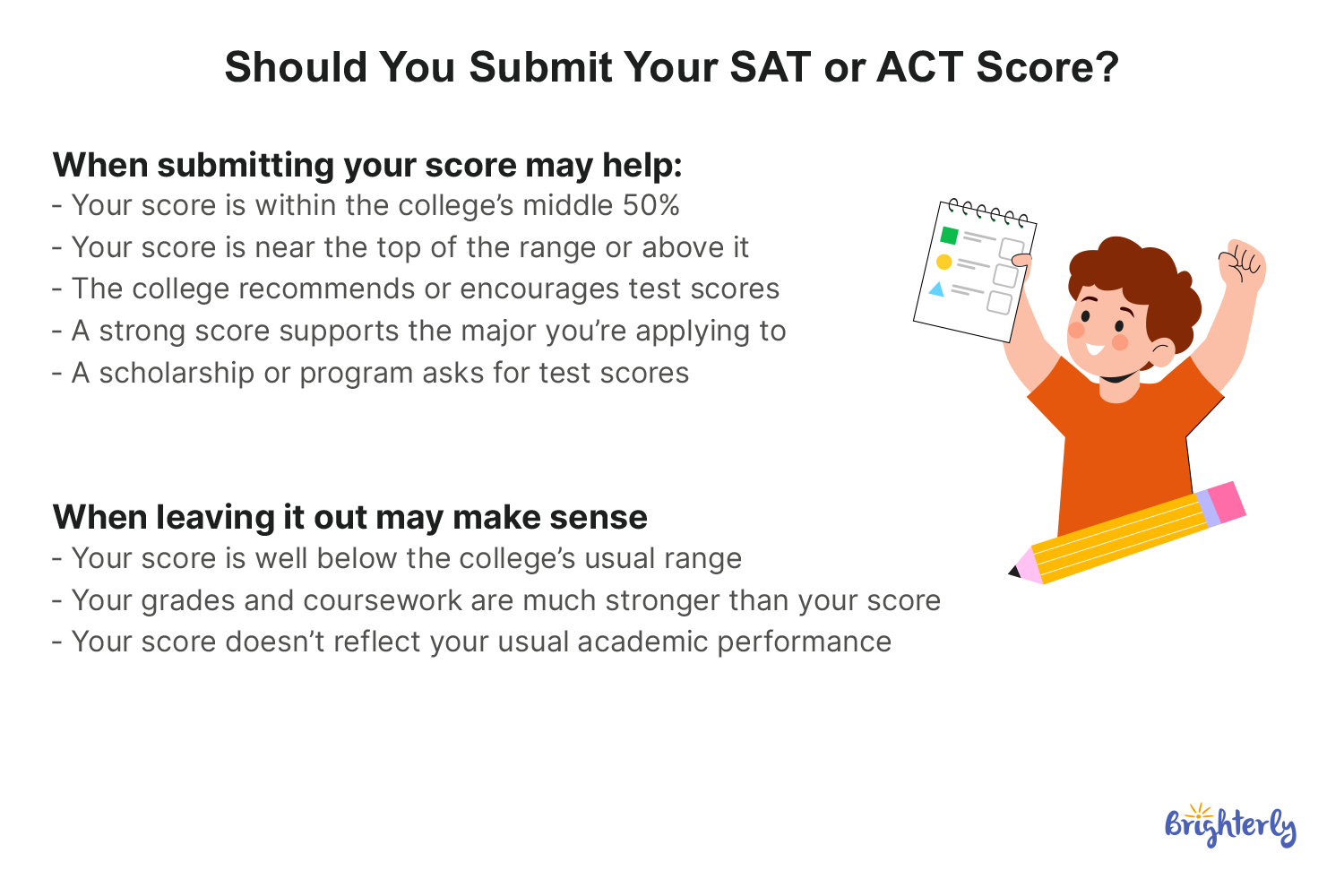
Send the SAT or ACT score if it falls in or above the college’s middle 50% range for admitted students.
When Submitting a Score Helps Your Application
A score helps most when it’s near the top of the college’s range. The major matters too. For instance, a strong math score may be more useful when your kid is applying to a STEM program. If they’re thinking about studying engineering, they should start getting comfortable with calculus early. Calculus tutoring can help with that.
Also pay attention to words like “recommended” or “encouraged.” The score may technically be optional, but the college is telling you it would like to see it.
And check scholarships and individual programs separately. A college can be test-optional for admission but still ask for scores elsewhere.
When It’s Better to Leave Your Score Out
A score well below the college’s usual range is a different story. If your child has strong grades and challenging classes, the application may say more about them without that lower score.
The same goes for a score that just doesn’t look like your kid’s usual work. When applying test-optional, you can leave the score out and let the rest of the application do the talking.
And if your kid would rather give the test another shot, there are plenty of online math tutoring options that fit around a busy school schedule.
Make high school math a little easier
Get 1:1 help with the math your child is working on.
How to Decide: A 5-Step Checklist Before You Apply
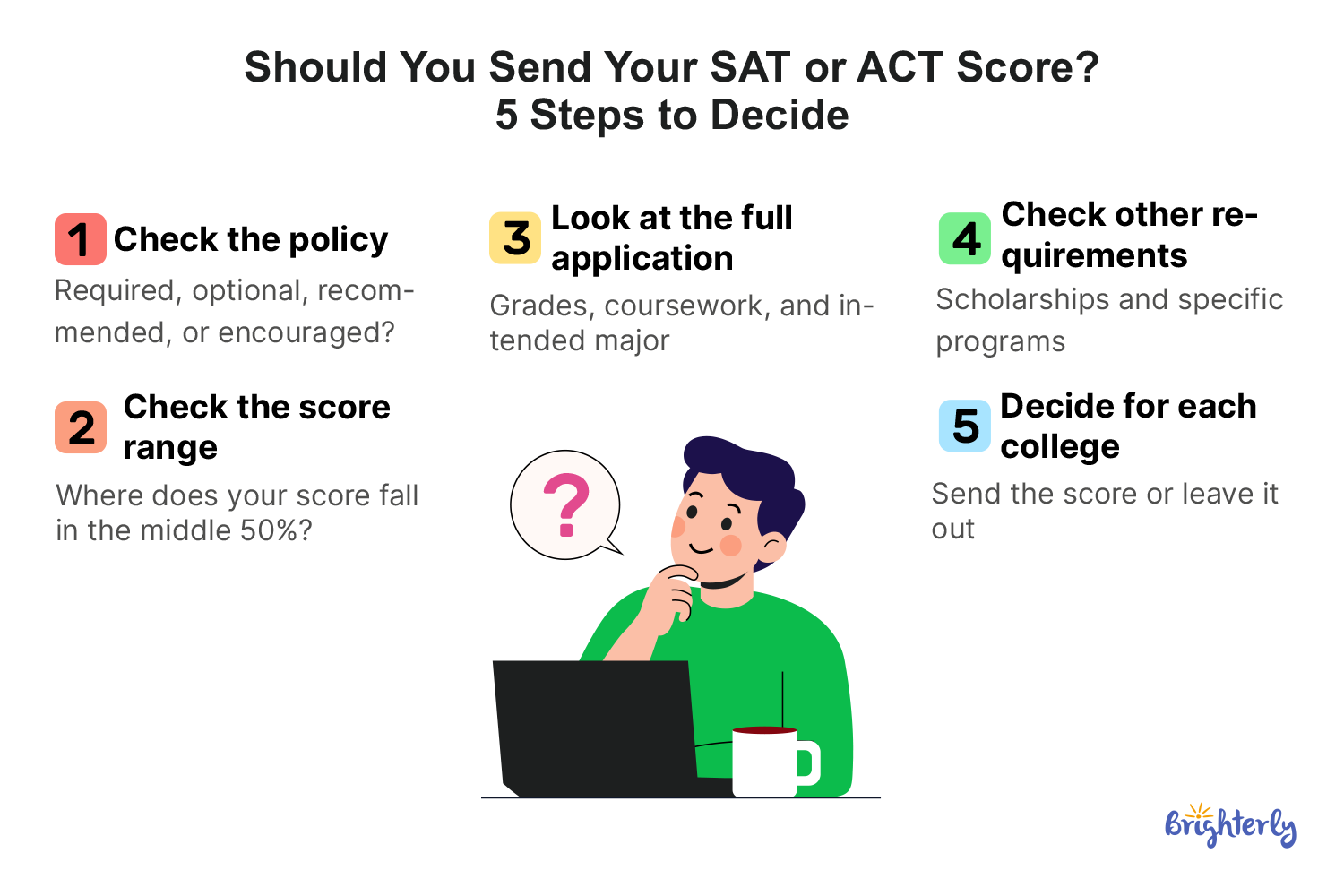
1. Pull Up the College’s Current Testing Policy
Even colleges without SAT requirements can have different rules for certain programs. Check the admission requirements for the one your kid is interested in.
2. Find the Scores of Recently Admitted Students
Most colleges publish a middle 50% SAT or ACT score range. You can usually find it in the college’s Common Data Set or on sites like Niche. Then, see where your kid’s score falls.
3. Compare the Test Score With Your Child’s Grades
If the test score matches the grades, great. But if your kid has strong grades and a much weaker SAT or ACT score, you may be better off leaving the score out.
4. Look Beyond Admission
Don’t forget about scholarships, especially merit-based aid. Some honors programs and majors may ask for test scores too.
5. Read Exactly What the College Says About Test Scores
Some colleges simply say SAT and ACT scores are optional. Others say they’re optional but recommended or encouraged. If you see wording like that, take it seriously.
Conclusion
There are still many colleges that are test-optional in 2026. That includes schools like Duke, Boston College, the University of Chicago, and Amherst. But the rules are changing, and some schools have already brought the SAT or ACT back.
If scores are indeed optional, compare their SAT or ACT score with the college’s usual range before deciding if you should send it.
Not sure where your kid’s math stands? Book our free demo lesson and let us do the testing for you. And if 1:1 lessons seem worth a try, compare the pricing plans and pick what works for your family.
Frequently Asked Questions
Is Harvard Test-Optional in 2026?
No. Harvard requires the SAT or ACT for first-year applicants. In exceptional cases where those tests aren’t accessible, it accepts certain alternative exams.
Is Yale Test-Optional in 2026?
No. Yale requires the SAT or ACT for students applying to enter in fall 2027. Before that, students could submit AP or IB scores instead, but Yale has ended that test-flexible policy.
Is Boston College Test-Optional?
Yes. You can apply to Boston College with or without SAT or ACT scores. The college hasn’t announced an end date for this policy.
If a School Says Test Scores Are “Encouraged,” Does That Mean I Should Submit Mine?
Not necessarily. “Encouraged” isn’t the same as required. A good way to decide is to compare your SAT or ACT score with what that college usually sees from admitted students. If you’re in that range, send it. If you’re well below, leaving it out may make more sense. Or, if there’s still time, your kid could work on the weak spots with a personalized math program and try again.
Does Applying Without a Test Score Hurt Your Chances of Admission?
Usually not, as long as the school is fully test-optional. Just make sure the college really does say “optional.” Some schools say scores are “recommended” or “encouraged” instead.
How Many Applicants Are Actually Submitting Test Scores These Days?
Just over half. About 779,000 students applying as freshmen through the Common App included an SAT or ACT score in 2025-26. About 748,000 didn’t. That’s the first time since 2019-20 that more students sent a score than skipped it.
Can Test Scores Affect Merit Scholarships Even at Test-Optional Schools?
They can. The college may let you apply without SAT or ACT scores, while a particular scholarship has its own rules. That’s why it’s important to check that scholarship before leaving the score out.
Will the SAT or ACT Eventually Become Required Everywhere Again?
There’s no sign that every college is going back to required testing. Some are bringing the SAT or ACT back. Others, like Boston College, Rice, Amherst, and Wake Forest, are still test-optional and haven’t announced an end date.



Brighterly helps K-12 students improve their math and reading skills in 1:1 online classes with professional tutors. Russian School of Math is a K-12 after-school group-class program with a competition-math focus. This Brighterly vs Russian School of Math comparison covers key features, pricing differences, and pros and cons for each platform. Brighterly vs Russian School […]

Oct 08, 2026
A weighted GPA is a calculation that gives extra bonus value to such difficult courses as honors, AP, and IB. Here’s why it can go above 4.0, the actual grade-to-points conversion, how you can calculate your own number by hand (a real worked example included), and what happens to that number once a college looks […]

Oct 19, 2026
Math & reading from 1st to 12th grade
Looking for homework support for your child?

Choose kid's grade

Math & Reading for Grades 1–12
Build real confidence for your child with a Brighterly math or reading tutor.