Technology in the Classroom: What Parents Should Know in 2026
reviewed by Marvi M. Andres
Updated on September 16, 2026
Key Points
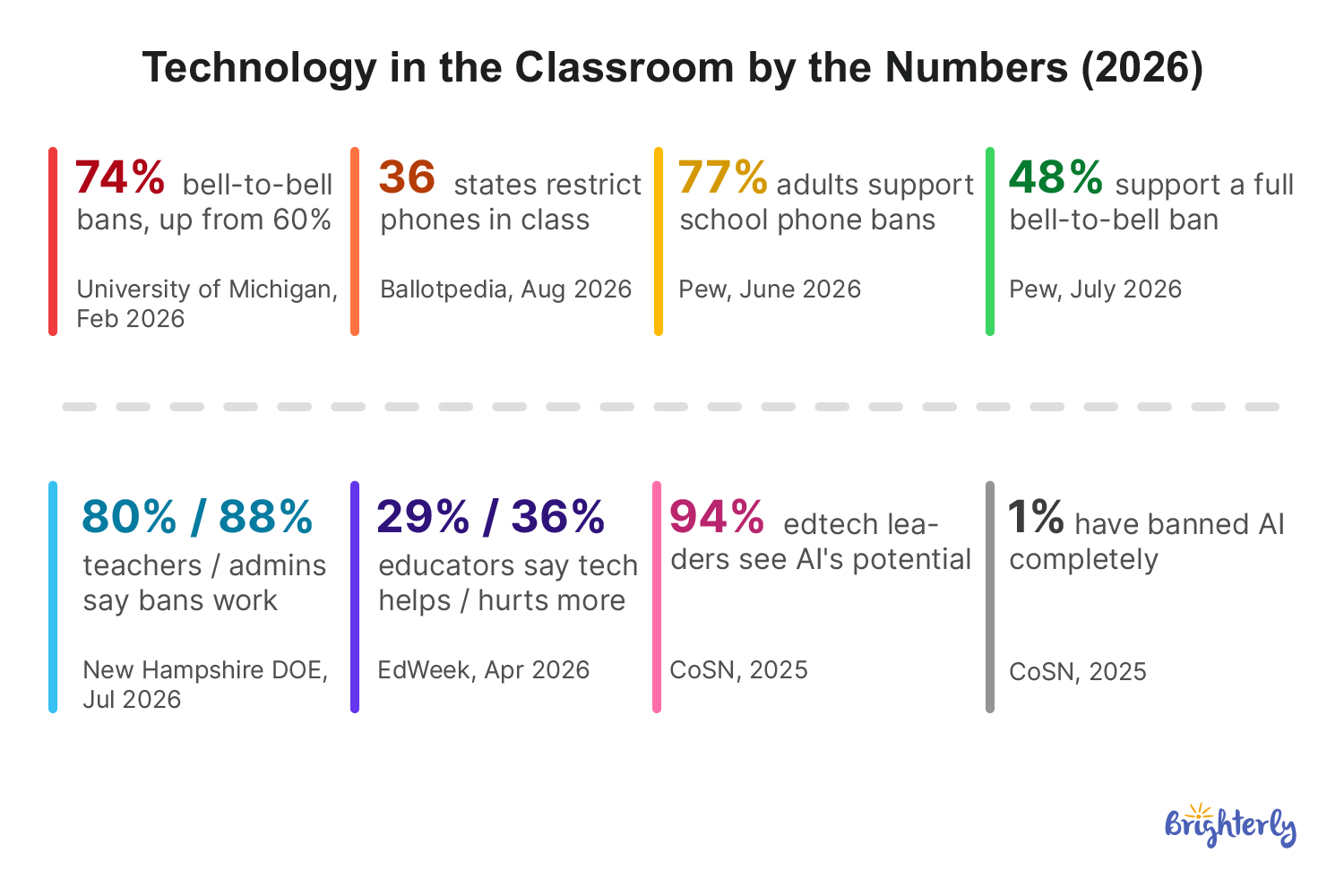
- When asked about the use of technology in the classroom, 74% of surveyed U.S. schools admit to having a bell-to-bell phone ban in 2025-2026 — a 14% increase from 2024-2025 (University of Michigan, February 2026).
- Support for in-class cellphone bans for middle and high school students has hit 77% among U.S. adults (Pew Research Center, July 2026).
- According to educators, the benefits of edtech include the possibility of personalized practice and instant feedback (EdWeek, April 2026).
- Among the biggest challenges schools can face due to technology use are student access to it and high device repair and replacement costs.
Depending on what state you reside in, your child’s school will have different device use rules, screen-time caps, and AI policy — all constantly changing and hard to keep up with. Find out what you need to know about the use of technology in schools as of September 2026 and what it could mean for your family.
What Is Fueling the Backlash Against Technology in the Classroom?
According to the EdWeek April 2026 article, the factors that fuel ed-tech backlash include the rapid growth of 1-to-1 computing, generative AI, and the growing number of lawsuits against social media companies. The article also adds that this backlash has already resulted in at least 17 states weighing bills to manage school tech use.
Scientific American, August 31, 2026, article adds that this backlash is still escalating, mentioning the NYC tech freeze initiative, Meta’s new “school mode” that blocks Instagram during school hours, and Utah and Alabama becoming the first states to put screen time limits for elementary school students.
Explore Brighterly Learning Experience
Learn exactly how Brighterly helps students thrive through expert sessions, online tools, and proven feedback from thousands of satisfied parents
Technology in the Classroom Statistics for 2026
The classroom technology statistics reflect how many schools have restricted phones/screens at school and what parents and teachers have to say about the use of technology in a classroom. In general, the data shows an increase in phone bans, and both parents and teachers support these restrictions.
How Many Schools Have Restricted Phones and Screens?
A Phones in Focus survey of more than 68,000 educators published by the University of Michigan in February of 2026 found that bell-to-bell phone bans in schools jumped from 60% of surveyed schools in 2024–2025 to 74% in 2025–2026, which marks one of the fastest school-policy shifts in recent years. Ballotpedia supports Phones in Focus data by showing that, as of August 2026, 36 states have already banned or restricted phone use in classrooms.
How Do Parents and Teachers Feel About Classroom Technology?
The July 2026 edtech statistics by Pew Research Center show that 77% of U.S. adults support a cell phone ban in schools for middle and high school students, with 48% supporting the bell-to-bell bans — the biggest support the entire school day ban has ever received.
As for the educators, the statewide survey by the New Hampshire Department of Education published in July of 2026 shows that about 80% of teachers and 88% of administrators called bell-to-bell cellphone bans effective. April 2026 research by EdWeek adds that 29% of surveyed educators believe technology does more to improve learning than hurt it, while 36% claim the opposite.
Speaking of AI specifically, the CoSN 2025 report shows that edtech leaders are more optimistic — 94% see AI’s potential, while only 1% have banned it completely. For more data and trends on AI in schools, see Brighterly’s 2026 AI in education statistics guide.


Try educational tech with online tutoring
Our online tutors merge technology with human instruction to improve the learning experience.
How U.S. School Districts Are Responding to Classroom Technology
The U.S. school districts usually respond to classroom technology with an action that results in the creation of school technology policy that restricts phone use, screen time, and AI. Below are some of the most recent and most prominent examples of such actions/technology policies from different school districts.
|
District / State |
Action/Policy |
Date |
|
New York City, NY |
One-year moratorium on student-facing generative AI for grades 2-K–8: – Affects around 600,000 students – Bans companion chatbots in every grade |
September 2, 2026 |
|
Palo Alto, CA |
Parent-led “Schools Beyond Screens” chapter petition: – Pushes for limits on devices and AI |
July–September 2026 |
|
Los Angeles Unified, CA |
Unanimous resolution bans devices through 1st grade – Sets daily caps of 20 min (grades 2–3) and 30 min (grades 4–5) |
April 2026 |
|
Lower Merion, PA |
Parent group “Pencils Over Pixels” petition: – Pushes to preserve the device opt-out *Petition not satisfied. Parents filed a federal lawsuit |
April-September 2026 |
|
New Hampshire |
Statewide bell-to-bell ban (HB2) in effect since the 2025–26 school year. *Survey shows strong educator support |
2025–2026 |
|
California (statewide) |
– Requires every district to adopt a phone policy |
In effect since July 1, 2026 |
New York City — The Nation’s Largest AI Ban
In an effort to regulate technology in education, the NYC Office of the Mayor announced a one-year pause on student-facing generative AI for grades 2-K through 8 on September 2, 2026, affecting nearly 600,000 students. Now, the 2026 New York City Public Schools guidance states that companion chatbots are banned for every grade, and high schoolers get supervised AI pilots plus required AI-literacy lessons. For additional insights on state-by-state AI classroom use regulation, see Brighterly’s 2026 AI policies in schools guide.
Palo Alto, California
According to the July 2026 Palo Alto Online news article, a local effort called Schools Beyond Screens has been pushing for an all-day phone ban, more physical homework, and an opt-out from ed-tech tools. Parents signed a petition urging the board of education to adopt the policy that would satisfy their demand. The number of signatures has increased from 228 in July of 2026 to 304 in September.
Check out Brighterly’s homework statistics guide to understand why it can be one of parents’ concerns.
Los Angeles Unified School District
According to the EdSource June 2026 article, LAUSD’s board unanimously approved a resolution on screen time in April of 2026. The policy bans devices for K-1 students completely and sets daily screen time at 20 minutes for grades 2–3 and 30 minutes for grades 4–5, starting from 2026–2027 school year.
Lower Merion, Pennsylvania
According to the WHYY April 2026 article, a campaign called “Pencils Over Pixels” gathered hundreds of signatures asking the district to preserve the ability to opt out of school-issued Chromebooks. However, CBS News August 2026 piece claims the board ended the opt-out instead, which made parents file a federal lawsuit.
New Hampshire (Statewide Ban)
New Hampshire’s bell-to-bell law (HB2) took effect at the start of the 2025–2026 school year, banning the use of phones during school time. A 2026 state survey by the NH Department of Education found about 80% of teachers and 88% of administrators have already found this policy effective at cutting distractions.
California (Statewide Ban)
In effect, since July 1, California’s Phone-Free Schools Act (AB-3216) takes effect on July 1, requiring every school district, charter school, and county office of education to adopt a policy limiting or banning smartphone use on campus. What makes this act different from the existing law is that schools are now not just allowed but required to adopt a policy.
Benefits of Technology in the Classroom
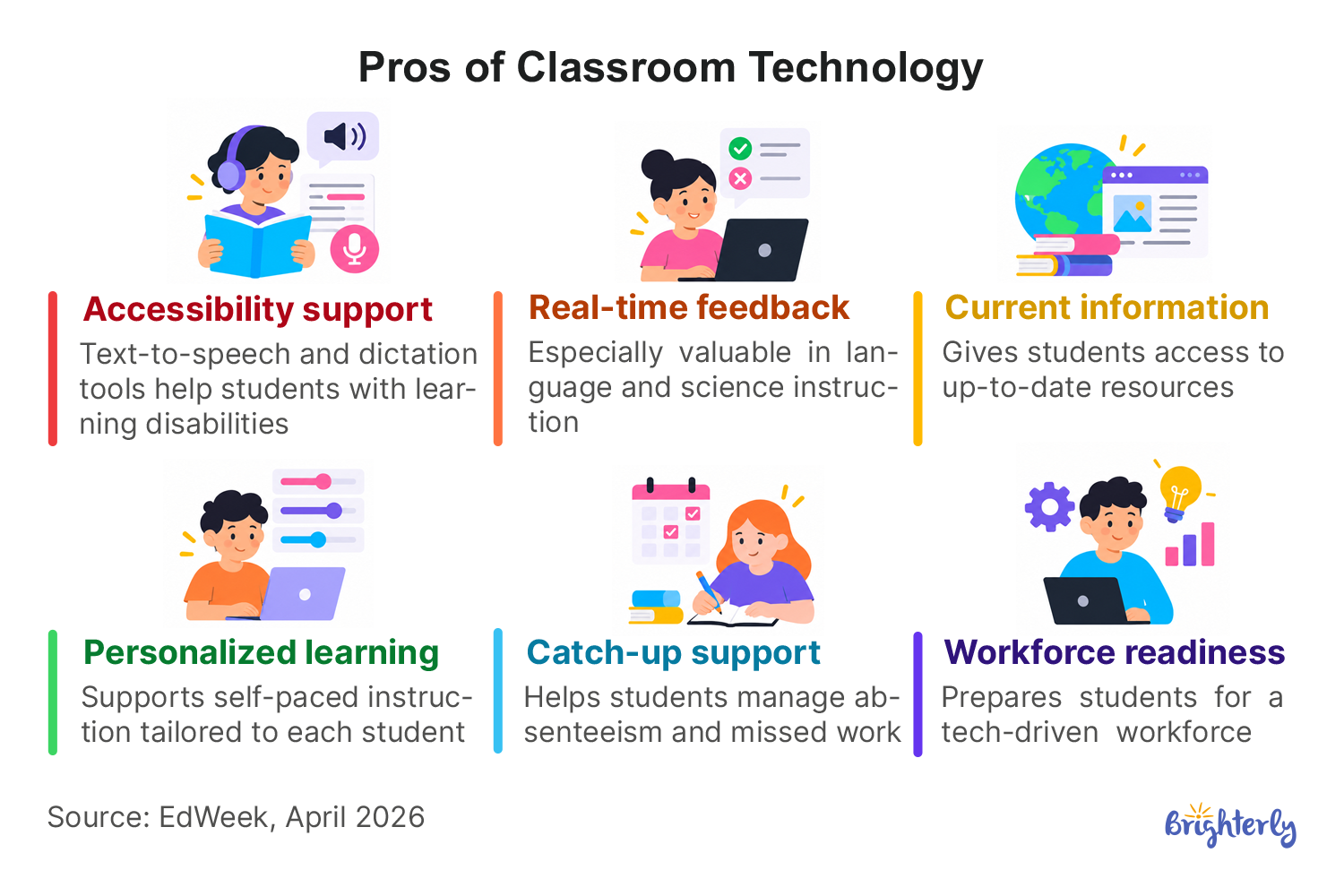
According to EdWeek’s April 2026 article, the educators believe that the benefits of tech use in schools include accessibility for students with learning disabilities (text-to-speech, dictation), real-time feedback (especially in language and science instruction), access to current information, personalized/self-paced learning, help with absenteeism/catch-up work, and preparation of students for a tech-driven workforce.
Besides classroom benefits, technology can be beneficial during home practice too. For example, on Brighterly, our online educators create AI lesson summaries for kids to go through any time. However, our one-on-one tutors also make sure to provide guidance and support based on the child’s learning style, pace, and needs, customizing the learning program.
Both our online math program and reading program for K-12 students align with the U.S. standards to make sure your kid learns what they need to succeed at school.
Find out more about the advantages and disadvantages of online learning in our 2026 guide.
Challenges and Concerns With Classroom Technology
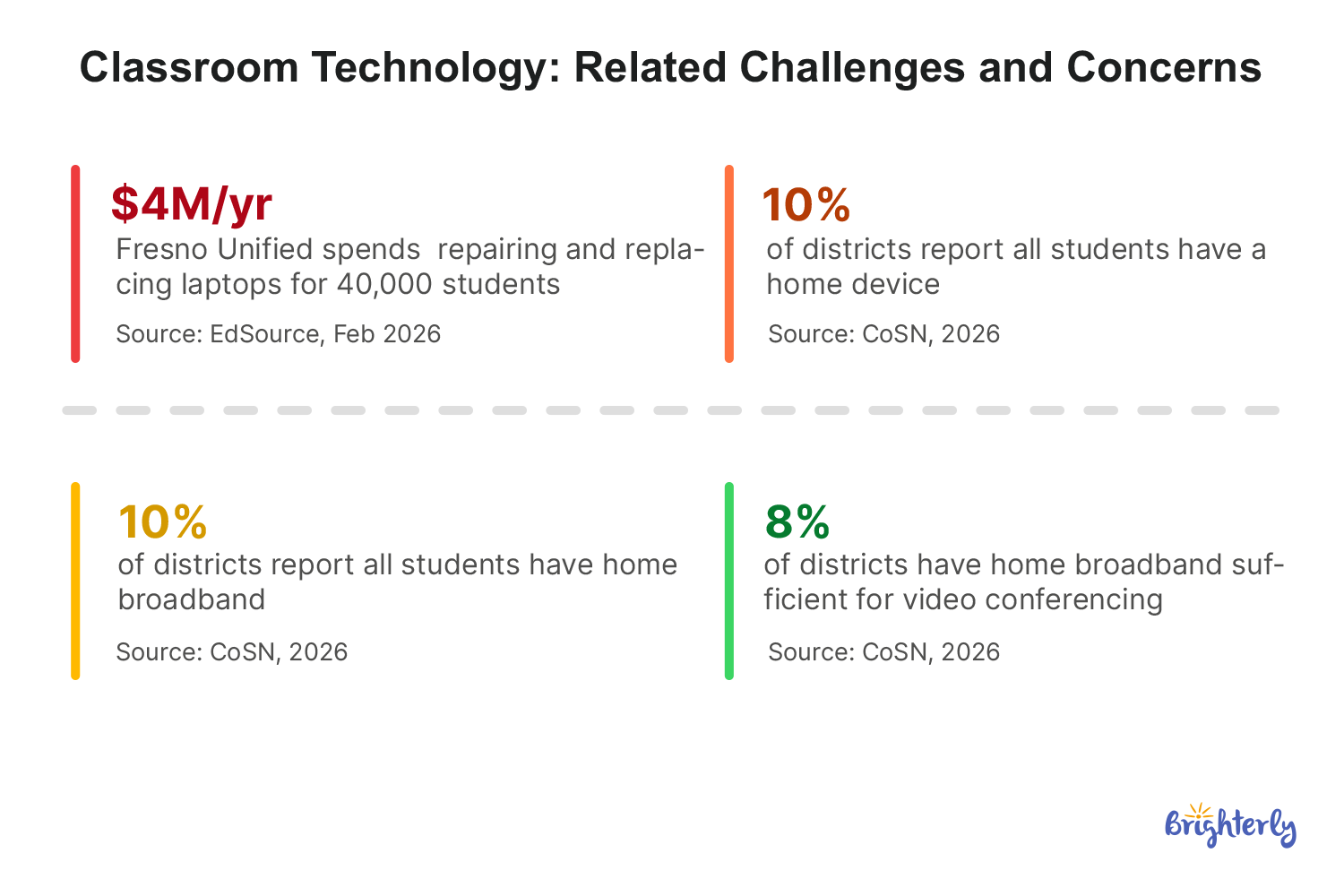
Some of the challenges and concerns with classroom tech have to do with the tech cost and access to it. For example, the EdSource February 2026 article claims that Fresno Unified school spends roughly $4 million a year on repairing and replacing laptops their 40,000 elementary students use at home — one reason the school is switching back to in-class-only computer use.
Another related concern is the digital divide in schools. For example, according to the CoSN 2026 report, even though the 1:1 device program implementation is nearly ubiquitous at all grade levels, digital connectivity is not the same for all districts:
- Only 10% of districts report all their students have home devices
- Only 10% of districts report all their students home broadband
- Only 8% of districts report all their students have home broadband sufficient for video conferencing.
If you want to dive into pros and cons of technology in the classroom in terms of AI use specifically, check out Brighterly’s guide to the risks of AI in education.
Benefit from personalized learning with tech
Our game-based and interactive online classes help make learning fun and effective.
What This Shift Means for Parents
The shift in the level of technology integration in the classroom means that parents should be ready to ask their child’s school direct questions about the phone use policy (bell-to-bell or class-time only), policy on the use of AI tools for school, and screen time restrictions. Also, consider how much your kid already spends on screen at home and which tools they use.
Make sure the tools your kid uses actually help them practice and learn instead of just doing everything for them — technology should supplement learning rather than substitute the thinking process. For example, some creative ways to use AI tools include the creation of lesson summaries, turning stories into pictures, and turning abstract math into a story.
Where Is Classroom Technology Headed Next?
Based on the statistics and policies mentioned above, like the Ballotpedia data on phone bans, California’s Phone-Free School Act, and NYC AI-related moratorium, the educational technology trends seem to point toward more restrictions on classroom phone use in the near future and more regulations on AI use.
Conclusion
From statewide phone bans in New Hampshire and California to NYC’s AI moratorium, districts nationwide are responding to parent and educator concerns by trying to manage device and AI access at schools. For parents, staying informed about their specific district’s evolving policies and keeping an eye on how their kids use tech at home are essential actions to take.
Frequently Asked Questions
Is Technology Harmful to Students in the Classroom?
No, technology isn’t inherently harmful to students in the classroom — it can cause issues only when used with no restrictions and clear structure. For example, unlimited phone access and passive screen time in schools can be harmful, while purpose-built tools used for a specific task can be even helpful.
How Many U.S. Schools Have Banned Cellphones in the Classroom?
According to a February 2026 University of Michigan survey, about 3 in 4 (74%) of surveyed U.S. schools adopted bell-to-bell cellphone bans in 2025–2026, which is one of the fastest shifts in school policy in recent years. This data could mean that the majority of U.S schools have either already banned cellphones in a classroom or might do so in the near future.
What Are the Main Disadvantages of Technology in the Classroom?
Based on the HMH April 2025 article, the main cons of technology in the classroom are the following:
- Extra screen time can affect child development
- Devices, apps, and social media constantly pull student attention away from lessons.
- Digital tools make copying others’ work easier, enabling cheating.
- Screens can reduce face-to-face interaction
- Unequal access to reliable Wi-Fi or devices can put some students behind.
For more information on social media as part of learning, check out the best practices of using social media in education in Brighterly’s guide.
Will Artificial Intelligence Replace Teachers?
No, AI will not replace human teachers — there’s no district policy that is moving toward this direction. On the contrary, more policies are restricting AI use, like New York City’s 2026 moratorium that bans AI companion chatbots across all grades.
How Can Parents Find Out What Technology Their Child’s School Uses?
To find out what technology your child’s school uses and approves, start by checking your school district’s acceptable-use policy, usually posted on the school website. You can also ask your child’s teacher which apps they allow to use, how, and when.
What Is a Bell-to-Bell Phone Ban?
A bell-to-bell phone ban is a restriction that means personal devices like phones are not allowed for the entire school day, from when the first class starts until the last class ends — students can’t use their devices even during the break, not just during class.



Once your kid brings home their GRL result from school, you want to know what it means and what exactly you need to do to address the problems it indicates. The guided reading level is a letter between A and Z — see how it compares to grade-level expectations and what to do next. What […]

Sep 16, 2026
Math & reading from 1st to 12th grade
Looking for homework support for your child?

Choose kid's grade

Math & Reading for Grades 1–12
Build real confidence for your child with a Brighterly math or reading tutor.