AI Policies in Schools: What the Policies Actually Say About Discipline and Appeals
reviewed by Armamie Tancio
Updated on September 16, 2026
Key Points:
- Speaking on AI policies in schools, only 45% of school principals said that their school or district provided them with any policies or guidance on the use of AI products and tools (RAND, 2025).
- 35 states have an official state-level AI guidance for K-12 schools (Ballotpedia, 2026).
- In Florida, the percentage of rural districts that have any guidance on AI use in schools is much lower compared to the percentage of urban districts that reference AI use — 0% against 41%, respectively (UF EPRC, 2025).
- Only 23.3% of school districts in Florida mention AI in their code of conduct (UF EPRC, 2025).
- A Massachusetts family lost a case over an AI cheating accusation, even though they argued the district had no specific policy on AI use (The74, 2024).
Most states in the US still have no clear guidance on the use of AI in US schools, including on what counts as cheating, how AI should be used as part of learning support, or how a student can defend themselves if they’re wrongly accused.
See how the AI use policies vary in different states and what you can expect in case your child is suspected of misusing AI.
How AI Policy Adoption Varies by State
| State | AI Policy Requirement | Details | Source |
| Florida | No statewide mandate |
UF EPRC has a research of 73 district codes of conduct: – Only 23.3% (17 of 73 districts) reference AI use in schools in their code of conduct. – 94.1% out of those districts that reference AI use in schools in their code of conduct specify potential punishment for AI misuse |
UF EPRC, 2025 |
| Ohio | Statewide mandate: House Bill 96 requires every public district to adopt a formal AI policy by July 1, 2026 |
Columbus City Schools (the state’s largest district) board unanimously introduced its AI policy in March 2026: – Teachers now have per-assignment discretion – Unauthorized AI use is considered plagiarism |
Forbes, July 2026; WOSU, March 2026 |
| Utah | H.B. 273, effective July 1, 2026, requires LEAs to adopt an AI-use policy based on the state model policy. |
Washington County School District’s board already has Policy No. 3750 (adopted Sept. 8, 2025) — a written AI-use policy that covers ethics, data governance, and staff/student conduct. Violating the policy guidelines results in general disciplinary action, but no clear process for appealing AI-specific accusations is defined. |
Washington County SD Policy 3750 |
| New York | No statewide mandate | New York City Public Schools (the largest US district) has published AI guidance built around a 76-member Central AI Task Force and a mandatory review process (ERMA) for any AI tool that touches student data — no appeal-specific language for AI misuse accusations appears in the public guidance | NYC Public Schools guidance |
| Idaho | Statewide mandate: Senate Bill 1227 (Generative AI in Education Framework Act), signed March 19, 2026, effective July 1, 2026 |
Requires the State Dept. of Education to build a statewide generative-AI framework: – Local school districts and public charter schools must adopt their own aligned policies covering acceptable/prohibited AI uses, student data safeguards, and AI literacy standards |
KTVB, March 2026; Idaho SB 1227 bill text |
| Maryland | Statewide mandate: Senate Bill 720 (Artificial Intelligence Ready Schools Act), signed into law (Ch. 634), effective June 1, 2026 |
Requires MSDE to publish AI guidance and a tool-evaluation rubric: – Each county board of education must adopt an AI policy aligned with that guidance and designate a non-instructional AI coordinator |
Maryland General Assembly, SB0720; BillTrack50 summary |
| Oklahoma | Statewide mandate: Senate Bill 1734 (Oklahoma Responsible Technology in Schools Act), signed May 12, 2026; district policies required by the 2027–28 school year |
– Prohibits AI from being the primary basis for high-stakes decisions like grading or discipline – Requires human-in-the-loop review – Parents can opt students out of student-facing AI tools without academic penalty – Districts must give annual written disclosures of AI tools/vendors/data collected |
K-12 Dive, July 2026; Lightspeed Systems |
| Virginia | Statewide mandate: Senate Bill 394 / House Bill 1186, effective July 1, 2026 |
Requires VDOE to publish AI guidance covering privacy, transparency, bias prevention, and limits on high-stakes decision-making – Local school boards must adopt/enforce aligned policies |
Williams Mullen; Virginia Mercury, 2026 |
| Tennessee | Statewide mandate: Senate Bill 1711 (2024), codified as Tenn. Code § 49-13-118; policies required by the 2024–25 school year |
– Required every public school board and charter school to adopt and report an AI-use policy governing students, teachers, and staff. |
Tenn. Code § 49-13-118, Justia |
| California | No statewide mandate |
The California Department of Education released a Model Policy on AI in Education on July 6, 2026 (advisory, not binding; Education Code §33308.5). The policy covers academic integrity and disclosure, limits on AI detection software, privacy by design and legal compliance: – AI detection software should not be used as the only basis for disciplinary action or grade penalty. – Concerns about misuse must rely on educator evaluation of student engagement, alternative assessment, and documented evidence of authorship, with clear criteria for rebutting claims of inappropriate AI use made available to students and parents/guardians. |
CDE Model Policy |
Apart from data in the table, there is a general nationwide data reported in the 2025 Ballotpedia overview of state policies on using AI in schools, stating that 35 states have an official state-level AI guidance for K-12 schools.
Another September 2025 research by RAND found that even though 54% of students and 53% of English language arts, math, and science teachers admit to using AI for school purposes, only 45% of school principals report having any school or district AI policy.
The most recent June 2026 Educational Policy research adds more clarity to the existence of policies on AI use in schools by finding that nearly two-thirds of school districts in the US don’t reference AI anywhere in their student handbooks at all.
Explore Brighterly Learning Experience
Learn exactly how Brighterly helps students thrive through expert sessions, online tools, and proven feedback from thousands of satisfied parents
What Happens When a School Suspects AI Cheating?
In case of suspected AI cheating in schools, the first two things teachers usually do are run the student’s work they suspect of being partly or fully AI-generated through commercial AI detectors and compare the work with the student’s past performance.
If after detectors and comparison the suspicion remains, the school may initiate an academic misconduct review, which can range from an informal chat with the teacher to a formal disciplinary hearing.
Note: Being wrongly accused of cheating isn’t just an academic issue — see Brighterly 2026 review student mental health statistics for more on how academic stress affects kids and how you can help.
Where AI Rules Usually Live in a Student Handbook
AI rules in a student handbook usually live inside the Academic Integrity Policy or the Student Code of Conduct. For example, according to the October 2025 UF EPRC research, among the 23% Florida districts that mention AI use in their student code of conduct, 29.4% reference AI under the general technology and digital misuse section.
What Counts as AI Misuse
What counts as AI misuse depends on the specific district’s policy. For example, according to Washington County School District policy approved in September 2025 and the October 2025 UF EPRC research, what counts as AI misuse is basically a form of data privacy and safety violations, which include:
- Submitting AI-generated work as one’s own
- Using AI on an assignment without permission or against the teacher’s instructions
- Using AI to fabricate or manipulate data
- Using AI as an uncredited collaborator
- Creating AI-generated deepfakes or impersonations
- Inputting confidential or protected data into AI tools
When it comes to AI misuse, there is another issue that the above-mentioned policies don’t focus on. In a 2026 Brighterly survey of US parents of students in grades K–10, 50.9% said AI tools make it easier for their child to hide that they don’t understand something — among parents who use AI chatbots themselves at least weekly, that percentage reaches 68.7%.
Avoid AI misuse with professional tutoring
Brighterly tutors teach kids to complete assignments without AI doing the work for them.


Can a Student Appeal an AI Cheating Accusation?
Yes, a student can appeal an AI cheating accusation. However, the result of the appeal depends on whether the school has a clear policy on AI misuse — if there’s no such policy to appeal to, the court might side with the school.
The Case That Tested This
Covering AI in schools policy news, The74 November 2024 article describes a case when the Hingham High School in Massachusetts accused a student of using AI to write an assignment — the sources a student cited turned out to be nonexistent. The student got a D grade, a detention, and was denied entry to the National Honor Society.
The Harris family, the student’s parents, issued an appeal against the school’s district representative, arguing that the district had no AI-specific policy the student could’ve violated — the handbook simply never mentioned AI.
The court decision published in FindLaw in November 2024 states that the court still sided with the school district, ruling that the student violated the district’s existing general academic integrity rules, which mention plagiarism and unauthorized technology use, although they don’t specify AI.
Why Unreliable AI Detectors Make Things Riskier
According to the CDT March 2024 report, 68% of teachers admit to using AI-detection tools regularly. The issue with the use of these tools is that they cannot always be trusted. For example, the Information October 2025 article states that AI detection tools frequently produce false positives, which poses a risk of a student being accused of cheating even when they are not guilty.
Which Students Are Most Likely to Be Left Without Guidance?
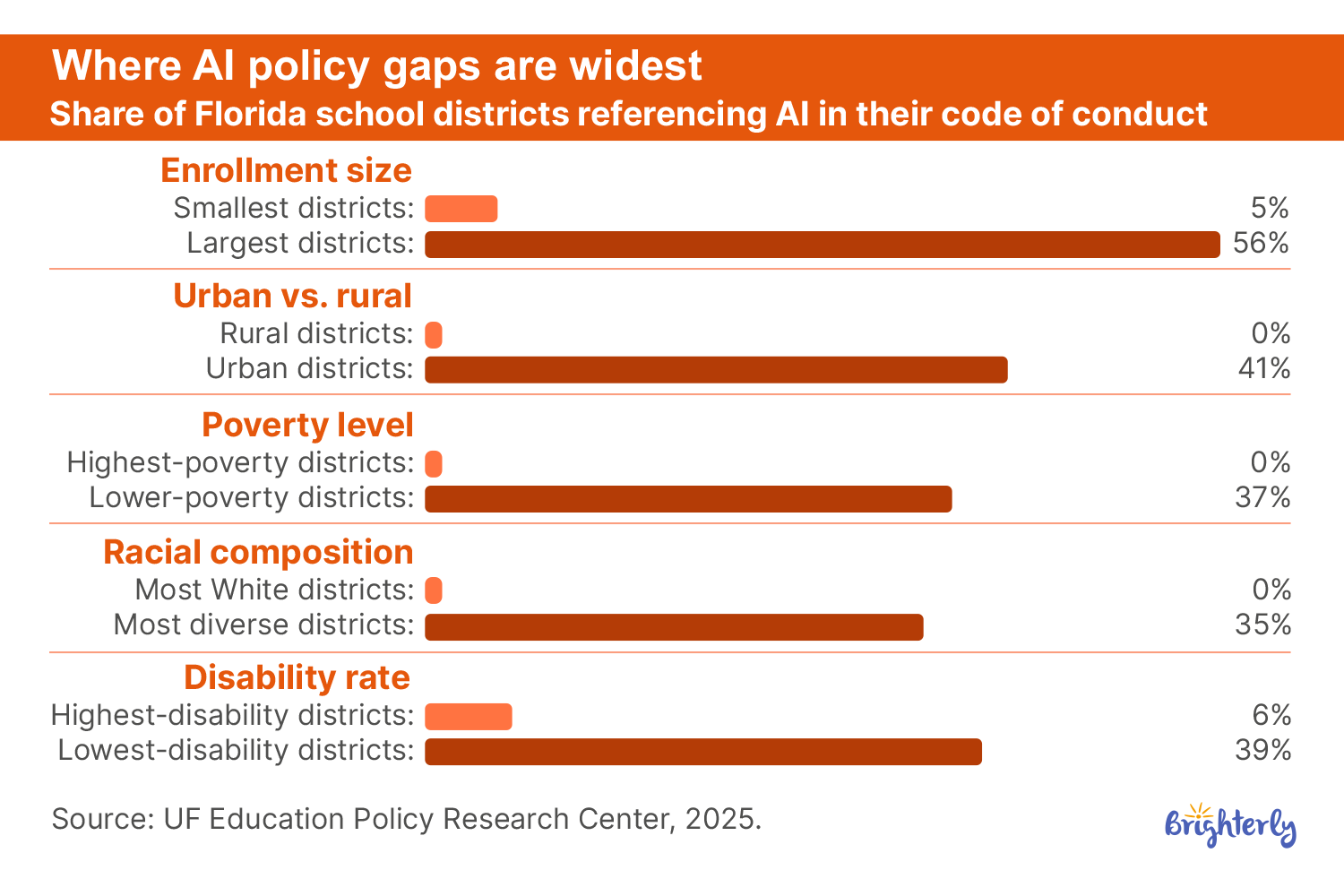
According to the October 2025 UF EPRC research brief that analyzes the situation in Florida, among the students that are most likely to be left without guidance on the use of AI in schools are the ones that reside in districts that are smaller, more rural, and higher-poverty:
- Urban vs. rural: 41% of urban districts reference AI in their code of conduct — 0% of rural districts do the same.
- Poverty level: 0% of districts in the highest-poverty quartile (56.9–100% eligible for free/reduced-price lunch) reference AI in their code of conduct compared to 22–37% for lower-poverty quartiles.
- Enrollment size: 28–56% of the largest districts (12,575–335,840 students) reference AI in their code of conduct, while only 5–6% of the smallest districts (512–12,040 students) do the same.
- Students with disabilities: districts with the highest share of students with disabilities reference AI in their code of conduct at only 6–17% compared to 32–39% for districts with the lowest share of students with disabilities.
- Race: Districts with the highest White student enrollment (62.9-86.8% White students; i.e., those with the lowest racial minority enrollment) do not explicitly reference AI use in their codes of conduct, while 25–35% of districts with more minority enrollment (37.2–99.2% minority students) referenced AI in their code of conduct.
What a Strong District AI Policy Looks Like
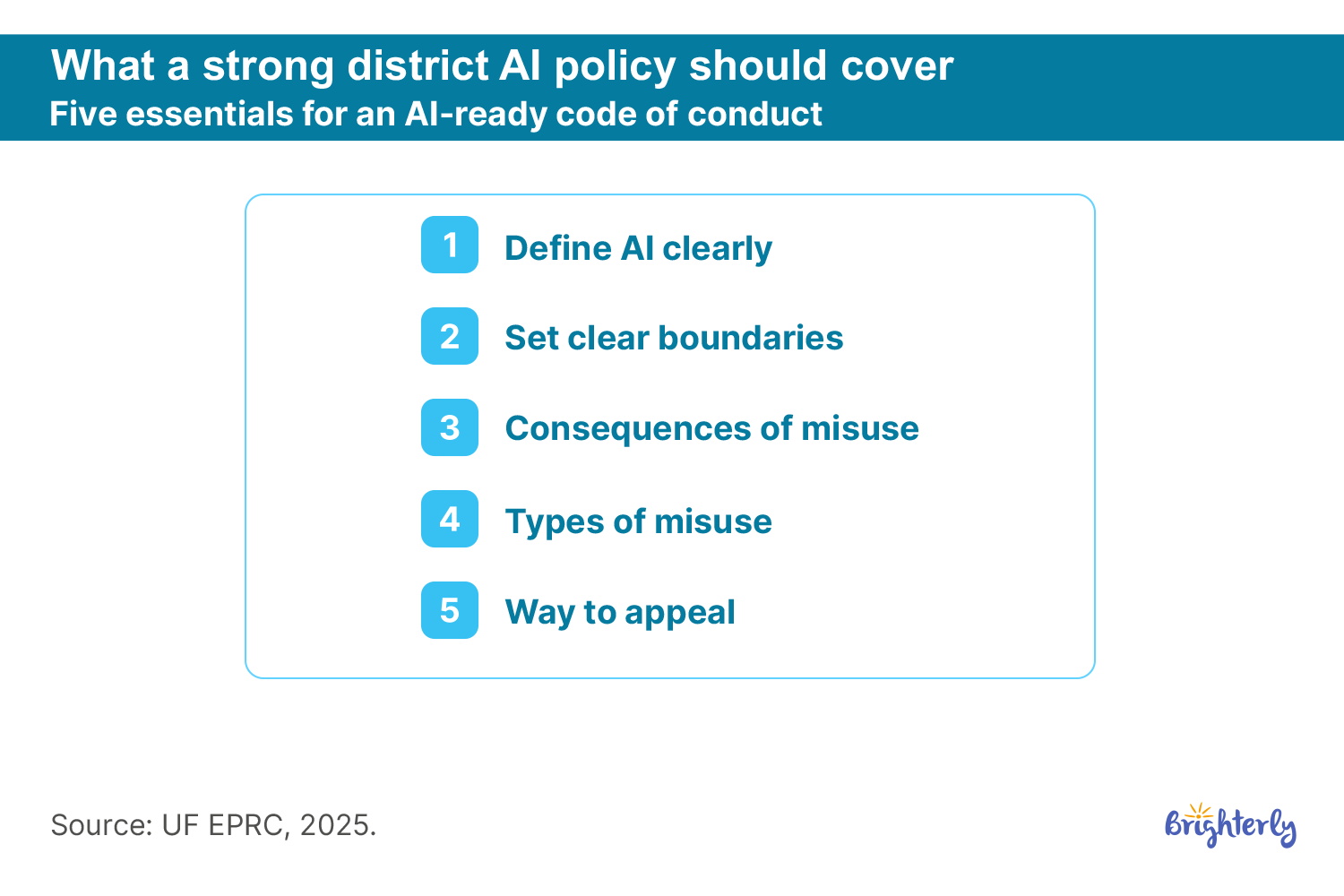
According to the October 2025 UF EPRC research brief, a strong district policy on AI in schools should define AI clearly, spell out exactly what’s allowed and what’s not, list the real consequences of AI misuse, address AI use beyond just academic cheating, and give students a way to appeal in case they are accused of AI misuse:
- Defining AI clearly — A policy should name specific tools or categories that count as AI (chatbots, image generators, writing assistants)
- Stating what’s allowed vs. prohibited — A policy should include examples for different assignment types when AI is allowed and when prohibited.
- Linking AI misuse to a specific, proportionate consequence — A policy should include clear consequences applied in case of AI misuse
- Covering technology misuse beyond academic dishonesty — A policy should include different types of AI misuse, like AI-generated deepfakes or impersonation of another student or school staff member.
- Giving students a way to appeal or contest an accusation — A policy should explain how and when a student can appeal in case they’re accused of cheating.
Examples Worth Learning From
| District (state) | Where they stand on AI policy | Appeal language |
| New York City Public Schools (NY) |
Formally published AI guidance: – Every AI tool is vetted through an internal review process (ERMA) before use with student data |
Not found |
| Columbus City Schools (OH) |
Board unanimously adopted a formal AI policy: – Teachers get per-assignment discretion – Unauthorized AI use equals plagiarism – Ban on training AI on student/staff data |
Not found |
| Washington County School District (UT) |
Formal written policy: – Covers ethics, transparency, and data governance |
Not found |
| Volusia County Schools (FL) |
Most detailed Florida example: – Dedicated “Guidelines for AI Use” section |
Not specified |
| California Public Schools (CA) |
– Warns that detection tools “may be unreliable or biased” |
Requires districts to publish the criteria a student can use to rebut an accusation |
Should AI Be Allowed in Schools at All?
AI has both pros and cons, so the discussion of whether it should be allowed in schools is better directed toward the purposes AI serves for students and teachers. For example, the December 2025 Discovery Education article offers the following checklist for determining whether AI is appropriate to use:
- This AI tool solves a real instructional or operational challenge
- This AI tool enhances rather than replaces a teacher’s judgment
- This AI tool protects students’ data and follows strict privacy requirements
- This AI tool is accessible to all students
- Teachers have the time and support to learn this AI tool
- This AI tool doesn’t distract students from their learning goals.
Overall, when used correctly, AI can increase personalized learning by up to 54%, according to Brighterly’s 2026 AI in education statistics.
As for the risks of AI in education, students may rely on AI tools too much. To prevent this reliance, it’s important that kids get support in their studies from parents or professional tutors, especially if they’re struggling learners.
A personalized learning platform offering one-on-one lessons with a real online math tutor and reading tutor can help K-12 children build confidence in their own knowledge so that they don’t feel the need to rely on AI as a substitute for their skills and critical thinking.
You can start with a free diagnostic math test or reading test on our website to see where your child currently stands and whether they need professional guidance.
Get your child expert learning support
Brighterly tutor personalizes the learning process to make a child confident and motivated.
Questions Parents Can Ask Their Child’s School
Before an AI cheating accusation ever comes up, it’s worth finding out where your school actually stands on its AI policy — whether an actual written policy even exists, which AI tools are allowed, how potential misuse is detected, whether a clear appeal process exists, and whether the school staff is trained to evaluate AI misuse cases.
Here is a list of exact and direct questions you can ask:
- Does the district have an official AI policy, and where can families read it?
- Which AI tools are permitted, and for which types of assignments?
- What AI-detection tool, if any, does the school use to check assignments, and how reliable does the district consider these tools?
- If a student is accused of AI misuse, is there a formal appeal or hearing process, apart from the initial disciplinary decision?
- How does the policy, if any, handle AI-generated deepfakes or impersonation involving other students?
- Have the teachers or staff members received guidance on evaluating suspected AI misuse?
To avoid cheating accusations, you can also make sure your child uses AI tools or homework help websites that support and help their learning rather than do everything for them to prevent a kid from blindly relying on generative AI in general.
Conclusion
Policies on AI usage in schools are still new to most states and districts — most don’t provide clear rules and instructions on what counts as AI misuse or how to appeal an accusation. Cases like Harris v. Adams show that unclear or missing policies leave students unprotected and unable to defend themselves. Until more districts adopt clear, well-defined AI policies with real appeal processes, parents should consider asking their child’s school where it stands on AI use, rather than assuming any policy exists.
Frequently Asked Questions
What States Require Schools to Have an AI Policy?
According to the K-12 Dive July 2026 article, new laws in Idaho, Maryland, Oklahoma, and Virginia will join the states of Ohio and Tennessee and now require schools to have an AI policy. So, as of August 2026, only a few states require schools to have an AI policy — a much bigger number of states (35) have an official AI guidance for K-12 schools, according to Ballotpedia’s 2026 overview.
How Do Schools Detect AI in Homework?
According to the CDT March 2024 report, most school teachers admit to using school-endorsed AI content detection tools to detect AI in students’ homework, even though the research in the International Journal for Educational Integrity published in September 2023 shows that AI detection tools are ineffective.
Is AI-generated Homework Treated the Same as Plagiarism?
Although AI-generated homework is not technically plagiarism since it doesn’t directly copy someone’s work, it can still be treated as plagiarism and fall into policy sections that cover academic dishonesty, plagiarism, or unauthorized technology use, even if AI is not specified.
Can AI Detection Software Be Wrong?
Yes, AI-detection software can be wrong. For example, a July 2026 Fortune article reviews studies finding that, depending on the AI detection tool, false-positive rates can reach 50% and false-negative rates up to 100%. Besides, these detectors seem to disproportionately misflag non-native English writing at an average rate of 61.3%.
Does FERPA Cover AI Tools Used in Schools?
FERPA does not have separate rules specifically for AI tools, but its privacy protections apply when schools disclose personally identifiable information from students’ education records to AI providers. Under FERPA’s “school official” exception, a school may share this information with an AI vendor without parental consent if the vendor performs an outsourced school function, remains under the school’s direct control over the records, and follows FERPA restrictions on their use and redisclosure.
What Should a Parent Do if Their Child is Accused of Misusing AI at School?
The first thing to do if your child is accused of AI misuse is to ask for a specific written policy the school is relying on, as well as the evidence, such as detection-tool results, that support the accusation. Then ask whether a formal appeal or hearing process exists.


If your child is experiencing worry and/or physical unease that appears before the start of a new school year, it could be back-to-school anxiety. If this anxiety is related to math specifically, you can follow the advice from Dr. Aly, the founder of Compassionate Math, mentioned below, or get an online math tutor to help […]

Aug 19, 2026
Interview with Claire Smizer, Brighterly Educational Advisor Claire Smizer is an educational adviser at Brighterly learning platform, helping with curriculum design, assessment and data literacy, math foundations, learning design, ELL/language-learning design, and responsible use of AI and EdTech. Being an education strategist and a curriculum architect, Claire understands how a school program works inside-out, including […]

Aug 21, 2026
Math & reading from 1st to 12th grade
Looking for homework support for your child?

Choose kid's grade

Math & Reading for Grades 1–12
Build real confidence for your child with a Brighterly math or reading tutor.