
Back-to-School Advice for Parents: Interview With Claire Smizer, Brighterly Educational Advisor
reviewed by Ann Carlen A. Flores
Updated on September 2, 2026
Interview with Claire Smizer, Brighterly Educational Advisor
Claire Smizer is an educational adviser at Brighterly learning platform, helping with curriculum design, assessment and data literacy, math foundations, learning design, ELL/language-learning design, and responsible use of AI and EdTech.
Being an education strategist and a curriculum architect, Claire understands how a school program works inside-out, including how hard it could be for K-12 students to get back into it when the new school year starts.
In this interview, Claire shares her expert back-to-school advice by answering specific questions parents have about their kids returning back to school — all backed by current research and data.
Key advice from Claire Smizer, Brighterly Educational Advisor:
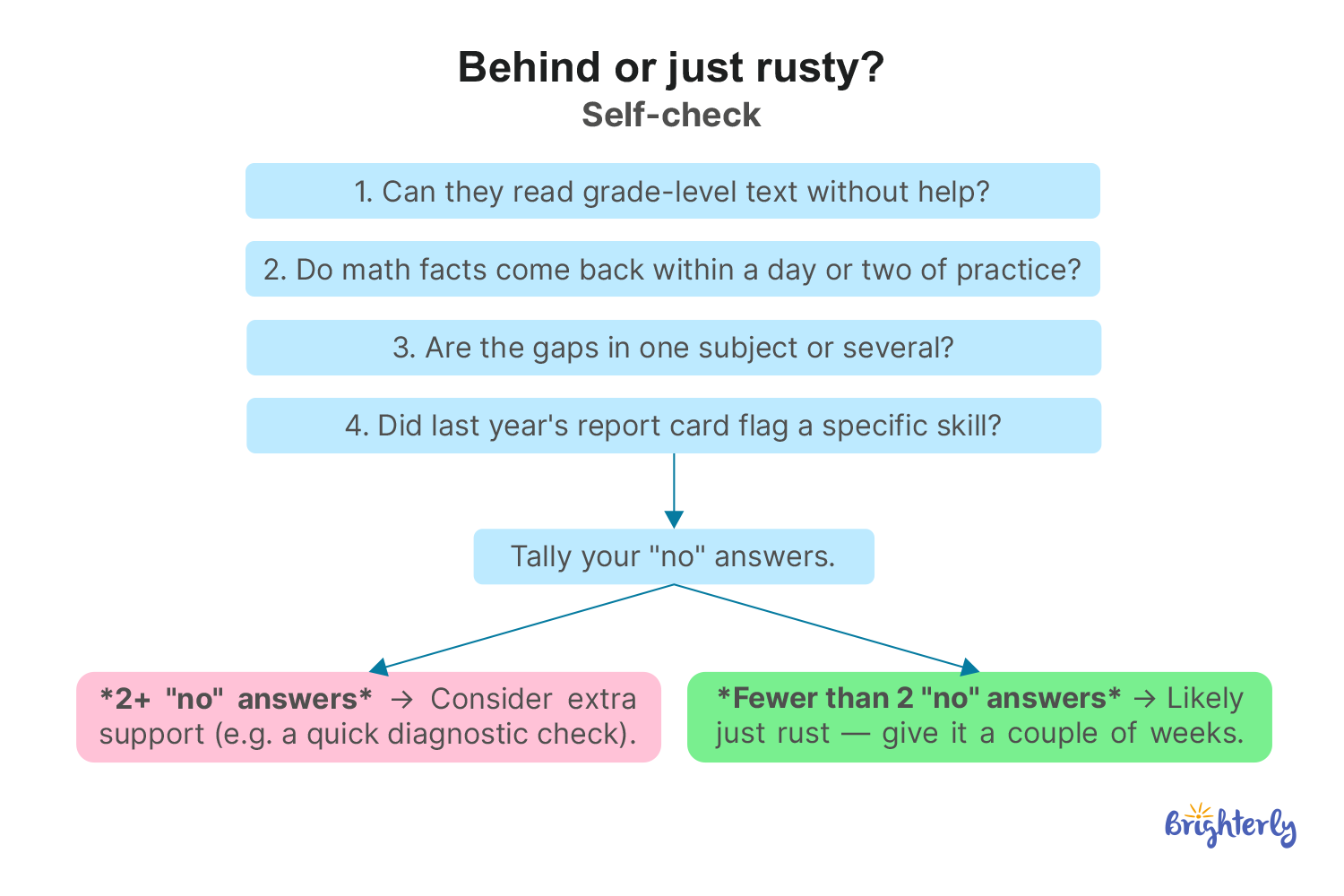
#1: Is My Child Behind After Summer, or Just Rusty?


NWEA April 2026 article shows that children can lose from 10% to 30% of their math knowledge through the summer months. Also, see our summer slide statistics guide for the full breakdown by subject and grade.
Claire’s answer adds more insight to both NWEA and our articles — although summer rust and a real knowledge gap can look the same in week one, the difference between the two starts showing over time. If a child has not regained the skill by week four of school, despite repeated review, the problem is most likely bigger than just rust.
One of the most useful back-to-school tips for parents who want to understand whether their child is just rusty or dealing with a learning gap is to start with a quick free diagnostic math or reading test.
Recover skills with professional tutoring help
Tutors help kids get back the exact knowledge and skills lost during summer.


Key insights:
- Knowledge and skills that improve/recover with normal repetition usually point to a child being rusty after the summer rather than a real gap
- If a child doesn’t regain skills lost during the summer in the first four weeks of school, it could mean a knowledge gap that requires more effort to fill
- A short diagnostic check can help confirm a knowledge/skill gap, if any.
Explore Brighterly Learning Experience
Learn exactly how Brighterly helps students thrive through expert sessions, online tools, and proven feedback from thousands of satisfied parents
#2: How Long Should Parents Wait Before Stepping In?
“Give it three or four weeks of real school routine before drawing conclusions, and watch the direction rather than the calendar.”
There’s no single research consensus on exactly how long a parent should wait before suspecting a knowledge gap and stepping in. Claire’s back-to-school advice for parents here is not to draw conclusions too early and give a child 3-4 weeks to regain knowledge and skills.
However, Claire also points out that the cost of waiting isn’t the same across subjects — in math, for example, a lost skill will simply prevent a child from learning further, since each subsequent topic and concept is tied to the previous ones.
Before drawing any conclusions on whether you need to step in, Claire advises seeking the opinion of the child’s teacher.
Claire also suggests that, if a child is experiencing math struggles, it’s best not to wait for weeks or months and get extra help, which could be a math tutor who will identify the gap and help fill it.
Key insights:
- Don’t draw conclusions too fast — give a child 2–4 weeks to get back into the school routine and regain knowledge
- If a child is plateauing in week four of school, especially in math, it’s worth acting on
- Tutoring is one of the effective solutions to fill a math gap
- Get a teacher’s opinion before deciding whether you need to step in.
#3: When Is a Diagnostic Assessment Actually Useful?
Claire explains that a diagnostic test gives a useful insight that a report card can’t provide — bad grades in a report card may show there’s a problem but won’t tell you what it actually is.
A diagnostic test helps identify where exactly a child is struggling when neither you nor the child can see it.
Key insights:
- Grades don’t show what specific skills or knowledge a child is missing
- A diagnostic assessment is useful when there is a clear struggle but you can’t identify what’s causing it
#4: How Much Should Parents Get Involved in Their Child’s Homework?
Homework is one of the biggest aspects of figuring out how to prepare for a back-to-school routine for parents.
According to our homework statistics review, the learning impact of homework isn’t constant across grades — it’s the lowest in elementary school and grows bigger in middle and high school. Claire adds to this data by clarifying that homework is just what teachers use to see what knowledge a child has “consumed” and which not.
Claire advises parents to be involved in their child’s homework by creating an environment where a child can do homework comfortably, rather than providing answers and doing the tasks for a child.
December 2025 NWEA article supports Claire’s point on the importance of creating conditions by claiming that homework works best for family engagement when it’s low-stress. The same NWEA article also mentions that homework should be tied to what’s already happening in class — it shouldn’t be a re-teaching session.
If homework is becoming a daily struggle, Claire suggests consulting the child’s teacher first to see whether the issue runs deeper than just homework assignments.
Key insights:
- Parental involvement in homework should come down to creating conditions for homework instead of just providing correct answers.
- Homework’s academic impact increases with grade level — elementary homework carries less weight than middle and high school homework.
- A constant homework-related struggle is a sign to talk to the child’s teacher.
#5: What Should Parents Do When a Child Says “I Don’t Understand This”?
“Ask them to show you exactly where it stopped making sense.”
When children going back to school and don’t understand something, Claire recommends asking a child to explain what exactly doesn’t make sense to them rather than trying to re-explain the concept or topic again.
The questions can revolve around what a child has already tried or whether a method that worked before might apply here. And if a child is stuck, give them time by stepping away instead of trying to push them to understand something immediately.
Claire also alerts parents not to say things like, “I was never good at math either” — a child may see it as permission to quit trying rather than your support.
If you see your child struggling to understand something, you can try using math worksheets and reading worksheets as a low-pressure way to reinforce a specific skill or knowledge without it feeling like homework.
Key insights:
- Digging into where exactly a child stopped understanding something is a better tactic than just repeating the original explanation
- Letting a child take their time understanding something is part of the learning process — don’t try to rush a kid
- When a child is stuck, a short study break is more helpful than continued pressure
- Comments about your own struggles with the same subject can do more harm than comfort a child.
Supporting a stuck child with tutoring
Private tutors provide professional guidance and address a child's needs.
#6: When Should Parents Contact the Teacher?
“Sooner rather than later.”
Our own research on problems in US schools found that 44.66% of parents believe teachers are usually either overwhelmed or under-resourced to teach kids effectively, which explains why some parents may postpone talking to their child’s educator.
Claire advises not to delay the teacher’s help going back to school. The sooner you contact the teacher, the easier it will be for them to intervene and provide clarity on what’s going on and how to help a child.
Claire also mentions that when you’re deciding whether it’s time to contact a teacher regarding a child’s back-to-school struggles/anxiety, pay attention to negative changes in the child’s behavior and physical state rather than the grades — these changes typically appear much earlier than their effects are shown on math or ELA report cards.
Key insights:
- Contacting a teacher early, when the material is still fresh, gives them more room to help a child
- Negative changes in a child’s behavior or physical state (dread, avoidance, stomachache) can be a sign of back-to-school struggles that need extra attention
- Contacting a child’s teacher isn’t an escalation of a problem but an information exchange that can result in effective actions that help a child go back to school and get back on track.
#7: What Should Parents Actually Ask the Teacher?
“Ask for specifics, not impressions. And then listen.”
Our research on problems in US schools found that the majority of parents (67.19%) believe that their child’s school program moves on too fast, not giving kids enough time to fully comprehend the basics. To identify where your child is lagging behind, including during back-to-school time, you need to ask specific questions, which is what Claire advises.
Possible questions back-to-school parents can ask a teacher:
- Where is he/she relative to where you would expect them to be at the start of this year?
- Is this a skill gap, or is it a stamina and attention issue?
- Are you seeing anything in class that I may not be seeing at home?
When you ask the questions, listen to what the teacher has to say — remember that they want to help.
Key insights:
- Specific questions will get you more useful answers than a general, “How is my child doing?“
- A skill gap and a stamina or attention issue call for different responses — it’s worth asking a teacher which one a teacher thinks is causing the child’s struggles
- Comparing what you’ve already tried with what a teacher has tried helps avoid wasted effort on both sides.
#8: Why Can Older Children Seem Less Engaged With School Than They Were When They Were Younger?
“Disengagement is usually protective.”
A Gallup October 2018 research found that while roughly three-quarters of 5th-graders report being engaged with school, only one-third of students feel the same in high school.
More recent August 2025 Gallup research found that even though classroom engagement among middle and high schoolers has reached record levels, engagement among middle schoolers is still historically higher than in high schoolers.
While these Gallup findings show that it’s common for kids to become less engaged with school as they get older, Claire explains that disengagement can also be one of the signs that a child is struggling in school — it may feel safer to pretend not to care than to admit they can’t keep up.
Key insights:
- A child looking like they don’t care about school could mean that they just can’t keep up.
- Disengagement can appear when a knowledge gap has quietly built up over time.
#9: How Much Should This Year’s Plan Depend on Last Year?
Claire advises that this year’s plan to help going back to school should depend on patterns rather than on a single task, grade, or temporary rough patch. If a pattern from last year resurfaces, it’s worth acting on and including it in this year’s plan.
You can use our guide to SMART goals and back-to-school math activities as useful starting points for turning a pattern into a specific plan.
Key insights:
- Rely on repeated patterns from last year to create this year’s plan
- Don’t see one test or assignment as a major factor to rely on when creating this year’s plan.
Conclusion
Looking at Claire’s answers as a back-to-school parents guide, the overall conclusion is that the earliest and most useful signals a child is struggling going back to school are rarely the grades — they’re time, behaviors and patterns. To help a child, it’s important not to push them and provide them with the support and guidance they need.


Most states in the US still have no clear guidance on the use of AI in US schools, including on what counts as cheating, how AI should be used as part of learning support, or how a student can defend themselves if they’re wrongly accused. See how the AI use policies vary in different states […]

Aug 20, 2026

The best online writing classes for kids in 2026 include Brighterly, Outschool, WriteShop, Brave Writer, Essentials in Writing, Athena’s Advanced Academy, Writing Wonders, and 826 Digital. They range from personalized 1:1 tutoring to live group classes and self-paced curricula, giving families options for different ages, writing goals, schedules, and budgets. Top Online Writing Courses for […]

Aug 23, 2026
Math & reading from 1st to 12th grade
Looking for homework support for your child?

Choose kid's grade

Math & Reading for Grades 1–12
Build real confidence for your child with a Brighterly math or reading tutor.