Back-to-School Math Activities for Kids, by Grade (K–12)
reviewed by Jessica Kaminski
Updated on October 16, 2026
Key Points:
- Back-to-school math activities can help your child to shake off summer slide and review important math skills before the school year begins
- Short, hands-on review can help you spot math gaps early, especially if your child avoids certain topics or loses confidence quickly
- Preschoolers need counting and shape play, while middle and high school students benefit from real-world problem-solving activities
Back to school math activities are simple yet effective and hands-on games and challenges you can use to prepare your kid for the school year, while also keeping them relaxed. Long summer break leaves math gaps, and these activities can help your kid fill them, while also keeping it light and fun enough so they can enjoy their last days of summer.
Read on for 25+ activities organized by grade level and free printable worksheets to jump right into learning.
Along with math review, a few practical back-to-school advice can help your child ease back into their school routine.
Back-to-School Math Activities for Preschoolers
At this age, math is about playing and the senses. These kindergarten math activities add counting, shapes, and comparison into what your child already loves, and don’t feel like math review at all.
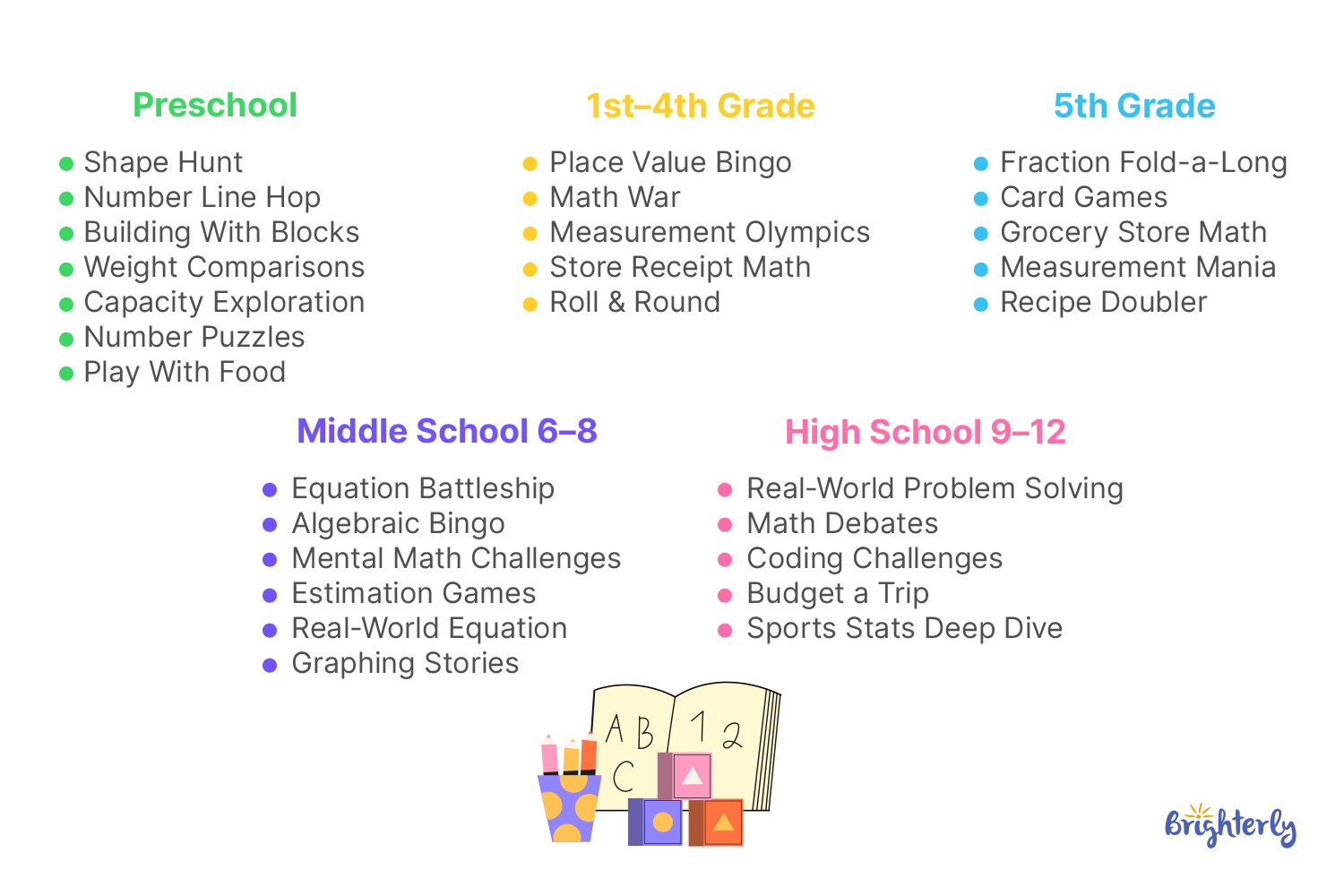
Shape Hunt
Ask your child to look around the house for familiar shapes and name them once they do. They might find a circle on a plate, a rectangle on a book, a triangle on a roof, or an oval on a rug. You can also give them simple challenges like finding three circles or something movable that’s shaped like a square.
Number Line Hop
Draw or tape a simple number line on the floor or driveway. Call out numbers and ask your kid to jump to. Once they feel comfortable, add small challenges, like asking them to jump to 4, then hop 2 more (or fewer) spaces.
Building With Blocks
Playing with blocks is a great back to school math activity. To play, give your kid blocks, LEGO, cups, or boxes, and ask them to build a tower, a bridge, or something else. Then ask them how many blocks they used, which tower is taller, which shapes they see, or if they notice any patterns.
Weight Comparisons
Choose a few safe household objects, such as a spoon, a toy car, an apple, a book, or a stuffed animal. Let your kid hold any two objects, say which one is heavier, then check on a kitchen scale. Ask them to do this for all the objects, and arrange them, using words like heavier, lighter, same, more, and less to build a comparison language.
Capacity Exploration
Another one in the list of back to school math activities for preschoolers is capacity exploration. Give your child cups, bowls, spoons, and containers during water play time. Ask them to fill, pour, and empty the containers into each other, and compare what they see. Simple questions like which cup holds more and how many small cups fill the big one will introduce measurement naturally, without a formal lesson.
Number Puzzles
Number puzzles are some of the most versatile fun math activities for your child you can go with. You can start with a matching game. Write numbers 1-10 on cards and mix them up. Ask your child to put them back in order. You can also remove one number and ask your child which one is missing. Or, you can ask them to match the numbers with the cards with pictures of objects (e.g., match the card for number 5 with an image of five buttons).
Play With Food
This is one of the more hands-on activities you can use to help your kid with math practice. Snack time can also become a quick math review time. Ask your child to count crackers, sort berries by color, divide apple slices into two small groups, or make a simple pattern with cereal pieces. Playing with food can turn abstract numbers into something concrete, while also keeping it light and playful.
Start the school year strong!
Help your kid rebuild math confidence with personalized online math lessons.
Explore Brighterly Learning Experience
Learn exactly how Brighterly helps students thrive through expert sessions, online tools, and proven feedback from thousands of satisfied parents
Math Activities for 1st-4th Grade
The elementary years are when your child develops the core numerical skills they’ll need for later years. The math back to school activities you choose at this stage need to reflect that.
Place Value Bingo
Create bingo cards with numbers instead of regular bingo spaces. Call out numbers by their place value (like “four tens and two ones”). Your child needs to mark the matching number on a bingo card. Finding the right matches will help them review ones, tens, hundreds, and place value before the school year begins, while also not feeling like a drill.
Math War
Use a regular deck of cards to play a math version of War. Each player flips two cards, then adds, subtracts, or multiplies them, changing the operation each round. The player with the higher answer keeps the cards. For example, if your kid flips 6 and 4, they might say 6 + 4 = 10 or 6 × 4 = 24. The game doesn’t feel like a worksheet, but functions like one by giving your kid enough drills to build arithmetic fluency.
Measurement Olympics
Set up a few playful measurement challenges around the house or outside. This can be long jumps, a paper-plane throw, or anything else that involves measuring a distance. Your child can measure how far they jump or how far the paper plane flew with a tape measure, or count how many steps it takes them to cross the yard. Measurement Olympics is great for helping them build measurement and estimation skills.
Store Receipt Math
Save a real grocery receipt and turn it into a short math review. Ask your child to choose two or three items, add their prices, estimate the total, or compare which item costs more. For older elementary students, you can also practice rounding prices to the nearest dollar. For example, $3.79 becomes about $4, and $2.20 becomes about $2. If your kid is even older, ask them to work out what percentage each item is of the total. This is a great option for quick back to school math activities for 3rd grade.
Roll & Round
Roll two or three dice to build a number, then have your child round it to the nearest ten or hundred. For example, if they roll 3, 8, and 2, they can make 382 and round it to 380 or 400. Roll & Round is a quick, repeatable game that can turn rounding into a habit. You can add one more die and round to the nearest thousand for a tougher version, or make a points version to make it more game-like.
Note: If you notice that your child struggles with early grade-level concepts or loses confidence quickly, an elementary math tutor can help them target and rebuild the exact skills they need. You can also add printable practice, among which are 3rd grade math worksheets, when your child needs extra review between activities.
Fun Math Activities for 5th Grade
Fifth grade leans heavily on fractions, decimals, and multi-step problems. The activities below can give these tricky and abstract skills some real-life context and make them easier to grasp overall.
Fraction Fold-a-Long
Give your child a sheet of paper and ask them to fold it into halves, fourths, eighths, or thirds. Physically folding the paper makes the abstract concept of fractions more visual. Then, have them label each section, compare sizes, and line up different folds side by side. They’ll notice that, say, 1/2 equals 2/4.
Card Games
At this age, too, a deck of cards is a great way to help your child with math practice before the school year kicks in. You can use cards to create quick multiplication, fraction, or comparison games. For example, for multiplication review, each player flips two cards and multiplies them. You can also add a little friendly competition, like a scoreboard, to keep the practice engaging.
Grocery Store Math
Turn a grocery trip into an easy weekly math review during the summer break. Give your kid the shopping list and the budget. They need to compare prices, estimate the total, calculate discounts, or decide which product offers better value for their budget, so they can buy everything on the list with the amount they have. Guide them with questions, like how much would you save with a 20% discount?
Measurement Mania
Have your child measure rooms, ingredients, or distances and convert between units. Converting inches to feet, or other measurements, is a skill that can fade over the seemingly endless summer vacation. To practice it for the first day of school, have your kid measure rooms, the perimeter of the desk, or the area of the rug. To make it more challenging, you can ask them to estimate first and measure second.
Recipe Doubler
For this one, pick a favorite recipe and ask your child to double or halve it, adjusting all quantities. Doubling the recipe is a great fraction and multiplication practice, where the payoff is both visible and delicious. Ask them to triple it and compare the totals.
Back-to-School Math Games for Middle School (Grades 6-8)
Back to school math activities middle school students will enjoy should be more grown-up than the ones for elementary kids, but still be low-pressure, as your kid is still on a summer break.
Equation Battleship
This is a math take on the classic coordinate-grid game. Draw a simple grid, place “ships” secretly on different coordinates, and ask your child to solve equations to earn guesses. For example, you might give an equation like x + 4 = 9. If your child solves x = 5, they can use 5 as part of their coordinate guess. Equation Battleship reviews equations, coordinate planes, and logical thinking at the same time.
Algebraic Bingo
Create bingo cards with answers such as 3, -2, 12, or x = 5. Then call out simple algebraic expressions or equations that match those answers. Kids love games, and this way, solving for x becomes a race rather than a chore. If your child is playing with a friend, they can even write the equations for one another to make the game even more challenging.
Mental Math Challenges
For this one, you need to set up short daily timers for quick mental math. Choose a short challenge beforehand. The goal here is not to pressure your kid, but to help them rebuild the calculation speed they may have lost during summer. You can try prompts like:
- double 36
- find 10% of 80
- add 25 + 37
- multiply 12 × 6
- divide 144 by 12
Estimation Games
Estimation is an important middle school math skill. It also sharpens number sense and reasoning. Ask them to estimate the total cost of a shopping bag, the number of jellybeans in a jar, or how many minutes they need to finish a task, then check the real answer. Encourage them to talk through the strategy behind each guess.
Real-World Equation
Turn everyday situations, like phone-plan costs, saving for a purchase, or splitting a bill, into equations. Here are a couple of examples:
- A taxi charges a $5 starting fee plus $2 per mile. If the ride costs $21, how many miles did you travel? Your equation is 5 + 2m = 21.
- A streaming service costs $12 per month. If the total after several months is $84, how many months were paid for? The equation is12m = 84
- A rectangle has a width of 6 cm and a perimeter of 40 cm. What is its length? The equation is 2l + 2(6) = 40.
These examples can show your kid that equations describe real patterns.
Graphing Stories
Give your child a short story and ask them to sketch a graph that matches it. For example: “A person walks slowly, stops for two minutes, then runs home.” Your child can draw a line that rises slowly, stays flat, then rises more steeply. They will learn to connect graphs with movement and change.
If your kid needs a steadier hand or more help to close the gaps from the previous school year, middle school math tutors can be a great help. They’ll review tricky topics one by one, understand where your kid needs help, and provide them with materials like 6th grade math worksheets, which offer structured practice.
Review smarter, not harder.
Learn how Brighterly math tutors build a plan around your child’s math gaps.
Back-to-School Math Activities for Geometry
When planning for back-to-school activities, don’t forget geometry. They should help your kid review shapes, angles, symmetry, area, and spatial reasoning before the school year begins.
Shape Scavenger Hunt
Ask your child to find geometric shapes around the house, neighborhood, or park. They might spot rectangles in windows, circles on wheels, triangles on rooflines, or cylinders in cans and bottles. Ask them to record each object and label the shape. Older kids can add extra details, such as the number of sides, vertices, parallel lines, or right angles.
Geometry Bingo
Use bingo cards filled with shapes, angles, and terms, and call out definitions for kids to match. Bingo cards are a painless way to review geometry vocabulary before they go back to school. Include real-world examples on the cards, not just the names.
Angle Estimation
Choose angles around the house or outdoors and ask your child to estimate whether each one is acute, right, obtuse, or straight. Doorways, book corners, laptop screens, clock hands, and open drawers all work well. Then, use a protractor or a right-angle object to check their answers.
Art Therapy
Combine geometry with creativity during an art session to lower pressure and deepen understanding. For this, your child needs to create a design using only certain shapes, such as triangles and circles, or to build a repeating pattern with lines and angles. Afterward, ask them to label the shapes or identify parallel lines or different angle types.
Symmetry Nature Walk
On a walk, hunt for symmetry in leaves, flowers, and buildings, and talk about lines of symmetry. Once you start looking, nature is full of geometry, and this is a great way to show it to your kid. You can also take photos of the best finds and sort them by type of symmetry.
Back-to-School Math Activities for High Schoolers
For high school students, relevance is everything. So, back to school math activities for high schoolers should consist of algebra, statistics, and logic about money, sports, travel, and other things teens care about.
Real-World Problem Solving
Give your teen a real situation and ask them to solve it with math. The situation can come from money, travel, sports, food, technology, or school planning.
For example, they might calculate the total cost of a subscription over one year, the cost per serving of a homemade meal, or the speed needed to arrive somewhere on time. They also need to explain their calculations.
Math Debates
Pose a question with more than one defensible answer and have the student argue their reasoning. For example, give them a specific situation, and ask them if it’s better to buy the house or rent it. Explaining and defending math builds genuine understanding.
Coding Challenges
With simple coding projects, your kid can apply high school math to something they are interested in. They can create a simple tip calculator, simulate rolling a die, or write a program that calculates sales tax. Start with a free block-based platform if they’re new to it.
Budget a Trip
Ask your teen to plan a realistic trip within a set budget. They can choose the destination, transportation, hotel, meals, activities, and spending money.
Give them a clear limit, such as $2000, and ask them to stay within it. To make the activity more challenging, add a discount, exchange rate, or unexpected costs.
Sports Stats Deep Dive
If your teen plays a sport, you can use player or team statistics to review math. Ask them to choose an athlete, team, or season and analyze the numbers. They can analyze averages, percentages, trends, ratios of wins to losses, and whatever they find interesting.
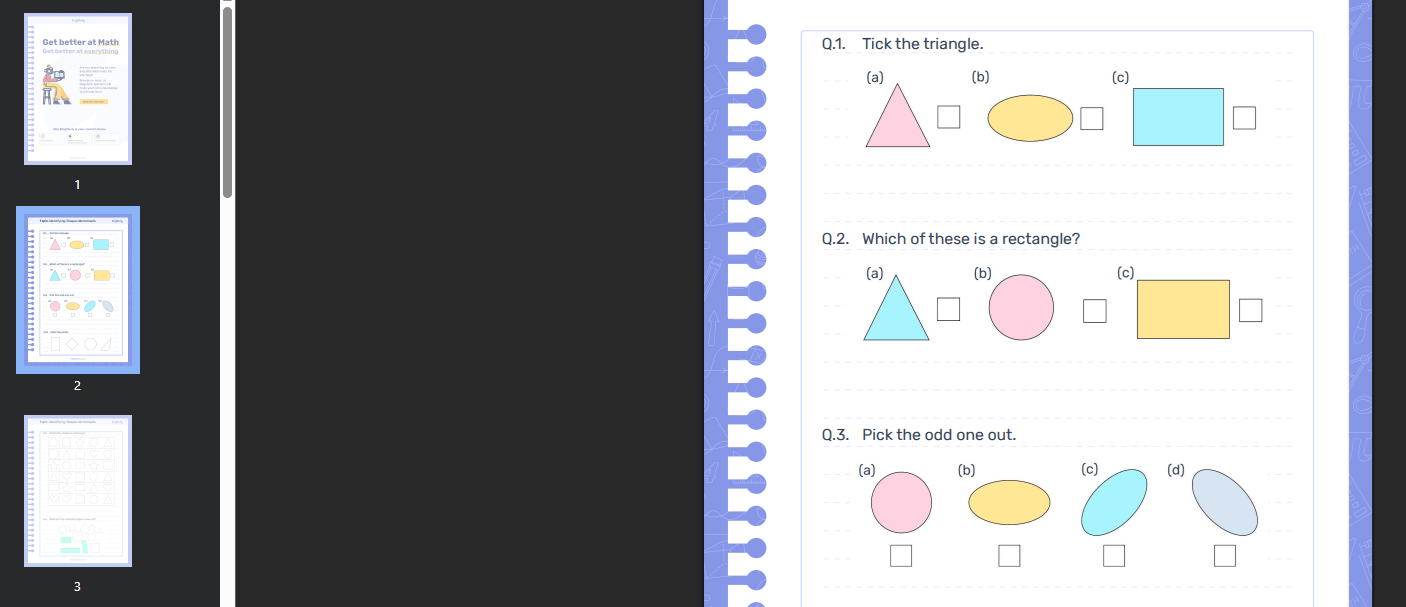
Free Printable Back-to-School Math Worksheets
Games are great for review, but sometimes, your child may need more structure. This is when you can turn to back-to-school math worksheets for some quick, effective, and structured practice. These free math worksheets offer targeted practice by grade, offering addition and subtraction warm-ups for younger children, place value and fractions for the middle grades, and algebra review for older students.
Why Back-to-School Math Activities Matter?
Back-to-school math activities matter because they help children restart math before the first day of school feels stressful. And also because math skills fade without use. NWEA 2024 research on summer learning loss finds that students can lose some of their school-year gains over the break, with math taking a harder hit than reading. More specifically, according to the same research, children who took summer math courses had higher test scores by 0.02-0.03 SD. A few weeks of light review helps your children to walk into the classroom ready, with much lower risk of falling behind or developing different math anxiety.
How to Tell If Your Child Has a Math Gap Before School Starts?
If you are unsure whether your child needs a review, watch for some signs. If you notice that your kid
- Avoids math when you try to bring up practice, or avoids certain topics
- Can give the correct answer, but cannot explain their thinking
- They understand the examples, but struggle independently
- Their test grades from the previous year are showing a steady decline (doesn’t have to be a dramatic decline)
If several of these sound familiar, your kid might have a gap that needs addressing. Focus the activities and the worksheets on those specific skills.
If you notice these problems in other subjects too, they may be signs that your child is struggling in school rather than dealing with a math gap alone.
How Brighterly Supports Back-to-School Math Review?
Back-to-school math review works best when it matches your child’s actual needs. Some kids only need a few playful activities and printable worksheets. Others need more guided support for various reasons.
At Brighterly, your child works one-to-one with a math tutor who starts with a diagnostic test to pinpoint exactly where the gaps are, then builds a plan around them. Our lessons are online, curriculum-aligned, and customized specifically to what your kid needs. The tutor will also adjust each class to your kid’s pace. For us, it’s important that the review and the learning process feel supportive rather than stressful and rushed.
The goal is not to overload your child before school begins. It is to help them feel ready, capable, and less anxious when math lessons start again.
Note: Brighterly can provide homeschooling options, after-school support, or homework help, according to your needs.
Frequently Asked Questions
What Are Good Back-to-School Math Activities to Do at Home Before School Starts?
The best activities are hands-on and use everyday items. These are counting games for little kids, card games and grocery math for elementary, and real-world budgeting or sports stats for teens. Match the activity to your child’s grade and keep sessions short. The best activity is the one you can do regularly.
My Child Doesn’t Want to Do Math Over Break — How Do I Get Them to Engage?
Make it playful and tie it to something they already like, like food, sports, games, or money. Keep sessions to 15-20 minutes, celebrate small wins, and keep it playful. Pressure won’t keep kids engaged. You need to understand what interests your kid.
The same approach can make the overall transition easier — these back-to-school tips can help your child get back into a school routine without adding extra pressure.
Are There Free Printable Back-to-School Math Worksheets?
Yes. We offer hundreds of different free worksheets that cover every grade, starting from addition and place value to fractions and algebra, as well as many other K-12 math topics. You can print the worksheets at home for a quick review.
What Back-to-School Math Activities Work Best for Preschoolers vs. Teens?
Preschoolers do best with sensory, play-based activities like shape hunts and counting snacks. Teens engage more with real-world challenges, like budgeting a trip, analyzing sports stats, or simple coding. These activities for teens are challenging enough and also target what they are interested in.
How Can I Tell if My Child Has a Math Gap Before the New School Year Begins?
To understand if they have a gap, watch for avoidance, guessing, or trouble explaining their answers. You can also do a short diagnostic test at home and review their last year’s report card. This can help you pinpoint specific skills you need to target.
How Long Should a Back-to-School Math Activity Take?
Short and regular practice beats occasional long sessions. Also, your kid is still on summer break. Aim for 15-20 minutes of light practice a few times a week. This will be enough to keep their skills warm.
Conclusion
Back-to-school math activities are crucial for your child. These easy games help them get used to the study routine without the boredom of school life. Those activities will also make your child more curious and confident. Later, they will use this confidence to become the best version of themselves.
Do you want to be sure that your child starts a new school season with boosted confidence? Book a free tutoring session with Brighterly today. Our tutors will create a customized learning plan to help your child thrive!


Whether your child needs extra math support or you’re looking to switch careers, online learning platforms can make it happen. This guide describes 20+ digital spaces to improve your skills and knowledge, comparing their pros and cons, prices, and learning focus so you can choose the best for yourself or your kid. Apart from the […]
Aug 19, 2024
To succeed in math, students should steadily build on their knowledge of math concepts. Inevitably, one-to-one correspondence is that skill that creates the ground for mastering counting and number sense. In this article, we explain what it is, provide the best one-to-one correspondence activities, and show why you and your child should take time to […]

Aug 21, 2024
Math & reading from 1st to 12th grade
Looking for homework support for your child?
Choose kid's grade

Math & Reading for Grades 1–12
Build real confidence for your child with a Brighterly math or reading tutor.