Back-to-School Anxiety: What It Is and How to Help Your Child Feel Ready
reviewed by Esther Daka
Updated on September 2, 2026
Key Points:
- 87% of parents of kids under 18 admit to feeling back-to-school anxiety (Understood, 2023)
- Signs that may point to a child feeling anxiety include sleep or appetite changes, stomachaches, increased clinginess, or resistance to leave the house (Children’s Nebraska, August 2025).
- School-related anxiety is often connected specifically to math — 67% of US teachers name math anxiety as a challenge for their students (EdWeek, 2020)
- If anxiety doesn’t go away in a month or start interfering with the kid’s daily life, it may be a sign to seek help from a pediatrician or licensed mental health professional (Children’s Nebraska, 2025).
If your child is experiencing worry and/or physical unease that appears before the start of a new school year, it could be back-to-school anxiety. If this anxiety is related to math specifically, you can follow the advice from Dr. Aly, the founder of Compassionate Math, mentioned below, or get an online math tutor to help your child feel more relaxed.
What Is Back-to-School Anxiety?
Back-to-school anxiety is the feeling of stress and/or physical unease that appears before the start of a new school year — a common response to the next big step in education.
For example, a child feeling anxiety while anticipating the start of school can ask questions about a new classroom, a new teacher, or whether their school supplies are ready.
Some kids can be more stressed and experience fear of going back to school, which manifests in physical symptoms like mild trouble falling asleep days before school starts or stomachaches.
Parents can feel anxiety too, when their kids are getting ready for school. The Understood 2023 survey found that 87% of parents whose kids are under 18 feel real stress or anxiety during back-to-school season.
Signs to Watch For
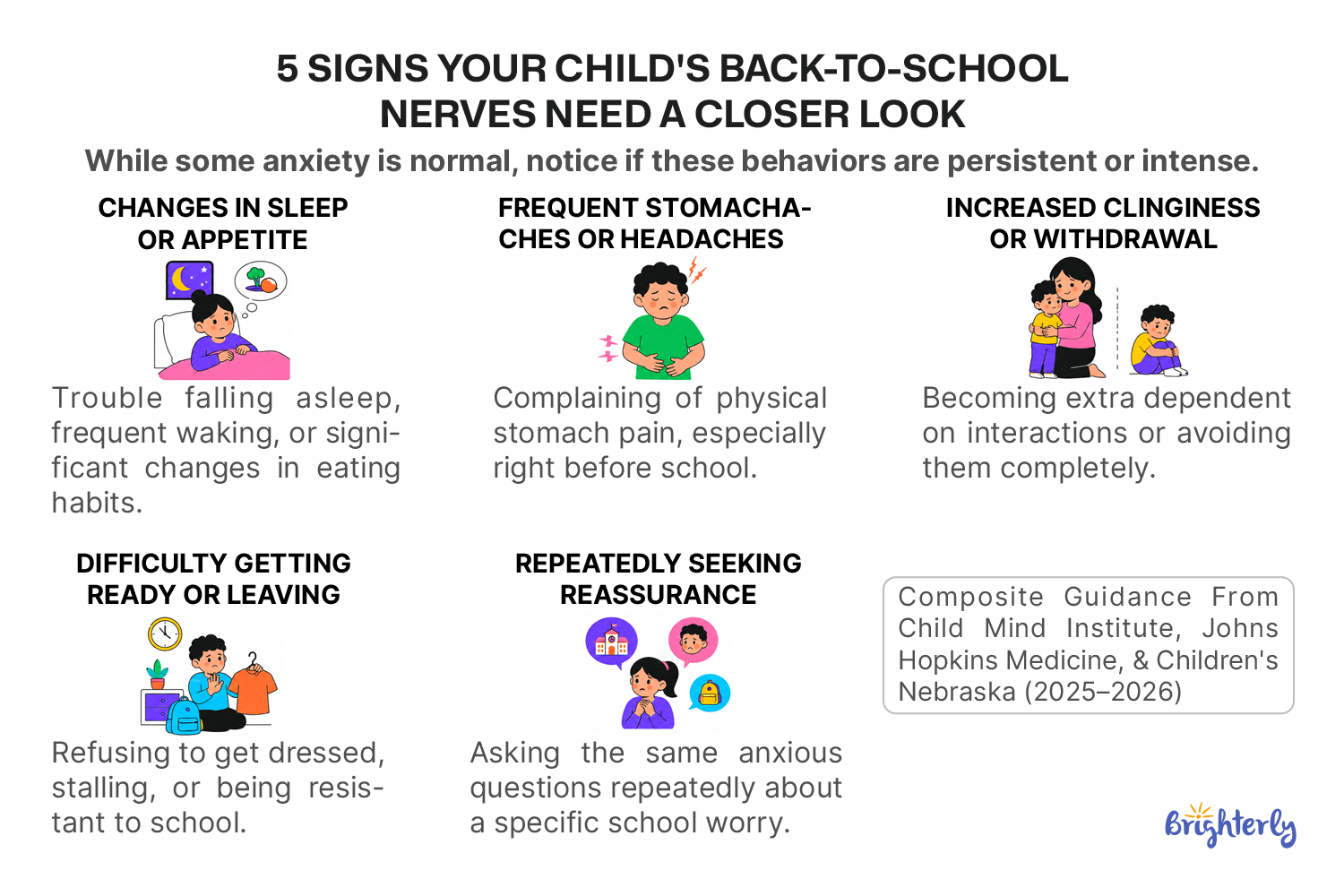
According to Children’s Nebraska’s August 2025 article, the signs a kid is experiencing back-to-school anxiety include:
- Sleep or appetite changes weeks before school starts
- Stomachaches or headaches specifically on school mornings
- Increased clinginess, withdrawal, or irritability
- Reluctance or refusal to get ready or leave the house for school
- Repeatedly seeking reassurance about the same school-related worry
*Even if a child doesn’t show any of these signs, they may simply admit, “I’m scared to go back to school” — it’s important not to ignore this worry if voiced.
Explore Brighterly Learning Experience
Learn exactly how Brighterly helps students thrive through expert sessions, online tools, and proven feedback from thousands of satisfied parents
Why Some Kids (and Parents) Feel It More Than Others
Some kids may feel school-related anxiety more than others if there’s any uncertainty involved, like when a child is going to a new school, transitions to middle or high school, has a new teacher, or experiences separation anxiety. And some parents may feel more anxious than others due to adjustment and logistics.
Apart from that, back-to-school worry can also be related to separation anxiety, especially in younger kids who are used to having a trusted adult nearby. For kindergarten kids, separation anxiety is usually expressed in the form of crying when leaving home or arriving at kindergarten and being left there. For older kids, crying usually changes into stalling.
Note: For parents of younger kids, following a kindergarten readiness checklist can help reduce anxiety.
Why Parents Get Back-to-School Anxiety Too
Back-to-school stress for parents is usually related to worries about how their kid is going to adjust at school and school-related logistics. For example, according to the July 2026 Talker Research survey, 28% of parents feel anxious about how well their kid is going to adjust at school, and 23% feel overwhelmed by logistics. Besides, 40% of parents admitted to putting their own mental health on hold most of the week to prioritize family instead.
Prevent anxiety by preparing for school
Brighterly tutors help kids fill knowledge gaps and feel more confident about school.


How to Help Ease Back-to-School Anxiety
Strategies and tips that explain how to deal with back-to-school anxiety include building a school-like routine before the school starts, doing a test run of the upcoming school experience, listening to the child’s worries before trying to solve anything, and creating an anxiety-coping plan.
Rebuild the Routine Early
The summer daily schedule is usually different from what it is during the school year, and having to shift back to the school routine in one moment can be stressful. To avoid a sudden routine change, an August 2023 article by ADAA suggests limiting screen time and moving bedtime and wake-up time to what they’ll be during school, a few weeks before school actually starts. Johns Hopkins Medicine’s June 2026 article also adds selecting tomorrow’s clothes as part of routine change preparation.
Do a Test Run
Uncertainty can contribute to anxiety, so you can try to eliminate as many unknowns as possible by doing test runs — a tip suggested by a Child Mind Institute expert article. For example, if your child is going to a new school, go there with them beforehand.
Even better if you can have a short chat with the teacher, or see the classroom. You can also practice the before-school morning routine, like setting an alarm, getting ready, and going to the bus stop.
Listen Before You Problem-Solve
Another one of the back-to-school tips from a Child Mind Institute article is to listen to a child’s worries. If your child admits they don’t want to go to school, don’t just reassure them with something like, “You’ll be fine”.
Listen to them and ask what specifically worries or scares them about going to school. Let them voice whatever they feel, even if it doesn’t seem that serious. When your child feels heard and understood, they will receive your help and solutions far more easily.
Build a “Cope-Ahead” Plan Together
The ADAA August 2023 article suggests building a coping plan around what exactly makes your child anxious about going back to school and rehearsing it. For example, if the worry is related to the lunchroom, plan who to sit with beforehand. If the worry is about a tough class, plan what to do when a kid feels stuck.
When It’s Really Math Anxiety
School-related anxiety is not always related to school experience in general. Frequently, the worry is about particular classes, with math being the most mentioned among subjects that can cause stress in kids. When back-to-school nerves are related to math, concentrate on supporting your child by helping them understand how one topic relates to another.
Why Math Anxiety Shows Up as “School” Anxiety
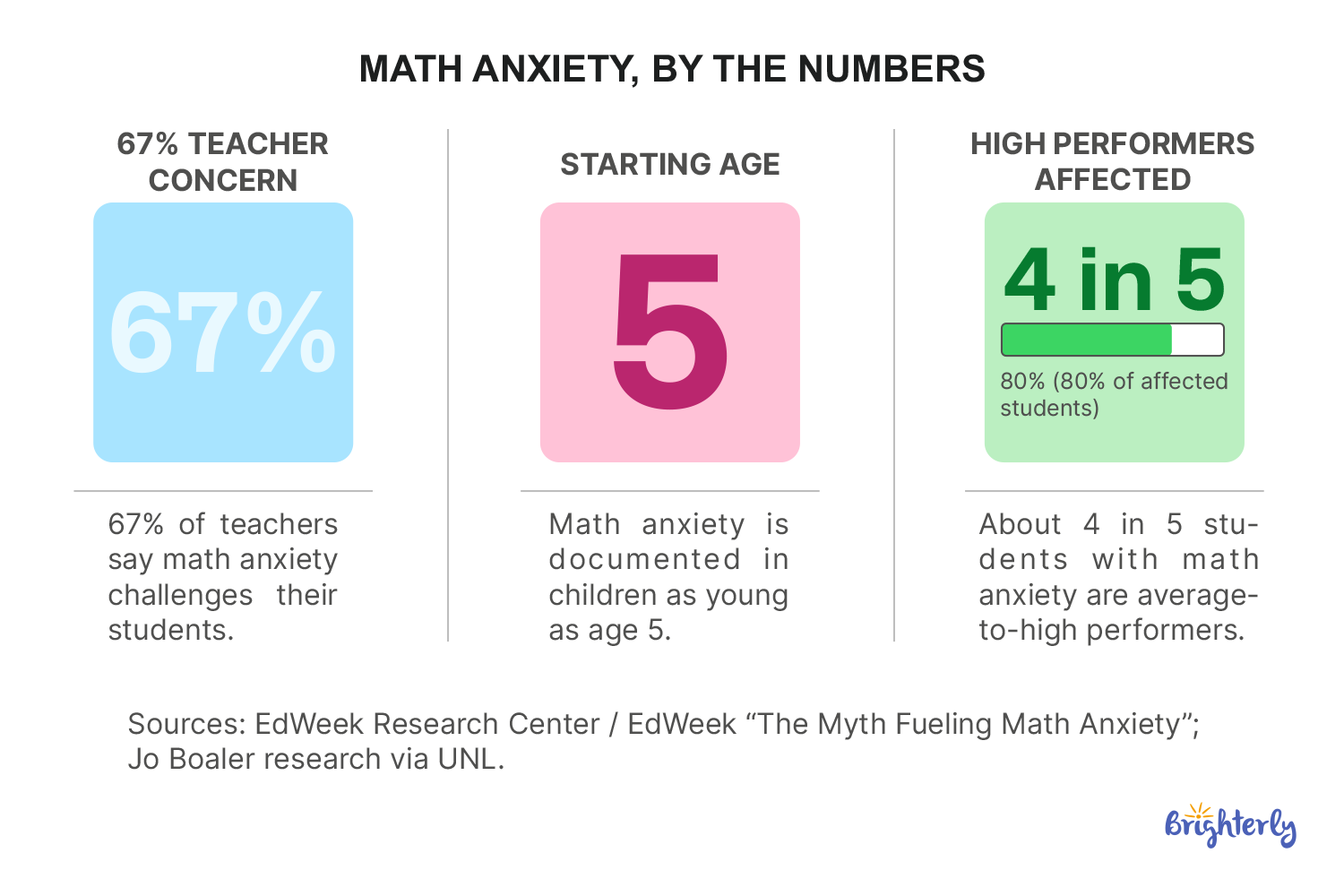
Math anxiety is one of the most documented, subject-specific forms of school anxiety. For example, according to the January 2020 EdWeek report essay, 67% of US teachers say math anxiety is a challenge for their students, and a quarter of teachers admit they feel anxious doing math themselves.
The same EdWeek report states that about 4 in 5 students feeling math anxiety are average-to-high performers, which means that if a kid feels anxious about math, they’re not necessarily bad at it.
The October 2012 article by the University of Nebraska–Lincoln also states that math anxiety isn’t limited to older kids and has been documented in children as young as age 5.
*Both EdWeek and the University of Nebraska–Lincoln data are still relevant as of August 2026, and no newer source contradicts them.
However, school anxiety is not always math-related. Any subject can cause a child to feel stressed, especially if your child is struggling in school or falling behind in a particular subject. In that case, parents can consider getting professional help from a tutor.
For example, at Brighterly, we have one-on-one online math and reading tutors for K-12 students who adjust the program according to the kids’ current knowledge and learning style. Whether in reading or math classes, our curriculum aligns with the US state standards.
For low-pressure practice at home, you can also try back-to-school math activities that help your child review familiar skills before the school year gets into full swing.
What Dr. Aly Recommends
Dr. Aly is the founder of Compassionate Math, a math education professional development and consulting company. When asked how a parent can identify if the back-to-school stress is related to math or any other subject, Dr. Aly recommends asking a child to eliminate one thing that makes them the most anxious:
“Math is wrapped up with so many expectations and challenges that it is possible that a child’s anxiety about math can take over the excitement of starting a new year.”


If the kid is anxious about math and the feeling doesn’t go away in a few weeks, Dr. Aly recommends that the child learn how one math topic relates to another:
“Ask the child to focus on understanding the math, and especially, try to focus on and learn one idea (even if everything else gets lost).”
Dr. Aly also stresses the importance of normalizing math as a skill rather than something that is either given to a child or not:
“One thing parents can do is to normalize that math is a skill that is learned through hard work. ”
In Dr. Aly’s book Compassionate Math: Book One in the Compassionate Math Series, you can find more information on math anxiety in adult learners and also pick up tips on how to support your child’s math learning.
Learn math with a professional educator
Brighterly tutors make math lessons fun and stress-free for the students.
When to Reach Out for Extra Support
Children’s Nebraska August 2025 article suggests that back-to-school anxiety usually eases within the first few weeks, once the child adjusts to the new routine. However, if the stress and anxiety are still intense, worsening, or interfering with daily life after about a month, parents should consider consulting a pediatrician or a licensed mental health professional.
It’s also worth knowing the difference between anxiety and something much deeper — persistent sadness, hopelessness, or a loss of interest in things a child used to enjoy may hint at back-to-school depression rather than just stress. Only a mental health professional can identify the difference and tell if a child is experiencing anxiety or depression.
Conclusion
Back-to-school anxiety is common for both parents and kids to experience before the start of a new school year. Worrying tends to be strongest around uncertainty, like a new school, a new teacher, or a big transition, or relates to a specific subject like math. To help your child with school-related anxiety, you can start rebuilding a school routine early, doing test runs of new situations, listening to your child’s worries before jumping to solutions, and building a coping plan together for specific stressors.
To make sure your child’s anxiety doesn’t stem from struggles with math or reading, you can consider getting them professional tutoring help through a learning platform like Brighterly.
Frequently Asked Questions
Why Do I Feel Scared to Go Back to School Even Though I Want to?
You may feel scared to go back to school even though you want to because although you’re excited about familiar experiences you look forward to, you’re afraid of the unknown, unfamiliar things awaiting in the new school year. This fear usually fades away in a few weeks.
Is It Normal to Still Get Back-to-School Anxiety in High School?
Yes, it’s completely normal to still get back-to-school anxiety in high school — even adult learners in college or university can also experience anxiety when the new academic year approaches. High school students specifically can experience anxiety about a new schedule, classes, or social dynamics, for example.
How Long Does Back-to-School Anxiety Usually Lasts?
Back-to-school anxiety usually diminishes after a few weeks, according to Johns Hopkins Medicine’s June 2026 article. If the anxiety and distress symptoms are still present in a month or worsening, parents should consider the child’s evaluation by a psychologist or psychiatrist.
Can Parents Get Back-to-School Anxiety Too, or is It Just Kids?
Yes, parents can get back-to-school anxiety too. According to Talker Research’s July 2026 survey, even though parents feel excitement for the year ahead, they are still anxious about how the kids will adjust at school and stress over school-related logistics.
How is Normal Back-to-School Worry Different From Something Like Anxiety or Depression that Needs Professional Support?
Normal back-to-school stress and worry are short-term and tend to fade away in a few weeks, while severe anxiety and depression manifest in intense, persistent sadness, hopelessness, and distress that doesn’t stop in weeks or even months and requires professional help.
Is Back-to-School Anxiety More Common Around Certain Subjects, Like Math?
Yes, back-to-school anxiety is often related to certain subjects, math being one of the most documented causes of academic fears. The January 2020 EdWeek report essay states that 67% of US teachers admit math anxiety being a challenge for their students.

Tutoring in elementary grades is an opportunity to provide a struggling kid with professional study help in covering knowledge gaps and supporting the knowledge they already have, while learning even more. You can choose online, in-person, or free community-based tutoring, depending on your kid’s learning style, family budget, learning goals, and needs. What Is Tutoring […]

Aug 14, 2026
Most states in the US still have no clear guidance on the use of AI in US schools, including on what counts as cheating, how AI should be used as part of learning support, or how a student can defend themselves if they’re wrongly accused. See how the AI use policies vary in different states […]

Aug 20, 2026
Math & reading from 1st to 12th grade
Looking for homework support for your child?

Choose kid's grade

Math & Reading for Grades 1–12
Build real confidence for your child with a Brighterly math or reading tutor.