Tutoring for Elementary Students: A Parent’s Guide to Getting Started
reviewed by Rachelle Bencio Yu
Updated on September 16, 2026
Key Points
- Tutoring for elementary students is a form of academic support when a professional educator teaches either one or a small group of kids, usually to cover learning gaps, improve skills, or gain extra knowledge in a particular subject.
- High-impact tutoring can add roughly 3-15 months’ worth of learning gains in math and reading across grade levels (National Student Support Accelerator, Stanford University, 2024).
- Types of tutoring for elementary students include online lessons, in-person sessions, and free tutoring programs.
- A child may need tutoring help if they start getting lower grades, avoid doing homework, or seem to lose confidence in their knowledge and skills.
- The right tutor or tutoring program for an elementary student, such as the Brighterly math and reading program, will match the child’s learning style, schedule, and goals.
Tutoring in elementary grades is an opportunity to provide a struggling kid with professional study help in covering knowledge gaps and supporting the knowledge they already have, while learning even more. You can choose online, in-person, or free community-based tutoring, depending on your kid’s learning style, family budget, learning goals, and needs.
What Is Tutoring for Elementary Students?
Tutoring for elementary students is a way to supplement school education by either giving kids access to more knowledge, skills, and subjects or by helping struggling kids fill knowledge gaps and improve scores. You can get in-person tutors, consider free tutoring programs available locally, or get an online tutor through a personalized learning platform like Brighterly.
Individual learning program for your child
Our private tutors build the program around your kid’s learning style and needs.
Explore Brighterly Learning Experience
Learn exactly how Brighterly helps students thrive through expert sessions, online tools, and proven feedback from thousands of satisfied parents
Why Does Tutoring Help Elementary Students?
Tutoring helps elementary students because professional tutors know how to assess kids’ current knowledge levels and guide them toward progress, regardless of learning style. Besides, tutoring helps build study habits and prevent knowledge gaps from getting bigger, which means a child naturally becomes more confident in their knowledge and skills.
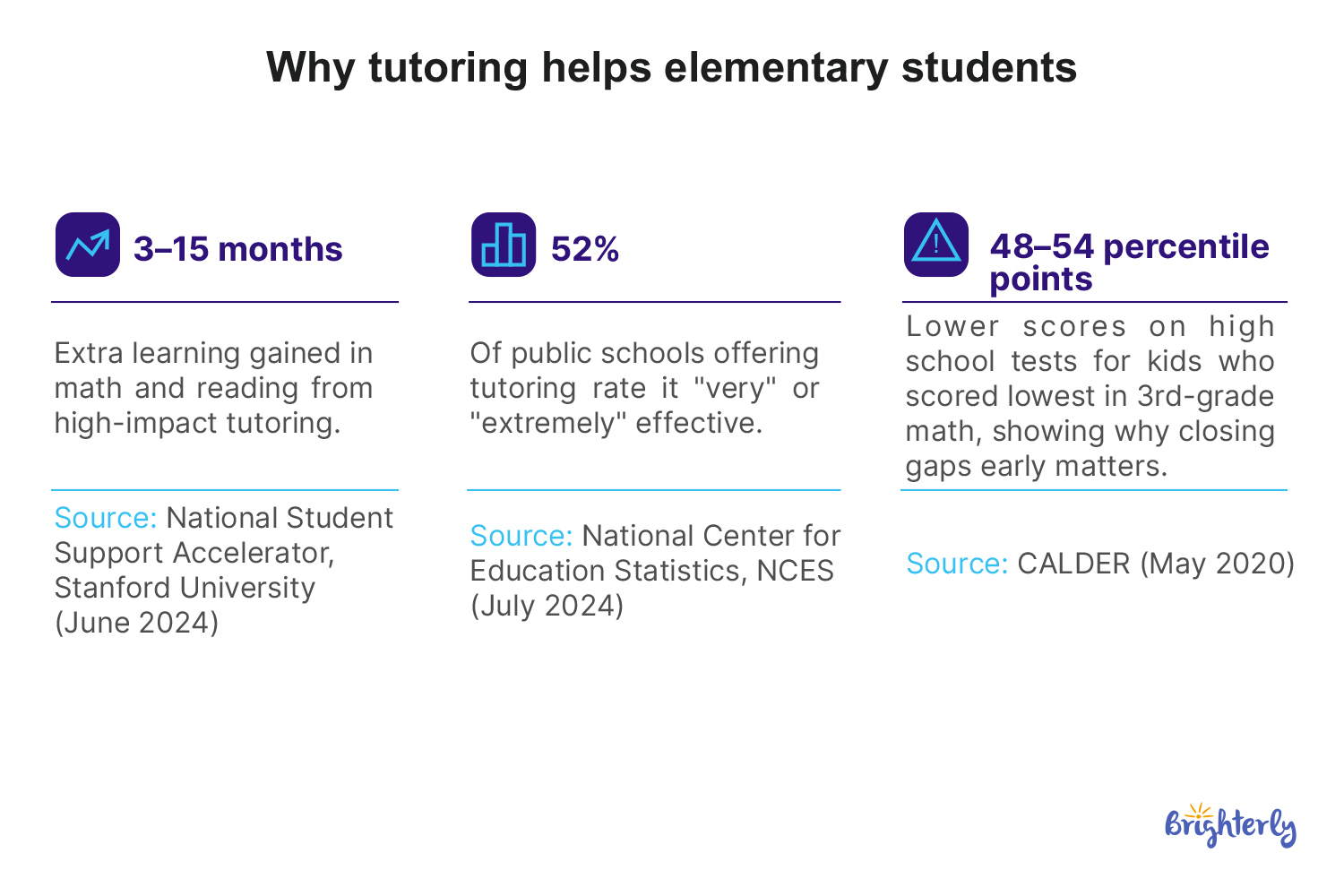
As for specific research data on why tutoring is helpful, the June 2024 brief by the National Student Support Accelerator at Stanford University states that high-impact tutoring can add as much as 3 to 15 months of additional learning in math and reading across grade levels.
NCES July 2024 data also shares insight on how tutoring can help kids by finding that more than half (52%) of public schools that provide tutoring rate it as “very” or “extremely” effective in improving student academic outcomes.
Builds Confidence and Stronger Study Habits
Tutors can help elementary-grade kids build confidence by providing interesting practice materials, explaining complicated concepts through games, and praising the kids’ success to make them feel successful and motivated. Also, tutoring helps set a routine, which means a child builds study habits that will last through their further academic journey.
Supports Different Learning Styles
Unlike the school all-for-one approach, a tutor, especially if it’s private tutoring for elementary students, builds the study program based on the kids’ learning styles. For example, a tutor can adjust to a child’s pace and speed up the program where a child is succeeding, while slowing down on topics where a kid is struggling. Additionally, a tutor can offer audio materials for auditory learners, colorful materials for visual learners, or hands-on materials for kinesthetic learners.
Note: You can learn more about multisensory learning in this guide.
Prevents Small Learning Gaps From Growing
A tutor helps detect and fill learning gaps in elementary grades so that they don’t pile up and negatively affect the kid’s studies further on. Most recent and still relevant CALDER May 2020 research shows why dealing with learning gaps early on is essential by finding that there is a strong and consistent relationship between third-grade scores and a high school outcome — students who score the lowest in math in third grade math also score 48–54 percentile points lower on their high school tests.
Types of Tutoring for Elementary Students
Types of tutoring for elementary grade students include online classes through tutoring websites for elementary students, in-person tutoring and tutoring centers, and free/community tutoring programs that local schools, libraries, or organizations offer. You can choose the type of tutoring that fits you most based on price, location, and goals.
Online Tutoring for Elementary Students
Online tutoring is a way to connect your child to a tutor no matter where you are, with no need to commute. A child can join an online lesson via a video call, usually through a digital tutoring platform. For example, our elementary math tutors or elementary reading tutors teach K-12 students through one-on-one online sessions that a kid can join from their account on the website.
In-Person Tutoring and Tutoring Centers
In-person tutoring for kids usually happens in tutoring centers for elementary students or at home. In both cases, the biggest difference from the online tutoring format is that the educator is physically present in the room. This type of tutoring can be suitable for kinesthetic learners and kids who find it hard to keep focus when the teacher is on the screen.
Free and Community Tutoring Programs
Free tutoring is usually available through the school services, a local library, or a community organization. This tutoring type is worth considering if your child needs occasional learning help rather than constant guidance, since free tutoring for elementary students usually implies classes in small groups rather than personal lessons.
In case your kid is struggling, needs to fill big learning gaps, or is far behind the program, you may need to seek either an online or an in-person private tutor.
What Subjects Do Elementary Tutoring Programs Cover?
Most tutoring programs for elementary students cover the core subjects kids learn at that grade level: math, reading, writing, and science. Besides, such programs teach kids basic learning habits like study skills and organization, which they will need throughout their educational journey.
Math Tutoring for Elementary Students
Math tutors for elementary students usually teach kids foundational number sense, basic arithmetic operations (addition, subtraction, multiplication, division), fractions, decimals, word problems, and introductory geometry — the basics students need to know at this grade level. However, the math tutoring program heavily depends on what math knowledge a child already has.
Note: Our tutors at Brighterly start by offering a child to take a diagnostic math test to determine strong and weak points and build the tutoring program accordingly.
Reading and Writing Tutoring for Elementary Students
Reading tutors for elementary students usually teach kids phonics, decoding, sight words recognition, reading fluency, vocabulary growth, and comprehension skills, while writing tutors usually focus on spelling, grammar, organization of ideas, sentence and paragraph structure, text editing, and story composition.
Science Support for Elementary Students
Science tutors for elementary students usually teach kids three core things: life science, physical science, and Earth science. Life science usually covers topics like plants, animals, habitats, life cycles, and basic food webs. Physical science is about states of matter, energy, light, heat, magnets, and simple forces like gravity. And Earth science covers topics like weather patterns, seasons, and the solar system.
Private math and reading tutors online
We teach foundational math and reading skills based on the kid’s current level.
Signs Your Child Could Benefit From Tutoring Services for Elementary Students
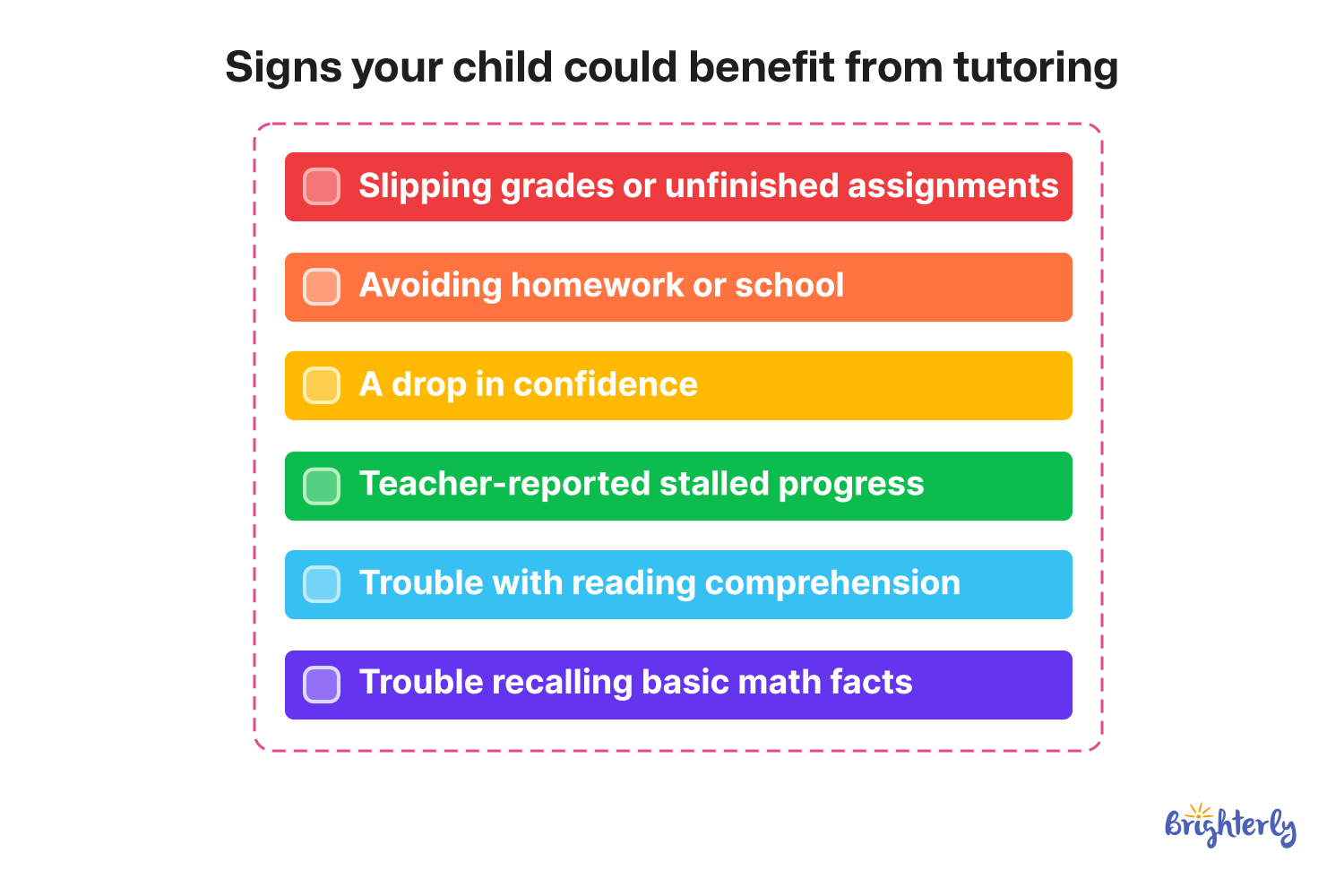
Common signs that your child could benefit from a tutoring service include a teacher reporting a kid’s stalled progress, the child getting lower grades, avoiding homework or complaining about school, losing confidence, losing reading comprehension skills, or having trouble recalling basic math facts that the kid knew a few months or a year ago. Additionally, a teacher reporting a kid’s stalled progress can be a sign to consider tutoring help.
An easy way to spot most of these signs is when your child is doing homework. Brighterly 2026 homework statistics review shows that elementary school kids are burdened with large amounts of homework, which can be hard for them to handle on their own. Pay attention to how your child handles their homework, and if you notice them struggling, consider getting professional tutoring help to ensure the kid is not overwhelmed and doesn’t fall behind.
How to Choose the Right Tutoring Program for Elementary Students
The right tutoring program for an elementary student should match a child’s learning style, schedule, and goals. As for the teacher, look for professional, qualified tutors who have experience in working with elementary students and keep track of your child’s progress to see if tutoring yields any results.
What to Look for in a Tutor
Look for a tutor with experience teaching kids your child’s age — elementary kids need a different approach than middle or high schoolers. Make sure the tutor tracks your child’s progress and shares the results with you. If your child has any learning difficulties, look for a tutor who knows how to work with such kids.
Tutoring Tips for Elementary Students at Home
Tutoring tips for elementary school kids include keeping tutoring sessions short but consistent, joining the first session or two to see how the tutor and child interact, and asking a child what they learned during a lesson afterward — if a kid can explain what they learned, the lesson can be considered successful.
Is Summer Tutoring for Elementary Students Worth It?
Tutoring elementary students in summer is worth it since it targets a specific problem of summer slide — it prevents kids from losing knowledge and skills in between academic years. For example, Brighterly summer slide statistics review shows that math summer loss can equal 10%-30% of lost knowledge, with the biggest loss in elementary grades. Tutoring in summer helps preserve this knowledge and prevent summer slide.
Conclusion
Tutoring for elementary school students works best when it’s built around your child’s learning style and needs. Whether it’s a free program, a tutoring center, or online tutoring, make sure the tutor is qualified to work with elementary students and that your child shows progress.
Frequently Asked Questions
What Age Is Best for a Child to Start Tutoring?
There is no specific age that is considered best for a child to start tutoring — you can get a tutor for pre-K kids and up. Whether your child needs a tutor or not depends on your kids educational needs and learning style, rather than on age. If a kid is facing challenges in a particular subject that they can’t overcome on their own or with your help, you can consider getting extra help from a professional educator.
How Many Tutoring Sessions a Week Does an Elementary Student Need?
An elementary student usually needs 2 to 3 tutoring sessions a week, if the tutoring goal is to fill learning gaps, improve academic performance, or learn something beyond the standard school curriculum. However, struggling students with significant learning gaps may need 3-4 tutoring sessions weekly to show progress.
Does Tutoring Help Kids Who Are Already Doing Well in School?
Yes, tutoring helps students who already do well in school — professional educators help already academically succeeding kids retain the knowledge they already have and gain more. Besides, tutors who work with kids who already perform well at school can help these kids prevent boredom and burnout by making learning personalized and gamified.
How Much Does Tutoring for Elementary Students Cost?
The cost of tutoring for elementary students depends on your location, the tutor, the lessons’ length, the tutoring format, and other factors. In general, according to Brighterly tutoring rates review for 2026, the average rates per hour in the US range from $25 to $80, with private in-person tutoring being the most expensive option.
To put it into perspective, Brighterly pricing plans for private online tutoring sessions start with 17.70 per 45-minute-long lesson with a 20% discount applied.
Can Online Tutoring Work as Well as In-Person Tutoring for Young Kids?
Yes, online tutoring can work as well as in-person tutoring for young kids. Even though online tutors are not physically in the room with the child, they still can use interactive tools like digital whiteboards, shared documents and worksheets, and screen-sharing during the session to keep the kids excited and focused.
Is It Too Late to Start Tutoring in the Middle of the School Year?
No, it’s not too late to start tutoring in the middle of the school year. In fact, there is no such thing as too late for tutoring — the tutor builds and personalizes the learning plan based on your child’s current knowledge, learning style, goals, and needs at any point of the educational process.


The best apps for learning keep kids engaged, are personalized to your child’s level, monitor progress, are safe to use, and help your child progress. This guide helps you to compare the 9 best apps in 2026, including apps for reading, math, and coding, so that you can find the best fit for your family. […]

Aug 13, 2026
If your child is experiencing worry and/or physical unease that appears before the start of a new school year, it could be back-to-school anxiety. If this anxiety is related to math specifically, you can follow the advice from Dr. Aly, the founder of Compassionate Math, mentioned below, or get an online math tutor to help […]

Aug 19, 2026
Math & reading from 1st to 12th grade
Looking for homework support for your child?
Choose kid's grade

Math & Reading for Grades 1–12
Build real confidence for your child with a Brighterly math or reading tutor.