What Is Multisensory Learning and Why Is It So Effective?
reviewed by Rachelle Bencio Yu
Updated on September 4, 2026
Key points: Does your child try hard but still struggle with reading? Multisensory learning can help, as it engages multiple senses in the teaching process without overwhelming students. This article provides an explicit multisensory learning definition, examples, and strategies to apply. Usually, classrooms rely on traditional reading and listening methods, but kids with learning differences may not learn with them effectively. To address the diversity in traditional classrooms, the multisensory approach to learning engages more brain pathways and improves learning outcomes for more students. Note: For kids with ADHD, dyslexia, and other learning difficulties, non-traditional school-supplementary support is highly important. Take our free reading diagnostic test to understand how your kid reads compared to their grade expectations. Based on the evaluation, our tutor can develop a personalized plan with multisensory learning included. Kids who struggle with letter recognition while reading can try touching them or imitating their shapes with their bodies. Such strategies can build a deeper understanding and make the recognition happen and stick. Yet, the benefits of multisensory learning are not limited to learners with reading difficulties. All the students can try multisensory methods to improve their information processing.
Get Free Consultation from Brighterly Tutors
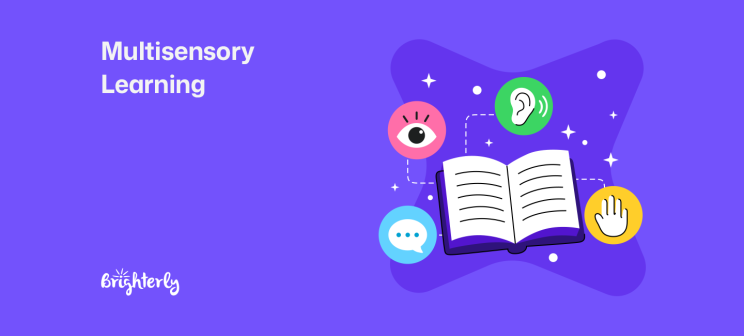
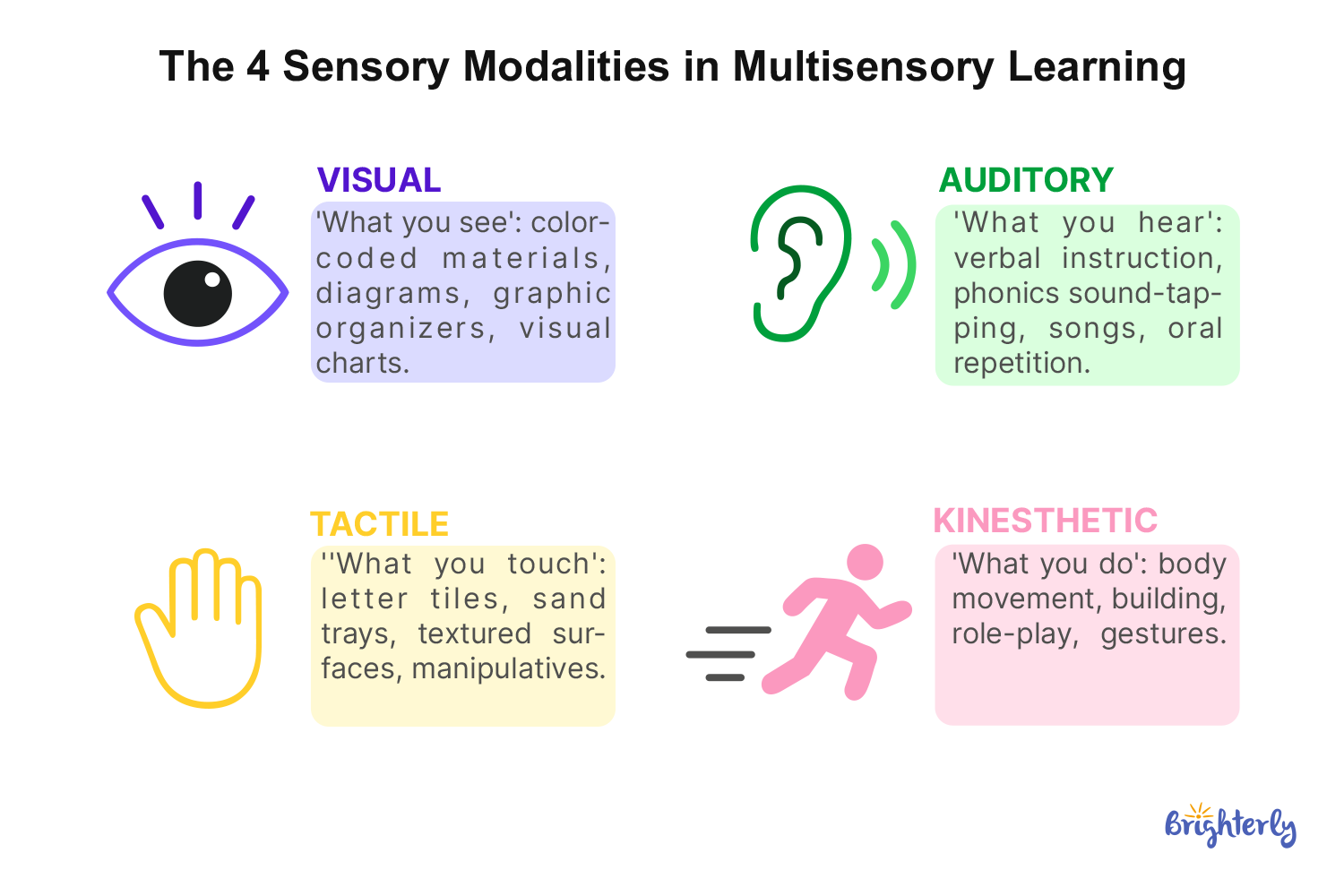
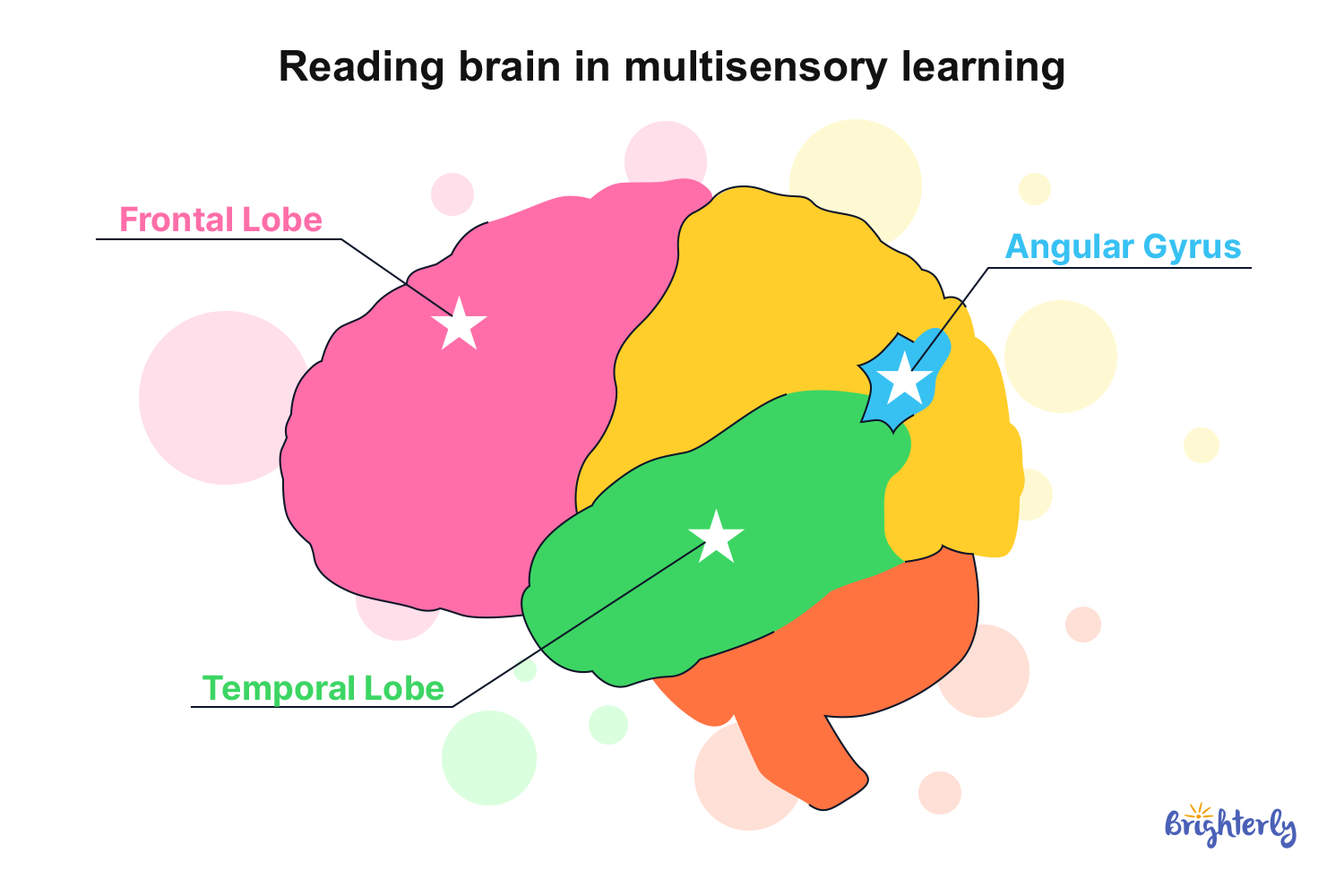
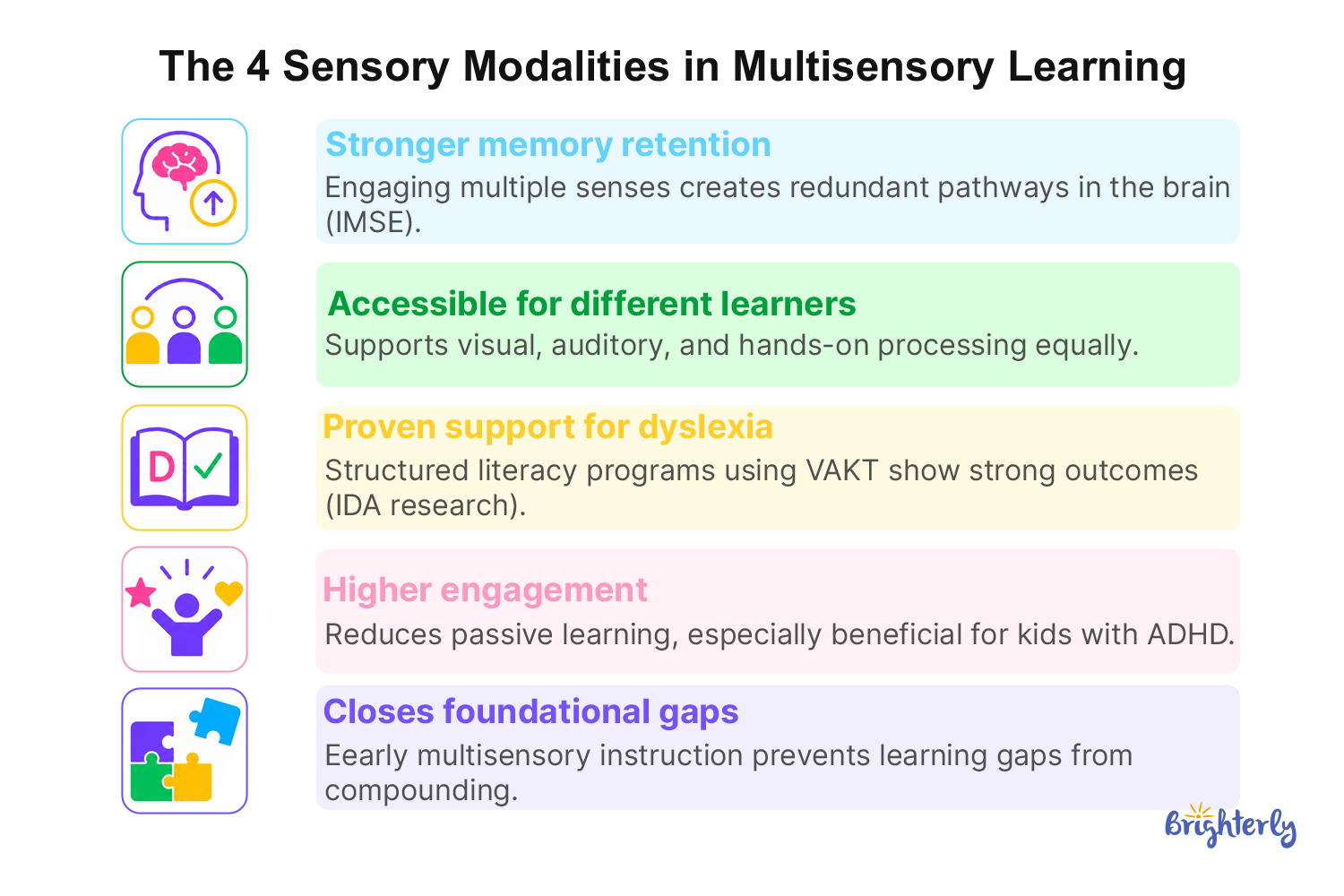
Talk to our reading tutors to see how they can help your kid Explore Brighterly Learning Experience Learn exactly how Brighterly helps students thrive through expert sessions, online tools, and proven feedback from thousands of satisfied parents Multisensory learning is an inclusive teaching method that relies on techniques that use multiple sensory pathways. By involving more senses in learning than traditional seeing and hearing for reading, it helps reinforce perception and memorize information — especially for kids with learning disabilities. Though in theory multisensory learning is not limited to the senses and ways of instruction, it typically engages visual, auditory, tactile, and kinesthetic senses within the VAKT model, applied in the Orton-Gillingham approach. VAKT model (Fernald 1943; Orton-Gillingham approach) Multisensory learning is helpful for kids who struggle with information perception. Students who stress out while listening can type letters on the keyboard or tap them out with their fingers. Learners who struggle with perceiving written words can try color-coding or imitating them in the air. Note: In contrast to fixed learning styles, multisensory approaches are not limited to a single way of instruction. They offer numerous opportunities to involve students’ senses, with the exact ways limited by the creativity of an instructor. The auditory modality stands for a verbal explanation of information. The exact multisensory learning examples for 1st grade reading include sound-tapping phonics instruction, songs, and oral repetition. For 2nd grade reading and higher, the examples of auditory modality include songs about new letters and audio recordings of speeches. An alternative to traditional teaching is sight-based learning, or relying on graphic materials like color-coding, diagrams, and visual charts. Once teachers illustrate new material with colorful visuals, they help kids engage with information in a meaningful way. Multisensory teaching strategies frequently rely on sensory integration, including combining hands-on learning with auditory tactics. “It is not at all necessary to buy special items to engage in highly effective multisensory play - you just have to be intentional.” The concrete tactile and kinesthetic learning strategies involve various touch-based inputs, including drawing on the sand and working with textured surfaces, and active participation, such as role-playing and dancing. Multisensory learning theory draws on dual coding theory, introduced by psychologist Allan Paivio, that recognizes two brain channels for information processing: verbal (cognitive system) and non-verbal (sensory experiences and mental images). Engaging additional senses on top of verbal perception, multisensory strategies reduce cognitive load and support working memory by reinforcing perception through redundant brain pathways. According to the IMSE research (2025), multisensory learning can involve the frontal lobe (to sound out a word), the occipital lobe (to see the letters), the temporal-parietal region (to make a connection between visual and auditory input), and the temporal lobe (to discern the word’s meaning). The hub connecting information from several sources is the angular gyrus (PubMed, 2025). The 2022 meta-analysis supports this claim: multisensory approaches work best when introduced within evidence-based instruction that is explicit and systematic, not as a standalone intervention. In practice, the exact way instructors apply multisensory learning is usually adjusted to each student to prevent cognitive overload. “A simple visual or verbal prompt is perfectly fine for concrete concepts or concepts they are already familiar with.” According to the studies conducted by IMSE for diverse learners and IDA for students with dyslexia, key multisensory learning benefits include: International Dyslexia Association (IDA), IMSE 2025 Multisensory learning for dyslexia, dyscalculia, and ADHD is effective in overcoming common learning difficulties, reducing cognitive load, and introducing information perception through visual, auditory, kinesthetic, and tactile experiences. “One of the most common misconceptions I see is that multisensory learning means making learning bigger, louder, or more stimulating. In reality, the goal is often the opposite.” For kids with dyslexia, multisensory instruction directly targets the phoneme-grapheme connection challenges that define dyslexia and reading difficulties. In a similar way, understanding how ADHD and reading interact helps adjust multisensory engagement to attention problems. Note: We customize our reading program to the strengths and weaknesses of each student, adjusting the teaching methods to the exact learning difficulties and knowledge gaps identified. The program remains aligned with the US state standards. Multisensory methods are especially effective for closing foundational gaps in reading, math, and writing. They can also help reinforce and deepen conceptual understanding for students in secondary school, higher education institutions, and in adult life. Orton-Gillingham and structured literacy programs use the VAKT model to build phoneme-grapheme connections that help improve reading and phonics. With simultaneous see-say-touch instruction, phonics is highly likely to stick for kids who struggle with decoding. The range of multisensory experiences includes phonics activities like sound-tapping (Wilson Reading System), tracing letters while saying their sounds, and using color-coded tiles to build words (Barton Reading and Spelling System). In math, multisensory approaches usually involve physical objects and movement to help with understanding abstract concepts. These strategies help kids to perceive arithmetic through the lived experience rather than memorization task. A multisensory math program can use manipulatives like counting cubes and number tiles or introduce number tracing worksheets to bridge sensory experiences with counting. Other examples include visual number lines, hopscotch counting, and abacus-based exercises to understand place value through touch. “The most effective multisensory learning is often surprisingly simple.” Multisensory writing activities rely on the VAKT-based instruction to develop foundational letter formation and reinforce story-building skills. The multisensory tools teachers use include alphabet writing worksheets, forming the shape of a letter with fingers or the whole body, and drawing letters in the sky. For older students, instructors can try color-coding (to show syntax and grammar in a sentence as a color pattern) as a multisensory strategy. 1. Start with understanding why is multisensory learning important for your child: Identify their exact learning difficulties and why you think the VAKT-based instruction can help. 2. Choose multisensory experiences carefully: It’s important not to overwhelm your child by activating all their senses simultaneously, especially when you teach phonics at home. 3. Turn a chosen multisensory strategy into a habit: If you go for color-coding, set aside 10-15 minutes every day to practice it together with your kid. Choose colors in advance and actively participate while your kid tries it. If needed, pair it with another sensory experience (like listening to an audiobook or drawing words in the sky). “Multisensory learning works best when it feels purposeful, calm and supportive.” 4. Encourage your child while learning: If your kid has ADHD, dyslexia, or any other learning disability, positive reinforcement is key to boosting their self-esteem. 5. Ask for help whenever needed: You can work with a reading tutor if you need support in finding the right methods for multisensory instruction.
Get Your Child a Personal Tutor
Our teachers apply multisensory approaches to help your kid learn better No, multisensory learning activities are different from learning styles because they involve sensory teaching methods for engaging multiple cognitive channels. In contrast to learning styles, multisensory teaching is not limited to a single way of instruction. The most common examples of multisensory learning activities within the VAKT model in the Orton-Gillingham programs include tapping out sounds while saying them aloud, using color-coded magnetic letters to create words, and writing in the air. Though multisensory learning work for dyslexia, ADHD, and other learning difficulties best, these methods can be beneficial for all kids. As multiple senses strengthen neural pathways and engage different brain parts, it helps reinforce perception and deepen conceptual understanding for all the students. The key difference between multisensory and multimodal instruction is the exact methods they apply. While multisensory learning involves sensory experiences to reinforce information perception, a multimodal approach introduces various communication modes to access content from different angles (as a text, image, or video, for example). Experiencing difficulties with cognitive perception lays the foundation for seeing clear benefits from a multisensory approach. If your child cannot focus while listening to the instructions, struggles with memorizing new information or learning a new skill, or has clear learning difficulties, multisensory learning strategies will be helpful in overcoming frustration. Though offline classrooms make it easier to engage students in kinesthetic and tactile learning, there are effective ways to implement multisensory strategies online. On your end, it’s important to enable screen sharing (for auditory and visual engagement), prepare required hands-on materials (for tactile activities), and install interactive platforms (for kinesthetic learning). Multisensory phonics applies the multisensory VAKT (visual, audial, kinesthetic, and tactile) model to teaching reading and spelling. Used in the Orton-Gillingham approach, it helps to learn the letters by approaching them from different senses (through seeing, hearing, and touching them). Sometimes you spend days preparing for your math exam and still don’t do well because you studied the wrong way. This guide gives you a day-by-day plan for studying for a math test successfully. The plan includes proven strategies on how to avoid losing points and improve your score effectively. Why Students Lose Points on […] Jul 01, 2026 One in five learners shows signs of dyslexia in kids, and early identification with the right support can help develop strong abilities to read, write, and spell. This guide will help you understand what dyslexia signs are and what exactly you can do to support your child. This article is for informational purposes only and […] Jul 03, 2026
The Challenge: Why One-Size-Fits-All Doesn’t Work
What Is Multisensory Learning?
The Auditory Modality
The Visual Modality
The Tactile and Kinesthetic Modalities


Why It Works: Research on Multisensory Methods

Benefits of Multisensory Learning
How Multisensory Learning Helps Kids with ADHD and Dyslexia

How Multisensory Methods Work Across Subjects
Reading and Phonics
Math
Writing
How to Create a Multisensory Learning Experience at Home
Frequently Asked Questions
Is Multisensory Learning the Same as Learning Styles?
What Are Some Examples of Multisensory Learning Activities?
Does Multisensory Learning Work for All Kids, not Just Those With Learning Differences?
What Is the Difference Between Multisensory and Multimodal Instruction?
How Do I Know if My Child Would Benefit From a Multisensory Approach?
Can Multisensory Learning Be Done Effectively Online?
What Is Multisensory Phonics?



Math & reading from 1st to 12th grade
Looking for homework support for your child?
Choose kid's grade

Math & Reading for Grades 1–12
Build real confidence for your child with a Brighterly math or reading tutor.