How to Study for a Math Test and Actually Improve Your Score
reviewed by Rachelle Bencio Yu
Updated on September 24, 2026
Key Points: Sometimes you spend days preparing for your math exam and still don’t do well because you studied the wrong way. This guide gives you a day-by-day plan for studying for a math test successfully. The plan includes proven strategies on how to avoid losing points and improve your score effectively. Studying passively, skipping mistaken problems, and starting too late are among the main reasons why students lose points on tests. Before you know how to study for a math exam, you should understand the most common reasons for lower-than-expected grades and how to fix them: Students tend to reread textbooks, class notes, and homework problems without getting into the concepts and meanings behind what’s on the page. Instead of wasting hours on going over the same theory, take an active approach. Become the teacher and explain out loud to imaginary students how to add fractions step by step. The most effective way on how to study for math tests is to redo the problems you’ve solved incorrectly in class or at home. Instead, students often skip these problems to avoid math anxiety. Focus on one difficult problem at a time; read the theory behind it; if you still don’t get it, ask your classmates or teacher for help. Note: If skipping hard problems sounds familiar, there are math concepts you never understood. Our algebra tutors and geometry tutors can help you identify where the gaps started and how to close them. Many students procrastinate until the night before the math quiz. This unhealthy habit forces you to cram all studying into a few short hours instead of benefiting from spaced practice. Research by The Learning Center at the University of North Carolina (UNC) explains how important distributed practice is – studying a bit every day over the course of a week. This strategy helps you understand and retain concepts to close learning gaps and get better grades. Claire Smizer, Brighterly Educational Advisor, explains why you need to start studying well in advance: “Math isn't a subject you can study your way into at the last minute. Your brain holds onto what it uses and releases what it doesn't…” That's why daily math sticks… The conceptual, procedural math kids meet in school behaves like a muscle. Use it regularly and it stays strong. Leave it alone for three weeks and it atrophies. Then a test asks a child to recall something their brain has already started letting go of, and they freeze. Cramming the night before asks the brain to do the one thing it's worst at: build durable understanding all at once, under pressure. Decades of research point the same way - a little practice, spread out over time, beats a big push at the end. Every time. Another grade mistake is to simply remember step-by-step solutions from your homework or in-class practice without comprehending the logic behind them. In case you get a slightly different problem on the test, you won’t have an idea what to do. So, make sure you understand how numbers and operations with them work. If you have doubts, ask your teacher or tutor for further explanations. Children naturally gravitate towards repeating what they already know to avoid failure and frustration. However, this approach doesn’t bring the expected results. Rather than solving the same easy problems, focus on the hard ones that you didn’t get right the first time. Your strategy on how to get ready for a math test should be based on learning what you don’t know, not repeating what you know. Explore Brighterly Learning Experience Learn exactly how Brighterly helps students thrive through expert sessions, online tools, and proven feedback from thousands of satisfied parents Learning how to study for a math midterm or another exam is not rocket science. All you need to succeed is a simple day-by-day study schedule, like the one below: Most importantly, begin your preparation a week before the exam to avoid cramming everything into a single night of studying. This timeline gives you enough time to identify gaps, fill them efficiently, memorize math formulas, and solve enough problems. Your first task is to understand what material the exam covers and what your gaps are in so that you can target these areas. For the first part, consult with your math teacher if you have doubts. For the second, take our free diagnostic math test to see your weak spots. After covering the necessary math concepts, move on to solving problems that you got wrong in class or on homework. Focusing on what you don’t know is a SMART goal when you study for a math test. Use math apps to practice similar problems to solidify your knowledge. Your work on how to study for a math quiz a couple of days before needs to center on solving math problems without the help of notes and previously worked examples. Get printable, topic-organized math worksheets for timed practice as time is of the essence during an exam. Your strategy on how to study for a math test the night before should focus on going over the most challenging concepts from the formula sheet you have prepared. The night before the exam is not the time to start studying new topics. Looking for qualified help?
See where your child stands in math!
Our tutors assess your kid’s strengths & weaknesses & prepare a personalized learning plan. Apply these six strategies to maximize the positive effects of your strategy on how to prepare for a math test: Timing yourself when solving problems helps reduce test anxiety related to having to work under time constraints. When practicing, give yourself as much time as you have in the real exam environment. Practice active recall to learn math efficiently – test yourself on the information you have remembered instead of rereading the text from the textbook. This constant retrieving of knowledge from memory forces your brain to actively dig for answers when solving problems. Focus on the hardest topics to make sure you understand them and know how to solve related problems. The best way to study for a math test is to allocate your precious time and energy efficiently. Don’t waste time on what you already know. Instead, delve into the gaps you have identified after a diagnostic test. Practice problems on the most challenging topics. Experts at The Learning Center at UNC stress having to do all assigned problems as one of the main misconceptions students have when preparing for a math exam. Instead, students need to value quality over quantity. Make use of flashcards with math vocabulary and formulas for self-testing. Don’t simply reread what’s on the flashcards, but read the concept and try to define it yourself. The night before the exam, take 30 minutes to one hour to review the toughest concepts. Don’t spend hours going through all notes without the necessary concentration. Since there isn’t a secret formula on how to study for a math test in one night, start on time, especially if you’re struggling with some concepts.
Help your child prep better for math tests!
Our program targets your child’s exact learning gaps for effective understanding & long-term retention. Part of your strategy on how to do well on a math test is to keep your review short and focused the night before. Spend 30-60 minutes on your vocabulary flashcards, formula sheet, and a few tricky problems. Then put your notes away and get at least 8 hours of sleep. On the morning of the test, eat a healthy breakfast, arrive at least half an hour early, and take a few moments to rest your mind. Read all instructions and problems carefully, start with the easiest ones to get them out of the way, and attempt all problems – even the ones you don’t understand as you might get partial credit. In case you’re struggling with test anxiety, Katya Seberson, Test Prep Expert and Co-Founder of SAT Boost, has some simple yet effective recommendations: “When students feel anxious before a math test, I encourage them to focus on something surprisingly simple: slow, gentle breathing through the nose.” How to study for your math test requires a week-long study schedule that incorporates comprehending challenging topics, practicing hard problems, and getting enough rest the night before. Use class notes, flashcards, and formula sheets to self-test. If you need support, consider 1:1 tutoring with professional math teachers. Allocate 30-60 minutes of focused math practice per day over 5-7 days before the test instead of one long study session the night before. Short, consistent review and problem-solving helps spot gaps early and build long-term retention. If the test covers multiple units, plan for a few extra days of exam prep. You can reduce math test anxiety by delving into the material you don’t understand, implementing timed practice, and starting studying well in advance. On the day of the quiz, breathe slowly but deeply and focus on one problem at a time. Write down all formulas as soon as the exam starts so that you don’t worry about forgetting them. The best way of how to study math formulas for an exam is to associate each formula with its purpose and usage and practice its real-life application through different types of problems. Also write formulas from memory and check your answers instead of rereading them from your notes. There isn’t a strategy on how to study for a math test in 30 minutes – preparing well requires a 5-to-7-day plan with specific steps. However, take 30-60 minutes on the night before the exam to review vocabulary, recall concepts and formulas, and check a few challenging problems. Whether you study alone or with a math study group depends on your preferred learning style and environment. You can also try working on tough problems on your own and then discussing challenging concepts with peers. You can combine the two methods with 1:1 online tutoring with a professional teacher to understand hard ideas. Start your test preparation with a review of recent quizzes and homework assignments to understand where you’re behind. Pay attention to recurring mistakes instead of single errors that happened due to distraction. You can also take a diagnostic math test or work with a tutor to get help identifying which topics to focus on. The 2026 after school programs come in various formats — some are self-paced, others give you real teachers like a trigonometry tutor. Both are effective, but they solve different problems, and picking the wrong one wastes time and money. This guide compares the 13 best after school tutoring programs across approach, subjects, and price. After […] Jun 30, 2026 Does your child try hard but still struggle with reading? Multisensory learning can help, as it engages multiple senses in the teaching process without overwhelming students. This article provides an explicit multisensory learning definition, examples, and strategies to apply. The Challenge: Why One-Size-Fits-All Doesn’t Work Usually, classrooms rely on traditional reading and listening methods, but […] Jul 03, 2026
Why Students Lose Points on Math Tests
Studying Passively Instead of Practicing Actively
Skipping the Problems They Got Wrong
Starting Too Late to Fix Real Gaps


Memorizing Steps Without Understanding Why They Work
Redoing Easy Homework Instead of Targeting Weak Spots
How to Actually Study for a Math Test: A Simple Plan
Start 5-7 Days Before the Test, Not the Night Before
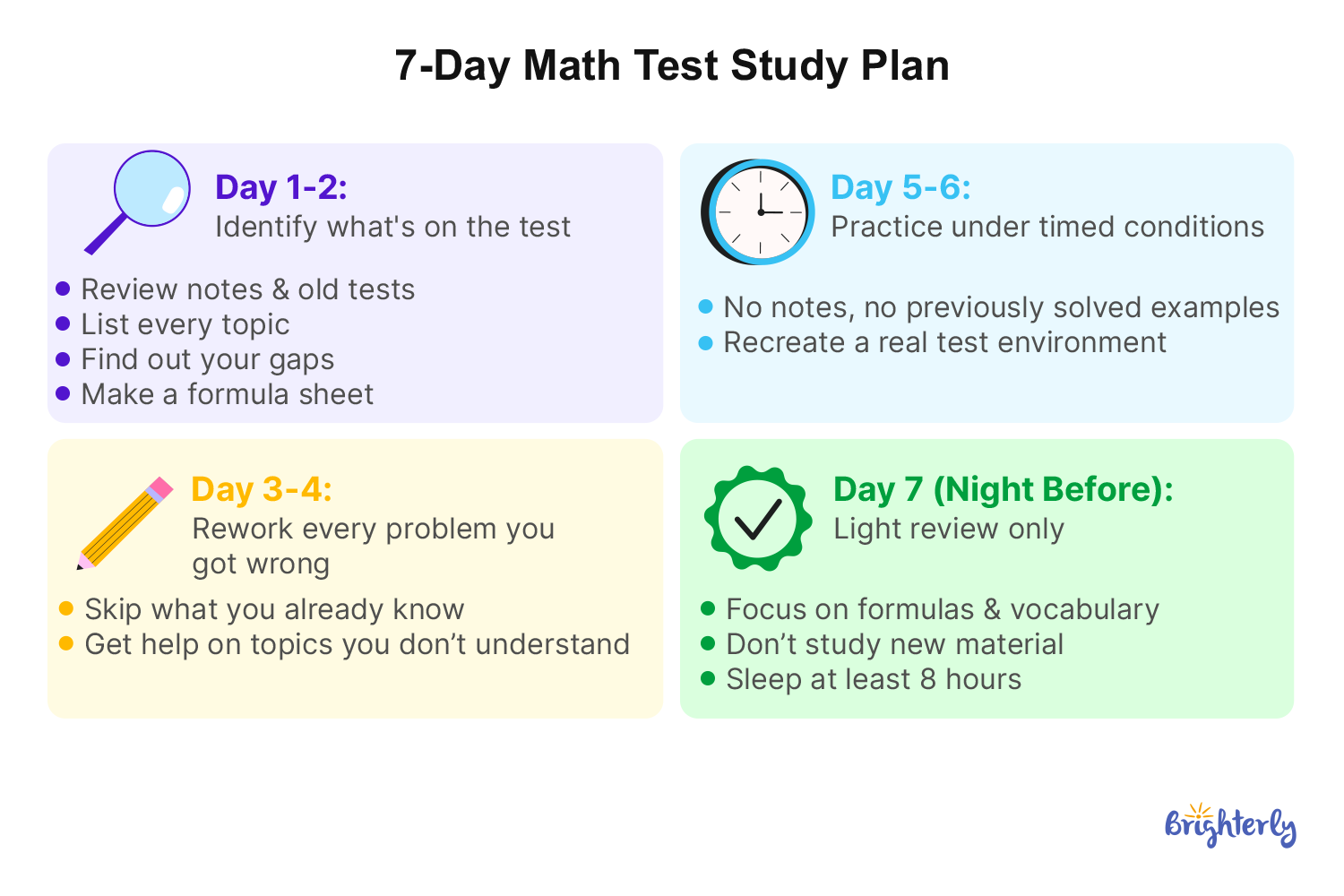
Day 1-2: Identify What’s on the Test and Where Your Gaps Are
Day 3-4: Rework Problems You Got Wrong – Don’t Redo What You Already Know
Day 5-6: Practice Without Looking at Examples or Notes
Day 7 (the Night Before): Light Review Only – No New Material


Math Study Dos and Don’ts
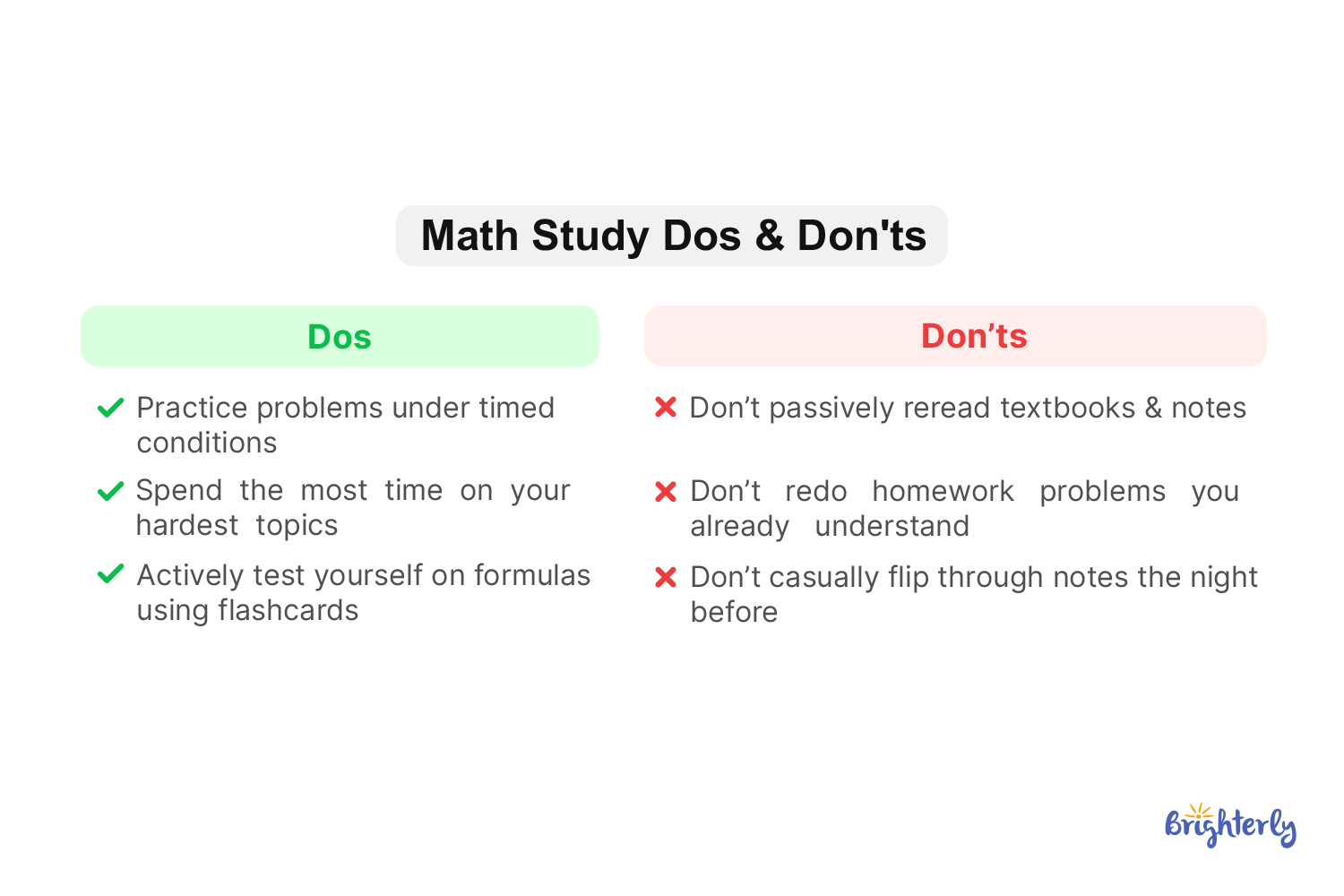
Do Practice Problems Under Timed Conditions
Don’t Just Reread Your Textbook or Notes
Do Spend the Most Time on Your Hardest Topics
Don’t Redo Homework Problems You Already Understand
Do Use Flashcards for Formulas – But Test Yourself, Don’t Just Read Them
Don’t Casually Flip Through Your Notes the Night Before
What to Do If You Don’t Understand the Material at All
The Night Before and Morning of the Test


Conclusion
Frequently Asked Questions
How Long Should I Study for a Math Test?
How Do I Overcome Math Test Anxiety?
What’s the Best Way to Memorize Math Formulas?
Can I Prepare for a Math Test in 30 Minutes?
Should I Study Alone or With a Study Group for Math?
How Do I Know Which Topics to Focus On When Studying?





Math & reading from 1st to 12th grade
Looking for homework support for your child?

Choose kid's grade

Math & Reading for Grades 1–12
Build real confidence for your child with a Brighterly math or reading tutor.







![Cuemath Reviews: All You Need to Know [2025]](https://brighterly.com/wp-content/uploads/2025/07/Cuemath-Reviews_-All-You-Need-to-Know-e1754582226241-360x200.png)