
ADHD and Motivation: Why It’s Hard to Get Started and What Helps
reviewed by Rachelle Bencio Yu
Updated on July 28, 2026
Key points
- The connection between ADHD and motivation is neurological, as ADHD motivation struggles appear when the brain generates and uses dopamine less efficiently.
- According to the CDC (2024), around 7 million children have ADHD; for them, novelty, challenge, urgency, and passion are key motivation drivers, as their brains rely on an interest-based nervous system.
- The signs of ADHD motivation struggles refer to effort, performance, and emotional state; while depression, anxiety, overwhelm, and perfectionism can worsen these struggles.
- Effective strategies for overcoming ADHD-related motivation problems include breaking tasks into parts, using immediate rewards, body doubling, time management, and task activation techniques.
ADHD motivation struggles connect to how the reward processing works, dopamine levels, and executive function. Before all, it’s not laziness or lack of effort; it’s a matter of dopamine regulation. This article explains why motivation among students with ADHD drops and why strategies, such as breaking tasks into parts or body doubling, can help.
What Is the Connection Between ADHD and Motivation?
The connection between ADHD and motivation lies in the role of dopamine in the brain’s motivation and reward systems at the neurological level. People with attention deficit hyperactivity disorder (ADHD) have a lower baseline of dopamine, so the brain struggles to generate motivation for routine or long-term tasks.
To deal with them, the brain needs instant gratification or a sense of urgency. Thus, it’s often not a matter of desire or willpower.
Note. According to the 2024 stats by the CDC, around 7 million children aged 3-17 in the U.S. have an ADHD diagnosis.
How the ADHD Brain Processes Reward
The ADHD brain processes rewards outside the available dopamine regulatory system, due to structural differences. As ADHD is associated with a lack of dopamine in the system, the brain needs intense or immediate stimulation to experience reward.
That’s the reason why your children may ignore preparation for an exam that is in two weeks, but will hyperfocus for hours on the creative project or game.
Executive Function and Task Initiation
Weak executive function or dysfunction is the core feature of ADHD. It affects working memory, self-regulation, self-activation, and organization. Because of it,
- The children feel the first step to be bigger than it is.
- The gap between “I know I need to do this” and “I’m actually doing it” is growing.
“People with ADHD can have inconsistent motivation even when the task itself seems reasonable, and supports are in place.”


Task initiation is a primary challenge of execution. As it’s not automatic, doing a task requires an internal push. The brain generates this push naturally from motivational cues.
When children have ADHD, they may sit at the desk for 15 minutes without writing a word, because they neurologically can’t, not because they decided to fail or disobey.
So, weak execution and initiation allow drawing a line in a “can’t start” vs “won’t start” distinction. Here’s how Polina Shkadron, a Neurodivergent Specialist and Family Therapist, explains this:
“Task initiation seems simple.”

Explore Brighterly Learning Experience
Learn exactly how Brighterly helps students thrive through expert sessions, online tools, and proven feedback from thousands of satisfied parents
Why Motivation Is Harder With ADHD
Motivation is harder with ADHD due to dopamine level deficiency and dysregulation. The students tend to hyperfocus on interest-based tasks and struggle with importance-based ones. If there is no immediate reward, the brain fails to trigger a certain chemical reaction, which leads to executive function challenges like task paralysis.
The Role of Dopamine in ADHD Motivation
Dopamine is the brain’s primary messenger or transmitter that carries a chemical signal for motivation, reward, and pleasure to the ventral striatum and nucleus accumbens, specific parts of the brain. In cases of ADHD, the brain brings in less dopamine and uses it significantly less efficiently due to fewer receptors. As a result, as dopamine levels circulate atypically, the brain under-responds to the anticipation of a reward but over-reacts when the reward is delivered.
Considering this, you can observe ADHD lack of motivation in the routine or low-stimulation tasks like homework, chores, or repetitive assignments. If the task has no novelty or payoff, the brain won’t produce enough dopamine to start.
Interest-Based Motivation vs. Importance-Based Motivation
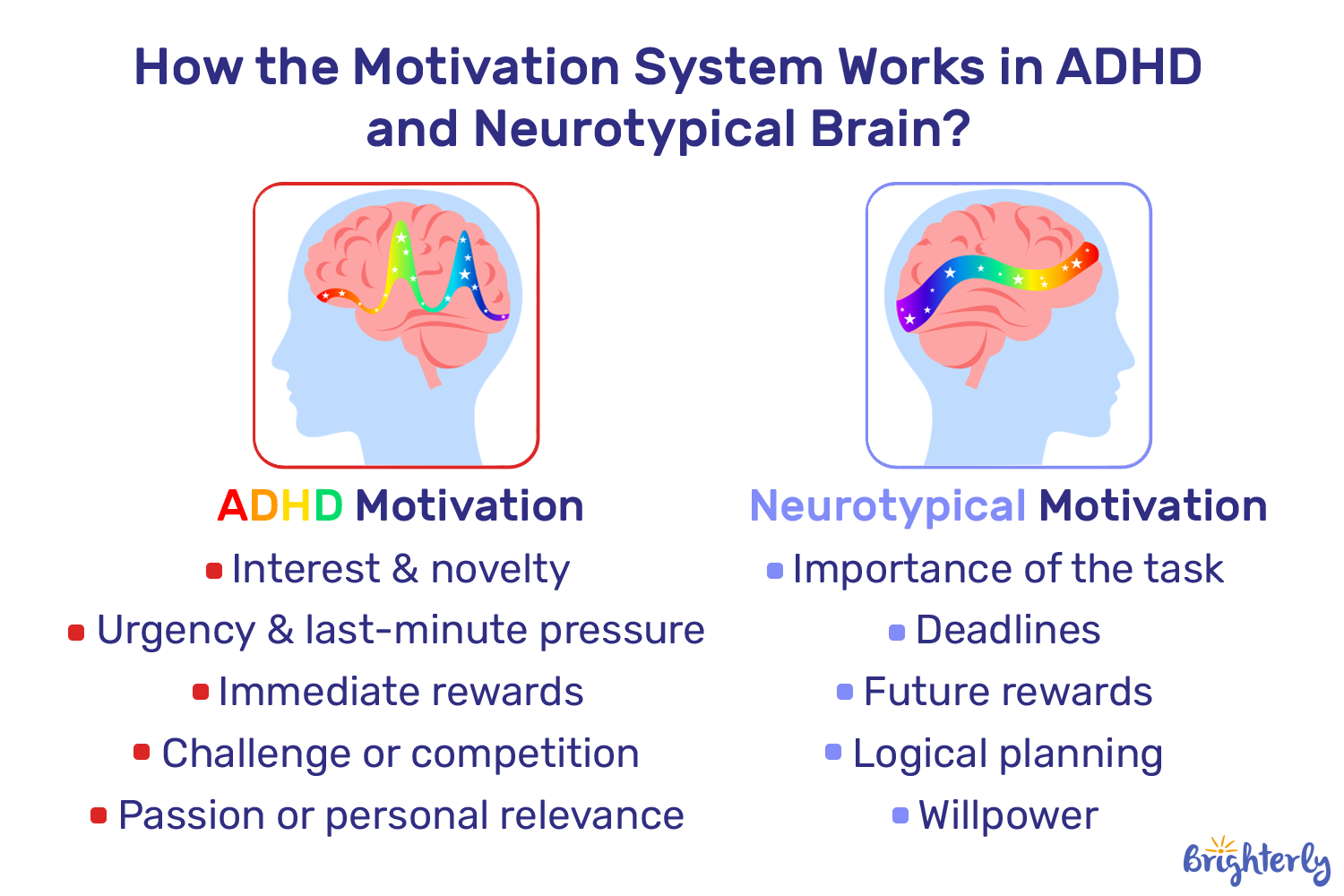
According to Dr. William Dodson (2025), people with ADHD have an interest-based motivation system, while neurotypical people have an importance-based motivation system. For the first group, the interests, challenge, novelty, passion, and urgency are key motivators; while for the second, it’s importance, timelines, and logical reasoning.
It means that for an ADHD student, the task should engage the brain, be exciting, personal, or urgent; otherwise, the brain won’t have enough dopamine to proceed with it.
Task Paralysis: When Task Feels Impossible
Task paralysis happens when a child knows exactly what they should do, but can’t make themselves do it. For those who observe this situation, it may look like an avoidance. Nevertheless, it’s a neurological state triggered by overwhelm and weak signals in the brain.


Help your child at their learning!
Brighterly ADHD-friendly tutors build lessons around how your child learns
As an ADDA 2025 post suggests, an ADHD hyperfixation may also be a reason for the task paralysis, coming from a hyperfocus on one task. According to Dr. Dan Goodman, Licensed Psychiatrist and co-founder of The Midtown Practice, this affects both personal time and leisure of a person with ADHD. Here’s how to tackle the issue:
“Those with ADHD may have trouble being aware of the passing of time.”

5 Signs of Your Motivation Problems May Be ADHD-Related
Is lack of motivation a sign of ADHD? Yes, when a motivation problem refers to effort, performance, and emotional state of a student, spanning from inconsistent effort to initiation problems.
- Inconsistent effort that confuses everyone around. If one day a child does great, and disengages the next one with no good reason, it’s a clear signal. Such inconsistency is an important characteristic of low motivation in ADHD.
- Strong performance only in areas that interest them. If a kid excels at creative projects or gaming, yet finds it difficult to keep up academically, that’s another sign.
- Finding it extremely difficult to start even simple tasks. Imagine you persuade a kid to start a short assignment for 20 minutes. In such cases, when kids find it hard to initiate a task, it illustrates the executive function challenge within ADHD.
- Urgency is the biggest motivator for a student. When ADHD’s “no motivation to do anything” can be fixed with the deadline that’s hours or minutes away, it’s how ADHD the reward system responds to the pressure.
- Emotional shutdown as a result of paralysis. When a kid bursts out in teams, withdraws, or has outbursts during a task initiation, it may be another sign. It hints at emotional dysregulation, which is another proven symptom of ADHD.
“There are some common signals and issues for kids with ADHD. They often have messy backpacks, lose items, and are often told that they are making ‘careless mistakes’”

Other Factors That Make ADHD Motivation Worse
ADHD is a condition that may be affected by numerous factors, from exercise and diet to lack of sleep and co-occurring conditions, like anxiety or depression. The latter can also add to motivation difficulties in ways that are easy to overlook or attribute wrongly.
ADHD vs Depression
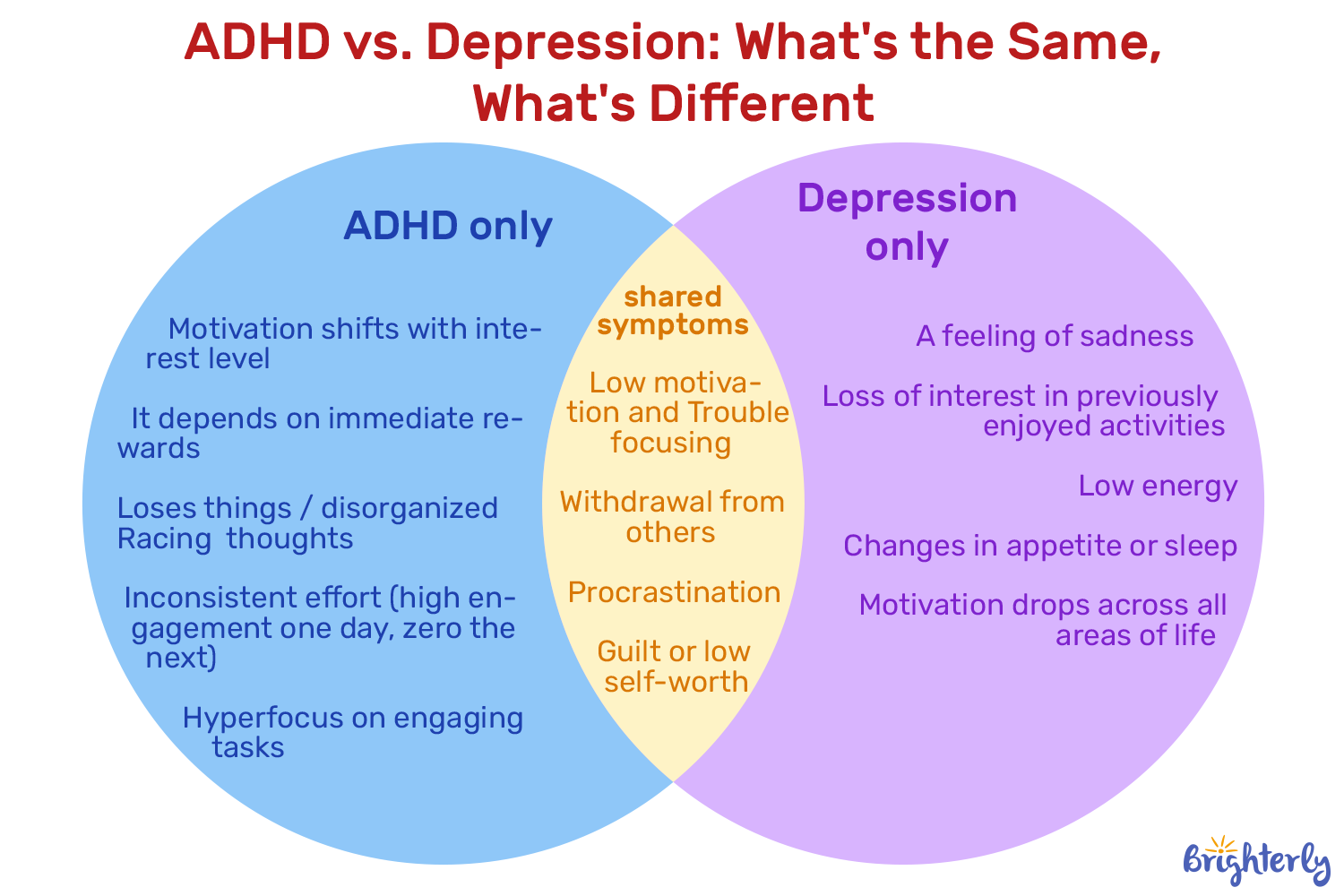
The question of lack of motivation ADHD or depression may be confusing, as both conditions share symptoms that overlap, including poor concentration and motivation. However, the roots are different.
- ADHD is the outcome of a neurological difference related to the brain and dopamine, affecting executive function. Does ADHD cause lack of motivation? Yes, the motivation changes and shifts back based on the interest.
- Depression mood disorder resulting from a chemical imbalance as an outcome of stress or life events. There, motivation change comes from chronic sadness and loss of interest affecting the activities kids normally enjoy.
Two conditions can coexist and occur together. For intance, a kid who struggles academically for years and doesn’t know that’s because of ADHD and lack of motivation can get a depressive condition as well.
Anxiety, Overwhelm, and Perfectionism
- Anxiety affects motivation via fear of failure or judgment, so the kid sees starting a task as risky, not just difficult.
- Perfectionism adds another level, as the desire to make the work flawless becomes a reason to postpone or refuse to start something and not produce something imperfect.
No motivation to do anything, and ADHD can bring cycles of stress and motivation traps.
“The two motivation traps I see most often in students with ADHD are relying on deadlines to get started and relying on hyperfocus to finish.’”
A fast-approaching due date can create enough urgency to begin homework. Hyperfocus can then feel like jet fuel, powering the work to completion. But this pattern is unreliable and often creates enormous stress.
One way to reduce this cycle is to break schoolwork into much smaller pieces, sometimes just 20 minutes, and practice starting, stopping, and returning later.

Practical Strategies to Build Motivation With ADHD
Break Tasks Into Smaller Steps
Try to divide the task into parts that take 10 minutes to complete. You can support by adding a step-by-step checklist.
“Make the first step as tiny as possible.”

Use Immediate Rewards and Positive Reinforcement
Using rewards and positive reinforcement will allow you to address the issue with delayed signals in the ADHD reward system. If there’s a gap that intrinsic motivation won’t fill, add a short break, a snack, or five minutes of screen time as an extrinsic motivation to complete the work. Dr. Anna Levy-Warren, CEO and Founder, Organizational Tutors, shares some further ideas:
“Delayed rewards and gratification do not work as motivators for ADHD brains.”
Try the 5-Minute Rule
Use time commitment as a strategy to activate the brain and answer the task initiation part. In this regard, applying the 5-minute rule to commit to spending just 5 minutes on a task is a decent strategy. This is likely to work, as when you activate the brain, it creates a different state and lowers the psychological barrier. Such a state is contrary to the one created by avoidance from the neurological perspective.
Use Body Doubling and Accountability Partners
Body doubling means working alongside another person, either physically or virtually. It helps as the presence of another person activates social attention regulation. In turn, it helps the ADHD brain keep focus on the task.
According to the 2024 article at Publication History on investigation of body doubling, study respondents with ADHD underline that body doubling, whether online via Discord or Focusmate, or in public, like in a cafe, is an effective means to initiate and complete tasks.
Reduce Friction Before You Start
Reducing friction is about removing the obstacles or factors between your child and a task that create such opportunities. And the ADHD brain often loves to take any opportunity to disengage from a task.
“You should lessen the pressure on the nervous system, which then increases flexibility and regulation.”

So, prepare all the things in advance. In particular, lay out the materials, open the right tabs, and clear the workplace, both physical and virtual. Even such activities as finding a pencil or deciding where to sit can impede task initiation. Brie Scolaro, LCSW, Licensed therapist and Director of Aspire Psychotherapy, advises one more technique:
“Keep a note app or paper nearby and write down distractions instead of immediately acting on them.”

Note: Importantly, kids should also be aware of and understand their condition. Here’s a full guide on how you can explain ADHD to them.
How ADHD Motivation Problems Show Up in Kids and Schoolwork
For children, motivational struggles are most visible in school settings, when they won’t choose the tasks. Homework is a vivid example, as it needs continuous effort, and the rewards are distant. There, with boring tasks, kids would disengage and struggle with task execution, whether it’s a math or reading lesson. That’s why it’s sometimes so important to seek qualified help.
- For instance, our ADHD math tutor sessions help build skills step by step, provide feedback to parents, and keep the kids’ confidence high.
- At the same time, in reading classes, ADHD can overlap with dyslexia. In that case, our dyslexia reading tutor can offer customized plans for one-on-one sessions to keep engagement high.
In any case, whether a kid is stuck with spelling or with a 3rd-grade math concept, the targeted support is an effective way to decrease frustration and cognitive load and support motivation levels.
Support kids’ learning with low-pressure tutoring
Brighterly tutors adapt every lesson to your child’s pace, needs, and interests
When to Seek Additional Support?
Additional ADHD support is a good idea when current coping strategies, productivity hacks, and self-management techniques are not working.
Specifically, seek professional help when:
- Motivation struggles are significant and consistent (more than 3 months) and are affecting many different spheres of life.
- ADHD difficulties begin to affect the grades, friendships, and self-esteem of a child.
- You see that motivation problems overlap with anxiety, depression, or emotional instability.
- ADHD has not yet been assessed, and you see the patterns in your child.
- The strategies and supports bring no results.
Note. Understanding how to motivate someone with ADHD requires advice from a professional, usually a clinical psychologist or an ADHD coach.
Frequently Asked Questions
Is Lack of Motivation Always a Sign of ADHD?
Not always, yet you should pay close attention to it. The rationale is that the lack of motivation ADHD provides follows the next pattern: children have high engagement towards interest-driven tasks and no engagement in tasks related to everything else.
Can ADHD Medication Help With Motivation?
For many people, yes; however, ADHD medication, especially stimulants, helps with task initiation and execution. However, it doesn’t provide structure or set habits that ensure actual help in the long run. It works best in combination and requires the advice of a professional.
How Can Parents Help a Child With ADHD Stay Motivated at School?
Parents can help a child with ADHD to stay motivated at school by setting an environment and supports, and by decreasing pressure. They can also work with teachers to reduce direction or break tasks. Parents can also build a reward system at home to support reinforcement provision.
Does ADHD Motivation Get Worse With Age?
It can change. One of the reasons is that teens face increasing academic demands, and it can coincide with the rise of executive function challenges. If there is overload and overwhelm, motivation can get significantly worse. Thus, strong strategies and support are necessary through high school.
What are the Differences Between ADHD Motivation Problems and Laziness?
The difference is neurological, as laziness is a choice not to try deliberately, while ADHD motivation is a response to difficulty with dopamine regulation and executive function. The children with ADHD have a system that struggles, while lazy students choose to skip effort.


⭐ Overall rating: 7.3/10. You’ll find out what real users on Reddit and TrustPilot think about the school’s learning approach, the overall experience, customer support, and pricing plans. Publicly shared comments will also reveal the most frequently reported benefits and complaints, and how families evaluate the academic and emotional effectiveness. Rating Methodology For an unbiased […]

Jun 02, 2026

The best ACT prep classes in 2026 include Kaplan, Princeton Review, PrepScholar, Magoosh, and Achievable. To decide which one is the right fit for your child, pay attention to what each course provider offers. The main criteria for that includes teaching style, ACT sections coverage, score improvement or high score guarantee, and pricing. Best ACT […]

Jun 02, 2026
Math & reading from 1st to 12th grade
Looking for homework support for your child?

Choose kid's grade

Math & Reading for Grades 1–12
Build real confidence for your child with a Brighterly math or reading tutor.