Guided Reading Level (GRL): A Parent’s Guide by Grade
reviewed by Tamaya Govender
Updated on September 18, 2026
Key Points:
- Guided reading level lets parents immediately see their child’s current reading level and what exactly they should do to help them improve.
- Each grade has its own typical GRL range at the beginning and the end of a school year, but the exact expectations can vary by district.
- GRL is not a fixed standard, label, or comparison tool but a reference for parents that indicates the need for extra reading practice.
- Getting an online reading tutor is one of the most effective ways to improve your child’s GRL results.
Once your kid brings home their GRL result from school, you want to know what it means and what exactly you need to do to address the problems it indicates. The guided reading level is a letter between A and Z — see how it compares to grade-level expectations and what to do next.
What Is a Guided Reading Level (GRL)?
GRL, or Guided Reading Levels methodology, is the Fountas & Pinnell A–Z scale teachers use to match children with just-right books based on their current reading skills. Developed by literacy experts Irene Fountas and Gay Su Pinnell, it gives parents a single letter that shows how a child’s reading compares to grade-level expectations.
Think of GRL reading levels as a compass to help your child become literate. They can let you know where your kid is currently at, whether their reading skills match the expectations for their grade, and if you need to do something new to help them read better. All you need to know is the letter they’ve got.
How Guided Reading Levels Are Determined
You get a GRL result as a letter within the A to Z range from a school teacher or a reading specialist. They assign a GRL by listening to your child read aloud and scoring three skills:
- Accuracy: How many words they read correctly.
- Fluency: How smoothly and expressively they read.
- Reading comprehension: How well they understand and can talk about what they just read.
The testing usually takes place as a short 1:1 reading check.
Explore Brighterly Learning Experience
Learn exactly how Brighterly helps students thrive through expert sessions, online tools, and proven feedback from thousands of satisfied parents
GRL Reading Level Chart by Grade (Kindergarten–6th Grade)
|
Grade |
Expected GRL (Beginning of the school year) |
Expected GRL (End of the school year) |
Levels behind the grade (by the end of the school year) |
|
Kindergarten |
A, B, C |
C, D, E |
Below C |
|
E, F, G |
I, J, K |
Below I |
|
|
J, K, L |
L, M, N |
Below L |
|
|
M, N, O |
O, P, Q |
Below O |
|
|
P, Q, R |
R, S, T |
Below R |
|
|
S, T, U |
U, V, W |
Below U |
|
|
Grade 6 and beyond |
V, W, X |
X, Y, Z |
Below X |
Source: Fountas & Pinnell Instructional Level Expectations for Reading (accessed September 2026)
Note: Actual expectations can vary by district, school, and the time of year your child is assessed.
How GRL by Fountas & Pinnell Compares to DRA, Lexile, and AR Levels
|
Reading System |
Scale |
What It Measures |
|
Fountas and Pinnell Reading Levels (GRL/F&P) |
From A to Z |
Readiness of your child to meet their grade-level reading expectations |
|
From A to 1, then from 1 to 80 |
Annual test on reading engagement, oral fluency, and reading comprehension |
|
|
Lexile Level |
From BR400L to 2000L |
Reading comprehension levels based on text complexity |
|
Accelerated Reader level (AR) |
From 0.1 to 13.5 |
Text complexity and reading comprehension by grade |
Fountas and Pinnell reading levels and Guided Reading Levels (GRL) are the same scale that uses the A-Z system.
AR and Lexile levels are different from F&P/GRL because they concentrate on the text complexity itself, without considering the themes and plot predictability behind the words.
Comparing DRA to Guided Reading Level, both measure an instructional and independent reading levels of your child, but use different testing approaches under different scaling systems.

Improve Your Kid’s Reading Skills Beyond GRL
Brighterly tutors work with your kid’s reading abilities to help them nail tests
What to Do If Your Child Is Below the Expected Guided Reading Levels by Grade
- Validate the result: Ask the teacher or a reading specialist what exactly your kid’s assessment involved. This will help you clearly understand what reading skills you need to improve.
- Choose the measures: Depending on your kid’s grade and their GRL result, you can encourage more independent reading or concentrate on a single problem skill, like phonics or building vocabulary.
- Build a learning plan: You can develop an after-school curriculum to practice with your kid at home or enroll them in a reading program with a dedicated tutor to accelerate the process.
How to Understand What to Do with the GRL
The literacy strategies you can apply for GRL improvement depend on their grade and the skills measured to get the letter result.
Here are some of the exact grade-based reading expectations that are usually behind the Guided Reading Levels:
- Kindergarten: The kindergarten readiness checklist includes understanding simple words, short sentences, and picture clues.
- Grade 1: Using sight words, longer sentences, and developing early self-monitoring skills.
- Elementary school: Understanding varied sentence structures, improved vocabulary, and reading early chapter books
- Middle school: Progressing to more complex plots, longer chapters with advanced themes, and deeper reading comprehension.
The strategies you can work with to improve GRL include working with an online tutor, enrolling in a reading program, or introducing shared or guided reading in their after-school reading program. Getting a platform that can offer a personalized curriculum under the foundation-first approach that is fully aligned with the US state standards is a good compromise for parents. It lets you get external help but stay involved in the process.
Note: You can combine several reading strategies for struggling readers or switch between them to keep your kid entertained and reduce the stress if one strategy doesn’t bring fast results.
How to Improve GRL Results with Brighterly
Our reading tutors and platform tools can help your kids practice daily to improve their reading comprehension and impact their GRL results.
Here is what you can get on Brighterly:
- A certified elementary reading or middle school reading tutor for 1:1, live, regular practice
- 1:1 reading program that helps your kid improve their reading skills
- Parent session report to keep your kid’s reading progress in control
- Kids Space with extra tools like an AI reading companion for read-aloud practice and a curated bookshelf
Read real-life Brighterly reviews to see what kids have achieved with our tutoring help.
Make Your Kid a Better Reader Today!
Struggling readers get personalized help and a comfortable space to grow in Brighterly
Why Guided Reading Levels Matter for Reading Growth
GRL lets parents understand the instructional, independent, and frustration reading level for their kids, or comfortable, easy-to-comprehend, and too-hard literature for them. With this measurement system, parents and teachers can develop a leveled reading practice. It means choosing the best-suited books for kids and using stories of different difficulties to practice specific reading skills.
Note: Matching your child to books they can actually handle and enjoy is key for them to show good results in class. National Assessment Governing Board press release on the 2025 NAEP Long-Term Trend Assessment results states that only 37% of 9-year-olds say they read for fun almost every day, compared to 53% in 1984.
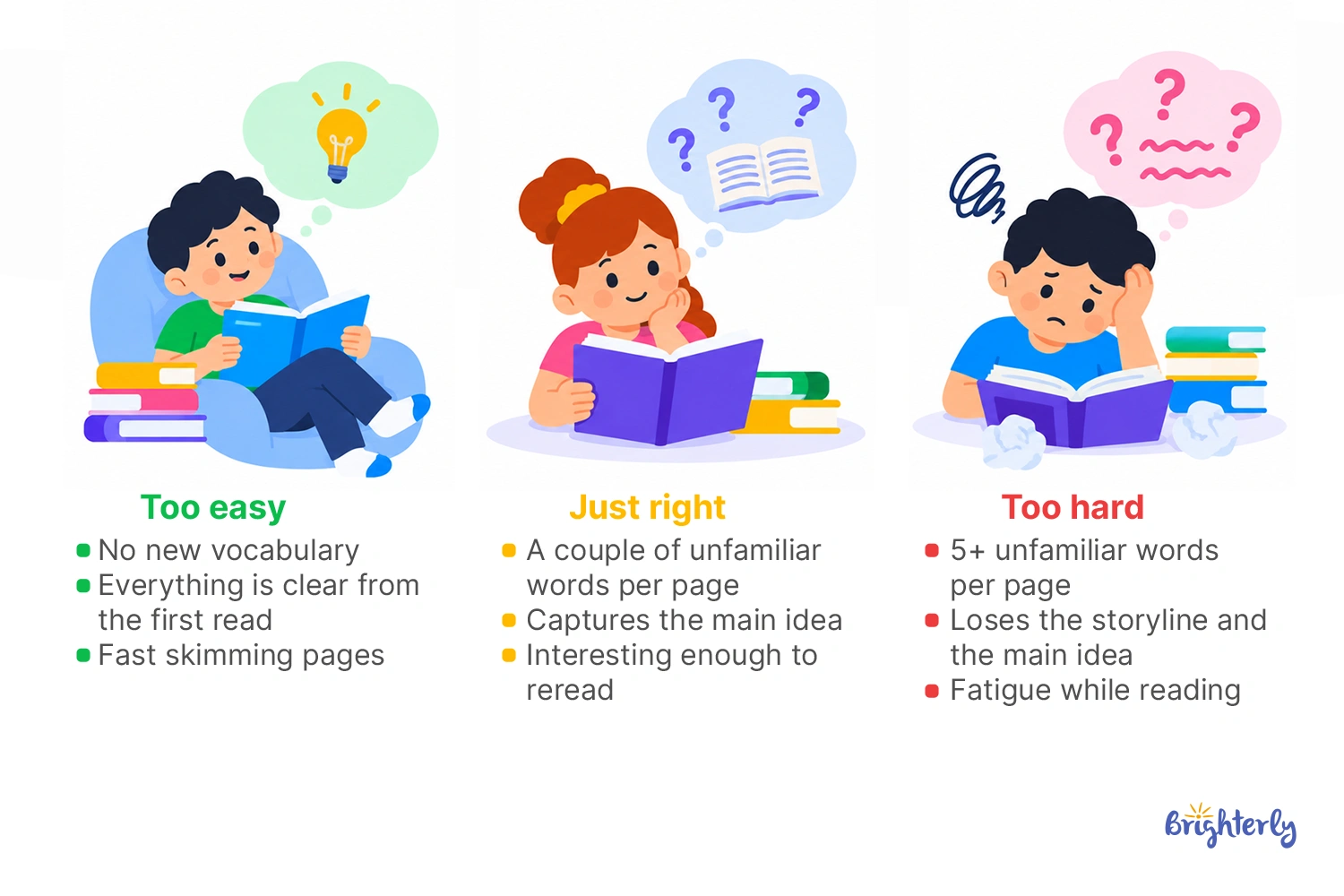
Books That Are “Just Right” vs. Too Hard or Too Easy
To make reading engaging for your kid, focus on “just right” books for their reading practice, with reading an occasional couple of pages from “too hard” literature and using “too easy” texts to relax.
Common Myths About Guided Reading Levels
In this section, you’ll see why GRL is not a standard or a permanent label, why you shouldn’t aim at 100% accuracy, and how important it is to understand how your school teacher used the GRL scale to assess your child.
Myth #1: GRL Is a Concrete Recommendation
Fact: The GRL by grade chart doesn’t set fixed standards. Use it for approximate guidance instead.
Myth #2: GRL Is a Permanent Label
Fact: Guided Reading Levels change with the reading skills of your kid. Use the letter as a starting point in the learning process.
Myth #3: 100% Accuracy Is the Goal
Fact: Getting the exact letter doesn’t equal achieving next-level reading skills. Aim at steady progress, not letter-chasing.
Myth #4: GRL Is a Universal Standard
Fact: Every school uses the GRL scale differently, so ask your teacher how they used it to better understand what the letter represents.
Tips to Support Your Child at Any GRL Level
- Don’t punish your kid for getting a low GRL result
- Adjust your child’s reading list to match their reading skills and interests
- Steadily include more complex books to gently raise the bar
- Don’t ban favorite books for their GRL label
- Get involved personally and/or hire a reading tutor to get support for reading struggles
- Never forget to celebrate their small wins and reading growth!
Conclusion
As GRL is just one of many tools to understand your child’s reading level, don’t put too much pressure on it. And if you see that your kid’s GRL result is significantly lower than expected, don’t panic.
Reading is a skill to practice, and you can improve it with various skills and techniques, including reading aloud and visualization tools.
If you don’t have time or an opportunity to work with your kid, try a free demo lesson at Brighterly! Our tutors know how to work with the GRL chart and will apply different techniques to improve your kid’s reading comprehension before their next GRL reassessment.
Frequently Asked Questions
What Does GRL Stand for in Reading Instruction?
As an instructional reading level, GRL lets parents and teachers understand the text complexity and match the books with the current level of reading skills a child has. It works as an A-Z scale, where A stands for the simplest texts kids in the early kindergarten days can read, and Z reflects the complex, fluent-level texts most kids generally start reading around sixth grade and older.
What Is a Good Self-Correction Rate at a Guided Reading Level?
Fountas and Pinnell’s official sources do not establish a good self-correction rate range as a single number. As a parent, you should ensure your kid feels comfortable and encouraged to learn from their mistakes, not aim at making everything perfect.
What GRL Level Should a 3rd Grader Be Reading at by Year’s End?
The exact reading expectations for third graders in GRL methodology differ by district, with Level P as a reference point that parents can use. However, if you aim to improve your kid’s reading level, pay closer attention to which skill (among accuracy, fluency, and reading comprehension) needs the most practice behind the GRL letter.
How Often Should a Child’s Guided Reading Level Be Reassessed?
The Guided Reading Level chart shows different expectations for kids in the beginning and near the end of a school year. So, measuring their reading level in autumn, winter, and spring at least once lets parents understand where their kids start, how they perform, and how they end a school year. You can reassess the GRL more frequently, but don’t do it more frequently than once every 1-2 months.
Is It Okay if My Child Reads Books Below Their GRL Level?
The GRL level is not a fixed standard or an aim you should stick to, but a recommendation to consider while evaluating the reading skills of your child in a complex. If their reading comprehension, grammar, vocabulary, and fluency are within their current grade expectations, let them read the books they find interesting to them.
Do Private and Public Schools Use the Same GRL System?
Public and private schools apply different standards and may get different results in the reading level correlation chart due to the high autonomy schools may have. There is no heavy regulation in private schools to prescribe the testing system on them, and public schools in different districts may adjust the GRL depending on their views on it.

Your child’s classmates are taking Algebra 1 in 8th grade, while your school schedules it for 9th grade. Is your child falling behind, or are those students simply ahead? If you’re trying to figure out what grade is Algebra 1, the answer is less straightforward than it seems. What Grade Is Algebra 1, According to […]

Sep 16, 2026
Depending on what state you reside in, your child’s school will have different device use rules, screen-time caps, and AI policy — all constantly changing and hard to keep up with. Find out what you need to know about the use of technology in schools as of September 2026 and what it could mean for […]

Sep 16, 2026
Math & reading from 1st to 12th grade
Looking for homework support for your child?

Choose kid's grade

Math & Reading for Grades 1–12
Build real confidence for your child with a Brighterly math or reading tutor.