AR Reading Level: Scores, Grades, and Book Levels Explained
reviewed by Tamaya Govender
Updated on September 23, 2026
Key Points:
- AR reading level is a number within the 0.1-13.0 scale that shows your child’s reading abilities for their grade and points to the relevant books for their current level.
- AR system uses a Grade Equivalent (GE) number, or exact reading score for a student, and a Zone of Proximal Development (ZPD) range, or the recommended books to match the current GE reading level.
- AR levels do not reflect the real interests of kids but help you match them with the most suitable books based on their difficulty, readability, and age appropriateness.
- Structured reading support under a tutor-led program can improve your kid’s AR and overall reading comprehension skills.
You’ve spotted a random decimal number on a textbook spine or got the AR reading level for your kid, but what does it mean, and how to use it? The Accelerated Reader program from Renaissance Learning can be a motivational tool or an indicator that your kid needs some reading tutoring support like Brighterly’s.


Get Free Assessment of Your Kid’s Reading Abilities
Start free demo lesson to see if your child needs a school-supplemental program
What Is AR Reading Level?
AR stands for Accelerated Reader, an educational reading program that uses quizzes and tests in English and Spanish to measure reading comprehension and match students with appropriately difficult books.
Accelerated Reader Levels are a cumulative average of all the AR books students have read. Based on the results of the questionnaire after each new text, a learner gets their AR reading level score. For next steps, they get AR reward points, personalized reading recommendations, and insights into improving their reading progress.
To match the students with the best-suited books, the Accelerated Reader program also calculates ATOS (Advantage TASA Open Standard) for texts. ATOS points measure the readability of a text to determine if a student with a given AR level can or cannot read it.
How Is an AR Level Calculated?
The formula that Renaissance Learning (the creator of the AR program) uses to calculate the average AR levels for students is the following:
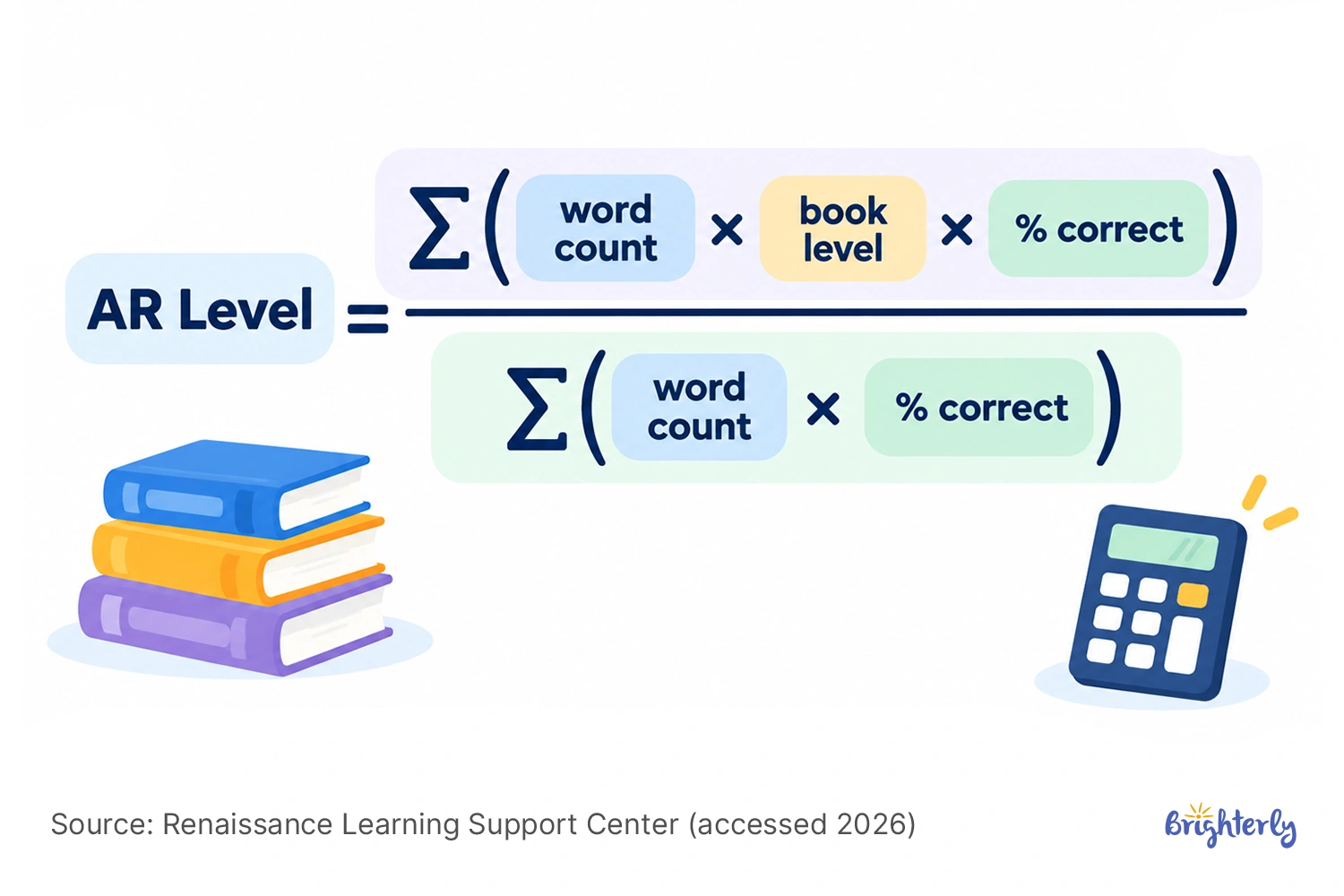
The overall AR reading level for your child is usually the average of all the texts they’ve read. Only the books that have designated AR quizzes are included in the average book level score.
Based on the specifics of AR level calculation, your child won’t progress much if they read books that are too easy for their reading level. Similarly, too hard books will cause too many mistakes or take too long to significantly improve the reading level.
The formula for AR points, or the reward students earn after passing a computer quiz on each new book, is the following:
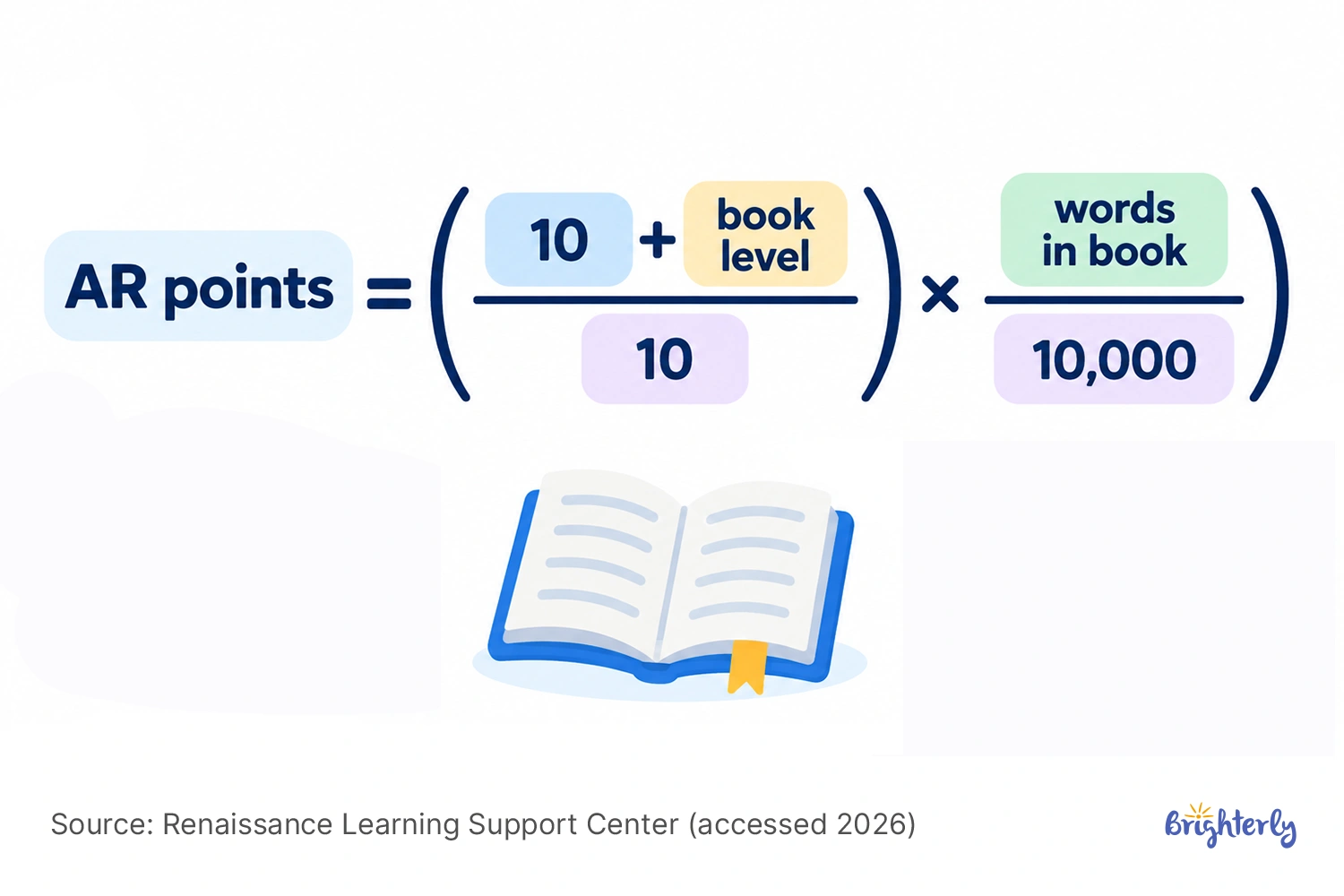
For AR points, the more complicated material your kid reads, the more points they can gain.
Explore Brighterly Learning Experience
Learn exactly how Brighterly helps students thrive through expert sessions, online tools, and proven feedback from thousands of satisfied parents
AR Reading Level Chart by Grade
|
Grade |
Grade Equivalent levels |
Zone of Proximal Development |
|
Kindergarten |
From 0.1 to 0.9 |
– |
|
Grade 1 |
From 1.0 to 1.9 |
From 1.0 to 2.5 |
|
Grade 2 |
From 2.0 to 2.9 |
From 2.0 to 3.3 |
|
Grade 3 |
From 3.0 to 3.9 |
From 2.6 to 4.0 |
|
Grade 4 |
From 4.0 to 4.9 |
From 3.0 to 5.0 |
|
Grade 5 |
From 5.0 to 5.9 |
From 3.4 to 5.7 |
|
Grade 6 |
From 6.0 to 7.0 |
From 4.0 to 6.5 |
|
Grade 7 |
From 7.0 to 8.0 |
From 4.3 to 7.5 |
|
Grade 8 |
From 8.0 to 9.0 |
From 4.5 to 8.0 |
Source: Renaissance Learning Support Center (accessed September 2026)
In theory, the AR level chart principle is straightforward: each number in Grade Equivalent (GE) level stands for the grade (whole number) and a month of a school year (decimal number). For example, the system expects that kids in Grade 3 in the middle of a school year will get a reading score of 3.5.
But in reality, most of the books are written below 6.0. So, reading at the GE level in the older years becomes highly challenging with a limited number of engaging texts. To address this problem, the Accelerated Reader level chart has introduced the Zone of Proximal Development (ZPD), or the range of enjoyable yet still challenging books for reading growth that is broader and starts a bit lower than an expected GE level.
What Are AR Reading Color Levels?
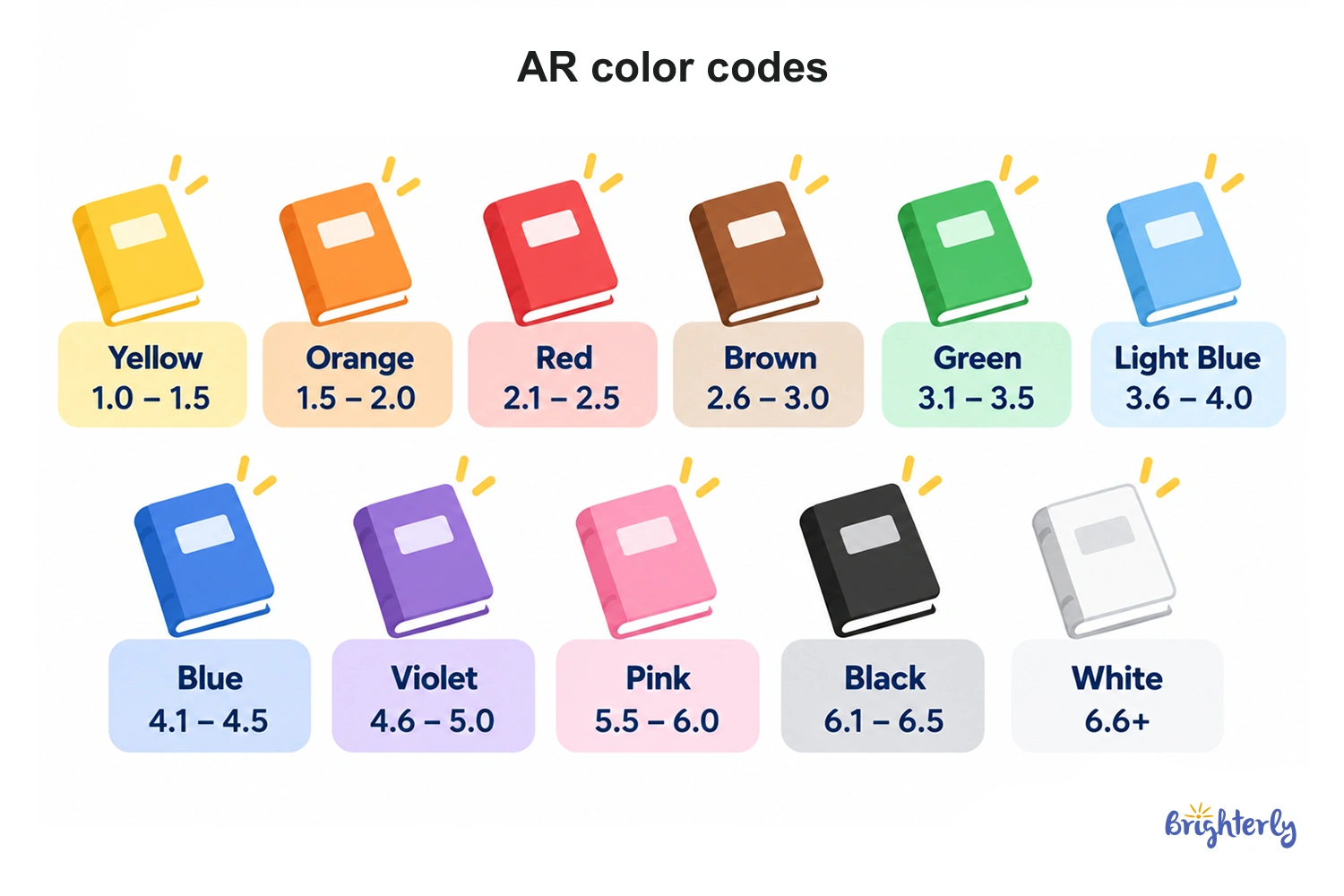
AR color levels are color-coding systems at schools that accelerate the search for just-right books for their reading level and ZPD range. There is no standardized color chart nationwide for AR levels, so each school uses its own color-coding system.
One of the examples of an AR color chart you can use as a template is below:
AR Reading Level vs. Lexile Level
|
Grade |
AR Reading Level (Zone of Proximal Development) |
Lexile Level |
|
Kindergarten |
– |
From BR to 100L |
|
Grade 1 |
From 1.0 to 2.5 |
From 100L to 300L |
|
Grade 2 |
From 2.0 to 3.3 |
From 300L to 500L |
|
Grade 3 |
From 2.6 to 4.0 |
From 500L to 700L |
|
Grade 4 |
From 3.0 to 5.0 |
From 700L to 850L |
|
Grade 5 |
From 3.4 to 5.7 |
From 850L to 900L |
|
Grade 6 |
From 4.0 to 6.5 |
From 900L to 950L |
|
Grade 7 |
From 4.3 to 7.5 |
From 1000L to 1050L |
|
Grade 8 |
From 4.5 to 8.0 |
From 1050L to 1200L |
Sources: Renaissance Learning Support Center, Brooklyn Public Library (accessed September 2026)
You can use scales interchangeably, since the Renaissance Learning system can show both Lexile levels and AR reading levels for one book.
How Do I Find My Child’s AR Reading Level?
To find your child’s AR reading level, you need to contact your school teacher. They get the program from Renaissance Learning to provide you with the parent portal or share with you their recent Star Reading Assessment results.
In the Renaissance Home Connect dashboard, you can see the exact GE score your child is at and the ZPD range of the recommended books for them.
Note: AR reading level (GE score) shows the most difficult text a student can comprehend based on their testing results. It doesn’t mean your child should consistently read literature at the same score for hours.
What an AR Reading Level Does Not Tell You
Since AR accelerated reading levels don’t work like a standardized test, they cannot tell you the detailed reading comprehension capabilities of your child. Also, the testing omits the depth of the text, your child’s personal interests, their critical thinking skills, and the emotional connection they can build with the story.
For a more customized approach, you might need to involve your child in a 1:1 tutor-led reading program.
Get Your Kid a Reading Tutor
Brighterly tutors build a personalized reading program that aligns with US state standards
To guide the book choice on the interest level, Renaissance Learning has developed book tags for age appropriateness:
- LG, or Lower Grades: Kindergarten to Grade 3
- MG, or Middle Grades: Grade 4 to 8
- MG+, or Middle Grades Plus: Grade 6 and up, also marked as YA (Young Adult)
- UG, or Upper Grades: Grade 9 to 12
Note: The interest level for Accelerated Reader reflects the judgment of the book’s publisher and reading specialists. It may be different from what school teachers, parents, or kids themselves find interesting.
Tips to Help Your Child Grow Beyond Their AR Level
The key reading strategies to help your kid outgrow their current AR level include building reading stamina, relying on their current reading interests, and talking about the book instead of focusing on the score.
Note: For struggling readers with reading difficulties, qualified help from a reading tutor for dyslexia may be more effective.
Build Reading Stamina
At times, a lower AR level is a sign of weak reading stamina. To work on this skill, consider:
- Using a reading timer
- Trying read-aloud techniques
- Diversifying the reading material for your child
The more they enjoy the reading practice and keep it up consistently, the more confidence they gain to develop independent reading skills.
Choose Books They Actually Want to Read
Rely on the current interests of your kid instead of simply following the AR book level chart recommendations. Since the testing system doesn’t reflect the real reading passions of children, make sure their reading list includes their current hobbies, favorite book series, or audiobooks they find genuinely interesting to them.
The AR score increases with each new book kids read, so don’t limit them to the literature within their ZPD range only.
Talk About the Book, Not Just the Score
Reading comprehension matters more than a particular AR level achievement. Using guided reading techniques with open questions instead of test-style questionnaires can start deeper conversations and contribute to greater reading comprehension of a text compared to the AR scoring system.
Note: You can browse the full list of reading comprehension strategies to see how you can get involved in improving your child’s reading abilities.
Conclusion
AR scores are a helpful tool to determine the reading level and the range of recommended books in the United States. But parents shouldn’t think of it as a standardized test or limit their kids’ reading lists to the ZPD recommendations only.
To build student literacy over time, you need extra support and time. To take the first step, book a free lesson to get expert advice from our certified reading tutor.
Frequently Asked Questions
Is a Higher AR Reading Level Always Better?
A high AR reading level is a great indicator of your kid’s reading progress, but it’s not always better. Since the AR measurement system doesn’t consider interest in the topic or enjoyment in its calculation, parents should keep an eye on a healthy balance between engagement and reading growth for their kids.
How Many AR Points Is a Book Worth?
The exact number of AR points a kid can gain from a book depends on its level and word count. To achieve more points on a Reading Practice Quiz, a student should aim for a higher ATOS number on a book and longer texts over one-page summaries.
Can My Child Read Books Outside Their AR Range?
AR range is not a strict limit, and your child can read any book they find interesting to them, notwithstanding their AR points. Also, the Zone of Proximal Development (ZPD) along the exact Grade Equivalent (GE) level for your kid allows for more flexibility in choosing the AR book level.
How Often Do AR Reading Levels Change During the School Year?
Even though the AR level number benchmarks prescribe the grade and month in the decimal results your kid receives, the real-life expectations for AR reading level changes are more flexible. The reading growth dynamic changes individually for each kid, so consider taking a regular reading comprehension test to keep their reading progress on track.
Is a Child’s AR Reading Level the Same As Their Official Grade Level at School?
No, the child’s AR reading level is not an official grade-level test that schools use. Accelerated Reader is a supplemental program that schools may use to match young readers with books they can understand more accurately. Also, AR levels don’t take into account the reading interests and the individual learning style peculiarities of students.
What If My Child’s School Doesn’t Use the AR Program?
If your child hasn’t adopted the AR program, you can find free reading comprehension questionnaires or reading speed tests online. Also, schools can rely on alternative reading level scores like Guided Reading Level (GDL) or Developmental Reading Assessment (DRA) levels for reading evaluations, or use Lexile scores to find the books your kid may like.


High school graduation requirements in the United States depend on your state and sometimes your school district. We’ll help you find the right number for your child, see what knowledge they need to have, and understand their options if they’re missing credits. How Many Credits to Graduate High School Do You Need? Most students need […]

Sep 22, 2026
Your kid may need math enrichment, or an extracurricular math practice that helps kids deepen their understanding of the subject, explore more complex concepts, or dedicate more time to the complicated areas. The best math enrichment programs, compared by features, pros/cons, and price, address the goals of math enrichment for kids with different levels of […]

Sep 23, 2026
Math & reading from 1st to 12th grade
Looking for homework support for your child?

Choose kid's grade

Math & Reading for Grades 1–12
Build real confidence for your child with a Brighterly math or reading tutor.