How to Check Your Child’s Reading Level: A Reading Level Test Guide for Parents
reviewed by Marvi M. Andres
Updated on September 24, 2026
Key Points:
- A reading level test evaluates how smoothly and correctly your child reads, categorizing their results into formats like Lexile, Guided Reading Level, DRA, or grade equivalents.
- Parents can monitor reading progress at home using quick methods like the five-finger book test, informal running records, or a simple story retelling check.
- Public schools check student growth with standardized screening assessments: DIBELS – for foundational literacy skills and STAR – for adaptive progress tracking.
- If home-based efforts and regular school support fail to close a reading gap over several months, a formal evaluation or expert guidance can help clarify your child’s particular learning needs.
A reading level test checks and tells you how smoothly and correctly your child reads and how well they understand what they read. You need to know it to match your kid with books that are not too hard and not too easy for them and to find hidden problems (if any) to provide reading help for kids early enough. Find out what DIBELS, STAR, and other reading-level measures mean, how to interpret their results, and which at-home methods you can use yourself to stay informed and updated.
What Is a Reading Level Test?
A reading level test for kids is what defines a child’s reading ability by assessing their
- Fluency – how smoothly and quickly your child reads aloud;
- Accuracy – how correctly they decode and read words;
- Comprehension – how well they understand and remember the meaning of the text.
The most common test result formats are Grade Equivalent, Lexile, and Guided Reading Level.
Explore Brighterly Learning Experience
Learn exactly how Brighterly helps students thrive through expert sessions, online tools, and proven feedback from thousands of satisfied parents
How to Check Your Child’s Reading Level at Home
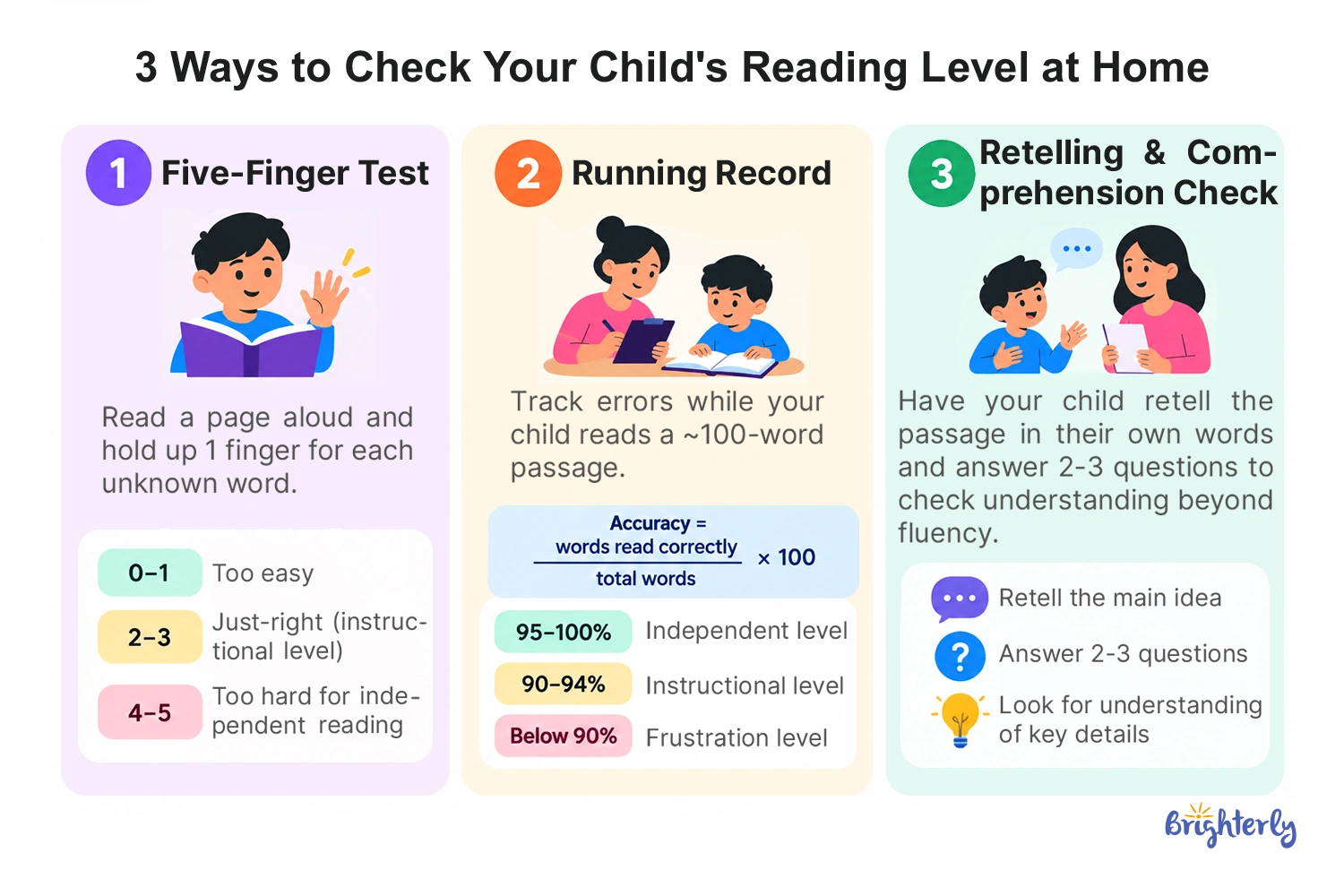
To check your child’s reading level at home, you can choose one of the most widely used methods for that purpose:
- Conduct a five-finger test;
- Do the informal reading inventory;
- Run a retelling and comprehension check.
All these approaches are easily applicable at home.
The Five-Finger Test
The five-finger test reading can quickly show whether or not a book is the right difficulty for your child.
Let them choose a book they’d like to read, ask them to read aloud any page in the middle of the book, and count mistakes they’ll make, holding up one finger every time your child encounters a word they don’t know or can’t read correctly. Result?
|
0-1 fingers |
The book is too easy – your child already knows all the words. |
|
2-3 fingers |
The book is a good fit – it’ll require effort to learn, yet not too hard to discourage. |
|
4-5 fingers |
The book is too difficult – your child will likely struggle to understand the story. |
Running Records (Informal Reading Inventory)
An informal reading inventory defines how accurately and smoothly your child reads a particular text.
How to do a running record?
- Choose a story (of about 100-200 words long) that your child hasn’t read prior to, and make a copy of the same text for yourself to make marks.
- Ask your child to read the text aloud and, as they read, make a checkmark for every word they read incorrectly.
- Count the total number of correct words, divide that number by the total number of words in the text, multiply by 100 to find the percentage, and see what it means below.
|
95% – 100% |
Independent level – your child reads the text easily without help and understands almost everything. |
|
90% – 94% |
Instructional (considered the most optimal level for learning) – your child needs a little bit of help from you to read and understand the text. |
|
Below 90% |
Frustration – the text is too hard for them to read and understand, they make too many mistakes. |
Retelling and Comprehension Check
With a retelling and comprehension check, you can figure out how well your child understands and remembers what they just read.
Depending on their age, have your kid read a chapter aloud or silently, and then ask them to explain what happened in the story in their own words. You may also ask follow-up questions about the main characters, the setting, the main problem, and how the problem was solved.
- If your child remembers the events in the correct order and describes the characters and the main idea, their comprehension is strong.
- It’s only developing, though, if they remember parts of the story but don’t mention important details or mix up the order of events.
- Consider your child’s comprehension poor if they can’t explain what happened or name the main character and the problem – it can mean that the book is too difficult, or your kid decoded the words without understanding the meaning.
DIBELS and STAR: What School Reading Screening Tests Measure
What Is DIBELS Testing?
Public schools employ DIBELS three times a year to find students who might need extra help with reading. DIBELS – Dynamic Indicators of Basic Early Literacy Skills – is a set of fast and short tests (done one-on-one) for checking the reading skills of students from kindergarten to 8th grade that measure:
- How fast a child can name random upper and lowercase letters;
- How well they can divide spoken words into individual sounds;
- How well a kid reads made-up words to show they know basic letter sounds;
- How many correct words can they read aloud from a real passage in one minute;
- How accurately and fluently a kid can read individual real words;
- How well they understand a passage, choosing words that make sense in context.
What Is the STAR Reading Test?
The STAR is a computer-based assessment that public schools employ to check the reading progress of students from 1st grade to 12th grade. Students read short passages and pick the correct answer from a list, and the computer changes the difficulty of the questions based on how your child answers. STAR answers the question, ‘How do I know my child’s reading level?’, measuring:
- Vocabulary, word parts, and structural analysis.
- Understanding the main idea, details, and sequence of events in a text.
- How well a child understands both literary and informational texts.
Schools give this test three or four times a year to watch how much your child’s reading skills grow over time. The test then results in a ZPD score (Zone of Proximal Development) that tells teachers the book level range your kid needs for independent reading practice, and a Scaled Score – for comparing performance over time and across grades.


Can’t tell if your child reads at level?
Find your child’s reading level and choose support that fits their needs.
Other Reading Levels and Measures You Might See: Lexile, GRL, DRA, AR, and Reading Speed
Report cards and school papers frequently use different numbers and letters to show your child’s reading progress. For a quick overview of the most widely used reading levels and measures, see their main characteristics in brief:
|
How it looks (example) |
What it measures |
How it’s used |
|
|
600L (or BR for beginners) |
Your child’s reading ability and the difficulty of a text using the same scale. |
Matches your child with books of the correct difficulty so they can read without feeling frustrated. |
|
|
Level J (scale from A to Z) |
Text complexity based on picture support, repeating words, sentence length, and vocabulary. |
Teachers use it to group students for small reading circles and choose appropriately challenging books. |
|
|
Level 28 (scale from 1 to 80) |
Reading accuracy, word-solving skills, and comprehension – during a 1:1 reading session. |
A teacher listens to your child read aloud and evaluates their overall reading performance to assign a level. |
|
|
3.4 (grade 3, month 4) |
Whether a student read and understood a particular independent reading book. |
Students take a short computer quiz after reading a book to check understanding and earn points. |
|
|
Words-per-minute (WPM) |
How fast, smoothly, and accurately your child reads a passage out loud without mistakes. |
Tracks fluency growth, which naturally increases as your child gets older and learns more words. |
If you’d like to learn more and need deeper details about each of the reading level measures and how they compare – see how Lexile, GRL, DRA, and AR line up by grade.
Can’t make sense of reading level reports?
See what your child’s scores say about their reading skills and progress.
When to Seek a Formal Reading Evaluation
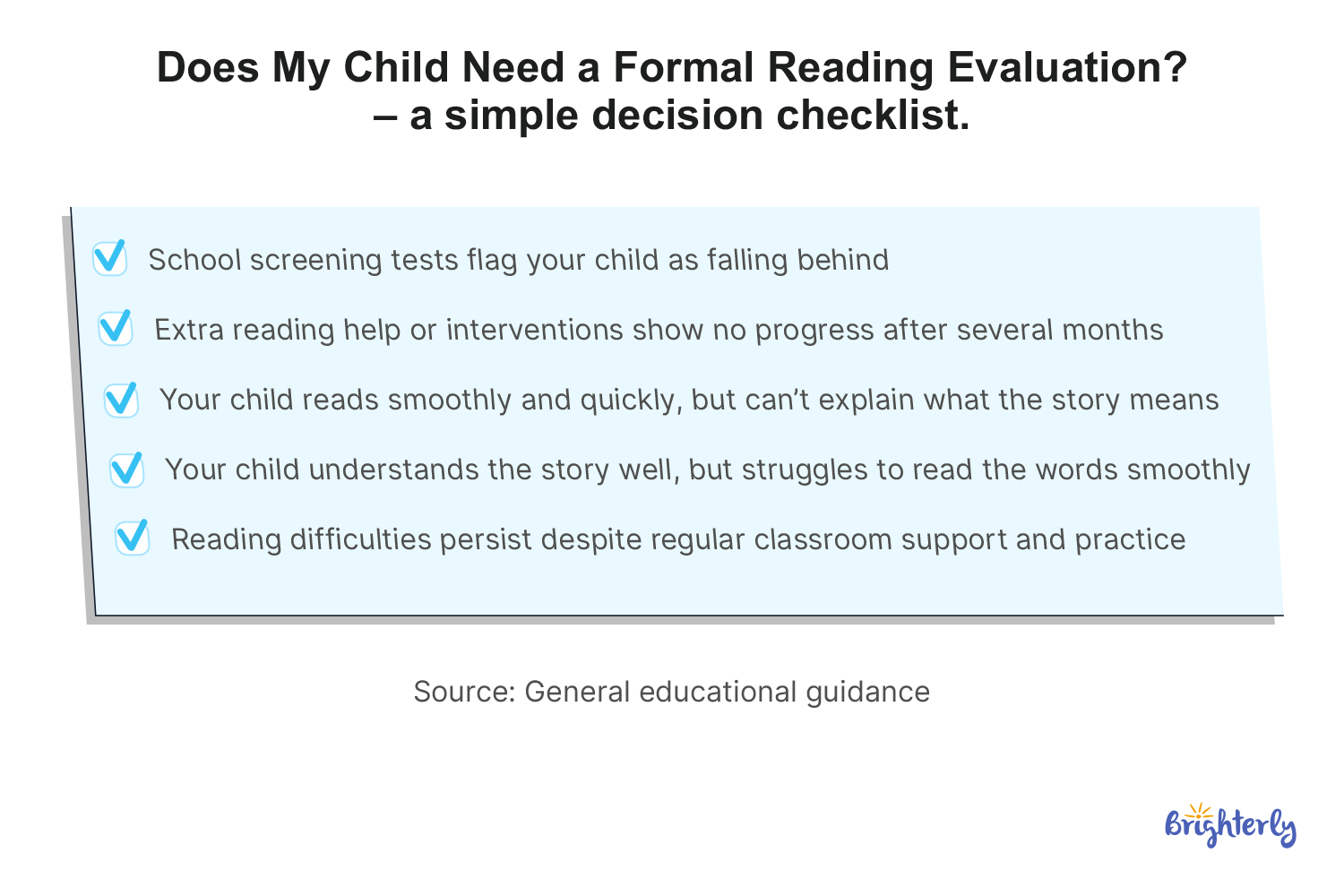
- Regular check-ins at school flag kids who are starting to fall behind their classmates – if the teacher notifies you about such a risk, it’s an early warning sign to look for a professional answer to the question ‘what reading level is my child?’
- If your kid receives extra reading help or interventions for several months, but regular classroom support and practice still don’t close the gap, it’s time to check deeper.
- Sometimes a child reads words very smoothly and quickly, but can’t tell you what the story was about. Other times, a kid understands the story well, yet it’s hard for them to read the words smoothly. When these two skills don’t match, it points to a particular difficulty with learning.
What to Do With Your Child’s Reading Level Results
If, having received your kid’s test results, you know what they mean – i.e., you understand exactly which skills they might need to practice, check our reading worksheets. They’re free, printable, and classified by grade and topic – you can head straight to paragraph comprehension worksheets, for instance, summary practice worksheets, etc.
Depending on the skills, after extra practice, let them take a reading level test, reading speed test, or a reading comprehension test (all free as well) to see their progress.
See no progress? Consider enrolling in our reading program and reading comprehension program – 1:1 online lessons with US state standards-aligned yet personalized to your child’s needs learning plans. Reading support for dyslexia is available as well.
Additionally, you get extra practice between lessons – for example, our AI reading assistant, Readerly, will listen to your child reading aloud tracking their progress book by book.
Conclusion
Even if understanding your child’s reading level test results still feels like decoding a foreign language, now you know how to monitor fluency with a running record (or book difficulty with a five-finger test) and compare Lexile scores to better understand a school report card. But if your home-based efforts don’t feel like enough, book a free reading lesson at Brighterly to clarify your child’s actual skill levels and particular learning needs so you know exactly what steps to take next.
Frequently Asked Questions
How Often Should You Test Your Child’s Reading Level?
For most kids, an informal check at home can be done every two or three months. With such intervals, your child will be able to build better vocabulary and practice more decoding. As a rule, schools screen students three times a year – fall, winter, and spring – employing a standardized tool like DIBELS or STAR. Aligning your informal home checks between these school windows will help you stay informed without overlapping too closely with official evaluations.
Is My Child’s Reading Level the Same as Their School Grade?
A child’s reading level is often different from their actual grade in school because a grade level represents the average expectation for students of a particular age, but every child develops literacy skills at their own unique pace. Some children read comfortably above their current grade, easily handling complex vocabulary and advanced themes. Others, however, need materials from a grade or two lower to practice decoding and comprehension without added stress. Using the right level of text (instead of forcing a grade-level book) is what ultimately helps your child grow into a stronger and more capable reader.
My Child Reads Fluently but Doesn’t Understand What They Read – What’s Going On?
When a child reads words smoothly and quickly but can’t explain the story afterward, it means their decoding and fluency skills are strong, yet their reading comprehension isn’t keeping up. Reading fluency involves recognizing and pronouncing words automatically, and comprehension needs active mental processing, vocabulary knowledge, memory, and the ability to make inferences. A child can easily sound like an expert reader yet treat words as mere sounds, not connecting them to meaning. This mismatch might point to limited vocabulary, difficulty making sense of text structure, or poor working memory.
Is an Online Reading Level Test as Accurate as a School Assessment?
If you know how to check reading level of your child at home, you can get a helpful quick picture, but it can’t replace school screenings like DIBELS or STAR that employ structured, standardized metrics that educators administer and adjust over multiple sessions in the school year. Online tests provide fast insights regarding particular skills – reading speed or general vocabulary – for practice at home. However, a formal school assessment evaluates a wider set of literacy indicators and provides official data further used for educational planning.
Do Reading Level Tests Work the Same Way for Kids With Dyslexia or ADHD?
Standard reading level tests don’t work in the exact same way for kids with dyslexia or attention differences. Given that dyslexia predominantly affects phonological processing, decoding, and word recognition, a child can score artificially low on tests that measure timed reading fluency or isolated word pronunciation, even if their actual comprehension of spoken stories is strong. Likewise, a child with ADHD may struggle with timed computer-based assessments or long reading passages due to problems with focus. For accurate evaluation of these learners, use specialized and multi-sensory diagnostic tools and individualized observation.

Most public schools in the United States introduce Geometry to students in 9th or 10th grade. Find out why this timeline is the most common, how this class fits into the math sequence, what the class actually covers, and what signs may mean a kid is ready to start Geometry earlier. What Grade Is Geometry […]

Sep 23, 2026
Math & reading from 1st to 12th grade
Looking for homework support for your child?

Choose kid's grade

Math & Reading for Grades 1–12
Build real confidence for your child with a Brighterly math or reading tutor.