Reading Level by Grade: Lexile, GRL, DRA & AR Compared
reviewed by Laila A. Lico
Updated on September 23, 2026

Key Points:
- Lexile measures word frequency and sentence length on a numeric scale.
- GRL – Guided Reading Level – employs running records to assess real-time accuracy, fluency, comprehension, and text characteristics.
- DRA – Developmental Reading Assessment – implies that an educator listens to a student read aloud to track miscues, self-corrections, oral retelling, and written responses.
- AR/ATOS – Accelerated Reader – uses an algorithmic formula to measure text readability and monitor comprehension via computerized quizzes.
- All reading level by grade charts employ different scales and metrics, applying varied methods, so if your child scores differently in various tests, such score discrepancies are normal.
- Address reading level gaps with home adjustments and diagnostic tests first, or resort to reading tutors if persistent difficulties continue.
Reading level systems – Lexile, Guided Reading, DRA, and AR – don’t always agree because they measure different aspects of reading. And it’s easy for parents to get confused about which to rely on. This guide lines them up by grade, explains how different testing systems compare, what each of them measures, how to correctly interpret the results, and what to do if they don’t meet grade (or your) expectations.
Reading Level Chart by Grade: Lexile, Guided Reading, DRA & AR
|
Grade |
Lexile |
Accelerated Reader (AR) / Grade Equivalent |
||
|
Kindergarten |
BR–230L |
A–D |
1–4 |
0.0–1.0 |
|
Grade 1 |
190L–530L |
D–J |
4–16/18 |
1.0–1.9 |
|
Grade 2 |
420L–650L |
J–M |
16/18–24/28 |
2.0–2.9 |
|
Grade 3 |
520L–820L |
M–P |
24/28–38 |
3.0–3.9 |
|
Grade 4 |
740L–940L |
P–S/T |
38–40/44 |
4.0–4.9 |
|
Grade 5 |
830L–1010L |
S/T–V |
40/44–50 |
5.0–5.9 |
|
Grade 6 |
925L–1070L |
V–X/Y |
50–60 |
6.0–6.9 |
|
Grade 7 |
970L–1120L |
X/Y–Z |
60–70 |
7.0–7.9 |
|
Grade 8 |
1010L–1185L |
Z–Z+ |
70–80 |
8.0–8.9 |
|
High School (9-12) |
1050L–1385L+ |
Z+ |
80+ |
9.0–12.9 |
The ranges above show broad grade-level patterns for the time being – September 2026 – and are not exact conversions between reading level systems. A child can be at different points in Lexile, Guided Reading, DRA, and AR because each system employs its own reading level scale and assessment approach.
❗Source note: Lexile grade-band information is cross-checked against guidance from the Georgia Department of Education, Nevada Department of Education, and Texas Education Agency.


Confused by different reading level scores?
Assess your child’s skills and find the right reading support for them.
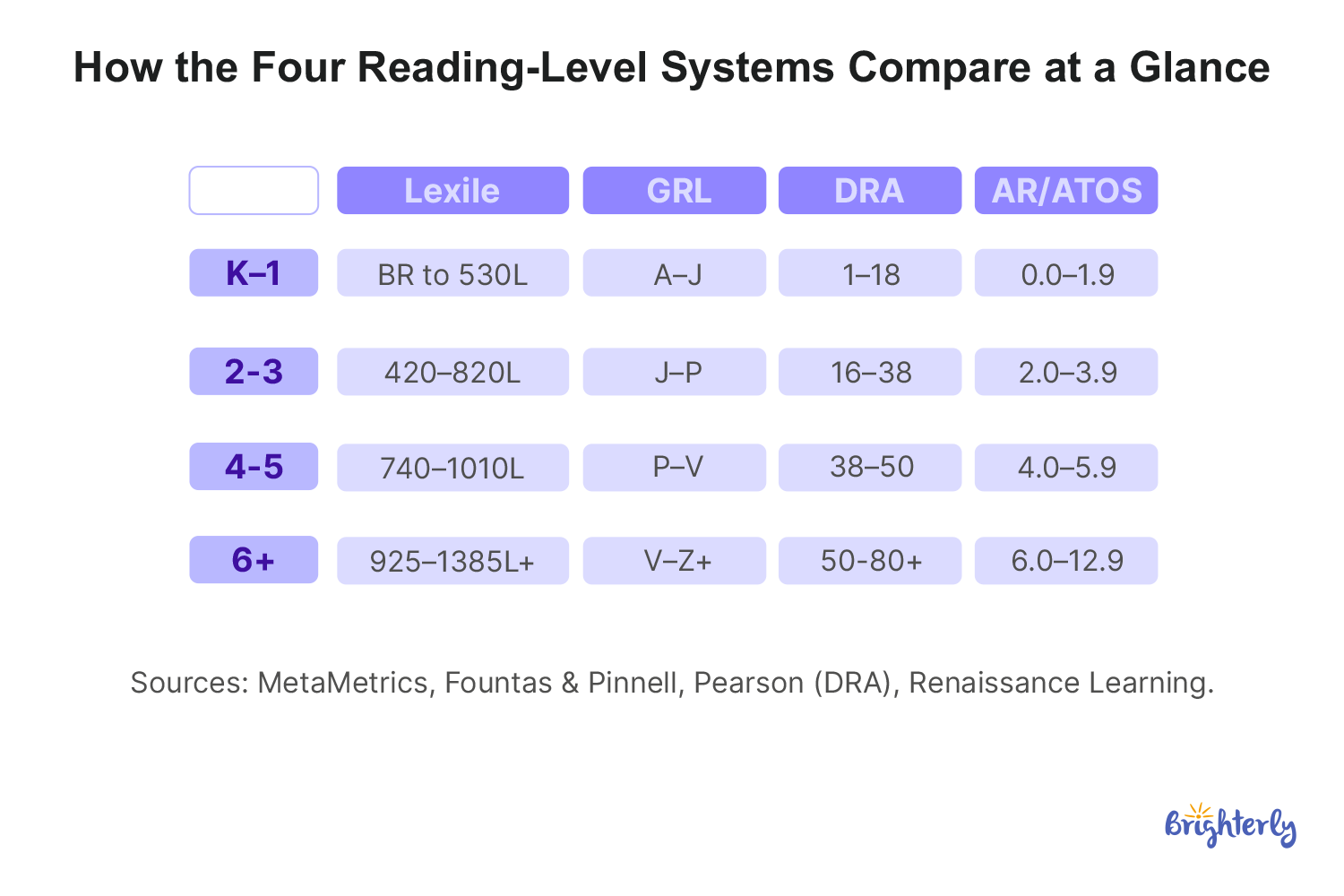
How the Four Reading-Level Systems Compare at a Glance
- Lexile employs a numeric scale, with higher values indicating more complex text.
- GRL uses lettered tiers, from early levels (A) to more advanced (Z+).
- DRA implies numeric levels that increase with reading skills and text demands.
- AR/ATOS entails a readability-based measure expressed along with grade-equivalent values.
Explore Brighterly Learning Experience
Learn exactly how Brighterly helps students thrive through expert sessions, online tools, and proven feedback from thousands of satisfied parents
Why Reading Level Charts Don’t Always Agree
To evaluate text complexity and student performance, Lexile, Guided Reading, DRA, and AR all employ different fundamental metrics and developmental scales. Every reading level chart might also differ because testing developers update their algorithms independently, and standardized tests rely on different testing schemes.
Depending on the system and what exactly it measures – word frequency, sentence length, vocabulary density, teacher-observed oral reading behaviors, etc. – your child might score at grade level on a Lexile assessment, for instance, yet fall somewhat above or below that range on a Fountas and Pinnell guided reading level.
When conflicting scores in different systems complicate figuring out your child’s true proficiency, you can resort to our free diagnostic assessments preceding our customized reading program or specialized reading comprehension program. Based on factual test results, our professional tutors further adjust a learning plan of 1:1 US-state standards-aligned online lessons to your child’s actual reading needs, not locking into any single-score evaluations. Our pricing options start at $17.70/lesson (2 lessons/week, 12-month plan, 20% discount as of September 2026).
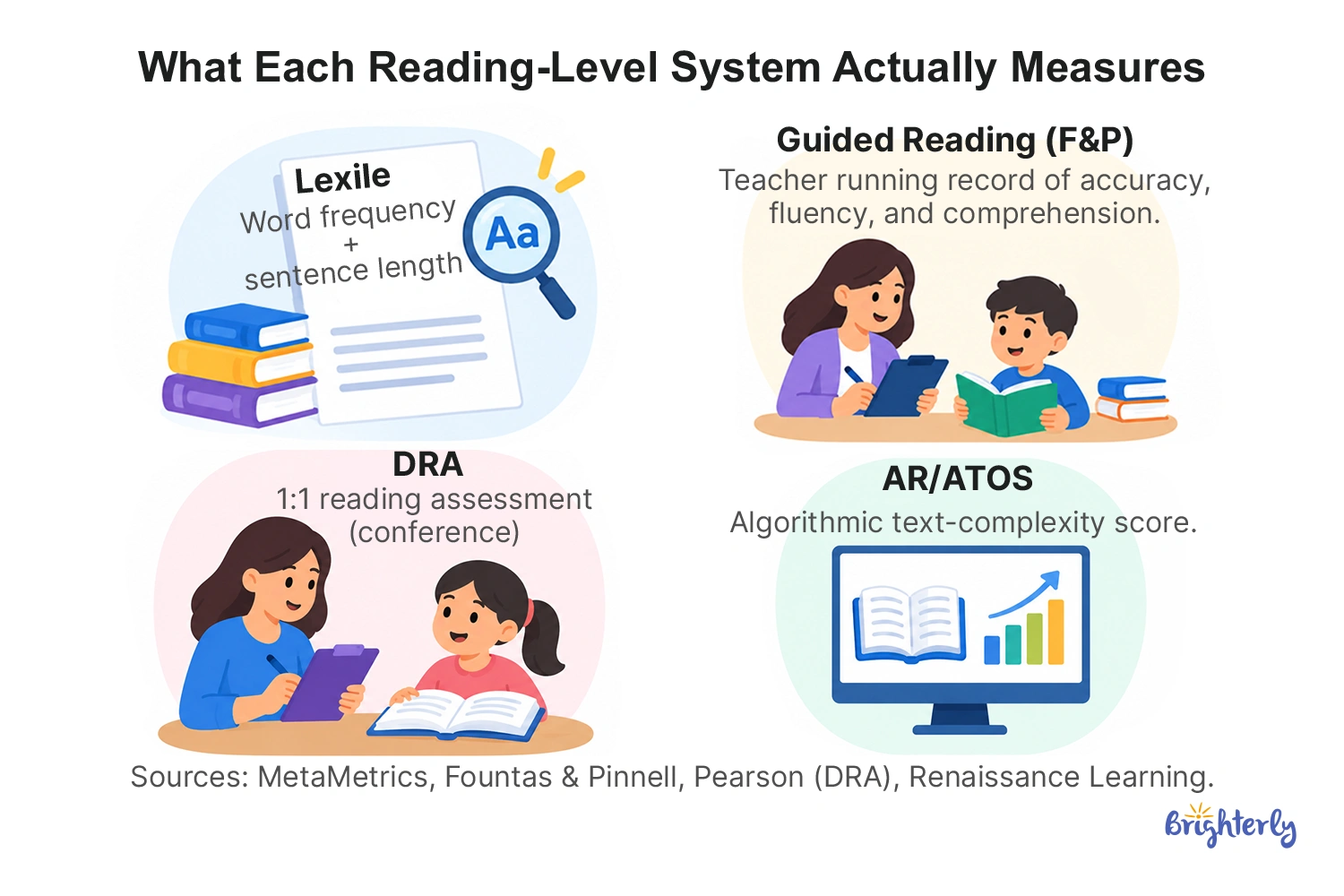
What Each Reading-Level System Actually Measures
Lexile
Evaluating text complexity, Lexile levels measure semantic difficulty (word frequency) and syntactic complexity (sentence length), matching a student’s reading ability with text difficulty on a separate developmental scale. As a quantitative criterion with a focus on vocabulary and sentence structure, Lexile is widely used for library books and independent reading selection.
Guided Reading Level (GRL)
Guided Reading Level assesses a student’s reading proficiency with teacher observation, running records, accuracy, fluency, and comprehension during small-group instructional reading. The GRL grade level reading chart evaluates how a reader handles books with varying text characteristics – layout, illustrations, sentence complexity, and literary structure – providing a teacher-led qualitative perspective on real-time reading behaviors and comprehension strategies in guided classrooms.
DRA (Developmental Reading Assessment)
The DRA reading level implies that an educator listens to a student and tracks particular miscues and self-corrections, further evaluating how smoothly and thoughtfully students read aloud. DRA differs from other systems because it prioritizes structured teacher observation and a student’s ability to orally retell or write responses about a text. Within the overall comparison, the DRA supplies a teacher-evaluated diagnostic metric.
Accelerated Reader (AR / ATOS)
The AR reading level employs the ATOS algorithmic text-complexity formula to measure the readability of books based predominantly on quantitative factors – average sentence length and word length, and vocabulary difficulty. As a software-based quantitative system with a focus on independent reading and student responsibility, the AR reading levels by grade chart matches students with relevant reading practice and monitors comprehension with computerized quizzes.
Where the Systems Disagree — and Why That’s Normal
According to the National Center on Improving Literacy, different reading tests measure different skills, so the way a test is given and how it’s scored will ultimately change the final results. Algorithmic systems – like Lexile and AR/ATOS – calculate text complexity from quantitative variables such as word frequency and sentence length. In contrast, observational methods – like Guided Reading and DRA – stand on teacher evaluation of oral reading behaviors, monitoring real-time accuracy, fluency, self-corrections, and comprehension.
Guided Reading is used for younger instructional grouping; DRA mainly applies in primary grades and becomes less precise afterward; Lexile better deals with advanced middle and high school texts. So, given the structural split, a student who decodes text fluently but struggles with deep analytical comprehension will often score higher on an algorithmic scale than on an observational one. Furthermore, different testing atmospheres – either a quiet, one-on-one running record or a computerized adaptive test in a noisy classroom – affect a child’s performance as well. Given that none of the four systems converts identically into another, published correlation tables are only approximations.
Cross-System Discrepancy Examples
|
Scenario |
What the parent sees |
Why the scores differ |
|
The fast and fluent fiction reader |
High Lexile score for chapter books, but a lower Guided Reading level in class. |
The child reads words quickly, but the small-group teacher checks catch missed vocabulary nuances and low comprehension depth. |
|
The quiet reader |
High independent digital test score, but lower oral fluency score on a teacher-run record. |
The child excels at silent independent reading on a computer, but stumbles when forced to read out loud and keep pace with a teacher. |
|
The mismatched district report card |
A student marked ‘at grade level’ on a state digital test, but ‘below benchmark’ on a classroom running record. |
The district employs a mix of algorithmic screening for school-wide tracking and manual running records for daily instruction. |
What Reading Level Should My Child Be at, by Grade?
- What Reading Level Should a Kindergartner/1st Grader Be At?
Kids’ levels from kindergarten to grade 1 reading skills are expected at Lexile scores ranging from Beginning Reader up to around 530L; Guided Reading – from A to J; DRA levels covering 1 to 18; and Accelerated Reader grade equivalents – from 0.0 to 1.9.
- What Reading Level Should a 2nd Grader/3rd Grader Be At?
Given that at this age, kids shift to independent reading and chapter books, your child should strive for grade 2 reading skills and grade 3 reading skills at levels: Lexile – from 420L to 820L; Guided Reading – from J to P; DRA – from 16/28 to 38; and Accelerated Reader – covering 2.0 to 3.9.
- What Reading Level Should a 4th Grader/5th Grader Be At?
Moving from learning to read to reading to learn, 4th grade reading and 5th grade reading skills are expected at the following levels: Lexile – from 740L to 1010L; Guided Reading – from P to V; DRA – from 38 to 50; and Accelerated Reader – from 4.0 to 5.9.
- What Reading Level Should a 6th Grader and Up Be At?
In the 6th grade reading curriculum and 7th grade reading curriculum in all four systems, students already deal with dense vocabulary and abstract concepts. So, get ready to reach: from 925L to 1385L+ (Lexile); from V to Z+ (Guided Reading); from 50 to 80+ (DRA); from 6.0 to 12.9+ (Accelerated Reader).
Unsure where your child stands in reading?
See how your child’s reading skills compare and identify areas for growth.
How to Understand Your Child’s Reading Level Results
When interpreting the reading level conversion chart, don’t try to find one ‘correct’ number. Look at the overall pattern:
- Check whether the results generally point to a similar grade band in Lexile, Guided Reading, DRA, and AR. A small difference between systems is normal, yet if it’s significantly large, discuss it with your child’s teacher.
- A higher or lower number in one system doesn’t automatically mean the same change in another – use each score within the scale it was designed for.
- Look at the results from several testing periods because one assessment is only a snapshot, and whether your child makes progress or stays at approximately the same level is more important.
- If one assessment places your child noticeably higher or lower than the others, use this discrepancy as a reason to look more closely at the underlying skills.
- A child who has problems with decoding may need more practice with phonics and word recognition. Those who read words accurately but struggle to explain a text might need more work on vocabulary or making inferences. Therefore, consider the reading level as an appropriate starting point, but the particular skill gap should guide practice.
- When analyzing reading level vs. age, consider reading speed separately because a child can understand grade-appropriate text but read it slowly, or read quickly without fully understanding it. If reading pace is your concern, check the guidelines for pacing by age, and evaluate fluency and comprehension together.
Note: If you need to fasten your child’s reading pace, remember that you may apply tips and strategies yourself or consider specialized speed reading apps (the top list is updated for 2026-27).
What to Do When a Reading Level Is Below or Above Grade
- For minor score gaps, try home-based adjustments first.
If your child’s reading level is below grade expectations, increase shared reading time, practice decoding unfamiliar words with phonics, and pay more attention to vocabulary in everyday conversations.
In case your child reads above grade level, offer more challenging texts in different genres and encourage them to discuss the characters, themes, evidence, and ideas they encounter.
- Assess particular skill gaps with our free diagnostic tools.
Use our reading speed test to check how many words your child reads per minute and compare it with the typical range for their age group. You can also use our reading comprehension test to examine how your kid identifies main ideas and key details, makes inferences, understands vocabulary in context, analyzes text structure, and uses evidence.
- Look for patterns.
See whether the discrepancy is isolated to one computer test or shows repeatedly in teacher evaluations and daily reading tasks. Temporary factors like testing anxiety or unfamiliar text formats often lead to disorienting score drops.
- Get professional help.
If your child remains multiple grade levels behind in several testing periods or persistently shows intense frustration and trouble, consider early reading tutoring or middle school reading help – personalized to your child’s needs yet US state standards-aligned 1:1 online lessons.
Conclusion
Given that different tests measure different things, no surprise that you might still wonder about your child’s real reading level. However, as emphasized above, a focus on their overall progress over time will be more representative than any single score. Practice at home, use diagnostic tools, get steady support – professional and human: book a free lesson with Brighterly and get that reading-level confusion finally clarified.
Frequently Asked Questions
Is It Normal for a Child’s Reading Level to Vary From Month to Month?
Yes, it’s normal. Variations can happen because performance can be influenced by temporary factors like testing anxiety or unfamiliar text formats. Additionally, given that different systems measure particular skills (algorithmic text complexity versus teacher-observed oral reading behaviors), scores can fluctuate depending on the type of test given. That’s why looking at results during several testing periods is more important to see whether your child is making progress, staying at approximately the same level, or encountering difficulties with increasingly complex texts.
How Often Should a Child’s Reading Level Be Reassessed?
There’s no universal rule that every child should have a formal reading level assessment every few months. For K-3 students, guidance from the Institute of Education Sciences recommends screening all students at the beginning of the school year and again in the middle of the year. It also recommends regularly monitoring students who are at elevated risk for reading difficulties. For students receiving Tier 2 reading intervention, the guidance recommends monitoring progress at least once a month.
Can a Child Test Differently on Lexile and Guided Reading Level in the Same Month?
Yes. A child can receive different results in systems in the same month because Lexile, Guided Reading (GRL), DRA, and AR all employ different fundamental metrics and developmental scales. Lexile measures semantic difficulty (word frequency) and syntactic complexity (sentence length) in quantitative digital or adaptive tests, and Guided Reading entails small-group teacher observations of real-time accuracy, fluency, self-corrections, and comprehension. Given that none of the four systems convert identically into another and each measures different skills, a child might score at grade level on a Lexile assessment yet fall above or below that range on a Guided Reading level.
Do Reading Level Charts Work the Same Way for English Language Learners?
Although reading level charts employ the same scales for English Language Learners (ELLs), the scores may need to be interpreted differently. A 2026 NCELA fact sheet (based on 2025 state-level assessment data), supported by the US Department of Education’s Office of Elementary and Secondary Education, particularly notes that testing students in a language they’re still learning can complicate defining whether an assessment gap reflects content knowledge or English proficiency. So, when interpreting a Lexile, GRL, DRA, or AR result for an ELL, consider the child’s English proficiency, time learning English, vocabulary, decoding, and comprehension.
What Does an “Advanced” Reading Level Mean at a Given Grade?
An “advanced” reading level usually means that a student can handle more complex texts and reading tasks than expected at their grade level. The National Center for Education Statistics (NCES) describes the NAEP Advanced level as representing superior academic performance. For advanced performance in reading, students may need to make complex inferences, evaluate an author’s choices, connect ideas across texts, synthesize evidence, and analyze literary or informational texts. So, anyway, “advanced” doesn’t equal simply having a high Lexile or AR number.
How Is a Grade Equivalent Score Different From a Reading Level?
A grade equivalent score – used in Accelerated Reader/ATOS – is a particular decimal value (like 4.0 to 5.9) representing a grade level and month based on an algorithmic text-complexity formula. In contrast, other reading levels employ different fundamental metrics and scales: Numeric ranges for Lexile, lettered tiers for Guided Reading (GRL), or educator-evaluated numeric scores for DRA – which all measure different elements.

Your kid may need math enrichment, or an extracurricular math practice that helps kids deepen their understanding of the subject, explore more complex concepts, or dedicate more time to the complicated areas. The best math enrichment programs, compared by features, pros/cons, and price, address the goals of math enrichment for kids with different levels of […]

Sep 23, 2026
Math & reading from 1st to 12th grade
Looking for homework support for your child?

Choose kid's grade

Math & Reading for Grades 1–12
Build real confidence for your child with a Brighterly math or reading tutor.