What Is a DRA Reading Level? A Parent’s Guide to the Grade Chart
reviewed by Marvi M. Andres
Updated on September 18, 2026
Key Points:
- DRA reading level is a school-based assessment that identifies your child’s reading accuracy, fluency, and comprehension on a scale from A/1 to 80.
- DRA assessment takes place up to 3 times per year and is a current snapshot of your kid’s reading level, not a standard or a permanent verdict on their reading abilities.
- To understand if the DRA level is good or bad, check how your child feels about their current books and introduce a customized learning plan if necessary.
Your child brought home DRA testing results, but you don’t know what DRA means and what to do next? DRA reading level assessment happens around twice a year — see how to prepare for the next test with your kid at home or whether they need extra online reading tutoring help like Brighterly’s.


First Demo Lesson Is Totally Free!
Get a Brighterly reading tutor and prepare for the next DRA assessment
What Is the DRA Reading Level?
DRA, or Developmental Reading Assessment, is a reading scale published by Pearson that runs from A/1 to 80 and measures reading accuracy, oral fluency, and comprehension. The DRA reading level for grades 1-8 is usually a number.
Teachers usually conduct the DRA assessment to compare each student’s reading abilities with the expected reading proficiency for their grade. Based on the assessment results, they can adjust the learning plan and get the just-right books for the student’s reading level.
Explore Brighterly Learning Experience
Learn exactly how Brighterly helps students thrive through expert sessions, online tools, and proven feedback from thousands of satisfied parents
How Does DRA Testing Work?
Usually, kids get their DRA result after passing a 1:1 test with their teacher. Parents cannot run the DRA test themselves because the assessment requires a trained specialist who follows a standardized testing procedure. Still, you can practice reading skills that DRA assesses or imitate the testing sequence with your child at home.
Here is a typical DRA testing process:
- A child reads aloud a leveled passage: A teacher finds a reading passage that is likely to match the current reading abilities of a student. Kids are usually allowed to preview the text before starting to read it.
- The teacher asks the student to retell the story they just read: After recording reading accuracy, the teacher will ask your child to describe the main things that happened in the story.
- The student answers several questions that determine their reading comprehension: As the final step, the teacher will ask comprehension questions to test literal understanding, personal interpretation, and the ability to build logical connections. Reading comprehension may be a written test for older students.
As of September 2026, DRA3 is the latest version of the assessment. Compared to the still widely used DRA2 version, DRA3 test added more flexibility and accuracy to the grade-level texts. The versions didn’t change how the testing works, but DRA3 added several revised materials, more fiction and non-fiction choices for all the reading levels, and special “Intermediate Bridge” texts for struggling students.
DRA Reading Levels Chart by Grade
|
Grade |
Expected DRA Level (beginning of the year) |
Expected DRA Level (middle of the year) |
Expected DRA Level (end of the year) |
|
Kindergarten |
A |
1 |
3 |
|
Grade 1 |
3 |
10 |
16 |
|
Grade 2 |
16 |
20 |
28 |
|
Grade 3 |
28 |
34 |
38 |
|
Grade 4 |
38 |
40 |
40 |
|
Grade 5 |
40 |
– |
50 |
|
Grade 6 |
50 |
– |
60 |
|
Grade 7 |
60 |
– |
70 |
|
Grade 8 |
70 |
– |
80 |
Source: Pearson Benchmark recommendations (accessed September 2026).
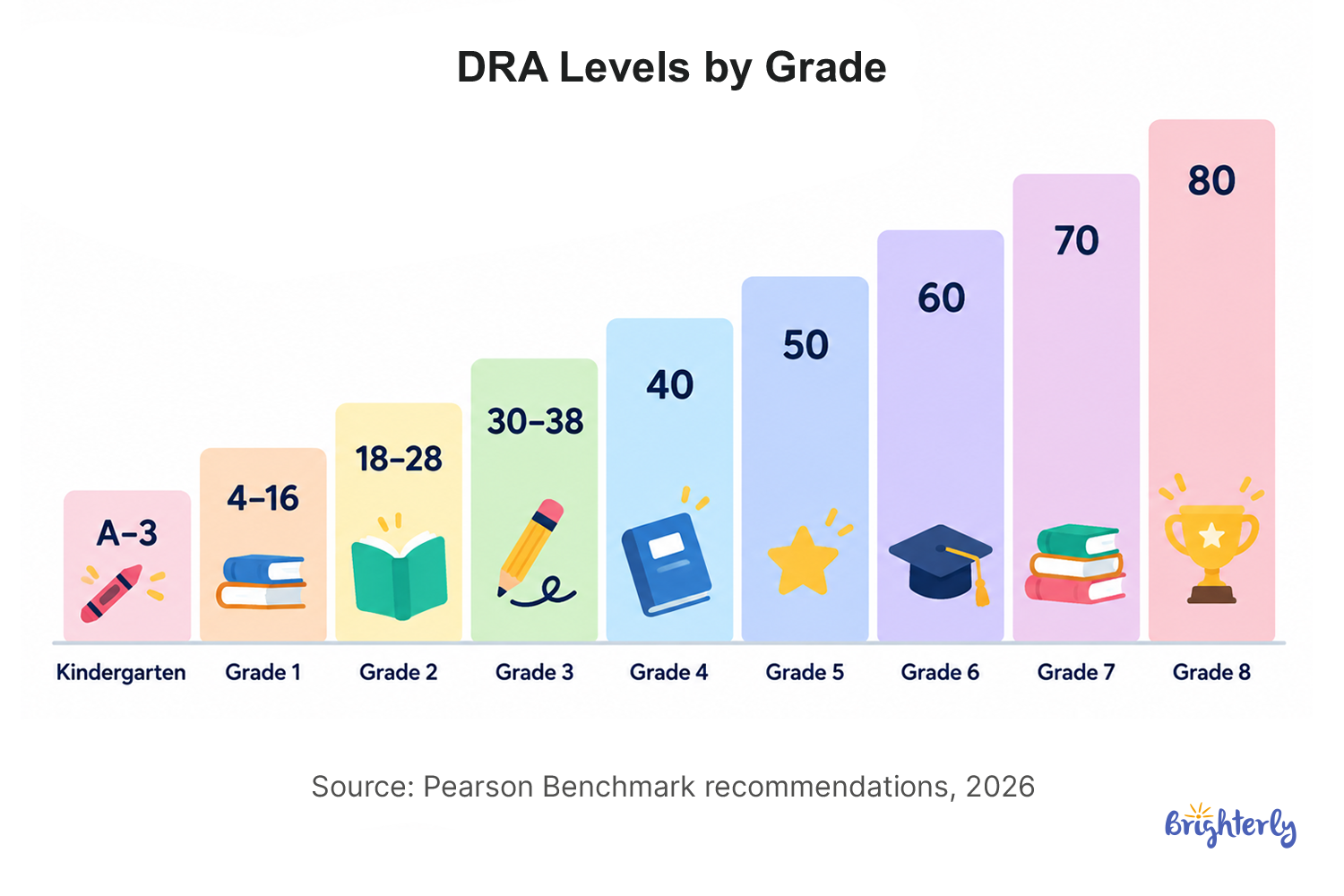
To interpret the DRA result after the test, Pearson has developed recommended benchmarks for K-8 students in alignment with Common Core standards. The numbers are suggestions, and teachers are free to adjust the recommendations to individual students.
Note: Do not consider the DRA level chart as a typical grade-level standard. They are approximate numbers that may overlap between grades. Also, they do not consider the individual learning pace and style of your child.
DRA Reading Level vs. Lexile and Guided Reading
|
Grade |
DRA expected range |
Lexile expected range |
Guided Reading Level expected range |
|
Kindergarten |
From A to 3 |
From BR to 100L |
From A to E |
|
Grade 1 |
From 4 to 16 |
From 100L to 300L |
From E to K |
|
Grade 2 |
From 18 to 28 |
From 300L to 500L |
From J to N |
|
Grade 3 |
From 30 to 38 |
From 500L to 700L |
From M to Q |
|
Grade 4 |
40 |
From 700L to 850L |
From P to T |
|
Grade 5 |
50 |
From 850L to 900L |
From S to W |
|
Grade 6 |
60 |
From 900L to 950L |
From V to Z |
|
Grade 7 |
70 |
From 1000L to 1050L |
From X to Z |
|
Grade 8 |
80 |
From 1050L to 1200L |
From X to Z |
Sources: Pearson Support Center, Fountas & Pinnell Instructional Level Expectations for Reading, Brooklyn Public Library (accessed September 2026)
The key difference between DRA, Lexile, and GRL/F&P (Guided Reading Level by Fountas and Pinnell) is the measurement system and the focus of their assessment:
- DRA levels by grade measure reading accuracy, fluency, and comprehension under a standardized, teacher-led procedure.
- Lexile score determines the complexity of the text by analyzing its parameters like word frequency and sentence complexity. The Lexile scoring system generally omits familiarity with the topic and the complexity of the ideas.
- GRL levels measure students’ reading accuracy, fluency, and comprehension on an alphabetical scale from A to Z to match them with just-right books for their reading level.
Neither of the reading level measurement systems is a standard test. Also, it’s not common to use them interchangeably, as each reading-level assessment depends on the context, the current school environment, and the individuality of the student being assessed.
Note: Whenever you see a conflict in the reading level correlation chart, prioritize your kid’s demonstrated reading skills over getting the expected letter or number for their grade on any measuring scale.
What Is a Good DRA Level for My Child?
Within the Developmental Reading Assessment system, a good DRA reading level is one that sits within or is steadily climbing toward the expected range for your child’s grade. The direction of progress over time matters more than hitting a specific number at any one test.
For example, if your third grader has got 40 at the end of a school year, they are performing way better than the expected 30-38 range in the grade-level reading chart. If they got 35 in the middle of a school year, they are also above the expected 34 DRA reading level.
But in reality, the steady dynamic of reading growth matters more than a single DRA level snapshot at a given time. If your child has scored 35 in the middle of a school year in third grade but hasn’t changed that number till the end of their school year, it’s already a problem. Your child has shifted from advancing to significantly falling behind within the same grade in this scenario.
Real reading skills also matter more than getting a single good reading score. Since the DRA meaning is to evaluate overall reading accuracy, fluency, and comprehension, good performance with a single text cannot be sustained if the real reading growth is not underneath.
What to Do If Your Child’s DRA Level Is Below Grade Level
- Talk to a teacher: Get the details of the DRA assessment to understand how exactly the testing went and what the reasons were why the score is below grade level.
- Adjust the difficulty: Revise the reading list of your child to see if the books match their current reading level. Make sure your kid reads just the right books that are interesting for them. Confidence matters more than grade level expectations.
- Read together: As a PMC study in 2025 found, interactive read-aloud activities reduce reading anxiety and help build more positive reading attitudes. Try reading pages out loud and make the reading practice fun to help your kid catch up.
- Track the progress: Notice wherever your kid makes a mistake, starts guessing words, or gets nervous to understand the exact reading comprehension strategies you need to apply.
- Develop a learning plan: Get regular reading practice for your kid. If they significantly fall behind on a certain reading skill, consider enrolling them in a reading comprehension program or focus on finding a vocabulary reading tutor for regular practice.
- Get interim reading assessments: Use free diagnostic reading test options available online to check progress between taking DRA reading assessments.
- Don’t hesitate to ask for help: Working with a Brighterly reading tutor can accelerate and facilitate the process of strengthening reading skills, especially when you find a certified professional or need to find a dedicated specialist who works with dyslexia or other reading struggles.
Get a Tutor for Steady Reading Growth
Brighterly tutors make a customized plan to work on all the reading skills
How to Find Books at Your Child’s DRA Level
- Ask their teacher: Reading instructors have access to a DRA bookshelf that contains the texts for any reading level.
- Use online tools: Some online libraries let parents filter books based on DRA levels. For additional support, you can use free, grade-sorted printable reading worksheets to reinforce skills between books.
- Evaluate the book’s complexity: Read aloud a page with your child to identify the exact signs your child needs extra reading support. If they find the book too easy or too complicated for them, it may not be right for their DRA level.
- Compare DRA with other reading level scales: A comparison table between DRA, GRL, and Lexile can be helpful to orient between different scaling systems.
Conclusion
The DRA levels are not a verdict on your child’s reading capabilities. As it’s a teacher-led test that scores reading performance, the DRA score is typically the latest snapshot of reading performance, not a standardized test or permanent label. The underlying reading skills are what the assessment tries to measure, and you can influence them with daily practice at home.
If you feel that your child needs extra practice with a certified reading tutor, get a free lesson from Brighterly. Our tutors can check your child’s current reading level and offer strategies to improve their next DRA result.
Frequently Asked Questions
What Does DRA Stand for?
DRA stands for Developmental Reading Assessment, distributed by Pearson, a 1:1 test that a child takes at least annually. Teachers use the DRA test to identify the current reading level of the students in terms of their reading accuracy, fluency, and comprehension.
Who Created the DRA Reading Assessment?
The original creator of the DRA reading assessment is Joetta M. Beaver, who designed the original scale and the DRA2 version of the test. The newest version, DRA3, Beaver created in collaboration with Mark A. Carter, PhD, along with the DRA2 version for grades 4-8. The test is sometimes called Pearson DRA by the title of its publisher and official distributor, Pearson Assessments.
How Often Is the DRA Test Given?
Most frequently, children take DRA testing twice a year. In some cases, the test is given 3 times a year or at least once a year. As of September 2026, Pearson has provided benchmarks for three testing periods: beginning of the school year (to establish the baseline at the beginning of the grade), middle of the school year (to check the progress), and end of the school year (to determine the grade-specific reading level).
Is a DRA Level the Same as a Reading Grade Level?
DRA is one of the assessments available to teachers and reading specialists to evaluate the reading grade level of students, along with Guided Reading Level (GRL), Lexile levels, and Accelerated Reader (AR) levels. Comparing DRA to Guided Reading Level or DRA vs. Lexile, you’ll get more insights about the overall reading grade level of your kid and the exact books that can be just right for them.
Can I Check My Child’s Reading Level at Home?
No, DRA assessment requires following a standardized procedure that only a teacher or a reading specialist knows. Even though you cannot give your child an official DRA reading assessment at home, you can work with them on the reading skills that constitute their overall reading level.
What If My Child’s DRA Score Doesn’t Move for Months?
The exact reasons why your child’s DRA doesn’t move for long may depend on several factors, like the exact strategies you used and the quality of the assessment they’ve got to their individual learning style and reading interests. To get an expert answer, enroll your child in a free demo lesson with a certified reading tutor from Brighterly. They can identify exactly what they need to improve.

Even though pre-calculus may feel like a mystery course, it’s the last checkpoint before calculus. It teaches concepts and skills related to functions, trigonometry, complex numbers, conic sections, sequences and series, and limits. This guide shows what to expect from and how to help students prepare for it. What Is Pre-Calculus? Pre-calculus is a math […]

Sep 18, 2026
Math & reading from 1st to 12th grade
Looking for homework support for your child?

Choose kid's grade

Math & Reading for Grades 1–12
Build real confidence for your child with a Brighterly math or reading tutor.