How Many Credits Do You Need to Graduate High School
reviewed by Armamie Tancio
Updated on September 22, 2026

Key Points:
- How many credits do you need to graduate high school? For the Class of 2026, around 22 credits is typical, but requirements vary by state. Some states set only subject minimums, while others leave the total to local school districts.
- How many math credits to graduate high school varies by state. The range is usually 2–4 credits, with 3 as the median. Some of the states also require specific math classes.
- Falling behind in 9th grade can make graduation harder. A 2025 University of Chicago report found that Chicago students who were on track after freshman year were 3.5 times more likely to graduate.
High school graduation requirements in the United States depend on your state and sometimes your school district. We’ll help you find the right number for your child, see what knowledge they need to have, and understand their options if they’re missing credits.
How Many Credits to Graduate High School Do You Need?
Most students need 20–24 credits. But the minimum credits to graduate high school depend on the state and sometimes the school district.
Typical statewide requirement
Around 22 credits
Highest comparable statewide total for the Class of 2026
25 credits (Connecticut)
States with no statewide credit requirements
Colorado, Pennsylvania, Vermont
States with subject minimums but no statewide total
Illinois, Iowa, Maine, Wisconsin, Wyoming
States with a statewide competency standard instead of credit minimums
Massachusetts
3 Steps to Check Where Your Child Stands Right Now
If you’re not sure how many credits your kid has earned, start with their transcript. Compare it with the requirements for their graduating class.
- Check which classes your child needs to graduate high school. Look at the school or district website, or ask their counselor.
- Go through their transcript. Check the credits and courses they’ve completed. Your child may have enough credits overall, but still be missing a required class or subject credit.
- See how they’re doing in math. Struggling with fractions, equations, or other earlier skills can make the next class harder. A diagnostic assessment can help pinpoint where they’re having trouble.
Start Practicing Weak Math Skills Today
Take a short diagnostic assessment and let us create a personalized learning plan


Explore Brighterly Learning Experience
Learn exactly how Brighterly helps students thrive through expert sessions, online tools, and proven feedback from thousands of satisfied parents
What Are Credits in High School?
High school credits show how much required coursework a student has completed. Schools record them on the transcript by subject, so you might see separate totals for English, math, science, and electives.
Three Classes Categories to Graduate High School
Category
What it includes
Core subjects
English, math, science, and social studies
Other required courses
Depending on the school: physical education, health, fine arts, world languages, or career and technical education
Electives
Courses like psychology, creative writing, computer science, photography, journalism, business, etc.
Half-Credit vs. Full-Credit Courses
A semester-long class may be worth 0.5 credit. A year-long class may be worth 1 credit. You’ll often see these amounts next to individual courses on a high school transcript.
Two half-credit courses add up to 1 credit overall, but each still counts toward its own subject or course requirement. For example, 0.5 credit in health and 0.5 credit in an elective don’t become 1 full credit in either category.
Core Subject Requirements: English, Math, Science, and Social Studies
English usually takes up the largest share of high school credit requirements, so keep an eye on your child’s high school English skills. Most states require 4 English credits, while math, science, and social studies vary.
| Subject | Median | Range |
| English | 4 credits | 3–4 credits |
| Math | 3 credits | 2–4 credits |
| Science | 3 credits | 2–4 credits |
| Social studies | 3 credits | 2–4 credits |
States may also name specific courses students need to complete, such as Algebra I in math or biology in science.
Why Math Requirements Vary Between States
How many years of math are required in high school depends on the state. Most expect 2–4 credits, but each state sets its own rules, including how many math credits students need and which classes they have to take.
California, for example, requires two math courses (credits), and at least one needs to cover Algebra I or more advanced math. Other states require 3 or 4 credits, and some set their own course requirements for those credits. Plus, in states with several diploma options, one may need more math than another.
Graduation Credit Requirements by State (2026)
| State | Total | English | Math | Science | Social studies |
|---|---|---|---|---|---|
| Alabama | 24 | 4 | 2-4 | 2-4 | 4 |
| The Class of 2026 has two options: Option A requires 4 math and 4 science credits; Option B requires 2 of each. Both require 24 credits overall. | |||||
| Alaska | 21 | 4 | 3 | 2 | 3 |
| Arizona | 22 | 4 | 4 | 3 | 3 |
| Students graduating in 2026 or later must also score at least 70 out of 100 on the Arizona Civics Test. | |||||
| Arkansas | 22 | 4 | 4 | 3 | 3 |
| Starting with the Class of 2026, students also need 1 credit in an approved computer science or related CTE course. | |||||
| California | 13
state-minimum courses
|
2 | 2 | 2 | 3 |
| The state requires these 13 courses, but school districts can require more. | |||||
| Colorado | Set locally | Set locally | Set locally | Set locally | Set locally |
| Districts set credit totals, but students must also demonstrate readiness in English and math under Colorado’s Graduation Guidelines. | |||||
| Connecticut | 25 | — | — | — | — |
| Connecticut requires 25 credits, but it groups the main subjects into 9 humanities credits and 9 STEM credits rather than providing separate totals for English, math, science, and social studies. | |||||
| Delaware | 24 | 4 | 4 | 3 | 3 |
| District of Columbia | 24 | 4 | 4 | 4 | 4 |
| Students also need 100 hours of community service. | |||||
| Florida | 24 | 4 | 4 | 3 | 3 |
| Most students follow the 24-credit program. Florida also offers an 18-credit ACCEL option and other ways to earn a standard diploma. | |||||
| Georgia | 23 | 4 | 4 | 4 | 3 |
| Hawaii | 24 | 4 | 3 | 3 | 4 |
| Idaho | 46 | 9 | 6 | 6 | 5 |
| Idaho counts credits differently. A semester-long class is usually worth 1 credit, so its 46-credit total isn’t the same as 46 credits in states that count a full-year class as 1. | |||||
| Illinois | Local | 4 | 3 | 2 | 2 |
| The state sets minimums for individual subjects, but each district decides how many credits students need overall. | |||||
| Indiana | 40 | 8 | 6 | 6 | 6 |
| Indiana counts each semester as 1 credit. Its 40-credit requirement is roughly equal to 20 full-year credits. | |||||
| Iowa | Local | 4 | 3 | 3 | 3 |
| The state sets minimums for these subjects, but school districts decide how many credits students need overall. | |||||
| Kansas | 21 | 4 | 3 | 3 | 3 |
| Kentucky | 22 | 4 | 4 | 3 | 3 |
| Louisiana | 23-24 | 4 | 4 | 2-4 | 2-4 |
| The total depends on the diploma: 23 credits for Jump Start TOPS Tech or 24 for TOPS University. Some subject requirements differ between the two. | |||||
| Maine | Local | 4 | 2 | 2 | 2 |
| Maine requires at least 4 years of English and 2 years each of math, science, and social studies. Local schools can add more requirements. | |||||
| Maryland | 22 | 4 | 4 | 3 | 3 |
| Massachusetts | Local | Local | Local | Local | Local |
| Districts set their own credit totals. Starting with the Class of 2026, students must also meet statewide coursework requirements in ELA, math, and science. | |||||
| Michigan | 18 | 4 | 4 | 3 | 3 |
| Minnesota | 21.5 | 4 | 3 | 3 | 3.5 |
| Mississippi | 24 | 4 | 4 | 3 | 3.5 |
| Missouri | 24 | 4 | 3 | 3 | 3 |
| Montana | 20 | 4 | 2 | 2 | 2 |
| Nebraska | 200
credit hours
|
40 | 30 | 30 | 30 |
| Nebraska uses credit hours instead of the more common 1-credit-per-year system. Its subject minimums are roughly equal to 4 years of English and 3 years each of math, science, and social studies. | |||||
| Nevada | 23 | 4 | 3 | 2 | 3 |
| New Hampshire | 20 | 4 | 3 | 2 | 2.5 |
| New Jersey | 120 | 20 | 15 | 15 | 15 |
| The Class of 2026 must also meet the state graduation assessment requirement in ELA and math. Alternate pathways are available. | |||||
| New Mexico | 24 | 4 | 4 | 3 | 3.5 |
| New York | 22 | 4 | 3 | 3 | 4 |
| North Carolina | 22 | 4 | 4 | 3 | 4 |
| North Dakota | 22 | 4 | 3 | 3 | 3 |
| Ohio | 20 | 4 | 4 | 3 | 3 |
| The Class of 2026 also needs 0.5 credit in financial literacy, must meet the competency requirement, and must earn two diploma seals. | |||||
| Oklahoma | 23 | 4 | 3 | 3 | 3 |
| Oregon | 24 | 4 | 3 | 3 | 3 |
| Pennsylvania | Local | Local | Local | Local | Local |
| School districts set their own course and credit requirements. Pennsylvania does have other statewide requirements students must meet to graduate. | |||||
| Rhode Island | 20
courses
|
4 | 4 | 3 | 3 |
| These requirements apply through the Class of 2027. New requirements begin with the Class of 2028. | |||||
| South Carolina | 24 | 4 | 4 | 3 | 3 |
| South Dakota | 22 | 4 | 3 | 3 | 3 |
| Tennessee | 22 | 4 | 4 | 3 | 3 |
| Texas | 22 | 4 | 3 | 3 | 3 |
| The 22-credit total is for the Foundation High School Program without an endorsement. An endorsement requires additional credits. | |||||
| Utah | 24 | 4 | 3 | 3 | 3 |
| Vermont | Local | Local | Local | Local | Local |
| Districts still set their own requirements. The new statewide requirements won’t apply until the Class of 2031. | |||||
| Virginia | 22 | 4 | 3 | 3 | 3 |
| A Standard Diploma also requires 5 verified credits. | |||||
| Washington | 24 | 4 | 3 | 3 | 3 |
| Students must also complete a High School and Beyond Plan and a Graduation Pathway. Up to 2 credits may be waived in unusual circumstances. | |||||
| West Virginia | 22 | 4 | 4 | 3 | 4 |
| Wisconsin | Local | 4 | 3 | 3 | 3 |
| The state sets minimums for these subjects, but local school boards decide how many credits students need overall. | |||||
| Wyoming | Local | 4 | 3 | 3 | 3 |
| The state sets these minimum subject requirements, while school districts decide what else students need to graduate. | |||||
“Set locally” means there isn’t one statewide credit total that applies to every student.
Which State Requires the Most Credits to Graduate High School?
Connecticut has the highest comparable statewide requirement at 25 credits. Ten states require 24 credits: Alabama, Delaware, Florida, Hawaii, Mississippi, Missouri, New Mexico, Oregon, South Carolina, and Utah. Washington, D.C., also requires 24.
Which State Requires the Fewest Credits to Graduate High School?
Michigan has the lowest comparable statewide requirement at 18 credits. Montana, New Hampshire, and Ohio require 20.
Why Algebra by 9th Grade Matters for Graduation
Passing Algebra 1 by the end of 9th grade keeps kids on track for the math courses that come next. It also gives them one of the math credits they need for graduation. D.C. even makes Algebra timing part of its graduation rules: students must enroll in Algebra I by 10th grade.
Algebra 1 as a “Gatekeeper” Course
You may hear Algebra 1 called a “gatekeeper” course. That’s because students usually need it before they can continue to courses such as Geometry and Algebra 2. Students who take Algebra 1 in 9th grade often move on to Geometry in 10th and Algebra 2 in 11th. Passing each course leaves the next year open for the next math credit.
What the Research Shows About 9th-Grade Credits
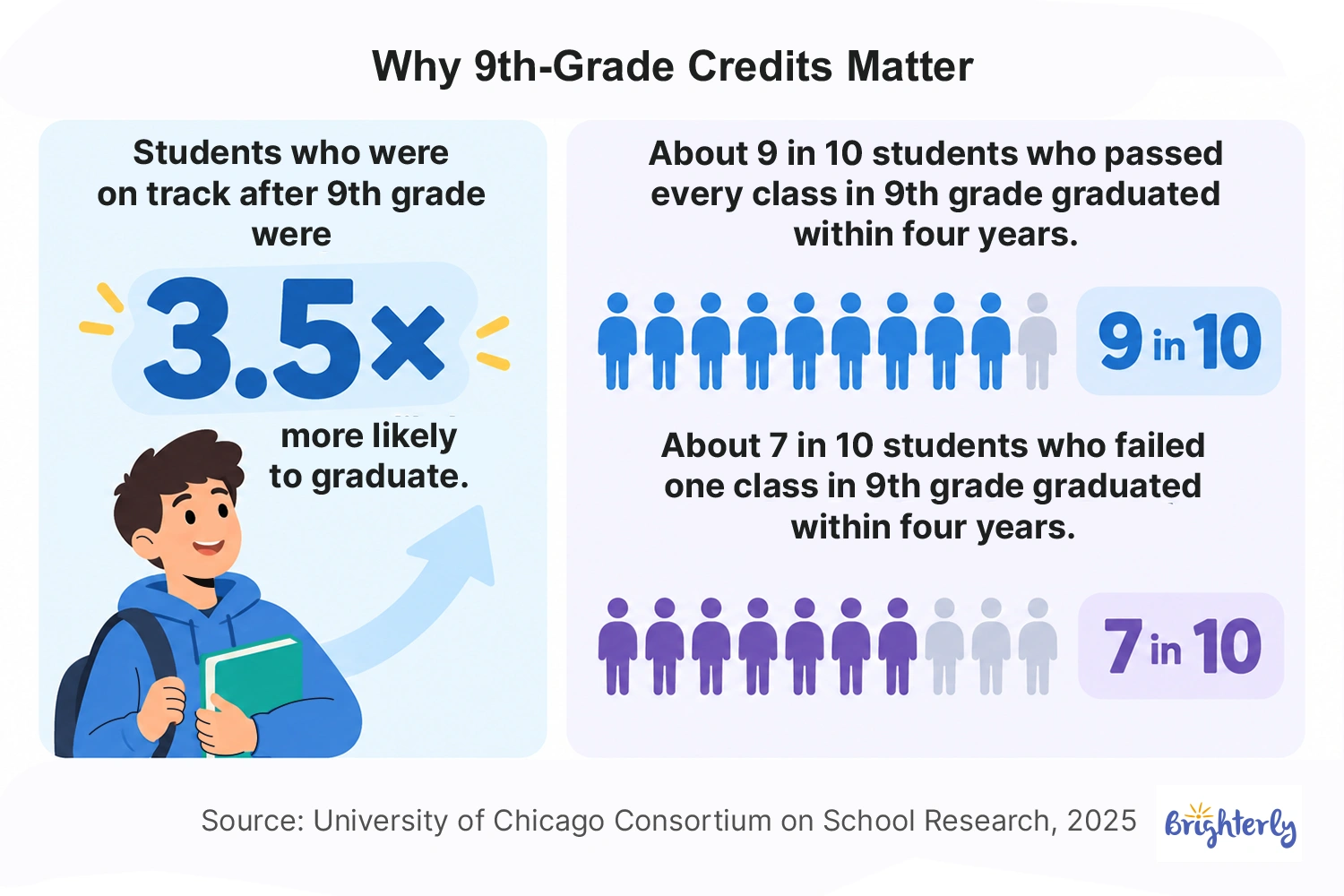
The University of Chicago’s Freshman OnTrack measure uses credits earned and failed core courses to tell if a student is on track. By the end of 9th grade, students need at least 5 credits and no more than one failed core course. According to a 2025 report, students who met these requirements were 3.5 times more likely to graduate.
The researchers also found a big difference with just one failed course. About 9 in 10 students who passed every class in 9th grade graduated within four years. For students who failed one class, it was about 7 in 10. (University of Chicago Consortium on School Research, December 2025).
Credit-Based Retention and the “9th-Grade Bulge”
Not earning enough credits can leave a child classified as a 9th grader. This is called credit-based retention. But it doesn’t always mean repeating the whole year; they may continue with some classes while making up the credits they missed.
When many students stay in 9th grade, it creates a “9th-grade bulge.” This simply means there are unusually many students enrolled in 9th grade. In 2023, for instance, NCES counted 4.05 million 9th graders nationwide. That compares with 3.71 million 8th graders and 3.98 million 10th graders.
Of course, this doesn’t mean every extra ninth grader was held back. Students enter and leave public schools for other reasons, too. But the jump is large enough to stand out in the national data.
Why Falling Behind in Freshman Year Matters
Freshman year is when graduation credits start adding up. Missing one doesn’t sound like much, especially with three years still ahead. But your kid will need to make up that missing credit later.
Catching up can be harder in math because the courses usually need to be taken in order. So catching up can affect their schedule for more than one year.
Get Extra Help With High School Math
Give your child one-on-one help with the math they’re struggling with.
Standard Diploma vs. College-Prep Courses: What’s the Difference?
Having enough credits to graduate doesn’t automatically meet college admission requirements. For example, the University of California requires applicants to have 15 yearlong college-prep courses. That includes 3 years of math, and UC recommends continuing with 12th grade math.
Standard diploma
College-prep course plan
What it’s for
Graduating from high school
Getting ready to apply to college
Who sets the rules?
The state or school district
The colleges your child wants to apply to
Math
Depends on state and school rules
Many colleges want at least 3 years; some recommend 4
Science
Depends on state and school rules
Colleges often want several years, including lab science
World languages
May not be required
Many colleges want at least 2 years of the same language
Advanced classes
Usually not required for a standard diploma
Colleges may look at the harder classes your child took
Beyond Credits: Diploma Types and Other Graduation Rules
Depending on the state, your child may have different diploma options or other requirements to complete before graduation.
Standard, Honors, and Special Diplomas
Some states offer more than one type of diploma. In Virginia, for example, most students earn either a Standard Diploma or an Advanced Studies Diploma. The advanced option requires 26 credits and includes more math and world language coursework. Virginia also offers an Applied Studies Diploma for some students with disabilities who complete their IEP requirements but don’t meet the requirements for another diploma.
Civics Exams, Community Service, and Other State-Specific Rules
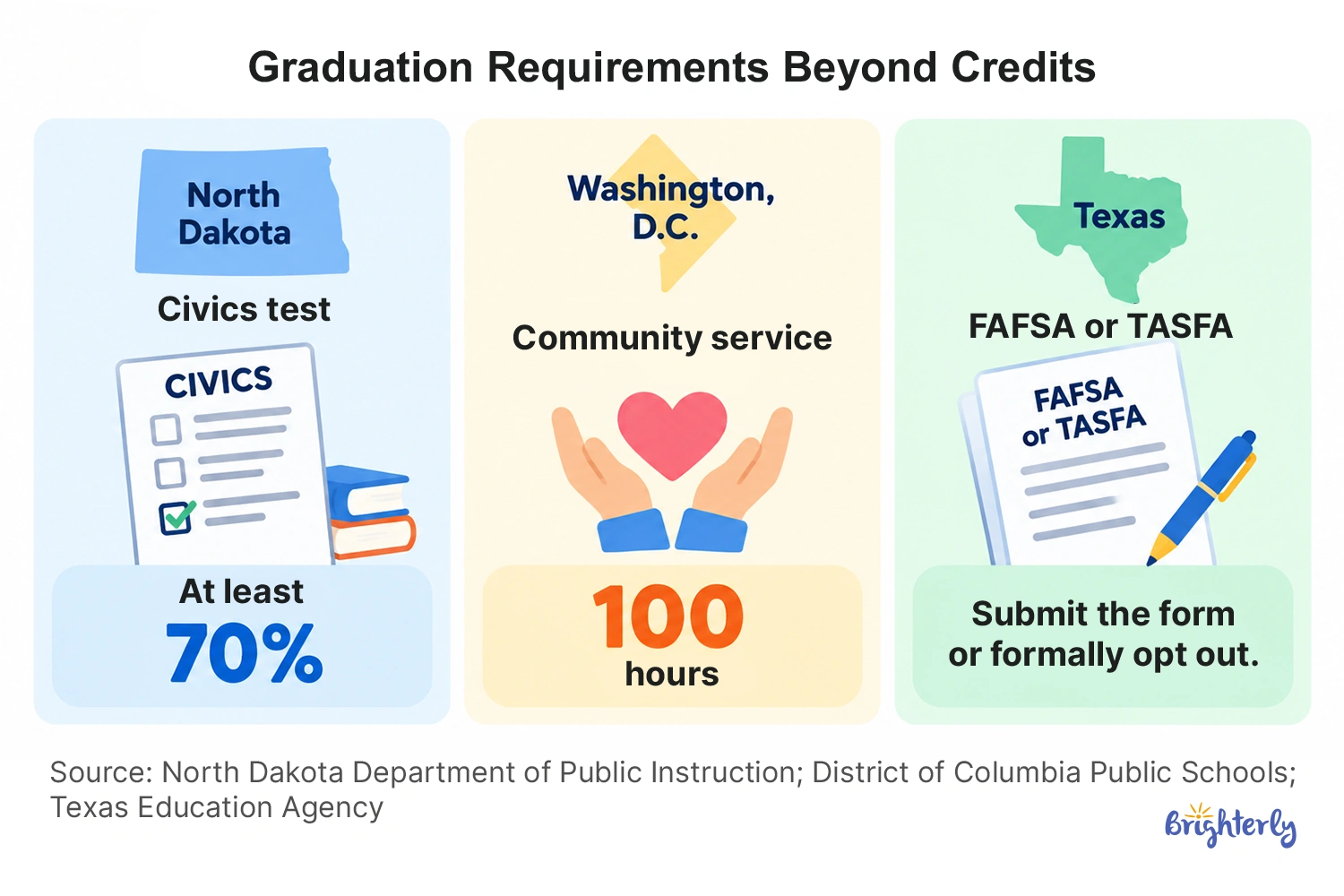
Some graduation requirements have nothing to do with course credits at all. North Dakota students must pass a civics test with a score of at least 70%. In D.C., students in the Class of 2026 and later need 100 hours of community service. Texas students must submit the FAFSA or TASFA before graduation, or formally opt out.
What to Do If Your Child Is Behind on Credits
If your child is behind on credits, start with their school:
- Talk to their counselor. Ask which graduation requirements they’re still missing and how they can complete them. Get the plan in writing, including the courses they need and an updated graduation timeline.
- Look into credit recovery. Options may include summer school, an online course, evening classes, or retaking the course. Ask what the school accepts for credit.
- Ask about other ways to earn the credit. Some states allow students to earn certain credits through an approved exam or college course.
- Check college admission requirements. A course may meet high school graduation requirements but not a college’s admission requirements.
Catching up on the credit is one thing. Your child may also need help with the math they missed or didn’t understand. Brighterly tutors can give extra high school math practice in those areas.
Conclusion
Knowing how many credits you need to graduate high school is a good place to start. But make sure you know which credits they still need, too. Check their transcript against the requirements for their graduating class. If anything is missing, talk to their counselor early so you have time to plan what comes next.
Needing extra help with math or reading? Book a free demo session with Brighterly to receive a personalized curriculum.
Related articles:
- High School Math Levels: Everything Parents and Students Need to Know
- Summer Writing Programs for High School Students
- Best High School Homeschool Curriculum: Top Programs for Every Teen
- Top Scholarships for High School Students
- How to Get Better Grades in High School
Frequently Asked Questions
What Happens If a Student Doesn’t Earn Enough Credits to Graduate?
They usually can’t graduate until they make up the missing credits. But that doesn’t always mean another full year of high school. Credit recovery, summer school, online courses, or retaking a class may help them catch up. Ask their counselor about the requirements to graduate high school and what they still need to complete.
Can a Student Graduate High School With a D in a Required Class?
Sometimes. A D may count for high school credit, depending on the school’s rules. Your child may also need a certain GPA or meet other graduation requirements. If they plan to apply to college, check the admission requirements. Colleges may not accept the same class as part of their admission requirements.
Do All States Require the Same Number of Math Credits?
No. How many years of math are required in high school depends on the state. Requirements generally range from 2 to 4 math credits, with 3 as the median. Some states also require specific courses, such as Algebra I. Your child’s school may ask for more.
Do You Need to Pass a Test to Graduate High School, Even With Enough Credits?
It depends on the state. Some states ask students to meet requirements beyond course credits. That can include passing a test or showing what they’ve learned in another way. Check the rules for your child’s graduating class, since they can change from one class to the next.
Can a Student Graduate Early If They’ve Already Earned Enough Credits?
Maybe. Your child still needs to complete all the requirements for their diploma, not only earn enough credits. Schools also have their own rules for graduating early. If your child wants to finish high school early, ask their counselor if it’s possible and what they still need to complete.
Do Online or Virtual School Credits Count the Same as Traditional School Credits?
They can. But check with your child’s school before enrolling in an online course. Schools may only accept credits from certain courses or programs. If your child needs the course for graduation, ask the school if it meets that requirement.


Your child brought home DRA testing results, but you don’t know what DRA means and what to do next? DRA reading level assessment happens around twice a year — see how to prepare for the next test with your kid at home or whether they need extra online reading tutoring help like Brighterly’s. What Is […]

Sep 18, 2026
Math & reading from 1st to 12th grade
Looking for homework support for your child?

Choose kid's grade

Math & Reading for Grades 1–12
Build real confidence for your child with a Brighterly math or reading tutor.