High School Math Levels: Everything Parents and Students Need to Know
reviewed by Rachelle Bencio Yu
Updated on September 16, 2026
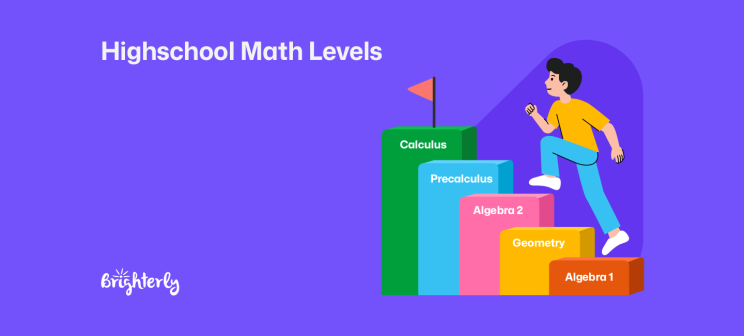
Key points:
- High school math levels generally follow a set sequence, but schools can offer each course at different levels of difficulty.
- Minimum graduation requirements vary by state, but typically require 3-4 math credits (years of math).
- Students aiming for STEM majors or top-tier colleges should aim to reach calculus or statistics by 12th grade and consider honors or AP courses.
- High school math tutors can help your child stay on track, reach their goals, and prepare them for important exams.
High school math levels follow a set sequence but how many, how quickly, and to what difficulty you can take them varies by state, school, and student. From algebra 1 to AP calculus, this guide explains the different levels of math in high school, when you can take them, and what colleges are really looking for when it comes to math.
What Are The Levels of Math in High School?
Math levels in high school can look complicated from the outside, but when you break it down it makes a lot of sense. Kids are taught sequentially, with each course building on the next. But, how many courses you take and how hard they are can vary.
Here are the key things you need to know about high school math courses:
- High school math consists of 5-6 core levels. Some schools offer additional elective courses typically taken in 12th grade.
- Each course typically takes 1 year to complete and upon completion, the student gets 1 high school credit.
- States typically require 3-4 math credits as a part of high school graduation requirements.
- The difficulty of each course can vary, with several options available including college-level courses.
- Advanced courses often offer higher GPA weighting and some even offer college credits.
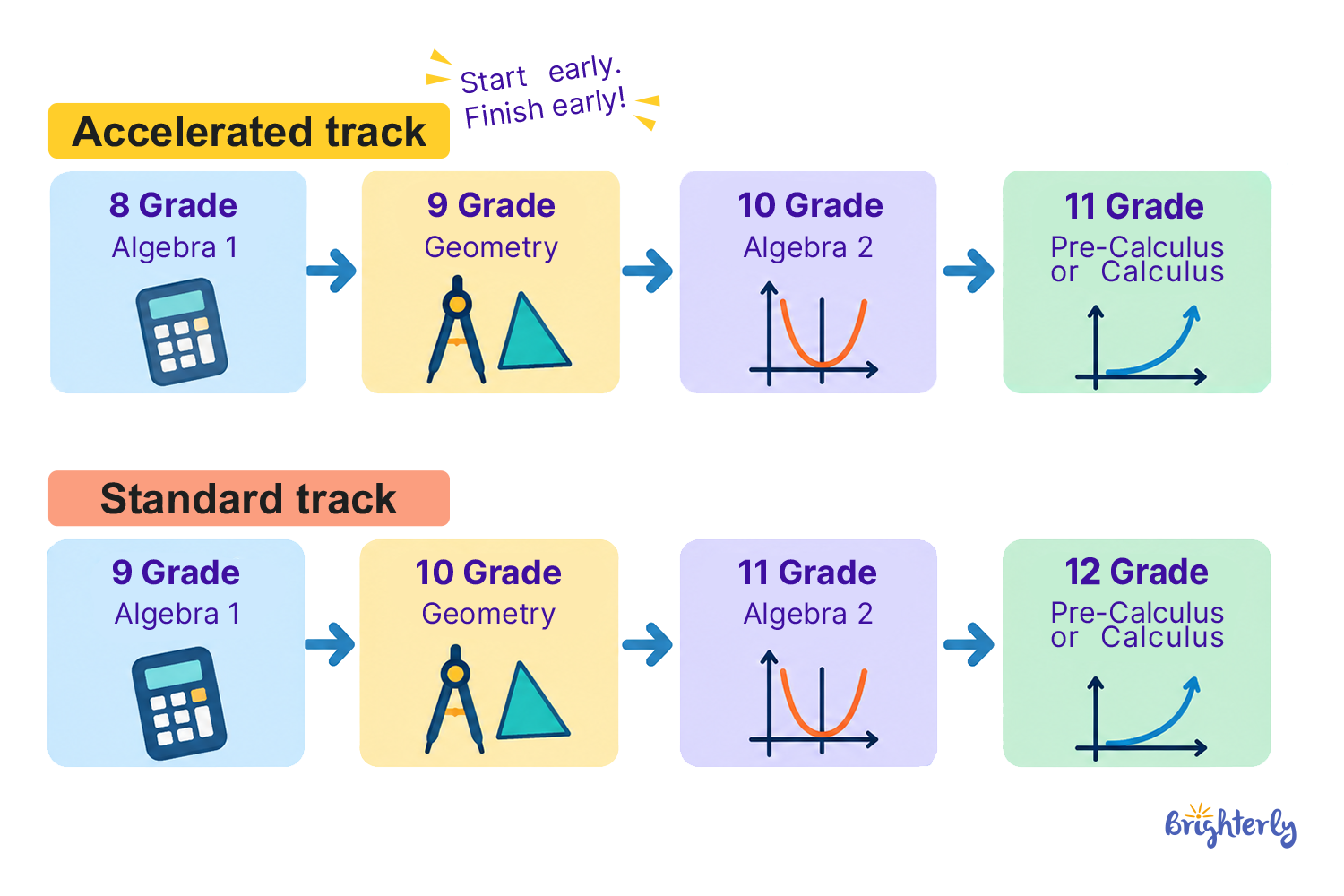
Schools typically follow this sequence but some may rearrange the subjects or offer alternative electives, like statistics, in the final year. Where you start and how quickly you can progress will depend on middle school performance, placement tests, your high school, and your performance throughout each course.
Explore Brighterly Learning Experience
Learn exactly how Brighterly helps students thrive through expert sessions, online tools, and proven feedback from thousands of satisfied parents
The Standard High School Math Curriculum, Grade by Grade
|
Grade |
Standard track |
Accelerated track |
|
8th grade (last year of middle school) |
Algebra 1 |
|
|
9th grade (Freshman) |
Algebra 1 |
Geometry |
|
10th grade (Sophomore) |
Geometry |
Algebra 2 |
|
11th grade (Junior) |
Algebra 2 |
Pre-calculus |
|
12th grade (Senior) |
Pre-calculus |
Calculus or Statistics |
If your child took Algebra 1 in 8th grade then they’ll likely start high school in the accelerated track which means completing calculus or statistics in senior year. Depending on your kids plans for after school, this can be an important decision. Here’s a quick look at what each course covers:
- Algebra 1: Variables, equations, linear functions, and introduction to quadratics.
- Geometry: Shapes, angles, area, volume, triangles, and mathematical proofs.
- Algebra 2 (and trigonometry): More advanced equations and functions including polynomials, exponentials, logarithms, and complex numbers.
- Precalculus: Advanced functions and trigonometry.
- Calculus: Change and accumulation, derivatives, integrals, limits, and applications
- Statistics: Collecting, analyzing, and interpreting data, probability, distributions, and statistical inference. Can be an alternative to the calculus path.


Not sure what math level your kid is at?
Figure out what level math your kid is at so you know how to help them.
Standard vs. Honors vs. AP vs. IB Math: What’s the Difference?
Not only do high school math classes vary by topic but each topic can also vary in difficulty (and thus count more towards your kids GPA). Lot’s of parents wonder ‘what is honors math’ so let’s break down the different levels of high school math and what each one means for your kid.
|
Key points |
Exams? |
GPA weight (may vary by state or district) |
College credit |
|
|
Standard |
|
|
1.0x (baseline) |
No |
|
Honors |
|
|
+0.5 (weighted) |
No |
|
AP (advanced placement) |
|
|
+1.0 (weighted) |
Yes – score of 3-5. (can vary by college) |
|
IB (international baccalaureate) |
|
|
+1.0 (weighted) |
Yes HL score of 5-7 |
How Many Years of Math Do You Need in High School?
High school math requirements vary depending on what state you live in, here’s a general overview.
State Requirements
Most U.S. states require 3 to 4 math credits (3 or 4 full courses completed) as a part of achieving the high school diploma.
- States set which courses must be completed, they typically include: Algebra 1, Geometry, and Algebra 2.
- Roughly half of U.S states require 3 credits including Washington, Virginia, and Alabama.
- Around 17 states require 4 math credits including Florida, Ohio, and Arizona.
- California is an outlier only requiring 2 credits for graduation but Californian colleges typically require more.
How to Choose the Right Math Level for Your Child
Choosing the right math level for your child depends on four things: their current level, their enjoyment and ability, their future goals, and their high school. Here’s a practical guide to choosing:
- Start with your child’s current level
What math courses they took in middle school and math placement test results will give you an idea of what their current level is and what they should take next.
Tip: Consider taking a free diagnostic math test to find out what level they’re working at.
2. Consider their strengths and interests
A kid who enjoys math and learns new concepts quickly may benefit from honors math or an accelerated path. Talk to your child about how much they enjoy math and how challenging they find the work.
Tip: How well kids do in the program is more important to colleges than what program they’re taking. So a good grade in a standard math program will look better than a poor grade in an honors program.
3. Think about future goals
Whether they want to go to college, what type of college they want to attend, and whether they’re interested in STEM-related careers will all influence what level of math they should take.
Tip: Plan backwards. Start with your child’s future goal (career or college goals) and plan backwards from there, figuring out what course they need to take for 12th grade math and working backwards to where they are now can help you find the starting point.
4. Check what the school offers
Not all schools offer the same courses, pathway, or levels. Speak to the school about what they offer and what might be the best route for your child to take.
Tip: Ask the school about placement tests, honors and accelerated courses, summer courses, opportunities to move up a level, math requirements for graduation, AP options, and dual-enrollment.
Help your child reach their academic goals!
1-to-1 tutoring can help them raise their GPA and prepare for what comes next.
What Do Colleges Expect From High School Math?
What colleges expect, and what impresses them can be two different things depending on what college you’re looking at and what you want to major in. Here’s a quick guide to how colleges see high school math.
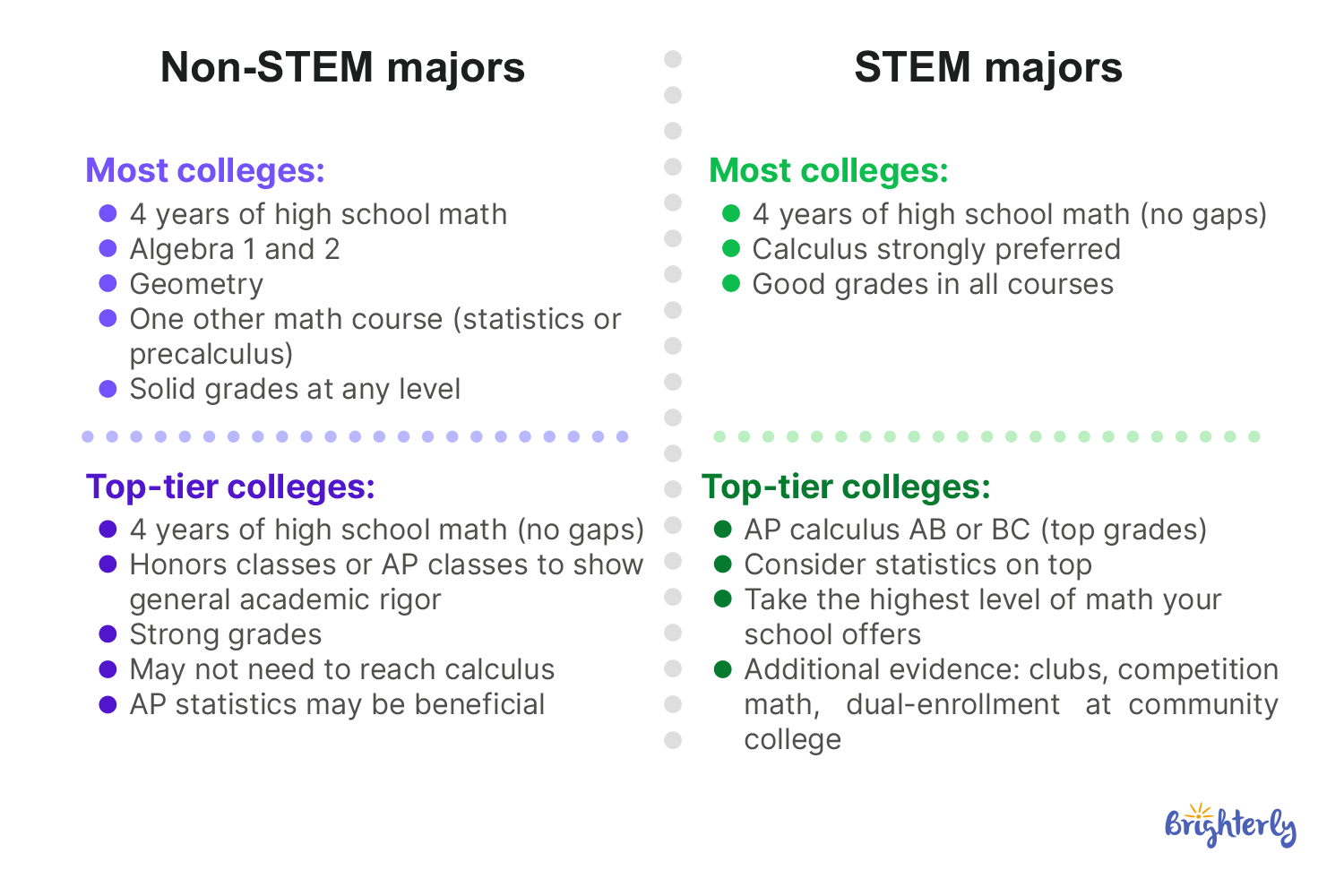
Non-STEM Majors
Most colleges:
- 4 years of high school math
- Algebra 1 and 2
- Geometry
- One other math course (statistics or precalculus)
- Solid grades at any level
Top-tier colleges:
- 4 years of high school math (no gaps)
- Honors classes or AP classes to show general academic rigor
- Strong grades
- May not need to reach calculus
- AP statistics may be beneficial
STEM Major
Most colleges:
- 4 years of high school math (no gaps)
- Calculus strongly preferred
- Good grades in all courses
Top-tier colleges:
- AP calculus AB or BC (top grades)
- Consider statistics on top
- Take the highest level of math your school offers
- Additional evidence: clubs, competition math, dual-enrollment at community college
How Brighterly Helps Students Stay on the Right Math Track
The Brighterly math program helps your kid stay on track by providing them with 1-to-1 personalized teaching. With pricing plans to suit all budgets you can get your kid the support they need to really thrive in high school math.
Here’s how our experienced tutors can help:
- Personalized learning plans adapted to your child’s needs, goals, and learning style
- Math programs aligned to U.S common core standards
- Specialist tutors experienced in high school math e.g calculus tutors
- Spot learning gaps and plug them
- Homework help
- In-depth cover for specific math courses e.g. Algebra or geometry
- Prep teens for AP math courses
- SAT/ACT math test prep
- Competition math courses
Conclusion
High school math typically consists of 5 to 6 core courses, with each course available at different levels of difficulty. How many courses you complete, and to what level, is important for both graduating high school and for those who have plans to go on to college. 1:1 high school math tutoring can help you deepen your understanding of complex math problems, improve your grades, and prepare you for college, if that’s where you’re headed. Book a lesson now and see how they work during a demo.
Frequently Asked Questions
Can a Student Skip a Level of High School Math?
Yes, in some schools students can skip a course. But, usually only if they can demonstrate they already know the material, usually by passing a test, this is because each course builds on the next, so taking math courses in order matters, There’s a difference between entirely skipping a course and taking an accelerated or compacted course, for example through a summer course.
What’s the Difference Between Honors and AP Math Credit?
Honors and AP math are more advanced than standard math courses but serve different purposes. Honors math is a more challenging, and higher paced, version of high school math and covers the same subjects but at a greater depth. Honors math courses also give additional (+0.5) weighting to your GPA.
AP math courses are equivalent to introductory college-level courses and thus cover subjects not covered in high school math courses. Students also take AP exams at the end of the course and depending on the college and their score, they may receive college credit.
Do Colleges Require Four Years of Math?
Yes, typically a college will want to see four years of high school math. However, if you plan to take a STEM or business/economics major or are planning to attend a top-tier college then you may need to go a step further. Typically top tier colleges and STEM majors want to see rigor, however, colleges care about both the course difficulty and your grade, so taking getting an A in standard math looks better than a poor grade in honors math.
What Happens If a Student Fails a Required Math Class?
Generally, they will need to retake the course or complete another approved option. The school should be able to offer students guidance on the best route to take to make up for the failed course. States have minimum limits on how many high school credits a student needs to graduate, which typically includes 3-4 math credits.
Is Algebra 2 Harder Than Geometry?
Many students find algebra 2 harder than geometry but it does depend on the students strengths. For students who prefer shapes, angles and proofs, geometry will likely feel easier. For those who enjoyed algebra 1 and like complex equations, functions, and graphs, they may feel more comfortable with algebra 2. Algebra 2 however does tend to move at a quicker pace as it’s seen as preparation for pre-calculus.
Can a Student Switch From Honors Back to Standard Math?
Yes, it is usually possible for a student to switch back to standard math if they need to. The goal of schools is to help students find a level that they find challenging but aren’t struggling to keep up, if a school notices a child is finding a particular course difficult then they may recommend a change. This doesn’t mean your kid is bad at math, they just may need a different pace to help them build that strong foundation.



Pre-algebra offers a way to Algebra 1, introducing variables, negative numbers, and ratios. Read this guide to learn what topics and skills kids learn during pre-algebra courses and how to help them succeed in them. What Is Pre-Algebra? Pre-algebra is a math course that bridges or connects basic arithmetic to formal algebra. It shifts kids’ […]

Sep 11, 2026

Struggling with reading isn’t just a school problem — it stretches beyond the classroom. If your child is losing confidence and you don’t know how to help, finding the right online reading tutoring can make the difference. This guide evaluates the 8 best online reading tutoring platforms, so that you can make an informed decision. Online […]

Sep 16, 2026
Math & reading from 1st to 12th grade
Looking for homework support for your child?

Choose kid's grade

Math & Reading for Grades 1–12
Build real confidence for your child with a Brighterly math or reading tutor.