What Grade Level Is Geometry Taught At in US Schools?
reviewed by Maila Caliao
Updated on September 23, 2026
Key Points:
- The most common answer to the question, “What grade is Geometry?”, is 9th or 10th grade, based on when most US schools introduce this subject in the curriculum.
- The timeline of when kids start learning Geometry shifts by district, state, and the student’s math track, not just age.
- Accelerated and honors students may start Geometry earlier than other learners — in 7th or 8th grade.
- After Geometry, the math learning sequence usually continues with Algebra 2.
Most public schools in the United States introduce Geometry to students in 9th or 10th grade. Find out why this timeline is the most common, how this class fits into the math sequence, what the class actually covers, and what signs may mean a kid is ready to start Geometry earlier.
What Grade Is Geometry Usually Taught In?
For the average student, the answer to the question, “What grade do you usually learn Geometry?”, is Grade 9 or 10, which is right after the kids complete their Algebra 1 course. However, the timeline may change depending on the standards of a particular district.
Why 9th or 10th Grade Is the Most Common Answer
The 9th or 10th grade is the most common answer to the question “What grade is Geometry taught?” because these are the grades where kids usually already complete Algebra 1 and are ready to deal with spatial relationships, proofs, and formal logic — abstract reasoning skills that Geometry requires.
Teaching Geometry too early, before Algebra 1 (covers linear equations and basic algebraic manipulation), may be too overwhelming for students who haven’t learned to deal with variables yet. Teaching Geometry too late may delay Algebra 2 (which covers advanced functions, complex numbers, and multi-step equation solving), which most US schools and colleges expect to be completed for graduation and admission.
Therefore, 9th and 10th grade are the perfect spots in the school math sequence — kids are already prepared to deal with abstract reasoning and have enough time for Algebra 2, Precalculus, and even Calculus before graduation.
Adolescent development data also provides insight into why it’s so common to teach Geometry in 9th-10th grade. For example, the January 2023 Cleveland Clinic article mentions that mental characteristics that develop and improve during adolescence include abstract thinking and reasoning skills, which are essential for learning Geometry.
Signs a Student Is Ready to Start Geometry Early
Signs a student is ready to start Geometry early revolve around the child’s knowledge, skills, and personal readiness. However, these signs don’t include eagerness or love for math — a child might love math but still not be ready to go beyond the standard program.
Here’s what to look for to determine if a student is ready to start Geometry early:
- The child easily solves complex linear equations without hesitation or frustration
- The child easily grasps exactly how 2D shapes translate into 3D models and can visualize structural rotations in their head without feeling overwhelmed
- The child shows natural curiosity about the physical dimensions of the world around them
- The child enjoys complex puzzles that require step-by-step deductive reasoning
- The child consistently scores in the top percentiles on standardized academic tests.
These signs are among the reasons why the answer to the question “What grade does Geometry start?” can vary for different students — some may be ready to start as early as grade 8, while for others it may be better to wait until grade 9 or 10.
To determine whether the child is ready to start Geometry early, you may ask them to take a diagnostic math test, which can help pinpoint specific gaps that could indicate the child needs more time before diving into the course.
How State and District Standards Shape the Timeline
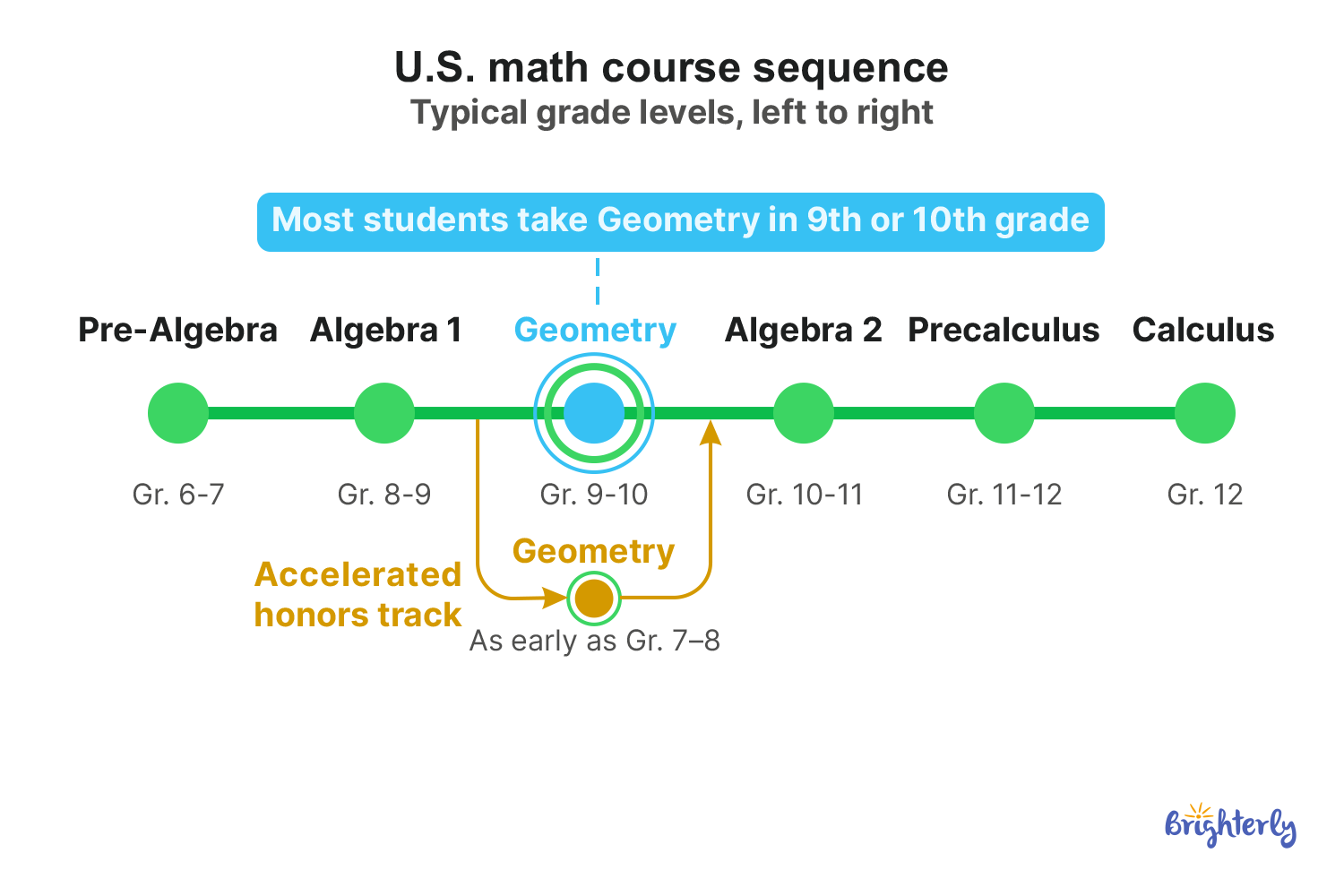
Since the US education system is governed at the state and district level, there’s no single nationwide mandate that requires schools across the country to introduce a Geometry course in a certain grade. However, most states and districts follow the traditional timeline, which is:
- Algebra 1 (8th or 9th grade)
- Geometry (9th or 10th grade)
- Algebra 2 (10th or 11th grade)
- Precalculus and Calculus (11th or 12th grade, mainly for STEM-bound students)
In general, states and districts shape this math timeline relying on the Common Core Standards, which define Geometry content standards for all K-12 grades, while singling out high school geometry as a single category/course. However, while the Common Core Standards provide content standards, they leave the decision to lock these standards to grades to states and districts.
This flexibility is exactly why the answer “What grade do you take Geometry?” may vary from one district or state to another. While most states place Geometry in grade 9 or 10, some states use an integrated mathematics pathway instead of the traditional Algebra 1, Geometry, Algebra 2 sequence, spreading both Geometry and Algebra content across Math 1, Math 2, and Math 3 — the Common Core Standards lays out both approaches.
For example, according to the 2014 EdWeek article, North Carolina, West Virginia, and Utah are among the states mandating Math 1, Math 2, and Math 3 pathways, with no newer data contradicting this information.
Explore Brighterly Learning Experience
Learn exactly how Brighterly helps students thrive through expert sessions, online tools, and proven feedback from thousands of satisfied parents
How Geometry Fits Into the Middle School Math Sequence
Geometry fits into the middle school math sequence quite smoothly, since children start learning basic shapes and related vocabulary as early as elementary school, so Geometry doesn’t just appear out of nowhere, neither in middle nor in high school — students just deepen their knowledge as the program goes on.
If you’re wondering, “What grade do you do Geometry in middle school?”, it’s usually in grade 7 or 8, as part of the Pre-Algebra course, right before Algebra 1.
How Accelerated and Honors Tracks Change the Timeline
Accelerated and honors tracks are among the factors that affect “What grade do you start Geometry?” timeline. For example, a student on an accelerated path might complete Pre-Algebra by 6th grade, Algebra 1 by 7th grade, and reach Geometry by 8th grade, which is one-two years ahead of the standard public school curriculum pace.
This acceleration usually happens in districts with dedicated gifted or honors math pathways. Some districts may even allow students to complete two years’ worth of math in one, combining Pre-Algebra and Algebra 1 in a single-year course.
If you’re looking for a personalized online math program, our online private tutors customize the curriculum based on your teen’s actual pace and skills rather than their grade level. Basically, a geometry tutor makes sure they don’t learn what they already know and move forward exactly when ready.
However, keep in mind that acceleration can sometimes lead to negative consequences, like knowledge gaps, academic burnout, and math anxiety. To avoid these, ensure your child is ready to move beyond the standard curriculum pace by discussing it with them and their teacher.


Online Geometry tutoring for all kids
Our tutors customize learning for both excelling and struggling learners.
What Do You Learn in Geometry Class?
Students basically learn spatial logic, deductive reasoning, and understanding the physical framework of the world in Geometry class — a shift from previous Algebra classes, where learning was focused on numbers, fractions, and isolating variables.
In other words, in Geometry class, kids transition from learning to calculate simple numerical answers to learning to write formal, structured mathematical proofs. Writing these proofs requires the child to justify every single step logically by using established theorems and postulates.
Ultimately, an average Geometry lesson heavily relies on learning visual abstraction (turning real physical objects into basic structural shapes like rectangles, cones, cylinders, etc.), which some kids may find disorienting during the first few months.
*Check out Brighterly’s article to find out more about what ninth graders learn in math, including Geometry.
Core Topics Covered in a Typical Course
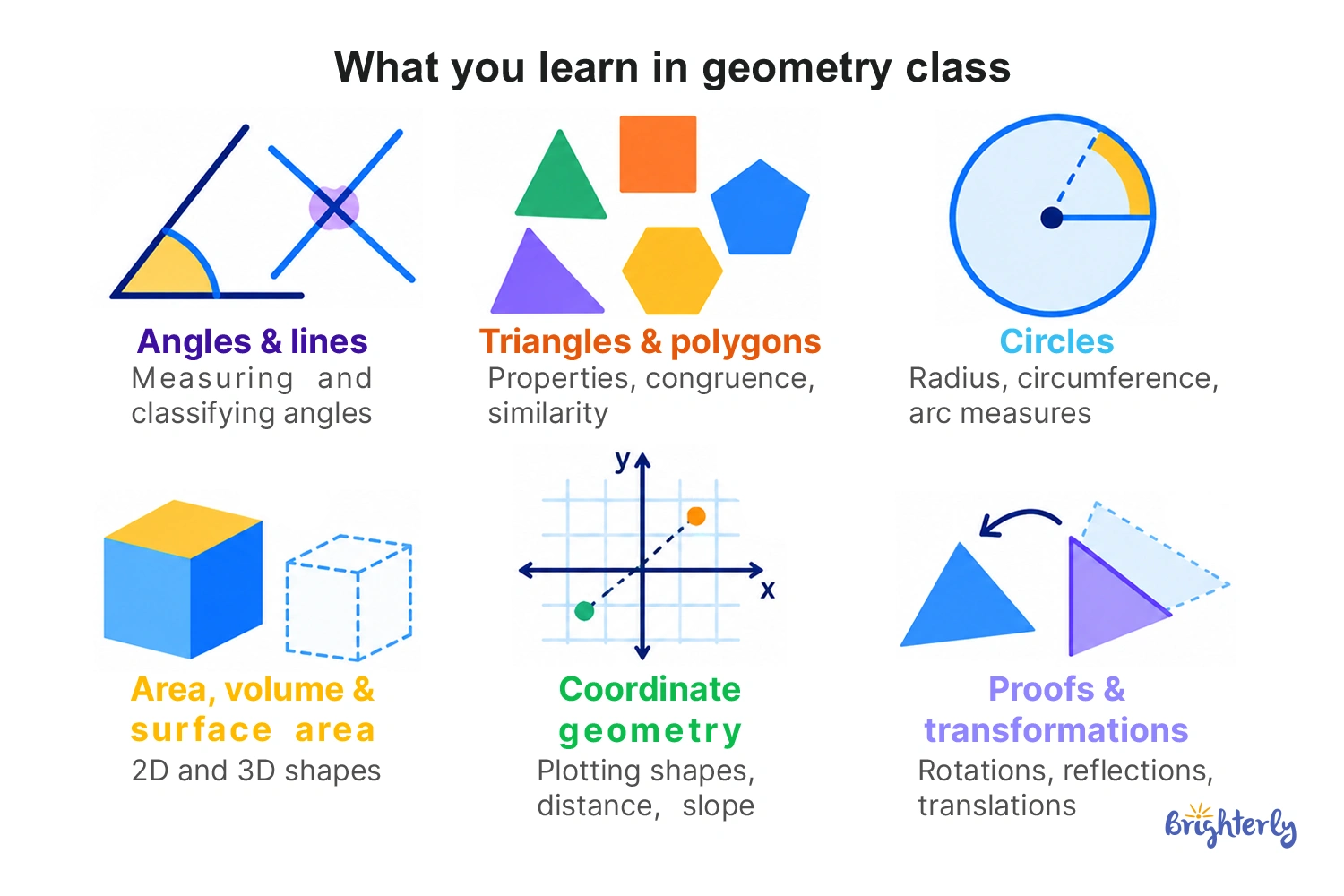
A typical Geometry course covers angles and lines, triangles and polygons, circles, area, perimeter, volume, surface area, coordinate geometry, and proofs and transformations. Mastering each of these topics helps children develop a mix of visual and logical skills, step by step.
- Angles and lines topic is about learning to measure, classify, and identify the exact relationships between intersecting lines, parallel lines, perpendicular lines, and transversals — foundational knowledge for the following topics
- Triangles and polygons topic is about learning the unique properties of triangles (congruence, similarity, the Pythagorean Theorem), while also covering interior and exterior angles of highly complex and multi-sided shapes
- Circles topic covers learning about radius, diameter, circumference, arc measures, tangent lines, and secants of circles
- Area, perimeter, volume, and surface area topics are about learning to calculate the area and perimeter of 2D shapes followed by learning to calculate the surface area and volume of 3D objects (cylinders, rectangular prisms, and spheres)
- Coordinate geometry topic is about learning to blend Algebra knowledge with spatial concepts to calculate things like distance, slope, and midpoints on an X-Y graph
- Proofs and transformations topic covers learning about rotating, reflecting, and translating visual figures, while using logic to write proofs for establishing indisputable geometric facts.
If you’re wondering how you can help your child to study Geometry topics in a home setting, see Brighterly’s article on how to teach Geometry at home with expert insights.
What Comes After Geometry?
The answer to the question “What is after Geometry?” is usually Algebra 2, which requires knowledge from prior Algebra 1 and Geometry courses while introducing more advanced functions like exponentials and logarithms. Following Algebra 2 come the Precalculus and Calculus (for students aiming at STEM-related further education).
If you want to make sure your kid masters Geometry and wants to prevent summer slide before they start Algebra 2, our 10th grade math tutors help make the transition smooth and comfortable for a child by making lessons customized and fun.
Customized math curriculum for kids online
Our math program covers all necessary topics kids must learn in K-12 grades.
Conclusion
No nationwide mandate answers the question “What grade is Geometry in high school?”— your state structures its own secondary math sequence. However, for most states, Geometry lands in 9th or 10th grade in this sequence, right between Algebra 1 and Algebra 2. In some states, accelerated and honors learners can take the class earlier.
If your child is starting Geometry soon or already struggling with proofs, angles, or theorems, they don’t have to figure it all out alone. Book a 1:1 lesson with Brighterly to help them work through tricky topics and feel more confident in class.
Frequently Asked Questions
Is Geometry Harder Than Algebra?
No, geometry is neither harder nor easier than algebra — it’s just different. While algebra is mostly based on rote numerical computation and solving equations, geometry is more about spatial reasoning and formal logical proofs. This difference is the reason why students who struggle with fractions might excel at understanding the properties of shapes, while highly analytical algebraic thinkers might find writing formal proofs extremely frustrating.
Can a Student Skip Geometry Entirely?
In general, a student can’t skip geometry entirely, as it remains a strict non-negotiable core requirement for high school graduation and college admission. For example, both SAT and ACT exams include a significant number of geometry questions — Geometry takes up 17–20% of math section on the ACT test and 5–7 questions of the SAT test math section.
Do All States Teach Geometry in the Same Grade?
No, not all states teach Geometry in the same grade — the United States leaves educational curriculum choices up to individual state departments of education and local school boards. However, when it comes to, “What grade one takes Geometry?”, it’s usually 9th and 10th grade for most students nationwide.
What Math Class Comes Right Before Geometry?
In the standard middle or high school math sequence, Algebra 1 is the math class that usually comes right before Geometry. Algebra 1 builds the equation and algebraic manipulation skills, introducing variables, functions, and linear equations to students. Following Algebra 1, Geometry introduces shapes, angles, and logical proofs to kids.
Is Geometry Required to Graduate High School?
Yes, in the majority of US states, Geometry is required to graduate high school — it’s usually a part of a mandatory three-to-four-year math sequence. For example, Washington requires at least three credits of math (including Geometry) for the kids to graduate high school.
Can Homeschoolers Take Geometry Earlier or Later Than Public School Students?
Yes, homeschoolers can take Geometry earlier or later than public school students. This personalization of curriculum is one of the pros of homeschooling — you’re more flexible in deciding what subjects and when your child studies without having to follow the standard school program.



Reading level systems – Lexile, Guided Reading, DRA, and AR – don’t always agree because they measure different aspects of reading. And it’s easy for parents to get confused about which to rely on. This guide lines them up by grade, explains how different testing systems compare, what each of them measures, how to correctly […]

Sep 23, 2026
Math & reading from 1st to 12th grade
Looking for homework support for your child?

Choose kid's grade

Math & Reading for Grades 1–12
Build real confidence for your child with a Brighterly math or reading tutor.