Why Is Online School Better Than In-Person? 12 Reasons That Matter for Your Child
reviewed by Rachelle Bencio Yu
Updated on July 23, 2026
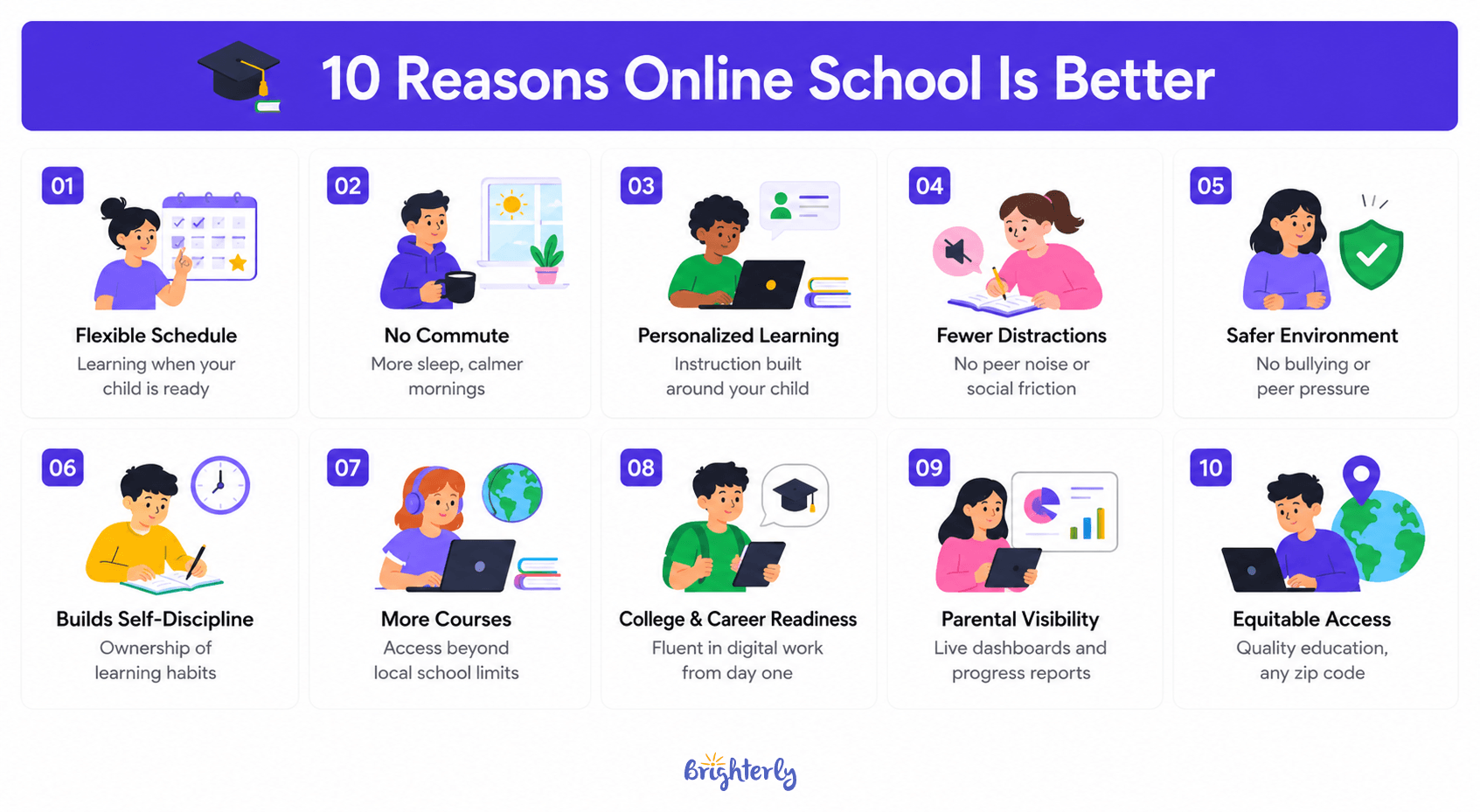
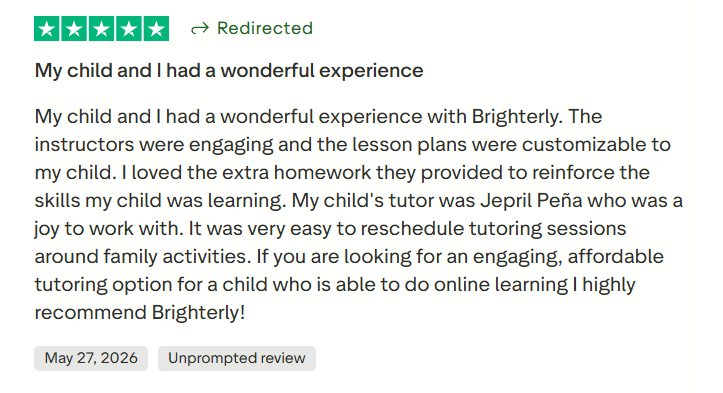
Key Points Online school is better than in-person because it offers flexibility, a safer learning environment, and personalization of the studying experience for students. Online school means no classic classroom with its distractions and peer pressure, no need to get to the actual school, and no stress of not being able to follow a standard one-size-fits-all curriculum. Reasons why online school is better include flexible scheduling, no need for commute, personalization, fewer distractions, a safer environment, the ability to build self-discipline, access to non-standard courses, a chance to prepare for remote career options, a chance for you to get more involved in your child’s education, the opportunity to access high-quality education from anywhere, access to assistive technology, and mental health benefits. Note: The reasons are backed up by different surveys and research from NCES, AERA, etc. Each research includes the most relevant data on the issue, with no newer authoritative data contradicting it. Standard school doesn’t account for how each child learns, how far they live, and when they are most focused during the day — the schedule is one for all. This can be a problem because your child’s sharpest focus window might be at 10 a.m., so starting at 7:30 AM – 8:30 AM, which is a typical first-lesson start time for most schools, might be too hard for them. Online school lets you match the learning schedule to your child’s needs rather than sticking to the standard. NCES data support this statement in their Parent and Family Involvement in Education September 2023 survey, which reveals that a flexible schedule is one of the reasons families choose to homeschool their children. What this means for your child: They can attend classes when they are ready, not when they have to, which is one of the main features of the best homeschool programs. If you live far from school, your child needs to either take a school bus or you need to drive them there. Both options take extra time and require at least waking up earlier, which usually means getting less sleep. CDC Sleep and Health July 2024 data highlights this problem, showing that roughly 57.8% of middle school students and 72.7% of high school students do not get enough sleep on school nights, while AERA December 2022 research found out that long commutes have negative effects on students’ attendance and chronic absenteeism. Online school doesn’t require any commute, so a child can get enough hours of sleep and not worry about being late or not wanting to go to school at all. For example, our one-on-one K-12 online math program or online reading program lets your child learn at a set time each week remotely — no sleep deprivation or wasted time on commute. What this means for your child: They get more sleep, a calmer morning, and more physical and mental strength to learn. One of the biggest differences in traditional vs online education is personalization. In a traditional classroom, one teacher has to manage over 20 students on average, which means they simply can’t attend to every child’s learning needs. In contrast, digital platforms usually use specific academic approaches and target specific educational goals. This is one of the core reasons why parents choose homeschooling over traditional school, according to the NCES Parent and Family Involvement in Education September 2023 survey. And if you want even more personalization, you can get a private tutor for your child. For example, tutors on our online learning platform teach one-on-one math and reading lessons according to the U.S. state-aligned curriculum, but adjust the program according to the child’s learning style, prior knowledge, and knowledge gaps, which parents confirm in their Brighterly reviews. There’s also a wealth of Trustpilot reviews showing the effectiveness of our approach for children. You may also consider getting an in-person tutor, depending on how much flexibility you’re looking for. In general, the online vs in-person tutoring debate comes down to scheduling and budget. For example, our lesson pricing starts at $17.70 per lesson (for a 12-month plan with 20% discount applied), while the average tutoring rate per hour across the US reaches $80. What this means for your child: They get attention, support, and feedback according to their knowledge level and learning style. In-person learning means your child has to interact with other students in a shared physical environment. They will have to navigate different peer-group dynamics, off-topic conversations, and constant background noise. For some kids, it can be too much, leading to distraction and loss of focus. Online classes eliminate these factors — there are no other students or distractions competing for the child’s attention. A student can focus on studying comfortably, not worrying about peers or irrelevant things. What this means for your child: They can learn in a distraction-free setting without worrying about what their peers are doing or about how their peers are judging them.
Personalized online learning with no distractions
We conduct private classes with zero distractions or peer pressure. The NCES Parent and Family Involvement in Education September 2023 survey states that concern about schools’ environment (safety, drugs, or negative peer pressure) is the number one reason parents choose to homeschool their children, with bullying following as reason number 12. So, if you ask yourself, “Is online school good for your child’s safety?”, the answer is most likely, “Yes”. In a virtual learning environment, a child is not surrounded by other students physically, which significantly decreases the risk of bullying or any stress related to negative peer pressure. Note: Check out virtual learning tips to find out how to make this type of studying effective. What this means for your child: They learn in a space where they feel safe and comfortable, both emotionally and physically. In online school, children have to manage their learning themselves — manage their schedules, learn to use digital tools, do homework, and track their progress. In doing so, they inevitably learn to be independent and self-disciplined, skills they will need in their future college studies and careers. A research article published in Educational Technology & Society in April 2022 states that students who studied in an online self-directed learning environment showed more improvement in creativity, thinking skills, and academic achievement than those who studied in traditional classroom methods. What this means for your child: They graduate with not just subject knowledge, but with skills that help them gain and analyze this knowledge on their own. Online vs in-person classes significantly differ in terms of the subjects you can choose. In-person classes are limited to what a specific school can offer, while with online courses, you can choose from a variety of educational platforms that offer options you may not find in a local school. With online classes, your choices are not geographically limited. Through online services, your child can access honors courses, dual enrollment, specialized electives, and subject-matter experts that may be hard or impossible to find locally. What this means for your child: Their curriculum is based on what they want to learn rather than on what options are available in nearby schools. Is online or in person school better for college and career preparation? To answer this question, consider this data — according to March 2023 U.S. Bureau of Labor Statistics data, over 27% of U.S. private-sector establishments have their employees teleworking some or all the time. In this context, children who are already familiar with internet-based collaboration and self-management, and have developed digital literacy, will feel more confident entering challenging, digitalized, and remote environments like college and careers. What this means for your child: They prepare for how the real world operates and are less anxious to move on from school. With traditional school, your main concern is usually how to help your child with homework. The process can be especially hard because you don’t have real-time visibility into what actually happens during classes. In contrast to this situation, online school platforms provide live dashboards, lesson recordings, and detailed progress reports. All this data and features you can access anytime to see what your child is learning and how well they are performing. What this means for your child: They’re less likely to fall behind without you noticing. The April 2025 fact sheet by the Learning Policy Institute shows that there is deeply inequitable school funding in the U.S. This means high-quality teaching with advanced learning materials is not available for all students. Is online learning better than in person for closing this gap? Yes, and the reason is that online school helps level the playing field for receiving high-quality education, even if you live in an area where schools are poorly funded. Through online educational platforms, your child can learn the curriculum they wouldn’t be able to access in any other way. What this means for your child: The quality of their education doesn’t depend on where they are geographically. When teaching a child online, you can use assistive technology such as screen readers, speech-to-text software, and adaptive keyboards. This specialized tech is especially effective for kids with disabilities and learning differences, yet it may not be available at every regular school. For example, a report published by the U.S. Department of Education in January 2024 states that a non-verbal child may require a communication device to communicate with others, while a kid with dyslexia can benefit from an audiobook, and a child with an intellectual disability or with fine motor impairments may seek help from speech-to-text software. What this means for your child: Better learning disabilities for a neurogenic learner. You can also amplify the benefits when addressing specialized educators, like our dyslexia reading tutor or ADHD math tutor. A 2024 study published in the Journal of Family Medicine and Primary Care found that anxiety levels were much higher in on-campus students compared to those who learned online. Besides, the NCES 2024 data shows that only 48% of public schools can effectively provide mental health services to all students who need them. So, if your child is prone to social anxiety, test pressure, or stress from competitive classroom dynamics, learning from home can be more comfortable for them and their mental state. What this means for your child: Minimized learning stress; focus on learning, not stressing.
Get an online curriculum for your child
Our expert educators ensure high-quality programs in a comfortable learning environment.
Explore Brighterly Learning Experience Learn exactly how Brighterly helps students thrive through expert sessions, online tools, and proven feedback from thousands of satisfied parents No, the benefits of in person learning vs online depend on each child — some kids thrive in physical classes and need social interaction to learn successfully, while others are way more comfortable studying in a home setting at their own pace and with no distractions. Why is online school better than in person? Online school gives your child what a traditional classroom was never designed to offer — a learning experience built around them. Whether your child needs more flexibility, fewer distractions, access to courses their local school doesn’t offer, or a learning environment where they feel safe and confident, online school is the way to get it. Online schooling can be as effective as traditional in-person schooling, but its effectiveness largely depends on whether students are disciplined enough and can study independently. In essence, while online schools offer much more flexibility and personalization than traditional schools, some kids need the physical, real-time engagement and social development that classrooms provide. Yes, online school can fully replace traditional schooling in terms of academic content. However, certain physical and social experiences are only possible in a traditional school. For example, these experiences include lab classes, team sports, and some performing arts programs. The biggest challenges of online school for kids include the feeling of social isolation due to the lack of a physical classroom and peer interaction, lack of motivation due to the absence of healthy peer competition, and digital fatigue due to online-based studying. Yes, online K–12 schools offer accredited diplomas. These diplomas are just as official and accepted by colleges, universities, and employers as the diplomas from a physical school. But keep in mind that this works only for accredited K-12 schools, not every online class or program. Prestigious International Awards Program Recognizes Standout Educational Technology Companies and Visionaries Shaping the Future of Learning NEW YORK, – June 10, 2026 – Brighterly, an innovative EdTech platform that helps K–12 students build foundational knowledge in math and reading, today announced that it has been selected as winner of the “Student Personalization Solution of the […] Jun 10, 2026 Superprof works if you have enough time to self-sort teachers’ profiles. For anyone tired of comparing unvetted listings, the 8 Superprof alternatives below cover every use case — with featured up-to-date pricing and the information on who they’re best for. Best Superprof Alternatives at a Glance Best for Starting Price (as of September 2026) Free […] Jun 16, 2026
Why Is Online School Better Than In-Person Learning?
1. Flexible Scheduling That Adapts to Your Child’s Life
2. No Commute Means More Time and Better Rest
3. Personalized Learning for Every Learning Style
4. Fewer Distractions and Less Peer Pressure
5. A Safer and More Comfortable Learning Environment
6. Builds Self-Discipline and Independent Thinking
7. Access to More Courses and Specialized Instructors
8. Better Preparation for College and Modern Careers
9. Real-Time Visibility Into Your Child’s Progress
10. More Equitable Access to High-Quality Education
11. Better Support for Children with Disabilities and Learning Differences
12. Reduced Anxiety and Stress Compared to Traditional Classrooms
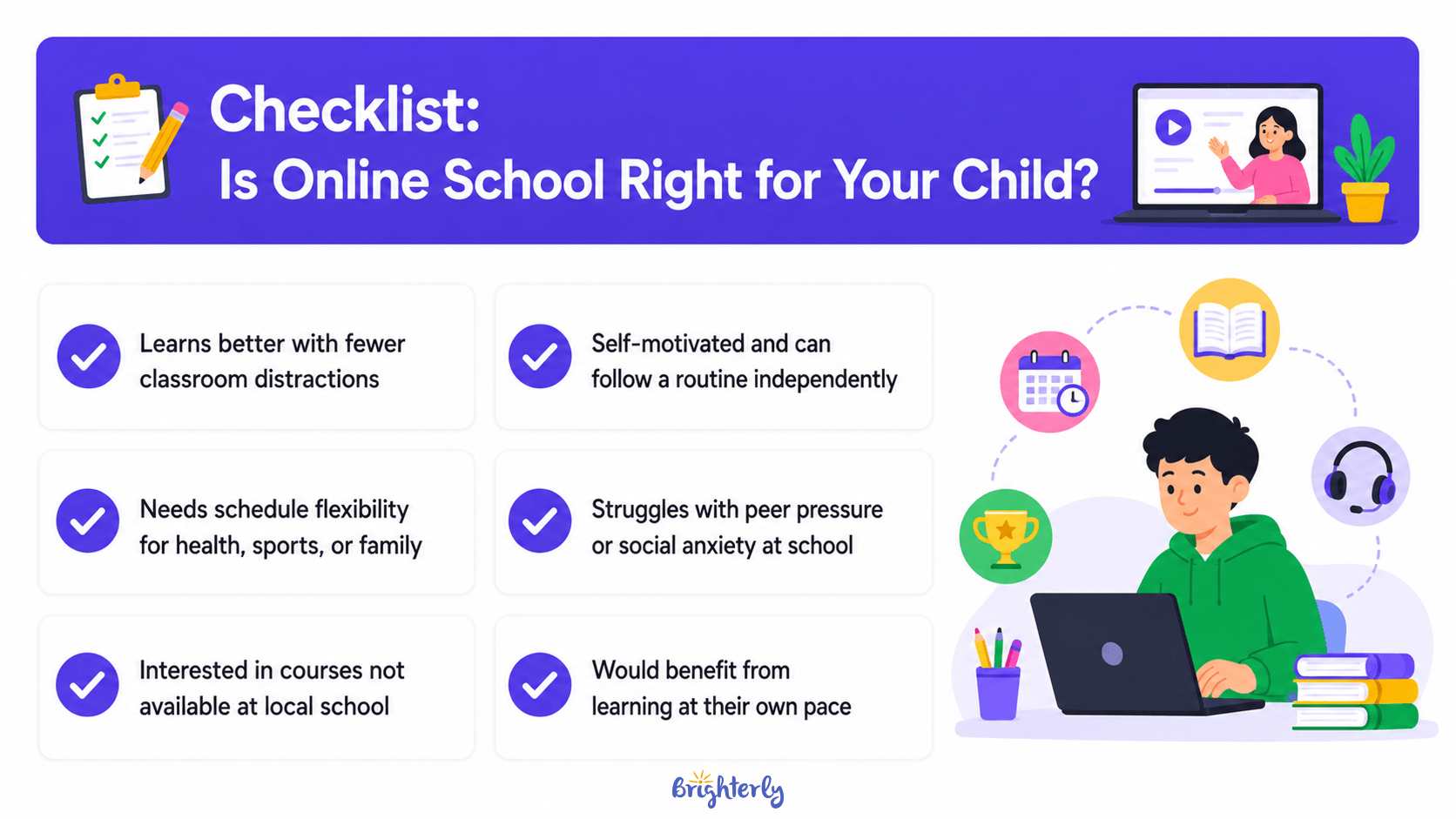
Is Online School Right for Every Child?
Conclusion
Frequently Asked Questions
Is Online School as Effective as a Traditional In-Person School for K–12 Students?
Can Online School Fully Replace Traditional Schooling?
What are the Biggest Challenges of Online School for Kids?
Do Online K–12 Schools Offer Accredited Diplomas?




Math & reading from 1st to 12th grade
Looking for homework support for your child?
Choose kid's grade

Math & Reading for Grades 1–12
Build real confidence for your child with a Brighterly math or reading tutor.