Is Algebra 1 Hard? Why So Many Students Struggle With It
reviewed by Rachelle Bencio Yu
Updated on November 3, 2026
Key Points
Many 9th graders respond “Yes!” to the question “Is Algebra 1 hard?” as it requires abstract thinking, builds on multiple earlier math skills, and moves quickly. However, with strong foundations, regular practice, and support, students can overcome the challenges that Algebra 1 poses and succeed. This guide looks at the reasons that make Algebra 1 challenging, the most common signs that your child might be struggling, and how to make the course easier step by step.
Is Algebra 1 Hard?
Many students find Algebra 1 difficult because it introduces abstract concepts, unfamiliar problem-solving methods, and complex math skills. According to the Gates Foundation (2021), Algebra 1 has the highest failure rate among high school courses, while a 2019 NCES study shows that 15% of 9th graders who took the subject failed it.
Thinking “Is Honors Algebra 1 hard?” – Honors Algebra 1 is generally harder than regular Algebra 1 because it moves even faster, covers mathematical concepts in greater depth, and involves more challenging problems. Honors Algebra 1 also demands stronger abstract reasoning, independent thinking, and problem-solving skills.
Explore Brighterly Learning Experience
Learn exactly how Brighterly helps students thrive through expert sessions, online tools, and proven feedback from thousands of satisfied parents
Why Is Algebra 1 So Hard?
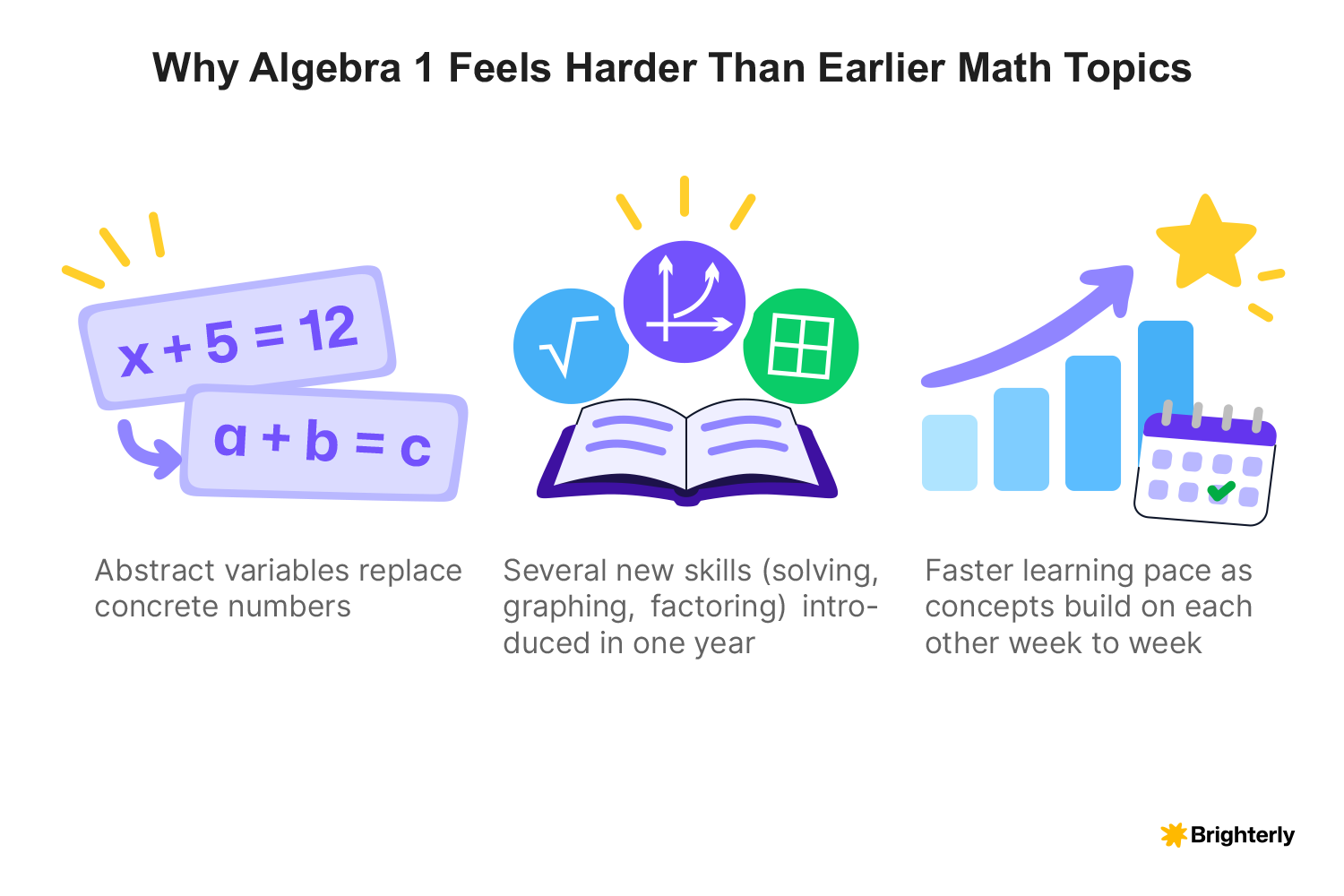
Algebra 1 is hard because students need to move beyond basic arithmetic and think abstractly while learning several math skills simultaneously and keeping up with a faster learning speed. These challenges become particularly overwhelming for children who lack strong foundational skills as each new concept builds on previous knowledge.
The Jump From Arithmetic to Abstract Thinking
Arithmetic focuses on calculations with known numbers, but Algebra 1 introduces variables, expressions, and equations that use unknown values. Students learn to recognize mathematical relationships and approach problems from different angles, which requires flexible thinking.
Dr. Dani Peloquin, Director of Instruction at Fusion Academy, explains what makes Algebra 1 so demanding:
“The best predictor of whether a student is ready for Algebra 1 isn’t actually a math skill, but rather flexible thinking.”

Several New Skills Introduced at Once
In Algebra 1, students work on multiple interconnected skills at the same time, including solving equations, graphing linear functions, working with inequalities, and factoring polynomials. You also need to apply arithmetic skills learned in earlier grades, so gaps in decimals, fractions, or the order of operations turn into obstacles.
Sheila Robitaille, Professional Development Manager at 3P Learning, highlights the complications that studying Algebra 1 brings along:
“Algebra 1 is where any unaddressed numeracy foundation gaps collide with the need to use them in abstraction.”
A Faster Pace Than Earlier Math Classes
Another reason why the answer to “Is Algebra 1 hard in high school?” is “Yes!” is that the subject moves faster than previous math courses. The course introduces a lot of new symbols and rules that stack on top of each other, and you need to learn them quickly to progress. For instance, you have to understand equations before you can work with systems of equations.
Personalized 1:1 support in Algebra 1 concepts!
Our tutors analyze your child’s gaps & provide a custom learning plan. 

Is Algebra 1 Harder for Some Grades Than Others?
Algebra 1 difficulty varies by grade level, as younger students might still be developing the abstract thinking skills they need. 7th and 8th graders have less experience with mathematical reasoning, while 9th graders show more maturity and preparation. But individual students’ readiness, foundational skills, and learning style matter as much as age.
Grade Level Typical Placement Expected Difficulty 7th Grade Advanced or accelerated math pathway Often challenging due to the early introduction of abstract concepts & complex problem-solving 8th Grade Accelerated math pathway in many schools Manageable for students with solid pre-algebra skills, still demanding a transition 9th Grade Standard high school math pathway Generally appropriate for grade-level expectations, but gaps in earlier knowledge might make it harder
Is Algebra 1 hard for a 7th grader? Most 7th graders face difficulties with Algebra 1, especially if they haven’t mastered fractions, negative numbers, and basic equations. Mathematically advanced students, however, might be ready to take the course before the Common Core Math Standards prescribe.
Is Algebra 1 hard for an 8th grader? 8th grade students with strong pre-algebra foundations can succeed as long as they can deal with abstract thinking, independent problem-solving, and more consistent practice than in previous math classes.
Is Algebra 1 hard for a 9th grader? While the Common Core places Algebra 1 in grade 9, students with weak foundational math knowledge might still find it difficult. High schoolers with a solid math base and abstract thinking abilities usually do well.
Is the Algebra 1 End-of-Course Exam Hard?
The Algebra 1 end-of-course (EOC) exam can feel hard because it tests an entire year’s worth of mathematical concepts rather than a single chapter. To pass the exam, you have to remember and apply everything from solving equations and inequalities to graphing functions and working with functions, under time pressure.
To evaluate how hard is the Algebra 1 EOC exam, keep in mind that you have to retain knowledge over a number of months and connect ideas from different parts of the course. Some students who earn passing grades throughout the year get a failing grade on the final because they have forgotten some material. Meanwhile, in many US schools, passing Algebra 1 is a graduation requirement.
How to Make Algebra 1 Feel Easier
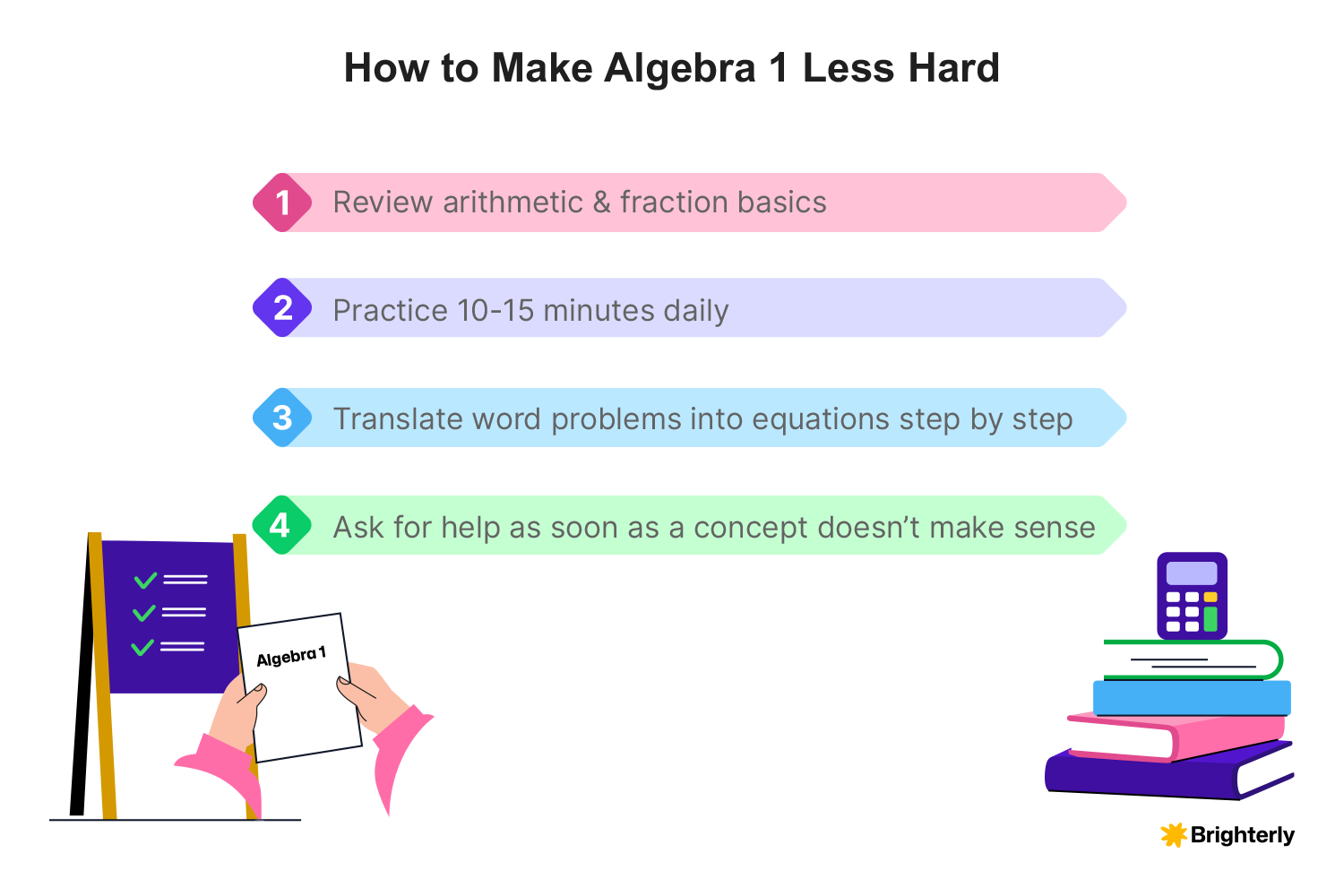
Regardless of why Algebra 1 is hard, to pass the course, you need to strengthen your arithmetic foundation, practice consistently, and learn to turn complex word problems into workable steps. Getting help, such as private tutoring, as soon as difficulties start to arise is important. These easy strategies help you build confidence, improve problem-solving skills, and prevent small learning gaps from becoming bigger obstacles.
Build Arithmetic Fluency First
To make Algebra easy, review essential arithmetic skills, such as multiplication, fractions, decimals, negative numbers, and the order of operations, before getting into more advanced concepts. Having strong foundations will help you focus on learning new topics rather than struggling with basic calculations.
Dr. Dominique Padurano, Founder of Crimson Coaching, explains why knowing the multiplication table and fractions is key:
“Mastering the multiplication table and then fractions are the two key ingredients for success in Algebra I.”
Practice a Little Every Day
To make Algebra less confusing, build a daily routine of 10-15 minutes for reviewing recent lessons, solving a few problems, and revising the most challenging concepts. Short, consistent practice helps improve knowledge retention, reinforces skills, and makes it easier to keep up with new topics based on previous concepts.
Break Word Problems Into Steps
As many students struggle with word algebraic problems, make sure to build a step-by-step process for solving them:
- Read the problem carefully.
- Identify the known and unknown variables.
- Translate the words into a numerical equation.
- Solve for the unknown.
Get Help as Soon as Gaps Appear
If your child is finding Algebra hard to learn, encourage them to ask their teacher for clarification. Additionally, online Algebra 1 tutoring can offer personalized explanations, targeted practice, and 1:1 guidance to address specific gaps before they affect future learning.
Our tutoring pricing plans start at $17.70/lesson with an annual plan covering 2 lessons/week, including a 20% discount.
Signs Your Child May Need Extra Support
Your child may require additional Algebra 1 help if they struggle with homework, get lower-than-usual grades, or show anxiety when solving problems. Other warning signs include difficulty remembering previously learned concepts and avoiding studying math. Recognizing these obstacles early on and taking measures can help prevent further gaps and decline in self-esteem.
Here are six signs to look for:
- Declining grades: If your child’s getting lower grades on quizzes, tests, or assignments, they may find Algebra hard and be unable to build skills.
- Difficulty completing homework: Spending too much time on homework or needing constant assistance suggests that your kid hasn’t understood the material.
- Forgetting previously learned concepts: If your kid doesn’t recall earlier lessons, they can’t understand new knowledge building on previous skills.
- Math frustration: If your child complains about homework, feels discouraged to solve problems, or says that they’re bad at math, you have to look into how hard Algebra 1 is for them and how to help.
- Avoiding math-related tasks: Postponing homework, skipping daily practice, or not wanting to attend classes may signal that your child feels overwhelmed with Algebra.
- Struggling with basic arithmetic: If your kid is continuously making mistakes with fractions, negative numbers, or multiplication, this may show foundational gaps affecting Algebra 1 performance.
If you notice any signs, consider looking for extra support. In our online math program, experienced tutors work 1:1 with your kid to identify gaps and provide personalized instruction and gamified practice to build Algebra 1 skills and boost confidence. You can start with a free math diagnostic test to see how your child compares to grade level.
Individualized support from professional math teachers!
Combine teacher-led instruction & self-paced, game-based practice to build Algebra 1 skills.
Conclusion
Algebra 1 is hard, but passing the course is required for more advanced STEM courses. Rather than focusing entirely on grades, pay attention to how well your child understands concepts and applies them independently. With patience and appropriate support, even students who initially struggle can develop the skills and confidence to succeed.
If you’d like to check whether private tutoring can help your kid with Algebra 1, you can Book a free lesson.
Frequently Asked Questions
Is Algebra 1 Harder Than Algebra 2?
Algebra 2 is generally harder than Algebra 1 because it expands into more complex topics, including logarithms, complex numbers, and advanced functions. Moreover, Algebra 2 moves faster and doesn’t include a comprehensive review as it assumes that students are already familiar with Algebra 1 concepts.
However, some students find Algebra 1 more challenging because it requires a significant shift from arithmetic to abstract thinking, while Algebra 2 simply builds on skills children already know.
What Grade Do Most Students Take Algebra 1?
Most students in the US take Algebra 1 in 9th grade though many schools offer the course in 8th grade as part of an accelerated math pathway. Some advanced students even begin in 7th grade. The exact placement depends on the school district, curriculum, and individual student’s readiness.
If you’re wondering if Algebra 1 is hard in 8th grade, it can be challenging because students encounter abstract concepts and advanced problem-solving earlier than in the standard high school sequence. However, learners who have mastered pre-algebra skills can handle the course better.
Is It Normal to Fail Algebra 1 the First Time?
Failing Algebra 1 on the first attempt is not uncommon as many students struggle with the transition to abstract mathematical concepts. Gaps in foundational skills, a faster learning pace, and difficulty keeping up with new topics can contribute to poor grades, even among students who previously performed well in math.
Some students pass the course but fail the final exam because the Algebra 1 EOC is hard, covering an entire year of material. However, failing the course or exam doesn’t mean that your child can’t succeed in math. Targeted practice, additional support, and opportunities to retake the course or exam can help get back on track.
What’s the Difference Between Algebra 1 and Pre-Algebra?
Pre-Algebra prepares students for Algebra 1 by introducing basic algebraic concepts while strengthening arithmetic skills, including fractions, decimals, negative numbers, ratios, and simple equations. The course helps students jump from working with numbers to understanding variables and mathematical relationships.
Algebra 1 builds on the foundations laid in Pre-Algebra and introduces more complex topics, such as linear equations, inequalities, functions, graphing, and polynomials. The subject requires students to apply multiple skills, solve multi-step problems, and think more abstractly, making it a more demanding course than Pre-Algebra.
How Can I Tell if My Child Is Falling Behind in Algebra 1?
Your child may be falling behind in Algebra 1 if their grades are declining, they often struggle with homework, or they can’t understand concepts covered in previous lessons. Other signs of potential failure include spending a lot of time on assignments, avoiding doing math, and getting frustrated or anxious when dealing with the subject.
Does Algebra 1 Get Easier With Practice?
Algebra 1 usually becomes easier with practice as you become more familiar with variables, functions, equations, inequalities, and techniques for solving word problems. Regular practice helps strengthen previously learned topics, improve accuracy, and build confidence. Over time, you start to recognize patterns and solve problems more efficiently.




If your child is a high-ability learner craving greater depth and faster progression, given that standard school curricula move at a fixed pace, you’re most likely considering enrichment programs for gifted students (and rightly so!). The following top programs differ in format, curriculum, flexibility, level of personalization, pricing, and much more – choose the one […]

Nov 03, 2026
Math & reading from 1st to 12th grade
Looking for homework support for your child?

Choose kid's grade

Math & Reading for Grades 1–12
Build real confidence for your child with a Brighterly math or reading tutor.