My Child Is Failing School: A Parent’s Action Plan
reviewed by Marvi M. Andres
Updated on November 18, 2026
Key Points:
- If you think, “My child is failing school”, focus on finding the reason before taking action — talk to your child first and identify which classes and assignments they are struggling with.
- Talk to your child’s teacher about missing assignments, skill gaps, and retake options — each school has its own policy on how to handle these.
- Build a recovery plan with 1–2 short-term goals and review the child’s progress every week.
- Consider Brighterly one-on-one tutoring in math or reading if the plan alone is still not enough to close the gaps and get the grades back up.
If your child is failing school, figure out which subjects are the problem and why, talk to your child, reach out to their teacher, and create a simple plan to help the kid catch up. A 48-hour checklist, questions to ask the teacher, an example email, a plan template, and advice for math and reading are below to help you.
What Should You Do If Your Child Is Failing School?
If your child is failing school, start acting within the first two days:
- Check which classes your kid is failing, what work is missing, and what the teacher notes say.
- Talk to your child and their teacher to get to the problem and figure out what support your child needs to get the grades back up.
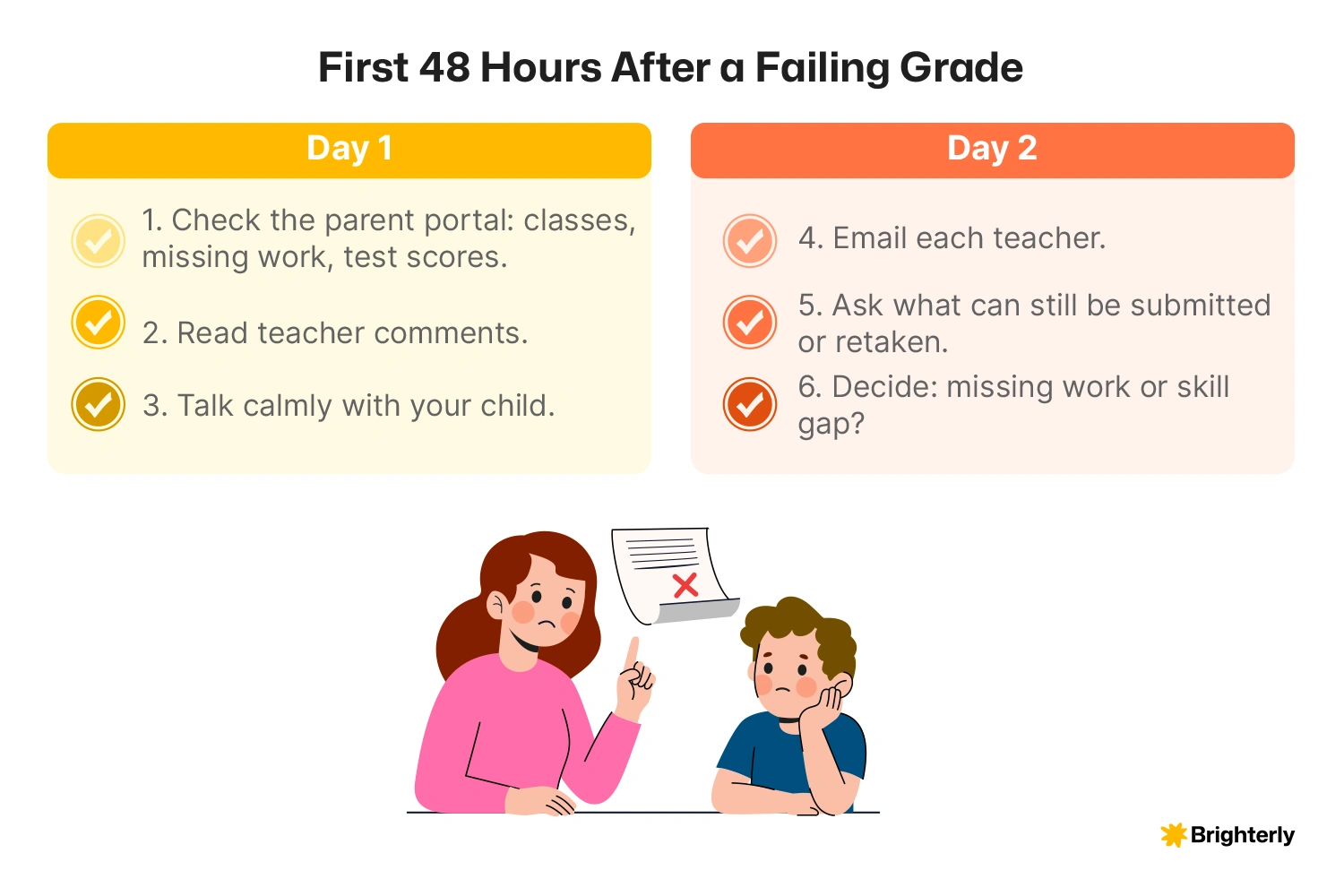
Here’s a checklist of what you can do in the first 48 hours if you ask yourself, “My child is struggling in school, what do I do?”:
- Check the parent portal for classes with D or F grades, missing assignments, and recent test scores.
- Review teacher comments and report card notes.
- Talk to your child calmly without threatening them with any form of punishment.
- Email the teachers of the classes your child is failing (see sample below) and ask what work can still be submitted, redone, or retaken, including the deadlines.
- Figure out if the problem is missing work or a learning gap.
So, a bad grades report card is the first warning sign that can point to your kid failing school. Gallup and Learning Heroes (2023) report that 79% of parents say their child earns mostly B’s or better on report cards, so grades below that often indicate a problem.
Note: See what counts as a failing grade to gain more insight into report card interpretation.
In general, if you’re wondering, “Why is my child struggling in school?” it could be due to a skill gap, organization issues (missed deadlines, unsubmitted assignments), or changes in a kid’s well-being (sleep, stress) — each issue needs a different approach.
Explore Brighterly Learning Experience
Learn exactly how Brighterly helps students thrive through expert sessions, online tools, and proven feedback from thousands of satisfied parents
How to Talk to Your Child About Failing Grades
To talk to a kid struggling in school about bad grades, pick a calm moment and try to figure out what exactly is making school hard for them — let them know you’re there to help rather than to blame. Then ask questions that encourage a kid to talk and listen before jumping to solutions.
Here are the questions you can ask:
- Which class feels the hardest now and when did it start feeling that way?
- Tell me about the last assignment you didn’t turn in and why?
- What kind of help would make the biggest difference for you this week?
When talking to your child, you may think, “My teenager is failing school and doesn’t care”, but remember that this attitude is often just a cover children use when they feel lost, so try to be understanding rather than judgemental.
What to Ask Your Child’s Teachers About Failing Classes
First, reach out to your child’s teacher right away if you have questions about areas where your child is struggling — don’t wait for any scheduled parent-teacher events. Start by sending a brief, focused email that a teacher can reply to with clear answers. Questions can be about missing work, areas needing improvement, and available options for this improvement:
- Which assignments is my child missing, and which can they still submit?
- Are test retakes, corrections, or makeup work allowed, and if yes, by when?
- Which specific skills does my child need to work on?
- Is there peer tutoring, a homework club, or any other free option that supports failing students?
- When can we contact you again to discuss progress?
If your student struggling in school is failing multiple subjects, misses classes, shows signs of distress, or shows signs of a learning disability, contact the school counselor or student support team to request an evaluation. After evaluation, recovery options for struggling kids vary, so ask about your school’s specific policies.
|
Sample email: Subject: Checking in about [Child]’s grade in [Class] Body: I noticed that [Child’s Name] is currently failing [Class Name]. Could you let me know which assignments are missing, if any can still be submitted or retaken, and what skills [Child’s Name] should focus on? We want to help at home. Would a brief call this week be possible? |
Can Your Child Still Pass After Failing Classes?
Yes, a child usually can still pass a class even if they’ve failed some assignments — it all depends on the school’s specific grading rules, how much each assignment is worth, what the course requires, and how much time is left till the end of a semester.
Example:
If your child got 52% on work that is worth 70% of the grade, they need to get 79% on the remaining 30% of assignments to reach the 60% passing point.
*Check your child’s current numbers with a final grade calculator.
To figure out how to pass a class you’re failing, focus on the most important assignments first, and then work on anything the teacher will still accept for credit.
If the grading period is already over, check if the school has options like summer school, credit recovery programs (usually for middle and high school), or if an incomplete grade is possible.
How to Create a School Recovery Plan
Creating a recovery plan involves listing what’s not working, what the next steps are, who’s responsible, and when to check progress. Keep the plan simple and short (one page is enough). Start with the most critical class, set a couple of quick goals, and review every week or two.
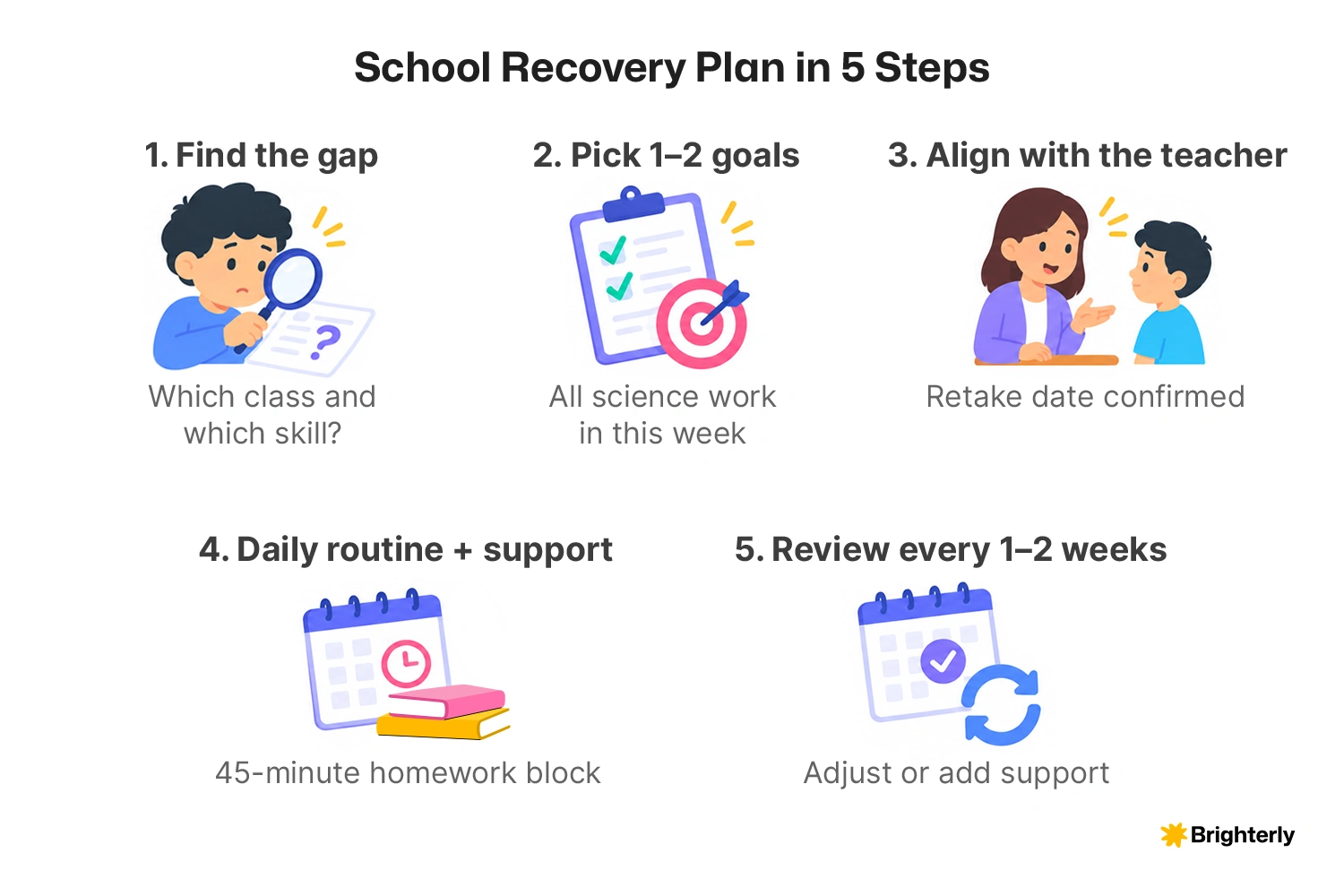
A recovery plan is essential in the “how to get help for failing grades” process and should focus on the learning gaps in a failing subject, set a few short-term goals, like completing all assignments for a failing subject that week, and establish a consistent homework routine (same time, same place, no phones). Provide extra academic support if needed and review progress regularly — every week or every couple of weeks.
| Problem | Recommended action | Who is responsible | When to review |
| 4 missing science assignments | Submit the ones that are still accepted and matter the most for the grade | Child (parent checks the portal) | End of this week |
| Failed the fractions unit test | Ask about a retake option (practice fractions 15 minutes daily before retake) | Child + teacher (tutor if a child has one) | Before the retake date |
| Can’t follow reading in social studies |
|
Parent + teacher | In 3–4 weeks |
| Homework isn’t getting done | Fixed 45-minute homework time (phone outside the room) | Parent + child | Weekly on Sunday |
| No improvement after 4–6 weeks |
|
Parent | End of grading period |
What If Your Child Is Failing Math or Reading?
If a child is failing math or reading, it’s usually because they have learning gaps in foundational skills needed for these subjects. To fill these gaps, figure out which skills are missing and practice them step by step. Your child’s teacher or a quick skills assessment can help find the problem areas.
Note: In 2024, only 30% of eighth graders met the proficient level in reading (Nation’s Report Card, January 29, 2025).
If Your Child Is Failing Math
If you think, “My child is failing math”, focus on earlier math concepts your kid is struggling with. For example, not understanding fractions can make ratios and algebra difficult later on, and repetitive work on current assignments won’t help until the child masters those earlier concepts.
To find the specific math gap, ask your child’s teacher or use a free diagnostic math test. You can also consider private math tutoring with our online math tutor to not just identify but also fill the learning gaps.
If Your Child Is Failing Reading
If your child is struggling with reading, start by checking their decoding, fluency, vocabulary, and comprehension skills via a free reading test to see which exact skills need practice and improvement. If self-practice and parent support are not enough, consider getting an online reading tutor for professional guidance.
Find the gaps behind failing grades
Free K-12 math and reading tests show where your child needs support.


When Should You Consider Tutoring for a Struggling Student?
Consider tutoring when a child is struggling in a subject no matter how much they study, or if the plan to boost their grade hasn’t helped in a few weeks. Remember that tutoring is not the immediate solution for every child — consider it after identifying a skill gap and attempting in-school intervention.
The signs your child needs a tutor:
- They keep failing tests in a subject
- They have gaps in foundational skills
- They have trouble keeping up with the class pace
- They show no progress after you’ve tried the recovery plan
For a child struggling in school, a private tutor can help find and fill the learning gaps while adapting to the child’s pace. Our tutoring programs also align with the US standards to make sure your kid learns exactly what they’ll need at school.
How to Track Academic Progress Without Adding Pressure
To track your child’s academic progress without stress, try doing it according to a schedule you set together. A predictable 10-minute check every Sunday is better than a random argument over a grade — your child won’t feel pressure over being constantly monitored, and you’ll be able to spot trends without going over every grade.
- Track assignment completion and grades
- Watch specific skills (not just scores) and compare each progress report with the last
- Check in with teachers every two to three weeks
- Celebrate and praise small wins (like one passed quiz)
- Adjust the recovery plan when and if needed
Personalized support for math and reading
Book a free lesson and see how a tutor rebuilds missing foundations.
Conclusion
When your child’s struggling in school, figure out what’s going on, have a calm talk about it, contact the teacher, create a simple one-page plan, and provide needed support. If the plan isn’t working and it’s math or reading your child is failing, try one-on-one tutoring online with Brighterly by booking a free demo lesson .
Frequently Asked Questions
Should You Take Away Privileges When Your Child Is Failing Classes?
No, you shouldn’t take away privileges when your child is failing classes — this approach rarely solves the issue and can actually make things harder for a kid. Instead, try to figure out what’s causing the problem and build a solution plan while also setting clear expectations. For example, you can set a specific “no phone” homework time and space.
What Can You Do If Your ADHD Child Is Failing School?
If you ask yourself, “What can I do if my ADHD child is failing school?”, the answer is to ask your child’s school about a 504 plan or IEP evaluation — even the US Department of Education says that schools are required to evaluate students who might need special education or related services because of a disability.
Why Would a Good Student Suddenly Start Failing?
A good student might suddenly start failing due to a new topic that relies on missed skills, a heavier course load, changes in sleep or stress levels, or a learning difference that only became apparent as the schoolwork got more challenging. Talk to your child and their teacher to find out for sure what is causing the failing. If the decline is significant, consider involving the school counselor.
How Long Does It Take to Bring Failing Grades Up?
There’s no set amount of time on how long it takes to bring failing grades back up. This time depends on what’s causing the problem, how much time is left in the school term, and what kind of support your child receives.


Your child says the phone is just for music while doing homework, but the assignments stay unfinished? Find out recommended screen time limits by age, 8 screen time rules you can implement tonight, and in what scenarios screen time isn’t the issue to decide how to manage your child’s time on the phone wisely. Should […]

Nov 12, 2026
Math & reading from 1st to 12th grade
Looking for homework support for your child?

Choose kid's grade

Math & Reading for Grades 1–12
Build real confidence for your child with a Brighterly math or reading tutor.