Screen Time Rules for Kids: Should Phones Be Allowed During Homework?
reviewed by Ann Carlen A. Flores
Updated on November 12, 2026
Key Points:
Your child says the phone is just for music while doing homework, but the assignments stay unfinished? Find out recommended screen time limits by age, 8 screen time rules you can implement tonight, and in what scenarios screen time isn’t the issue to decide how to manage your child’s time on the phone wisely.
Should Parents Limit Screen Time for Kids?
Yes, parents should limit screen time for kids, but not based on the clock — the AAP guidance for parents on limiting screen time for kids offers 5 Cs of media rules (Child, Content, Calm, Crowding Out, and Communication) updated in September 2026 to rely on instead:
- Child: Does the content match your child’s age and needs?
- Content: Is the content high quality?
- Calm: Can your child calm down without needing a screen?
- Crowding out: Which activities does screen time replace (sleep, homework, sports, family time)?
- Communication: Do you talk about media early and often with a child?
Answering these questions helps you identify if your kid might be spending too much unnecessary time on screen and where this time can and should be reduced.
If you’re wondering, “Why is screen time bad for kids?”, the AACAP June 2025 guide links too much screen time to sleep problems, lower grades, and less reading. You can use AAP’s 5 Cs guide to prevent these issues from rising.
Following the AACAP guide, Christine Miles, M.S. Ed., founder and CEO of EQuipt and creator of The Listening Path, also addresses the excessive screen time effect on sleep and learning:
“Sleep is usually the first thing to go.”


Explore Brighterly Learning Experience
Learn exactly how Brighterly helps students thrive through expert sessions, online tools, and proven feedback from thousands of satisfied parents
Should Kids Use Phones or Tablets While Doing Homework?
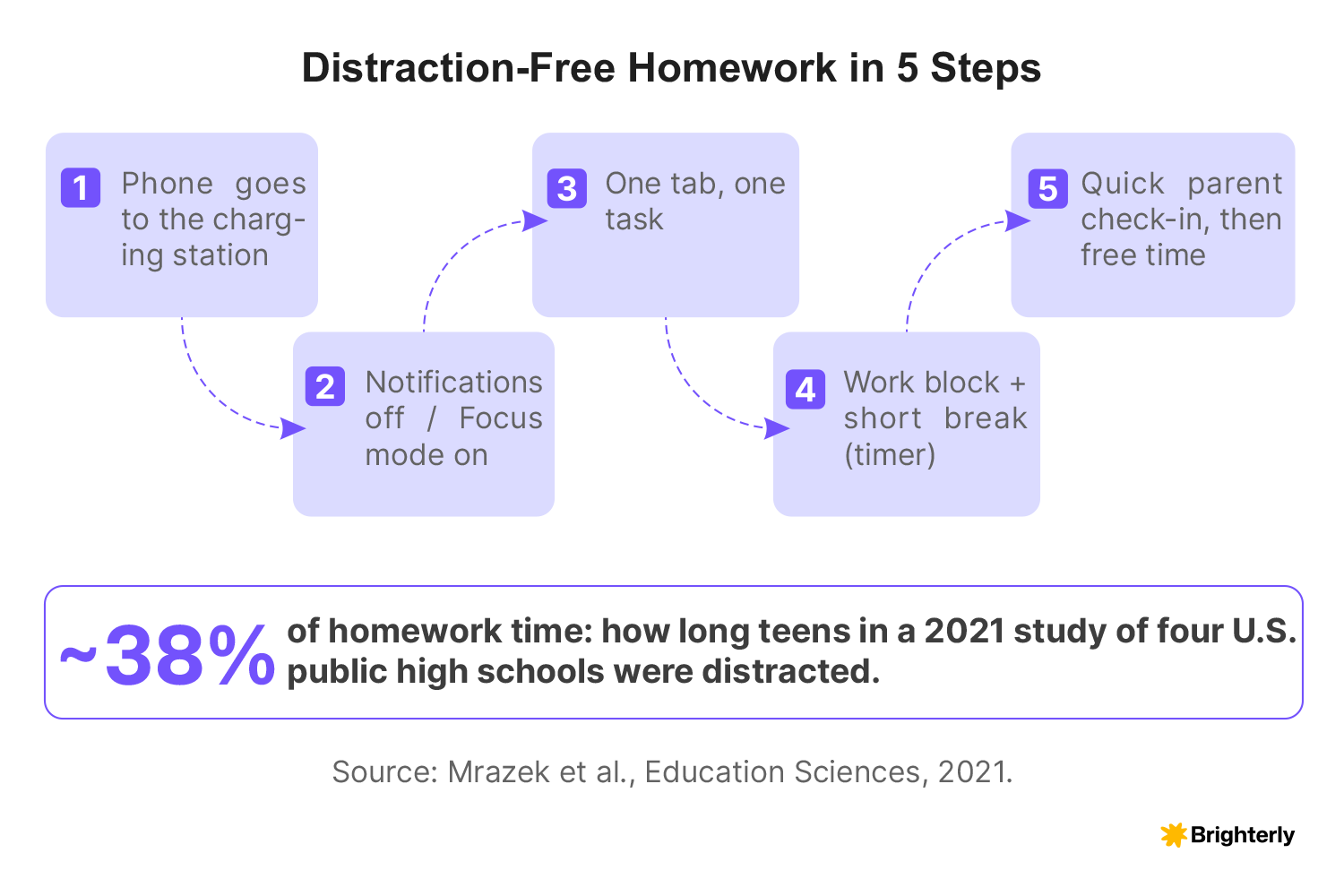
Kids should be using phones or tablets while doing homework only if the assignment requires it — in other cases, the gadget will just distract the kid. For example, the Education Sciences November 2021 survey (most relevant on the topic as of November 2026) found that teens get distracted during homework about 38% of the time if they’re mind-wandering or on a digital device.
“I'd ask a different question: is the device doing the thinking, or is your child?”
This Education Sciences survey proves that digital multitasking is one of the reasons for homework distractions. Additionally, Brighterly’s homework statistics review shows that 74% of students consider homework a major source of stress, which could explain why they seek distraction when doing it.
Note: Check AI policies in schools to see when using AI tools is acceptable and counts toward homework-related screen time.
If you’re wondering how to identify whether your kid’s screen time is affecting their homework, Dr. Michael Glazier, Chief Medical Officer and pediatrician at Bluebird Kids Health, shares these signs to look for:
“I'd ask a different question: is the device doing the thinking, or is your child?”

Turn screen time into learning time
Live 1:1 lessons with a tutor who keeps your child engaged. 

Top Screen Time Rules That Work
If you wonder how to manage screen time for kids, you can apply the following rules one by one, fitting them into your family’s schedule and adding more as each rule becomes a habit:
1. Build a Family Media Plan Together
Follow the AAP’s recommendation to build a Family Media Plan where you write down when, where, and what devices your child uses. And since kids are more likely to follow rules they helped create, keep them involved in creating the plan.
“Let me say this plainly: the app is not the best support for your child. You are.”

2. Set a Charging Station Outside Bedrooms
Following the AACAP June 2025 guidelines that suggest turning screens off 20-30 minutes before bed, implement a device curfew — set a rule of leaving gadgets in the kitchen to charge for the night, so that they don’t disturb a kid’s sleep.
3. Create Screen-Free Zones
Make the dinner table and bedroom areas where screens aren’t allowed, including yours — your kids learn by watching their parents, so lead by example.
4. Finish Homework Before Recreation
Post a checklist on the fridge, where you have homework, reading, chores, and screen time in order (homework being the highest priority and screen time the lowest). Ask a child to check each box one by one when they’re done.
5. Check Content Before Your Child Clicks
Set parental controls, such as iOS Screen Time or Google Family Link, to keep an eye on what your child watches and plays to make sure the content is safe and beneficial for them. You can start by walking a kid through helpful social media in education practices.
6. Co-View and Co-Play
Watch or play something together with your child once a week. Doing this co-viewing or co-playing can make screen time a shared activity that builds trust and shows you what your child is really doing online.
7. Teach Calm Without a Screen
When your child is upset, try a simple calming routine before letting them use a device. This routine could be taking a few slow breaths, having a snack, going for a short walk, or looking at a picture book. Such activities teach kids to manage their feelings without needing a screen to feel better.
8. Reduce Screen Time Gradually and Fill the Gap
Lower screen time by suggesting something else to do instead, like riding bikes, playing a board game, or doing a math worksheet if you want them to practice learning. Making these small, regular breaks from screens (digital detox) a habit works better than cutting them off completely all at once.
“You probably won't see a big change in the first few weeks.”
Screen Time Limits for Children by Age
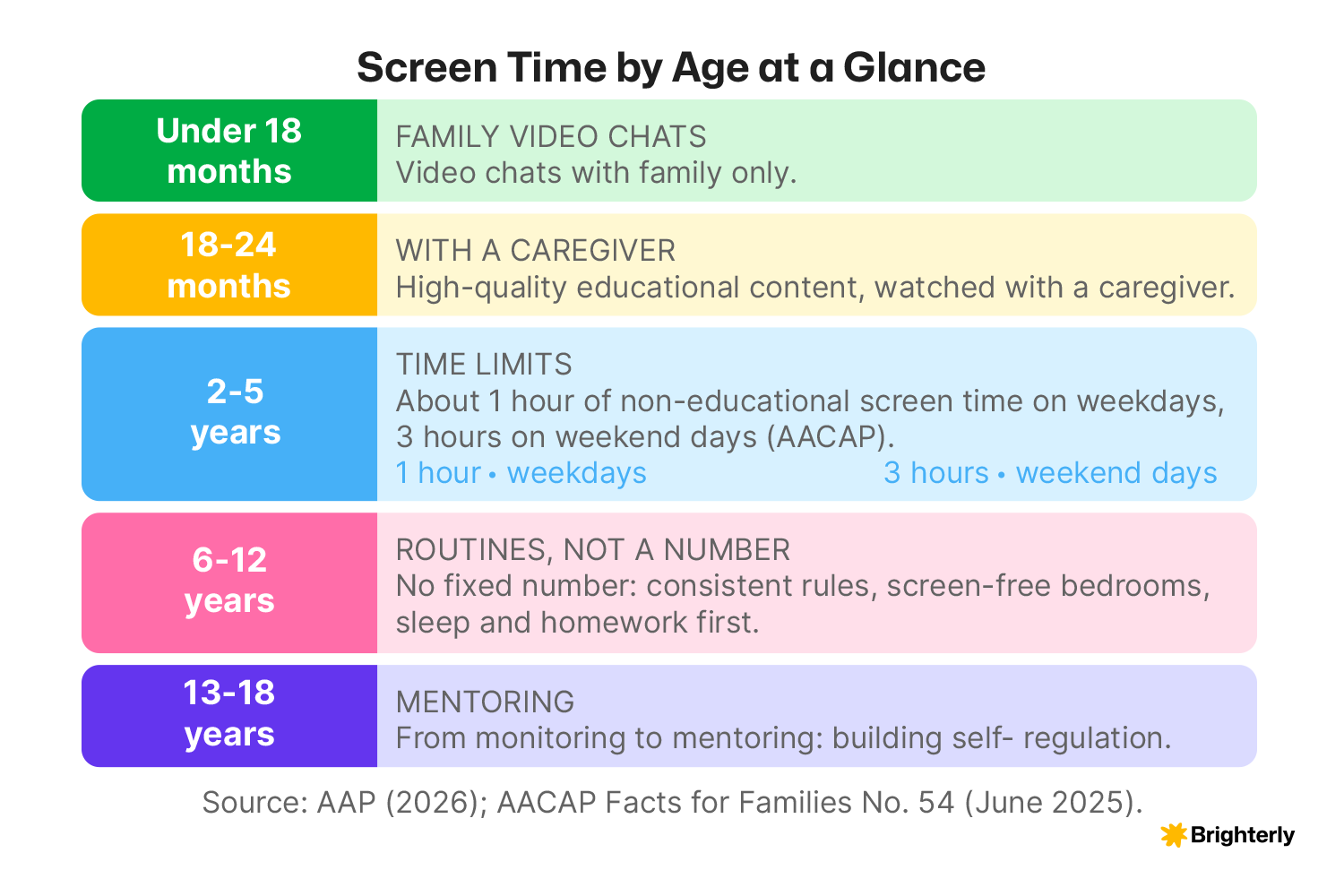
Both the AAP (January 2026) and the AACAP (June 2025) give recommended screen time by age for kids through age 5. For ages 6 and up, neither AAP nor AACAP sets a fixed limit — both recommend rules for protecting sleep, homework, and activity instead of focusing on hourly caps.
How Screen Time Rules Change as Kids Grow
- Ages 6–9: Keep an eye on what a child is watching; set the time and place for using devices.
- Ages 10–12: Supervise device use, but give a kid some room. Establish device-related rules before the device is in the house.
- Ages 13–18: Mentor device use instead of monitoring it. Review settings together but encourage teens to manage their screen time on their own.
Note: Screen time rules should change as your child grows. In general, the younger the kid, the less screen time and the more supervision they need to make sure they build healthy screen habits.
Educational vs. Recreational Screen Time: What’s the Difference?
Educational screen time has a clear and beneficial purpose — it’s when a child learns, creates, solves, or practices something. In contrast, the usual purpose of recreational screen time is entertainment and relaxation. Neither recreational nor educational screen time is bad if it’s balanced according to the kid’s needs and age.
| Educational / Active | Recreational / Passive | |
| Purpose | Learn, practice, create | Relax, play, socialize |
| Examples | Live tutoring, coding, and reading with a parent | Autoplay videos, endless scrolling |
| Who controls the pace | Child, teacher, parent | The app or algorithm |
| What to watch for | Drifting into other tabs | Lost sleep, no stopping point |
If you’re struggling to tell educational screen time from recreational, Claire Smizer, an educational adviser at Brighterly, offers a solution:
“For telling educational from recreational, ask one question: does the app push my child’s thinking or problem-solving?”
An example of having educational screen time is getting Brighterly live 1:1 tutoring lessons online. Our tutors in an online math or reading program make sure the lessons are interactive and customized according to the child’s age, knowledge level, and needs, aligning the curriculum with US state standards.
If you have concerns about online education, check out the online vs. in-person school review.
Find out where your child stands today
Take a free math or reading test and spot learning gaps early.
What School Phone Bans Mean for Screen Time Rules at Home
Parents can use school phone bans as a model to rely on when creating relevant and matching screen time rules at home. For example, according to September 2025 news from Radio Sweden, Sweden’s nationwide ban, active from the 2026–2027 school year, covers classes, breaks, and after-school activities. So, Swedish parents can match their home rules to that phone-free school day rule by establishing a no-phone rule during homework.
The education minister of Sweden also said that the ban could help parents with screen struggles at home (The Economic Times, January 2026).
In June 2026, The Guardian published news that Sweden’s public health agency also urged parents to put their own phones away around children.
Note: Check out how schools in the US are restricting phone use.
Conclusion
To sum up, when it comes to screen time and homework:
- Put screen time necessary for homework first
- Keep the phone completely out of reach during homework if the assignment doesn’t require it
- Keep the gadgets out of the bedroom for the night
- Adjust screen time rules as your kid grows.
If your kid struggles with healthy screen time habits, try educational screen time with a professional tutor.
Frequently Asked Questions
Does Homework Count Toward Daily Screen Time?
Whether homework counts as screen time really depends on each family’s rules, because there isn’t an official guideline for this. That said, most families don’t include homework when they’re tracking screen time — they see it as something needed for school, unlike using devices just for fun.
Is 5 Hours of Screen Time Bad for a Child?
Considering how much screen time is too much, whether it’s 5 hours or more/less, depends on the child’s age and on whether you include homework in it. In general, neither the AAP nor AACAP sets a fixed screen time limit for ages 6 and up, but in its updated April 2026 article, OSF HealthCare recommends no more than 2 hours per day (not including homework) for kids ages 5-17.
Should I Take Away My Child’s Phone as a Punishment?
According to the May 2026 updated Child Mind Institute article, taking a child’s phone as a punishment might not be a good idea since this measure takes away not just a kid’s phone but multiple forms of communication and entertainment it provides. Besides, as you deprive a kid of this essential, for them, communication and entertainment tool, you can risk damaging your parent-child relationship.
Should Screen Time Rules Be Different on Weekends?
Screen time rules can be slightly different on weekends, but it depends on the child’s age. For example, AACAP guidance updated in June 2025 recommends about 3 hours of screen time on weekends for kids ages 2–5 versus 1 hour on weekdays — educational activities not included in both. If your kid is older, encourage healthy device use habits by try to limit activities that involve screens in general.
At What Age Should a Child Get Their Own Smartphone?
According to the April 2025 Child Mind Institute article, the age at which a child gets their own phone should depend on whether this particular child is mature enough to take responsibility for their belongings and is able to follow screen time limits. The article adds that most kids get their first phone when they’re 12 to 14.
Is Watching TV Better Than Using a Tablet or Phone?
Watching TV can be considered better than using a tablet or a phone because the TV is viewed from a distance, which means less risk of negatively affecting the kid’s eyesight. Also, TV is easier to watch together, and the TV time ends when the show does, unlike constant phone scrolling.


In October 2026, Brighterly surpassed 1,000,000 lessons on our platform, including more than 600,000 math classes and 400,000 lessons in reading. This milestone shows our commitment to making 1:1 learning accessible to kids across the US, helping them strengthen foundational skills and improve their grades. One Million Lessons in Math and Reading Our 1,000,000 milestone […]

Nov 03, 2026
Math & reading from 1st to 12th grade
Looking for homework support for your child?

Choose kid's grade

Math & Reading for Grades 1–12
Build real confidence for your child with a Brighterly math or reading tutor.