
How Many Sides Does a Heptagon Have? Explained Simply
Updated on September 24, 2026
A heptagon is a two-dimensional geometric shape classified as a polygon that possesses exactly seven sides. It is a closed figure, meaning all its sides connect to form a continuous boundary with no openings. In geometry, the name is derived from the Greek words hepta, meaning seven, and gonia, meaning angle, highlighting its primary characteristics.
Understanding the properties of a heptagon is essential for mastering geometry and spatial reasoning. While it is less commonly discussed than squares or triangles, it appears in various real-world applications, including currency design and architecture. By learning about its angles, symmetry, and types, students can better understand how different polygons are classified and measured.
How Many Sides Does a Heptagon Have?
A heptagon always has exactly seven sides, which are the straight line segments that form its outer boundary.
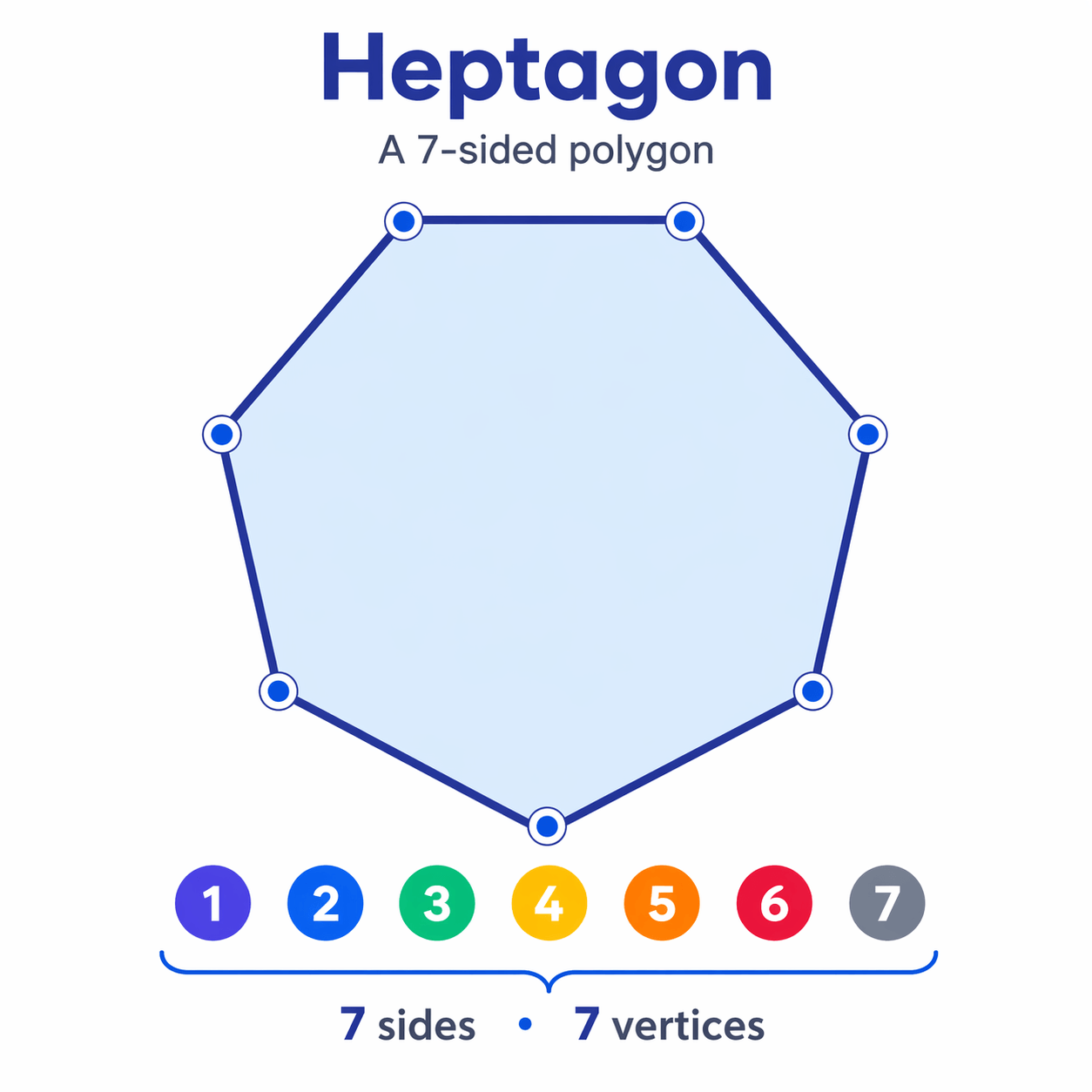
These seven sides meet at seven distinct points called vertices, creating seven internal corners or angles. Regardless of whether the sides are equal in length or the shape looks symmetrical, any closed polygon with seven straight edges is correctly identified as a heptagon.


Help your child reach their full potential!
Answer a few quick questions about your child’s learning, and we’ll recommend next steps.
Quick Reference:
| Polygon | Number of Sides | Number of Angles |
| Triangle | 3 | 3 |
| Square | 4 | 4 |
| Pentagon | 5 | 5 |
| Hexagon | 6 | 6 |
| Heptagon | 7 | 7 |
| Octagon | 8 | 8 |
Expert Math Tutors for Every Level
Connect with professional and certified educators who provide specialized support for every grade level, from elementary school basics to advanced algebra
Properties of a Heptagon
A heptagon is defined by several core geometric properties that remain constant across all variations of the shape. Every heptagon contains seven vertices and seven interior angles, and it can be divided into exactly five triangles by drawing diagonals from a single vertex. These properties provide a foundation for calculating more complex measurements like area, perimeter, and angle sums in both academic and practical settings.
Regular and Irregular Heptagons
Heptagons are primarily classified as either regular or irregular based on the relationship between their sides and angles. A regular heptagon is a shape where all seven sides are of equal length and all seven interior angles are of equal measure. Because of this perfect uniformity, a regular heptagon possesses high levels of symmetry, including seven lines of symmetry and rotational symmetry of order seven. Conversely, an irregular heptagon is any seven-sided polygon where the sides or angles are not all the same. Irregular heptagons can take on a wide variety of appearances, ranging from slightly skewed shapes to highly lopsided ones, but they still retain the fundamental requirement of having seven sides.
Convex and Concave Heptagons
Another way to categorize heptagons is by the orientation of their vertices and the measure of their interior angles. A convex heptagon is one where all interior angles are less than 180 degrees, causing all vertices to point outward away from the center of the shape. In a convex heptagon, any line segment drawn between two vertices will stay entirely within the boundaries of the shape. A concave heptagon, however, contains at least one interior angle that is greater than 180 degrees, creating a “dent” or “cave” in the shape where a vertex points inward. This distinction is important for higher-level geometry because the formulas for area and properties of diagonals can change depending on whether a shape is convex or concave.
Angles and Diagonals of a Heptagon
The relationship between the sides of a heptagon and its internal space is governed by specific mathematical rules regarding its angles and diagonals. A diagonal is a straight line that connects two vertices that are not next to each other. In a heptagon, you can draw a total of 14 unique diagonals, which helps in identifying the internal structure and symmetry of the figure. The study of these angles is crucial for understanding how the shape fits into a larger geometric plane.
Sum of Interior Angles
The sum of the interior angles of any heptagon is always 900 degrees. This can be proven using the general formula for polygons, (n – 2) x 180, where n represents the number of sides. For a heptagon, substituting 7 for n results in (7 – 2) x 180, which is 5 x 180, totaling 900 degrees. This constant sum applies to every heptagon, whether it is regular, irregular, convex, or concave. In a regular heptagon, since all angles are equal, each individual interior angle measures approximately 128.57 degrees. This measurement is found by dividing the total sum of 900 degrees by the seven angles.
Exterior Angles of a Heptagon
The exterior angles of a heptagon, like those of all convex polygons, always add up to exactly 360 degrees. An exterior angle is formed by extending one of the sides of the polygon and measuring the angle between the extension and the adjacent side. In a regular heptagon, each exterior angle is equal in measure. By dividing the total sum of 360 degrees by seven, we find that each exterior angle of a regular heptagon measures approximately 51.43 degrees. Understanding exterior angles is helpful for determining the turn angle required to draw a heptagon or for calculating individual interior angles when only the external measure is provided.
Solved Examples on how many sides does a heptagon have
Practicing with specific problems helps reinforce the concepts of side counts, perimeters, and angle sums. These examples demonstrate how to apply geometric formulas to various types of heptagonal shapes. By working through these solutions, students can gain confidence in identifying the shape and performing the necessary calculations for school assignments and tests.
Example 1: Finding the perimeter of a regular heptagon
If a regular heptagon has a side length of 8 centimeters, what is its total perimeter? To solve this, recall that the perimeter of any polygon is the sum of all its side lengths. Since a heptagon has seven sides and this specific one is regular, all sides are equal. The formula is Perimeter = 7 x s, where s is the side length. Substituting the value, we get 7 x 8 = 56. Therefore, the perimeter of the regular heptagon is 56 centimeters.
Example 2: Calculating the sum of interior angles of a 7-sided polygon
A student is asked to find the sum of the interior angles for a lopsided, seven-sided figure. To find the answer, use the formula (n – 2) x 180. Even though the figure is irregular, the rule for the sum of angles remains the same based on the number of sides. Since the figure has 7 sides, the calculation is (7 – 2) x 180, which equals 5 x 180. The sum of the interior angles for this polygon is 900 degrees.
Example 3: Identifying a heptagon from a list of polygons
Given a list of shapes including a triangle, a pentagon, an octagon, and a 7-gon, which one is a heptagon? A triangle has 3 sides, a pentagon has 5 sides, and an octagon has 8 sides. A 7-gon is another name for a heptagon because the prefix “hepta” means seven. Therefore, the 7-gon is the heptagon in the list. This exercise reinforces the definition that any polygon with exactly seven sides is a heptagon.
Example 4: Finding the area of a regular heptagon using its side length
What is the approximate area of a regular heptagon with a side length of 5 inches? The simplified formula for the area of a regular heptagon is Area = 3.634 x a squared, where a is the side length. First, calculate the square of the side length: 5 x 5 = 25. Next, multiply this by the constant: 3.634 x 25 = 90.85. The approximate area of the heptagon is 90.85 square inches.
FAQ
Is a heptagon the same as a septagon?
Yes, a heptagon and a septagon are two different names for the exact same seven-sided polygon. The term heptagon uses the Greek prefix “hepta,” which means seven. The term septagon uses the Latin prefix “sept,” which also means seven. In mathematical and scientific contexts, “heptagon” is the more standard and widely accepted term because it follows the Greek naming convention used for other polygons like pentagons and hexagons.
How many diagonals can be drawn in a heptagon?
A heptagon has a total of 14 diagonals. A diagonal is defined as a line segment that connects two non-adjacent vertices of a polygon. You can calculate the number of diagonals for any polygon using the formula n(n – 3) / 2, where n is the number of sides.
For a heptagon, you would substitute 7 for n: 7(7 – 3) / 2, which simplifies to 7(4) / 2. This results in 28 / 2, giving you 14 diagonals. From any single vertex in a heptagon, you can draw exactly four diagonals to other vertices. This property is often used in geometry to divide the shape into smaller triangles for easier calculation of area or internal angles.
What is the measure of each interior angle in a regular heptagon?
In a regular heptagon, every interior angle has the same measure, which is approximately 128.57 degrees. To find this value, you first determine the sum of all interior angles, which is always 900 degrees for any seven-sided polygon.
Since a regular heptagon is defined by having seven equal angles, you simply divide the total sum by the number of angles: 900 / 7. This results in a repeating decimal (128.571428…), which is typically rounded to 128.57 degrees for most classroom applications. It is interesting to note that unlike a hexagon (120 degrees) or a square (90 degrees), the interior angle of a regular heptagon is not a whole number.
What are some real-life examples of a heptagon shape?
Heptagons are not as common in nature as hexagons or triangles, but they are frequently used in human-made designs for security and distinction. One of the most famous examples is the British 20p and 50p coins, which are shaped as Reuleaux heptagons—a specific type of heptagon with curved sides that allows them to roll easily in vending machines while remaining distinct from circular coins.
Additionally, the Barbados dollar and some coins from Botswana also feature heptagonal shapes. In architecture, heptagonal floor plans or windows are sometimes used to create unique visual interest. You might also find heptagonal patterns in certain crystal structures or specialized police badges that use a seven-pointed star design based on heptagonal geometry.


Math & reading from 1st to 12th grade
Looking for homework support for your child?

Choose kid's grade

Math & Reading for Grades 1–12
Build real confidence for your child with a Brighterly math or reading tutor.