Irony Worksheet
Updated on October 22, 2026
Irony worksheets help 5th grade students recognize situations in which the intended meaning or outcome differs from what is expected. Brighterly’s printable activities introduce the three main types of irony — verbal, situational, and dramatic — through short passages, examples, and reading comprehension questions.
Students learn to look beyond literal meaning, compare expectations with actual outcomes, and use context clues to explain why a situation is ironic.
Irony Worksheets: Examples
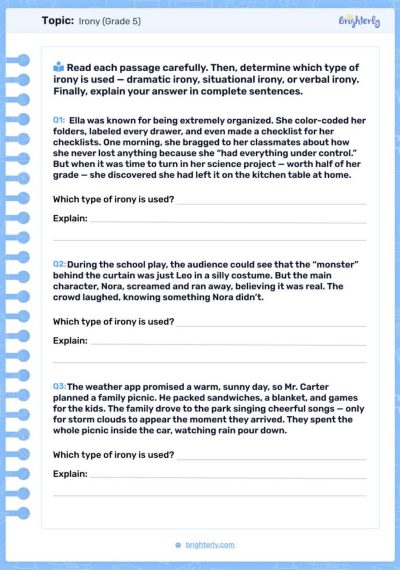
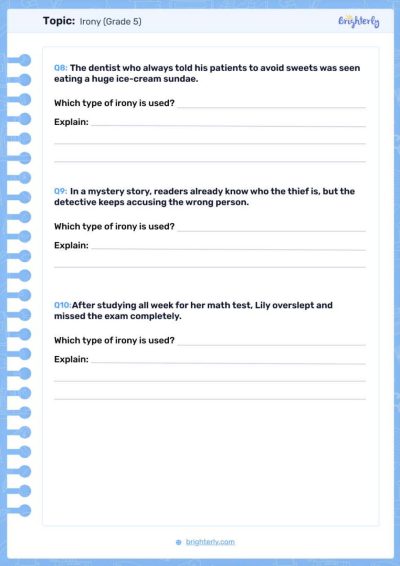
Brighterly’s irony worksheets give students practice identifying different types of irony in sentences and short reading passages. They may need to decide whether an example is verbal, situational, or dramatic irony and explain the contrast that creates the ironic effect.
For example, imagine it starts pouring rain during a picnic and someone says, “What perfect weather!” The speaker’s words mean the opposite of what the situation suggests, so this is verbal irony.


See how well your child reads between the lines
A quick quiz can reveal which Grade 5 reading skills need practice
Irony Worksheets With Answers [Download for Free]
Download Brighterly’s free irony worksheets for 5th grade to practice identifying verbal, situational, and dramatic irony. The printable PDFs include answer keys so students can check their responses and review how each example creates an unexpected or contrasting meaning.
For broader grade-level comprehension practice, students can also use 5th grade reading worksheets.
What Are the Three Types of Irony?
Irony occurs when there is a contrast between what is said, what is expected, and what actually happens. Students commonly learn three main types:
| Type of Irony | What It Means | Example |
|---|---|---|
| Verbal irony | A speaker says something different from or opposite to what they really mean. | Saying “Great job!” after someone spills an entire box of papers. |
| Situational irony | What actually happens is very different from what the reader or character expects. | A fire station catches fire. |
| Dramatic irony | The reader or audience knows something important that a character does not know. | The reader knows a character is hiding behind the door, but another character does not. |
How to Identify Irony in a Text
Students can use a few simple questions to decide whether a sentence or passage contains irony:
- What does the character or reader expect to happen?
- What actually happens?
- Does a speaker mean exactly what the words say?
- Does the reader know something a character does not?
- Why is the contrast important or humorous?
Identifying the difference between expectation and reality is especially helpful for recognizing situational irony, while paying attention to tone and context can help students spot verbal irony.
Verbal Irony
Verbal irony happens when a speaker’s intended meaning differs from the literal words they use.
For example:
A student sees a huge pile of homework and says, “Well, this looks fun.”
The literal statement sounds positive, but the context suggests that the student means the opposite.
Recognizing verbal irony often requires students to consider the speaker’s attitude and word choice. They can reinforce this related skill with tone worksheets.
Situational Irony
Situational irony occurs when the result of an event is noticeably different from what would normally be expected.
For example, if a professional swimming coach forgets how to swim, the outcome conflicts with what readers would reasonably expect from that person.
Students should explain both parts of the contrast: what was expected and what happened instead.
Dramatic Irony
Dramatic irony occurs when the reader or audience knows information that one or more characters do not know.
For example, a reader may know that a surprise party is waiting behind a door while the character believes everyone has forgotten their birthday.
This difference in knowledge can create suspense, humor, or tension because readers understand the situation differently from the character.
Irony vs Other Literary Devices
Irony is often connected with other literary techniques, but it has its own purpose. Figurative language such as metaphors or personification changes how something is described, while irony depends on a contrast between literal meaning, expectations, or knowledge.
Students can practice distinguishing these techniques with figurative language worksheets.
Irony can also appear in satire, where writers use humor, exaggeration, and contrast to criticize behavior or ideas. Older students can explore this relationship further with satire worksheets.
How Word Choice Helps Create Irony
Authors often rely on specific words, tone, and context to signal that a statement should not be interpreted literally. Looking closely at those choices helps students explain not only that a passage is ironic, but also how the author creates the effect.
Students can deepen this type of literary analysis by exploring how deliberate word choice shapes meaning and tone with Brighterly’s diction worksheets.
Benefits of Irony Worksheets
- Recognize different types of irony. Students practice distinguishing verbal, situational, and dramatic irony instead of treating every unexpected statement or event as the same literary device.
- Look beyond literal meaning. Irony requires students to consider context, speaker intention, and expectations rather than relying only on the literal meaning of words.
- Strengthen reading comprehension. Understanding irony helps students interpret characters, events, author choices, and implied meaning in fiction and nonfiction passages.
- Develop literary analysis skills. Students learn to support an interpretation by explaining what creates the contrast and why the author may have used irony.
- Build context and tone awareness. Verbal irony in particular requires students to pay attention to attitude, wording, and context clues that reveal what a speaker actually means.
Other Worksheets
- Tone worksheets
- Figurative language worksheets
- Point of view 5th grade worksheets
- Cause and effect worksheets
- Diction worksheets
For additional Grade 5 reading practice, students can also work through Brighterly’s 5th grade reading comprehension worksheets.
Frequently Asked Questions
What Are the Three Types of Irony?
The three main types of irony are verbal, situational, and dramatic irony. Verbal irony occurs when a speaker means something different from the literal words, situational irony involves an unexpected outcome, and dramatic irony occurs when the reader knows something a character does not.
What Grade Do Students Learn Irony?
Students can begin identifying straightforward examples of irony around 5th grade as reading comprehension becomes more analytical. They may practice recognizing verbal, situational, and dramatic irony in short passages before studying more complex literary uses in middle and high school.
What Is the Difference Between Verbal and Situational Irony?
Verbal irony involves a contrast between what someone says and what they actually mean. Situational irony involves a contrast between what is expected to happen and what actually happens. For example, saying “Lovely weather” during a storm is verbal irony, while a weather station being destroyed by a storm is situational irony.

Math & reading from 1st to 12th grade
Looking for homework support for your child?

Choose kid's grade

Math & Reading for Grades 1–12
Build real confidence for your child with a Brighterly math or reading tutor.