Composite Functions Worksheets
Updated on September 28, 2026
Composite functions worksheets develop students’ ability to evaluate f(g(x)) — using the output of one function as the input for another. These exercises cover inside-out evaluation, one-to-one function that arise from combining functions, and the notation (f ◦ g)(x), building a critical foundation for the chain rule in calculus.
Composite functions bridge basic Algebra 2 and calculus — students preparing for the rigors of high school math will find this topic reappears consistently as functions become more complex.
Download Composite Functions Worksheet PDFs
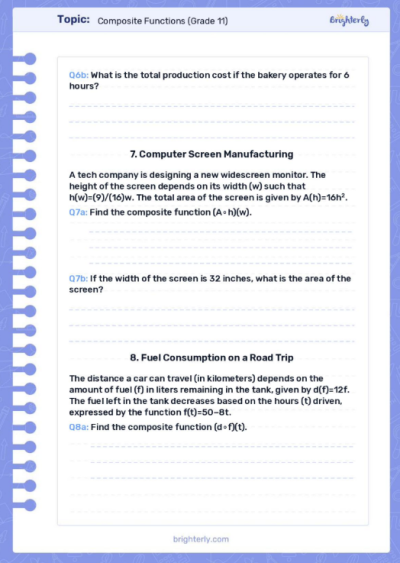
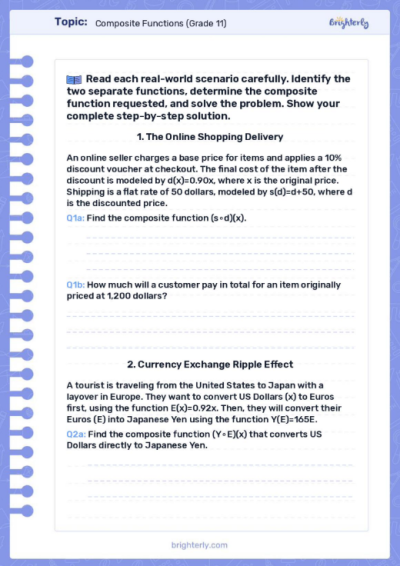
Access our curated collection of high-quality printable materials designed to help students practice and refine their ability to solve complex function operations.
More functions worksheets
Expand your function analysis skills with these related resources covering exponential and logarithmic functions (the most common function types used in composition practice), graphing, and broader algebraic equation work that strengthens the domain reasoning required for composite functions.
- solving exponential equations worksheets
- logarithmic worksheets
- algebra 2 worksheets
- graphing linear inequalities worksheets
- equations and inequalities worksheets


Help your child reach their full potential!
Answer a few quick questions about your child’s learning, and we’ll recommend next steps.
Benefits of Composite Functions Worksheet
Utilizing a dedicated composite functions worksheet provides significant cognitive advantages by reinforcing the logical sequence required to process multi-step mathematical operations.
By working through these problems, students learn to treat the output of one function as the input for another, a fundamental concept that bridges the gap between basic algebra and more advanced calculus topics like the chain rule.
This practice sharpens abstract thinking as learners must navigate different notations, such as f(g(x)) or (f ◦ g)(x), and manage domain restrictions that arise when combining various function types. Consistent engagement with these worksheets helps students internalize the “”inside-out”” method of evaluation, reducing errors in substitution and algebraic expressions.
Furthermore, mastering these compositions builds the persistence and attention to detail necessary for success in STEM fields, where understanding how different mathematical systems interact is essential.
These resources provide a structured environment for students to build confidence in handling quadratic, radical, and rational functions within a single composite expression, ensuring a robust foundation for future academic challenges in mathematics and science.


Math & reading from 1st to 12th grade
Looking for homework support for your child?

Choose kid's grade

Math & Reading for Grades 1–12
Build real confidence for your child with a Brighterly math or reading tutor.