
Integrals Worksheets
Updated on October 20, 2026
Integrals worksheets give students structured practice applying antiderivative rules to polynomials, trigonometric functions, exponential functions, and composite expressions using u-substitution, integration by parts, and partial fraction decomposition. Students work through both indefinite integrals and definite integral evaluation using the Fundamental Theorem of Calculus. Students who can apply u-substitution confidently but struggle with integration by parts or partial fractions make much faster progress with calculus tutors who can clarify exactly when each technique is appropriate and how the function’s structure determines the choice.
Download Integrals Worksheets: Examples
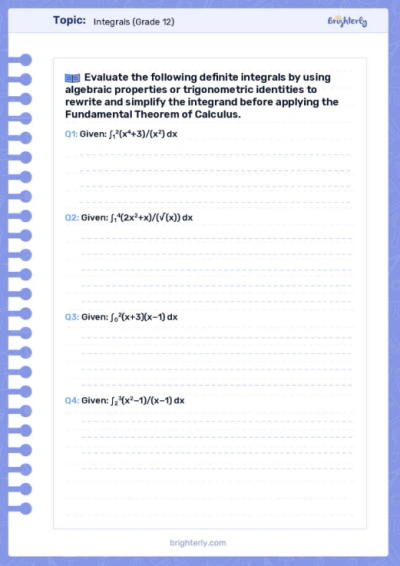
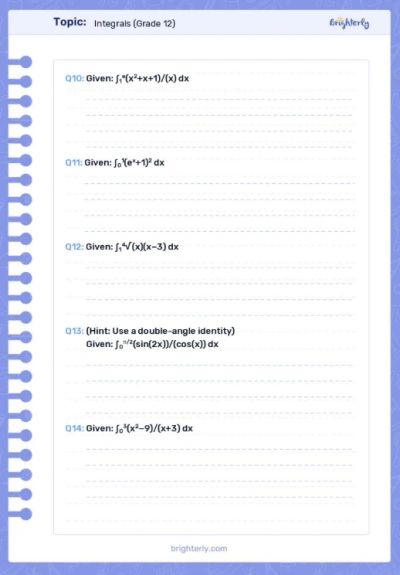
Download Integrals Worksheet PDFs
Access our collection of high-quality, printable PDF worksheets designed to reinforce fundamental and advanced integration techniques through structured problem sets covering all major function types.
More calculus worksheets
Build the algebraic and trigonometric fluency that integration techniques require with these related resources covering polynomial operations, rational expressions, trig identities, and exponential function manipulation.
- algebra 2 worksheets
- trigonometry worksheets
- factoring polynomials worksheets
- multiplying and dividing rational expressions worksheets
- solving exponential equations worksheets


Help your child reach their full potential!
Answer a few quick questions about your child’s learning, and we’ll recommend next steps.
Benefits of Integrals Worksheets
Integrals worksheets develop the technique recognition and algebraic fluency that integration demands. Students practice identifying which method applies — direct antiderivative rules, u-substitution, integration by parts, or partial fractions — based on the function’s structure, and then executing multi-step calculations accurately.
Working through u-substitution exercises builds the pattern recognition needed to spot a composite function’s inner derivative hiding inside the integrand. Partial fraction problems require differentiation of trigonometric functions knowledge as context, but more importantly they develop the algebraic decomposition skills that carry over into Laplace transforms and differential equations in engineering courses.
Definite integral evaluation using the Fundamental Theorem of Calculus connects the antiderivative process to geometric area and net accumulation, which gives students a concrete interpretation for every integral they evaluate and a check on whether a computed answer is reasonable.
Consistent practice across all integration techniques builds the speed and confidence needed for AP Calculus BC and university-level calculus, where integration appears in every unit from area and volume to differential equations and series convergence testing.


Math & reading from 1st to 12th grade
Looking for homework support for your child?

Choose kid's grade

Math & Reading for Grades 1–12
Build real confidence for your child with a Brighterly math or reading tutor.