Limits Worksheets (Grade 12)
Updated on September 4, 2026
Limits worksheets give students practice describing function behavior as an input value approaches a specific point, using graphical analysis, direct substitution, factoring, and rationalization. Students work through one-sided limits, limits at infinity, discontinuities, and indeterminate forms such as 0/0. Students who first encounter indeterminate forms typically make faster progress when they work through factoring and rationalization strategies alongside calculus tutors who can explain when each technique applies and why L’Hôpital’s Rule is — or isn’t — appropriate.
Download Limits Worksheet PDFs
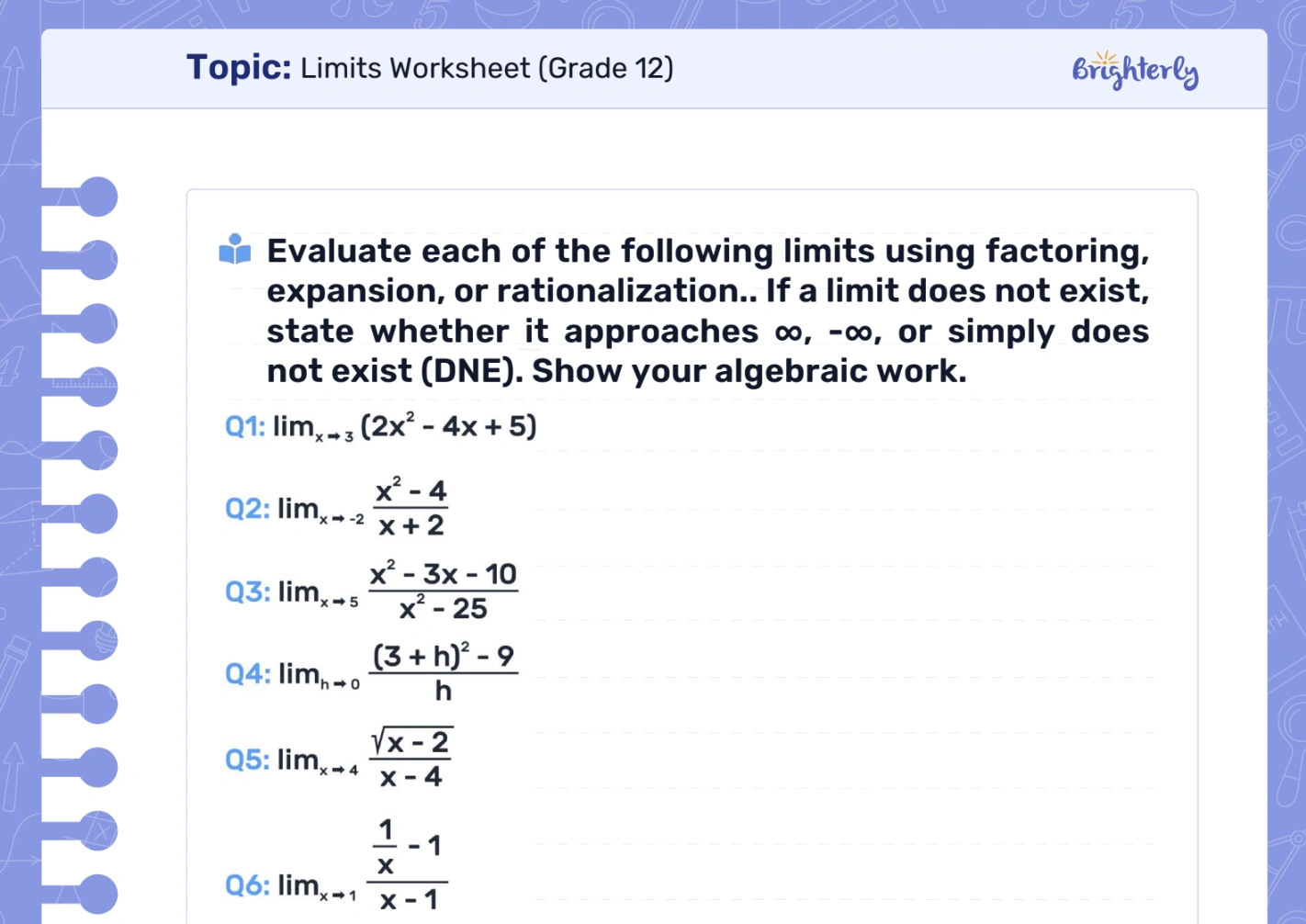
Access our curated selection of printable practice sets covering graphical limit analysis, algebraic evaluation, one-sided limits, and limits involving indeterminate forms.
More calculus and precalculus worksheets
Build the algebraic fluency that limit evaluation requires with these related resources covering rational expressions, polynomial operations, and equation-solving techniques.
- algebra 2 worksheets
- multiplying and dividing rational expressions worksheets
- factoring polynomials worksheets
- solving equations worksheets
- completing the square worksheets


Help your child reach their full potential!
Answer a few quick questions about your child’s learning, and we’ll recommend next steps.
Benefits of Limits Worksheets
Limits worksheets build the foundational reasoning that all of calculus depends on. Students practice evaluating limits graphically — identifying jump discontinuities, removable holes, and vertical asymptotes — and develop the ability to distinguish between what a function value is at a point and what it approaches near that point.
Algebraic limit techniques require fluency with polynomials and rational expressions. Students practice factoring to cancel common factors in 0/0 forms, rationalizing expressions involving radicals, and recognizing when direct substitution applies versus when algebraic manipulation is required first.
Working through limits involving dividing polynomials and rational functions prepares students to evaluate limits at infinity, identify horizontal asymptotes, and understand end behavior — skills that appear consistently in function analysis and AP Calculus exams.
Consistent practice with one-sided limits builds the precision needed to determine where a limit exists, where it does not, and how to articulate the difference — a level of mathematical rigor that carries directly into the formal definition of the derivative.


Math & reading from 1st to 12th grade
Looking for homework support for your child?

Choose kid's grade

Math & Reading for Grades 1–12
Build real confidence for your child with a Brighterly math or reading tutor.