
Polar Coordinates Worksheets
Updated on September 4, 2026
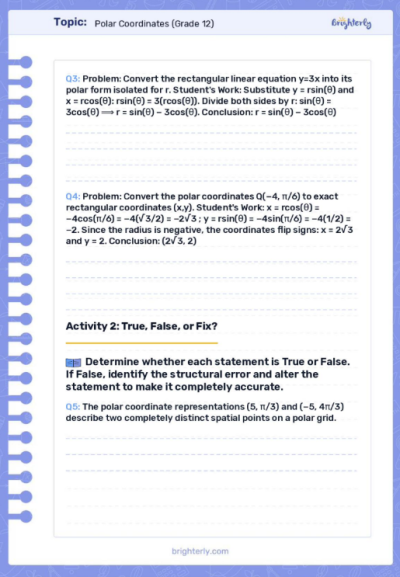
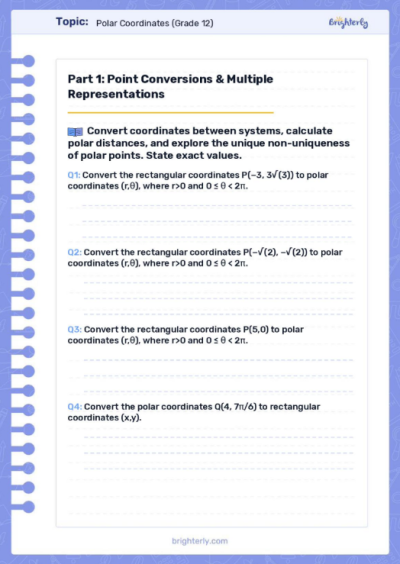
Polar coordinates worksheets give students practice converting between (r, θ) polar form and (x, y) rectangular form using the conversion formulas x = r·cos θ and y = r·sin θ, plotting polar points on a polar grid, and sketching polar equations including circles, limaçons, and cardioids. Converting between polar and rectangular forms is manageable with practice, but sketching limaçons and cardioids accurately — and understanding what each parameter in the equation controls — becomes far clearer when students work through the geometric intuition with a precalculus tutor.
Download Polar Coordinates Worksheet PDFs
Access our printable high-quality worksheets designed to help students practice coordinate conversions, polar point plotting, and graphing polar curves.
More coordinate geometry and trigonometry worksheets
Develop the trigonometric and coordinate reasoning that polar graphing requires with these related resources covering angle measurement, graph plotting, circle equations, and trig function evaluation.
- trigonometry worksheets
- graph worksheets
- algebra 2 worksheets
- circle worksheets
- types of angles worksheets


Help your child reach their full potential!
Answer a few quick questions about your child’s learning, and we’ll recommend next steps.
Benefits of Polar Coordinates Worksheets
Polar coordinates worksheets develop the ability to describe position using distance and direction rather than horizontal and vertical offsets — a shift in perspective that is essential for modeling rotational motion, orbital paths, and antenna radiation patterns. Students practice the conversion formulas until switching between systems becomes fluent and automatic.
Plotting polar curves requires understanding how r changes as θ sweeps around the pole. Working through these exercises builds intuition for how coterminal angles produce the same point in multiple representations and why a single polar point can be described in infinitely many ways.
Graphing equations like r = a + b·sin θ (limaçons and cardioids) develops the ability to trace a curve by analyzing its periodic behavior, which reinforces the relationship between degrees and radians and deepens understanding of how trigonometric functions produce geometric shapes.
These skills carry directly into calculus, where polar area calculations and arc length in polar form appear as extensions of integration — students who already understand polar graphing handle these topics significantly more efficiently.


Math & reading from 1st to 12th grade
Looking for homework support for your child?

Choose kid's grade

Math & Reading for Grades 1–12
Build real confidence for your child with a Brighterly math or reading tutor.