
Triangle Similarity Worksheets
Updated on September 4, 2026
Triangle similarity worksheets provide a rigorous way for students to master the geometric principles that define proportional figures: equal corresponding angles and proportional sides connected by a constant scale factor. These resources focus on proving that two triangles share the same shape — regardless of size — using the AA, SAS, and SSS similarity postulates, and on applying that proof to solve for missing measurements. Students who grasp congruence but struggle to extend that logic to proportional scaling gain confidence faster when a geometry tutor explicitly bridges the two concepts.
Download Triangle Similarity Worksheet PDFs
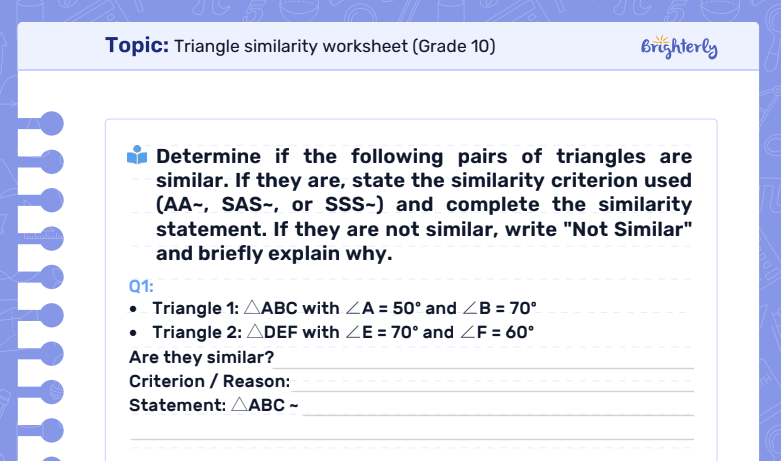
Access our curated collection of printable documents designed to help learners practice identifying scale factors, proving similarity with AA, SAS, and SSS, and solving for missing side lengths in similar triangles.
More triangle worksheets
Deepen your triangle geometry skills with these closely related resources — from isosceles triangle proportionality problems to right triangle applications of the SAS criterion. Practice identifying scale factors in scalene triangle configurations and applying the AA postulate through angle-focused exercises.
- similar triangles worksheets
- triangle congruence worksheets
- classifying triangles worksheet
- types of triangles worksheets
- angles in a triangle worksheets


Help your child reach their full potential!
Answer a few quick questions about your child’s learning, and we’ll recommend next steps.
Benefits of Triangle Similarity Worksheets
Utilizing triangle similarity worksheets offers a structured approach to one of high school geometry’s most critical components. By engaging with these problems, students refine their ability to recognize corresponding parts and set up accurate proportions — foundational skills for advanced trigonometry and calculus. These activities require learners to move beyond visual observation and use rigorous logic to verify similarity through AA, SSS, and SAS postulates. Practicing with diverse problem sets helps students understand the distinction between congruence and similarity, emphasizing how dilations preserve interior angles while altering side lengths. These worksheets also incorporate real-world applications such as indirect measurement for calculating heights and distances, demonstrating the practical utility of geometric theorems in engineering and architecture. Consistent practice strengthens algebraic manipulation skills and ensures students are well-prepared for standardized testing and future STEM coursework.


Math & reading from 1st to 12th grade
Looking for homework support for your child?

Choose kid's grade

Math & Reading for Grades 1–12
Build real confidence for your child with a Brighterly math or reading tutor.