Does Dyslexia Affect Math? What Parents Should Know and How to Help
reviewed by Rachelle Bencio Yu
Updated on November 12, 2026
Key Points
- Does dyslexia affect math? Often, yes: dyslexia leaves a child’s sense of quantity intact but makes the reading, memory, and speed demands of math harder.
- Dyslexia mainly hits the language side of math, including word problems, math vocabulary, fact recall, and multi-step procedures.
- Dyslexia and dyscalculia are different learning disabilities, but a child can have both, so trouble judging quantities needs its own evaluation.
- Short visual routines at home, explicit instruction, and school accommodations lower the reading load in math, and a tutor can build the reading skills that word problems depend on.
The link between dyslexia and math comes from language: dyslexia, a language-based learning disability, affects the reading, vocabulary, working memory, and quick recall that math class depends on. Many children with dyslexia understand quantities yet lose points on word problems, symbols, and math facts. This guide shows how dyslexia appears in math by grade, how it differs from dyscalculia, and what helps.
Does Dyslexia Affect Math?
Yes. Dyslexia in math usually shows up as slow fact recall, confusion with math words and symbols, and trouble turning word problems into equations. Dyslexia doesn’t remove a child’s ability to reason about numbers. Instead, dyslexia raises the language, memory, and speed demands of math, and many children with dyslexia also have a math disability.
Note: According to a 2023 study in Developmental Science, researchers tested the math skills of 86 children with reading disabilities. Of that group, 43% had a co-occurring math disability, 22% showed possible math vulnerability, and 35% had no math difficulty. Children with both disabilities also showed more working memory difficulties than children with a reading disability alone.
For parents, the split matters. Can dyslexia affect math in every child with dyslexia? No, dyslexia doesn’t guarantee math trouble, but the combined 65% of children with a math disability or math vulnerability makes a math screening worth requesting for any child diagnosed with dyslexia, even one who seems fine with basic arithmetic.


Get targeted math support for dislexia
Take a free grade-level math test and let our tutors create a tailored program for you
Why Do Estimates of Math Struggles in Dyslexia Vary So Much?
Estimates vary because studies use different math cutoffs, ages, and samples. Studies of children already identified with reading disabilities can report higher overlap than whole-population screenings, which also include children with milder reading risk. Comparing two recent studies shows how much the sample changes the answer that parents read online.
A 2025 population screening of Spanish 5th and 6th graders, published in Frontiers in Psychology, found that 23.7% of children at risk for dyslexia also showed math difficulties. The overlap ran the other way too: 48.3% of children at risk for dyscalculia also showed reading difficulties. In both directions, the overlap exceeded what chance alone would predict.
Explore Brighterly Learning Experience
Learn exactly how Brighterly helps students thrive through expert sessions, online tools, and proven feedback from thousands of satisfied parents
Math for Dyslexia at Home: A 5-Step Plan
Effective math for dyslexia at home is short, predictable, and visual. A 10- to 15-minute daily routine that moves from words to objects to symbols lowers the reading and memory load, so a child can show what they know about numbers instead of getting stuck on the language around them.
- Preview two or three math words. Before practice, define each word with an object or gesture, such as “difference” as the gap between two towers of blocks. Micro-goal: your child explains each word in their own words.
- Read the problem aloud, one sentence at a time. Pause after each sentence and ask your child to retell the story without numbers. Micro-goal: your child names what happens (“she gets more,” “he gives some away”) before choosing an operation.
- Build or draw the problem before writing it. Use blocks, coins, a number line, or a bar model, then write the equation. Children who need a refresher on number sense gain the most from this step. Micro-goal: one model per problem.
- Keep a symbol key and step card on the desk. List +, −, ×, ÷, <, and > with a picture for each, plus the steps for the current procedure. Short greater than less than worksheets make good 2-minute symbol warm-ups. Micro-goal: your child checks the card instead of guessing.
- Finish with three problems and one note. End on problems your child can solve, then jot down which step broke down. Micro-goal: one written note per session, so patterns become visible within two weeks.
Note: When the same step breaks down week after week, a trained second set of eyes helps. Brighterly, a school-supplemental K-12 math and reading platform, pairs children with an online math tutor for personalized 1:1 lessons aligned with US state standards.
Worked Example: Breaking Down a 2nd Grade Word Problem
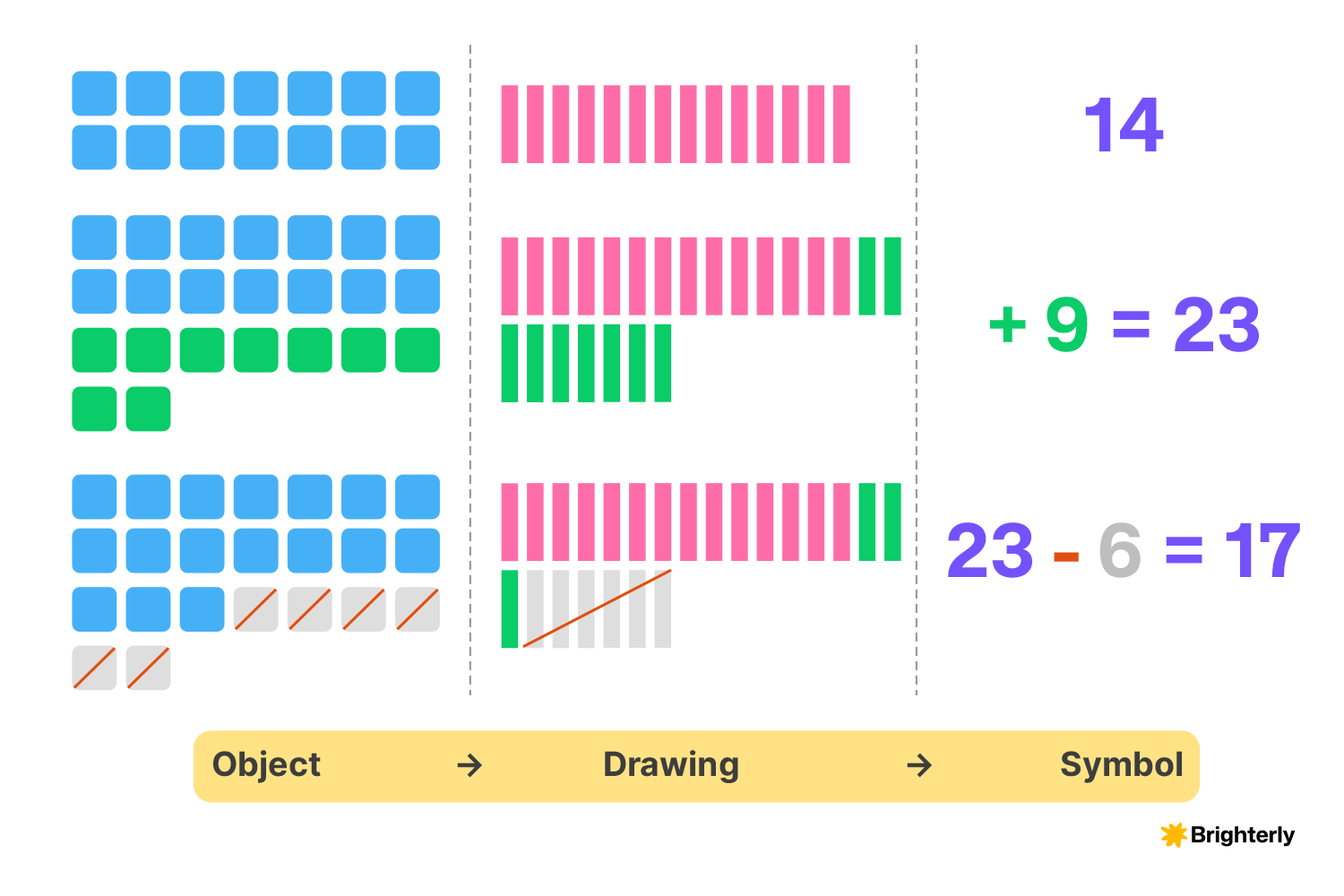
Here’s how the five steps work on a typical two-step problem: “Maya has 14 stickers. Her aunt gives her 9 more. Then Maya gives 6 stickers to her brother. How many stickers does Maya have now?”
| Step |
What it looks like |
|
1. Preview words |
“Gives her … more” means add. “Gives … to her brother” means take away. “Now” asks for the final amount. |
| 2. Retell |
Maya gets some stickers, then gives some away. |
| 3. Model |
Line up 14 blocks, add 9 blocks (23 total), then remove 6 blocks. |
|
4. Write |
14 + 9 = 23, then 23 − 6 = 17. |
|
5. Check |
17 + 6 = 23 and 23 − 9 = 14, so Maya has 17 stickers. |
Each step separates the reading from the math, so a wrong answer shows exactly where the breakdown happened: in the words, the model, or the arithmetic. For more practice in the same format, try these two-step word problems worksheets for 2nd graders.
How Does Dyslexia Affect Math Skills?
How does dyslexia affect math in daily schoolwork? Mostly through five pathways: math language, word problems, fact recall, multi-step sequencing, and processing speed. A 2025 review in Frontiers in Education notes that dyslexia and dyscalculia often share working memory difficulties, which helps explain why reading and math struggles so often appear together.
|
Skill area |
What parents notice |
Example |
|
Math vocabulary |
Confuses words such as “difference,” “product,” “of,” and “less than” |
Reads “5 less than 12” as 5 − 12 |
| Word problems |
Solves the equation easily but freezes when the same problem is written as a story |
Rereads the problem several times and still picks the wrong operation |
|
Math fact recall |
Knows how to find an answer but can’t retrieve the fact quickly | Counts up by 7s on fingers every time 7 × 8 appears |
| Sequencing and multi-step procedures |
Loses steps in regrouping or long division |
Starts dividing, then forgets to bring down the next digit |
| Processing speed |
Correct but unfinished work on timed tests |
Finishes half of a timed quiz with every answer right |
|
Similar symbols and number words |
Mixing up numbers and signs that look or sound alike |
Writes 30 when the teacher says “thirteen”; swaps < and > |
Working memory, the mental space that holds numbers while a child works on them, ties most of these rows together. When decoding a problem uses up that space, little remains for the math itself. Lowering the reading load, through read-aloud problems or a fact chart, frees space for reasoning.
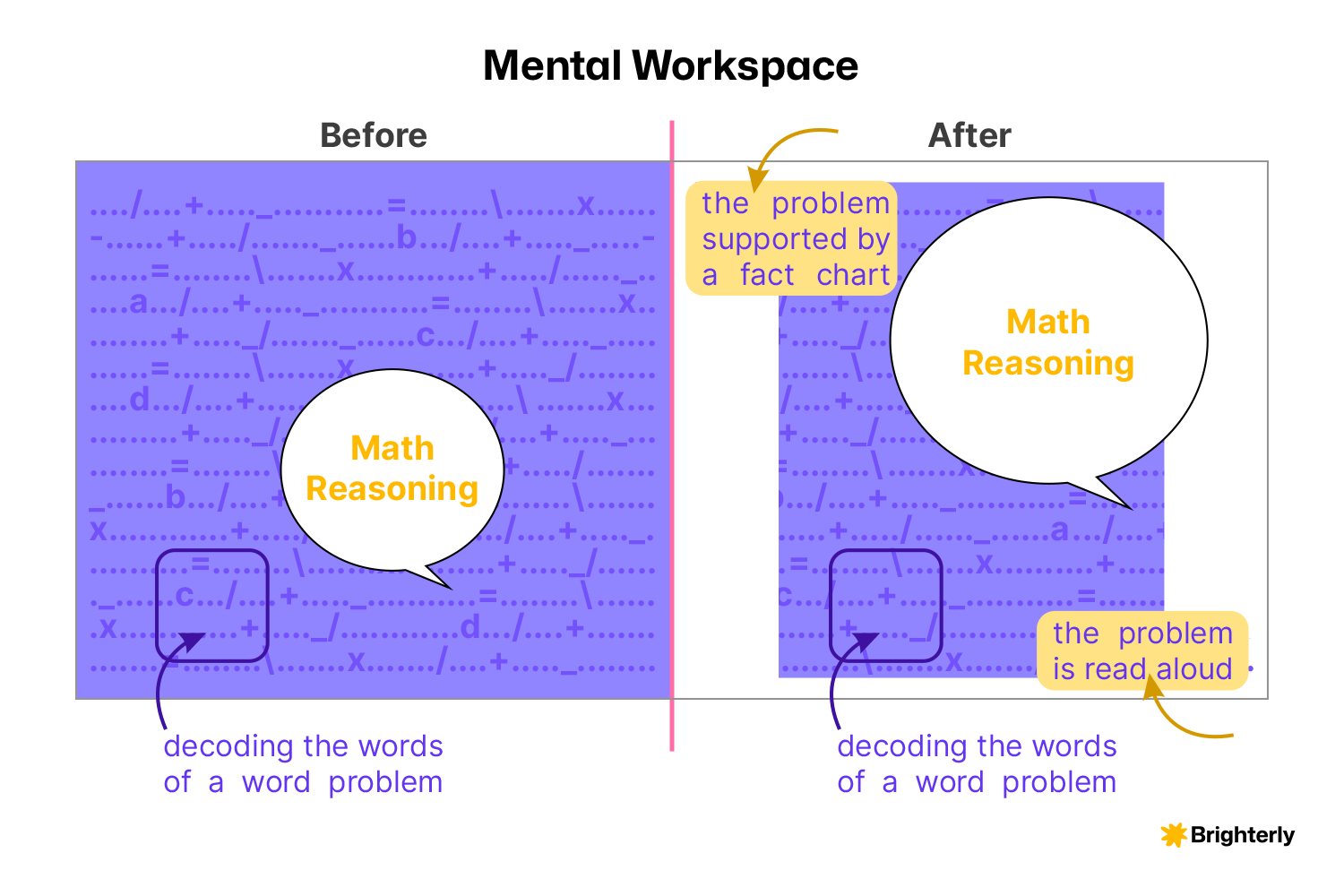
Note: Word problems combine nearly every pathway at once, which is why they’re often the first place dyslexia and math difficulties show up. A step-by-step approach to solving math word problems helps on the math side, and a structured reading program for dyslexia strengthens the decoding underneath.
Which Math Topics Are Hardest for Kids With Dyslexia?
Topics that load language or memory the heaviest tend to be hardest: multiplication facts, telling time, counting money, long division, fractions, and multi-step word problems. Teachers often see these topics stall even in children who handled early addition well, because each one adds new vocabulary or more steps to hold in mind.
Math builds on itself, so a gap in one topic slows the next. Slow multiplication recall, for example, makes fractions and long division harder a year later. Spotting and closing learning gaps early keeps a small problem from compounding across grades.
Dyslexia Math Symptoms by Grade: What to Watch For
Dyslexia math symptoms change as math becomes more verbal. In K-2, they show up in counting sequences and number words. In grades 3-5, they appear in multiplication facts and word problems. In middle school, long procedures break down, and in high school, dense algebra notation and reading-heavy test questions slow a student down.
Yale’s Center for Dyslexia and Creativity notes that a student with dyslexia may struggle with math facts yet still understand and do higher-level math quite well. The table below shows how that uneven pattern tends to look at each stage, along with a matching support for each grade band.
| Grade band |
Common signs |
What helps |
| K-2 | Loses place when counting backward or by 2s; confuses “thirteen” and “thirty”; mixes up + and − |
Number lines, counting with movement, a daily 2-minute symbol review |
| 3-5 | Multiplication facts don’t stick; misreads multi-step word problems; struggles with time and money |
A fact chart during problem solving, bar models, one sentence of a word problem at a time |
| 6-8 |
Loses track in long division, fractions, and order of operations; slow on timed quizzes |
Written step lists, graph paper to line up digits, worked examples to copy from |
| 9-12 | Confuses similar variables or symbols; reading-heavy test items take too long; formulas fade |
Formula sheets, color-coded terms, extended time on tests when written into a plan |
Teachers often see concerns surface in grades 3 and 4, when word problems get longer and multiplication facts need quick recall. At that stage, elementary math tutors who break problems into short steps can keep a child from falling behind in math while reading skills catch up.
Is It Dyslexia or Dyscalculia?
Dyslexia is a learning disability in reading and language, while dyscalculia is a learning disability in understanding numbers and quantity. A child with dyslexia usually knows which group has more but stumbles on words, facts, and steps. A child with dyscalculia struggles with quantity itself, even when nothing needs to be read.
|
Clue |
More typical of dyslexia |
More typical of dyscalculia |
|
Judging which group of objects is bigger |
Usually quick and accurate |
Slow or unsure, even with small groups |
|
Same problem read aloud vs. on paper |
Does much better when the problem is read aloud |
Struggles in both formats |
|
Noticing an unreasonable answer |
Usually senses when an answer is far off |
Often accepts an answer like 8 + 5 = 31 |
|
Math facts |
Also difficult |
Often on grade level unless both conditions are present |
Is “Math Dyslexia” a Real Diagnosis?
No. Math dyslexia is an informal nickname, usually used for dyscalculia. Understood.org research by Peg Rosen points out that the nickname isn’t accurate because dyscalculia is not dyslexia applied to math. A child whose dyslexia affects math needs language-focused support, while a child with dyscalculia needs direct work on number sense.
Can a Child Have Both Dyslexia and Dyscalculia?
Yes. Dyslexia and dyscalculia can occur together, and a 2025 international expert consensus, summarized in the Frontiers in Psychology screening, lists dyscalculia, ADHD, and developmental language disorder among conditions that frequently co-occur with dyslexia. A child with both needs support for reading and for number sense.
Note: ADHD adds its own layer, mainly attention and working memory strain during long problems. Parents sorting out several overlapping needs can compare notes with this guide to math challenges for kids with ADHD before an evaluation meeting.
Get 1:1 Math Help Built Around Your Child
Book a free lesson with a tutor who breaks problems into clear steps.
Teaching Math to Dyslexic Students: What Works
Teaching math to dyslexic students works best with explicit, systematic instruction that pairs words with visuals and hands-on models. Teachers name each skill, teach one step at a time, give immediate feedback, and revisit the skill often. The same principles that help children with dyslexia learn to read also help them learn math.
In practice, how to teach math to dyslexic students comes down to sequence. Multisensory math lessons move from concrete objects to drawings to symbols, so each idea has a picture before it has a written form. Movement-based ideas from these kinesthetic learning strategies fit naturally into the first, hands-on stage.
Consistency matters as much as method. Structured math classes that follow the same lesson pattern each session let a child with dyslexia spend energy on new math rather than on figuring out what comes next, which matters most with multi-step topics.
“Most word-problem errors from students with dyslexia start with one word, not with the math.”
Common Mistakes and How to Fix Them
Well-meant habits can add to reading or memory load instead of removing it. Math for dyslexic students improves fastest when adults swap these five common mistakes for the better approaches beside them, especially during homework time.
|
Common mistake |
Better approach |
|
Telling a child to reread the problem |
Read the problem aloud together, then ask for a retell without numbers |
|
Assigning more of the same worksheet |
Change the representation: blocks, a drawing, or a number line |
|
Starting timed drills before accuracy is solid |
Add short timed rounds only after accuracy, and compare the child only to their own last score |
|
Banning finger counting or fact charts |
Let the chart handle recall while the child practices reasoning |
|
Teaching several strategies for one skill at once |
Teach one method and keep it until the child uses it without prompts |
What Dyslexia Math Accommodations Can Schools Provide?
Dyslexia math accommodations change how a child accesses or shows math without changing what the child is expected to learn. In US public schools, accommodations are written into an IEP or a 504 plan, and the most useful ones reduce the reading and memory load that hides a child’s real math skill.
The Colorado Department of Education’s dyslexia handbook names calculators, basic math facts charts, graph paper, step lists for multi-step problems, and shorter assignment segments as math accommodations for students with dyslexia. Parents can bring this checklist to the next IEP or 504 meeting:
- A basic math facts chart during problem solving
- A calculator when calculation isn’t the skill being tested
- Graph paper or boxed workspaces to keep digits lined up
- Written step lists for multi-step problems and algorithms
- Assignments broken into shorter segments
- Word problems and test directions read aloud
- Extended time, paired with a plan for using it
Like other dyslexia accommodations, extended time needs a plan. The International Dyslexia Association notes that extra time alone rarely improves performance and that some students need to be taught how to use it, for example, by rereading each problem aloud and checking each step.
When Should You Ask for an Evaluation?
Request an evaluation in writing when math struggles last for several months despite steady help, when a child avoids math, or when a child solves problems read aloud but fails the same problems on paper. Ask the evaluator to test math skills along with reading, since a math learning disability can co-occur with dyslexia.
Note: The International Dyslexia Association notes that formal testing of reading, language, and writing skills is the only way to confirm dyslexia. Reviewing the signs of dyslexia before the meeting helps parents bring specific examples from homework and tests.
Online Math Tutor for Dyslexia and Learning Differences
An online math tutor can provide what school accommodations don’t: direct teaching of the skills a child is missing. For a child with dyslexia or another learning difference, the best fit is a 1:1 tutor who teaches one step at a time, moves from objects to drawings to symbols, reads problems aloud, and keeps the same lesson pattern each session. The one-on-one format lets the tutor slow down on word problems or math facts without holding up a class.
Before booking, ask whether the tutor has worked with learning differences and how progress will be reported. A tutor works alongside an evaluation and an IEP or 504 plan, not in place of them.
Brighterly’s online math tutors start with a grade-level math test and build lessons aligned with US state standards, and a free first lesson lets you check the fit. If attention is also a concern, see the ADHD math tutor page. For the decoding side, a reading tutor for dyslexia can run in parallel.
Conclusion
Dyslexia often affects math through language, memory, and speed rather than through weak number sense. Short visual routines at home, explicit teaching at school, and the right accommodations let a child show what they understand. If word problems or math facts keep stalling, book a free lesson with a Brighterly tutor who works through math one clear step at a time.
Frequently Asked Questions
Are Dyslexic People Good at Math?
Many are. The International Dyslexia Association notes that people with dyslexia are often capable or even gifted in areas such as math, physics, and computer science. Strengths in reasoning, patterns, and visual thinking often show up once the reading and fact-recall load is reduced, which is why some children struggle with arithmetic drills yet excel at problem solving.
Do Number Reversals Mean a Child Has Dyslexia?
Not by themselves. Writing 2, 3, or 7 backward and mixing up numbers like 6 and 9 are common among young children who are still learning to write digits. A 2025 review in Frontiers in Education identifies the belief that dyslexia equals reversals as a misconception that hinders effective support. Teachers look more closely when reversals persist alongside reading trouble.
Can Dyslexia Cause Math Anxiety?
Math anxiety can stem from repeated struggle, especially with timed tests and reading aloud in class. Parents often notice avoidance, stomachaches before math tests, or “I’m bad at math” talk. Reducing time pressure, praising strategy use over speed, and ending each session on a success help a child rebuild confidence while skills catch up.
Does Dyslexia Get Better With Age?
Dyslexia is a lifelong condition, but the skills it affects improve with the right instruction. The International Dyslexia Association states that with appropriate teaching methods, students with dyslexia can learn successfully. In math, children who once struggled with facts and word problems often become capable students once they learn strategies and use accommodations.
Is Dyslexia Linked to High IQ?
No. According to the International Dyslexia Association, dyslexia occurs in people of all backgrounds and intellectual levels. Dyslexia reflects a difference in how the brain processes written language, not a measure of intelligence. A bright child can still have dyslexia, and strong reasoning often masks the problem until reading demands rise in later grades.
What Is the Difference Between Accommodations and Intervention?
An accommodation changes access, such as a fact chart or a read-aloud test, while an intervention teaches the missing skill, such as explicit fact-fluency instruction. The International Dyslexia Association stresses that an accommodation is not a substitute for appropriate intervention, so a strong plan for a child with dyslexia includes both.



How much does Best Brains cost? Best Brains cost is $159 per month for one subject and up to $399/mo for four subjects, per child. Other typical packages include $259 for two subjects and $299 for three. Pricing varies by location and program format. Most centers also offer a free placement assessment. Plus, mind possible […]
Dec 19, 2025

You’d be surprised how many active learners there are. Yes, traditional methods don’t work on them. Children just won’t sit and listen. Does it sound like your child? In this case, you should consider kinesthetic learning strategies – they can make a big difference. Read on to define kinesthetic learning and explore key methods to […]

Dec 21, 2025
Math & reading from 1st to 12th grade
Looking for homework support for your child?

Choose kid's grade

Math & Reading for Grades 1–12
Build real confidence for your child with a Brighterly math or reading tutor.