How to Motivate a Teenager: Tips for School, Study, and Future Goals
reviewed by Janice S. Armas
Updated on May 7, 2026
Key Points
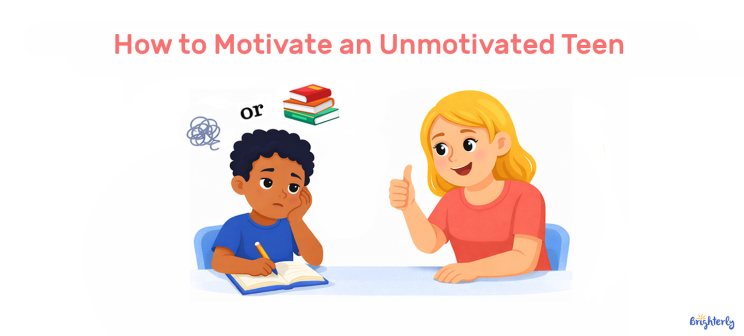
Figuring out how to motivate a teenager starts with finding the reason for their disengagement or behavior. Upon it, you, as a parent, should find supporting strategies, determine the goals that make learning meaningful to them, and focus on developing a growth mindset.
The best ways to motivate teenagers are to find the balance between exerting pressure, offering support and space, and linking learning to personal interests.
Why Teenagers Lose Motivation
Teenagers can lose motivation due to cognitive or emotional overload, pressure from parents or the school system, lack of autonomy, and stress as a result of changes.
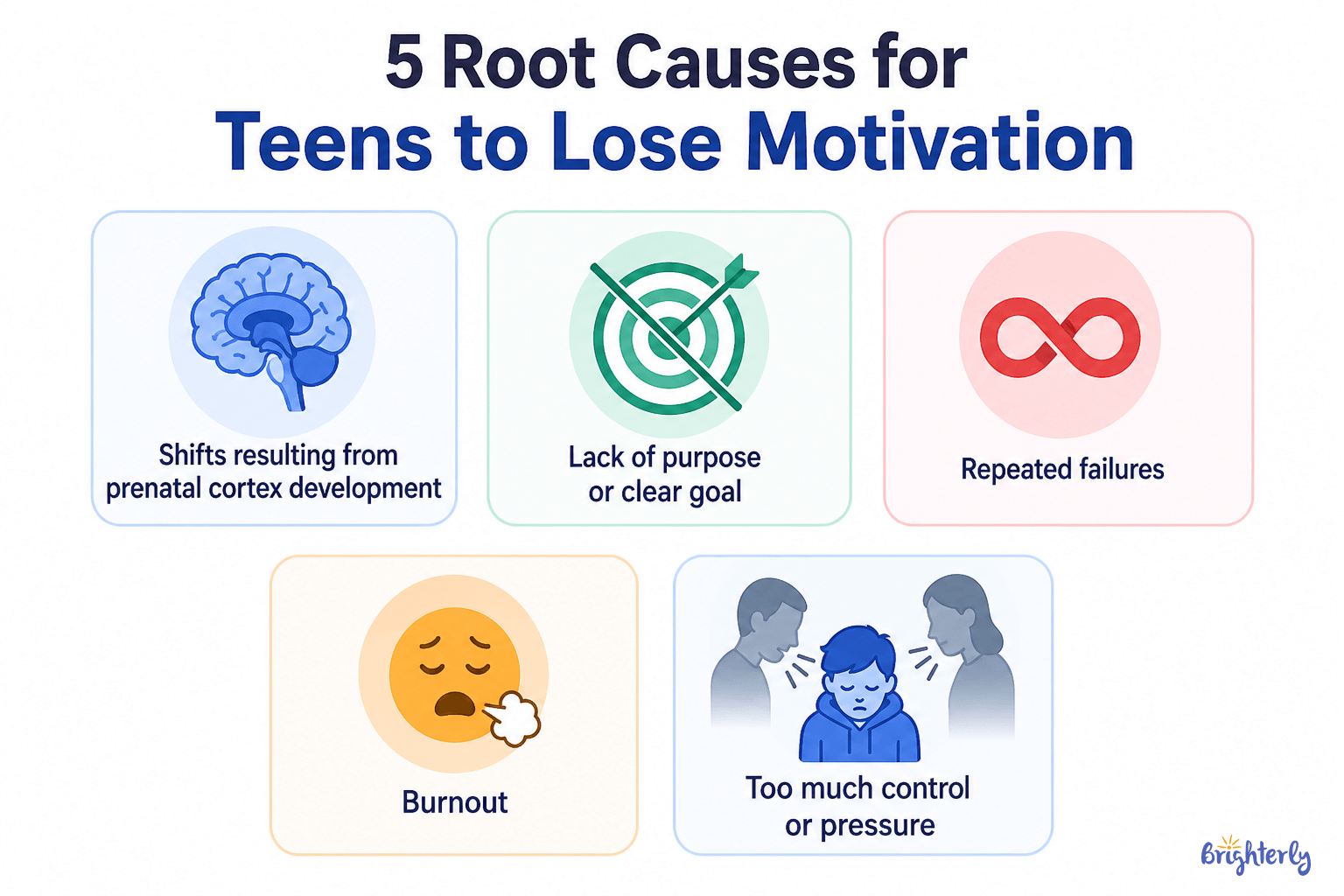
The common reasons for losing motivation among teens are:
- Disconnection from purpose. When solving a task or learning a topic that seems irrelevant, a teen may feel that their effort is pointless.
- Reaction to failure. Repetition of the situation of the possible failure can also affect students’ academic motivation, especially if they tried hard and still underperformed.
- Burnout. When schoolwork and activities are piling up, children can sometimes feel extremely overwhelmed or overloaded.
- Too much parental control. Micromanaging a teen’s life may harm motivation. Learners feel they are not in control and may sabotage learning or just do nothing.
- Learning differences. When teens’ brains manage information differently, for instance, because of ADHD or dyslexia, the struggle to meet expectations can make learners feel helpless.
Note. According to a 2025 article on neuroplasticity during adolescence, the prefrontal cortex, which affects planning and impulse control, is still developing, so teens tend to prioritize immediate rewards.
Explore Brighterly Learning Experience
Learn exactly how Brighterly helps students thrive through expert sessions, online tools, and proven feedback from thousands of satisfied parents
How to Motivate a Teenager Who Doesn’t Care
The first step to understanding how to motivate teens who don’t care lies in the reasons behind their disconnect in the first place. The reason may refer to the attitude or environment, thus try to identify what it is. It may be a system, a view of tasks as pointless, or the inner protection mechanism from failure.
Next, you should pick a solid strategy responding to their future goals, independence, routine, and concerns. Here’s what can help:
Tip #1. Stop Nagging, Let Them Own It Instead
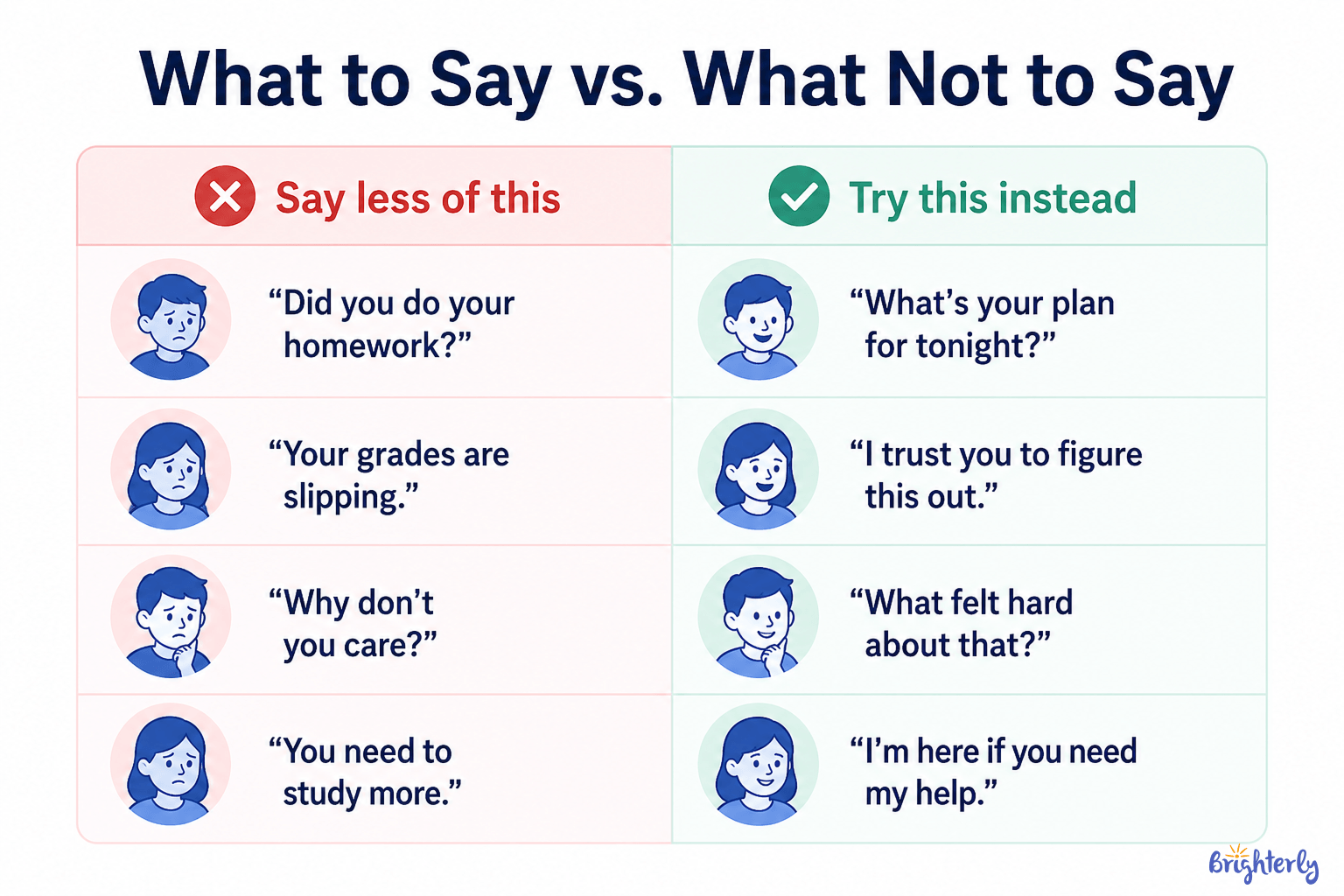
Offer the learners support and autonomy, and show you are on their side. Parents’ reminders and control over homework or grades may signal to your teen that you don’t trust them. A student may perceive it as a control that kills motivation.
As the 2023 article on Parental Support and Adolescents’ Coping suggests, autonomy-supportive parenting is linked to engagement, especially in relation to coping with academic pressure.
Instead of reminders, you can ask what they think, what’s their plan for the night, or how you can help, especially if they’re stuck.
“Students will feel more supported and motivated if parents can support their sense of independence while staying close enough so they still have that shoulder to rely on.”


Tip #2. Connect School to Personal Goals
When school brings them something they actually want, the motivation for teenagers grows. It’s about finding an actual reward that’s not abstract but is linked directly to their future or needs.
Yet, as students only develop and understand themselves and their goals, it may not be as easy. The first thing to ask is what genuinely interests them.
Their answer may be a career path, a certain creative skill, or a problem. Next, help them draw a line between their interests and their learning.
“Parents can research careers together with their teens, help them identify and name their strengths, and say things like, “I could see you doing something like this because you’re really strong at…” ”

Your goal is to convince teenagers to see schoolwork as a tool for reaching their goals. If your teen wants to build apps, you can link it to math and storytelling, referring to coding and product development.
Other than that, you can go further and make learning more personalized, putting the goals, needs, and preferences of a teen at the center of most sessions.
At Brighterly, an online learning platform, we put such an approach at the center of learning provision for teenagers with various needs.
First, we assess the level and gaps of a student with a diagnostic test. Then, our tutors customize 1:1 lesson plans of a math program or a reading program so they match learning needs, whether it’s a learning difficulty or a special interest in certain subjects.
When tutors combine the standard curriculum with children’s interests, it doesn’t feel that sessions are obligatory; they focus on purpose.
Help your child overcome a struggle with motivation
Brighterly tutors connect concepts to real-life goals and activities.


Tip #3. Give Them Autonomy and Choices
No nagging is one thing. However, giving autonomy and choices is another. And it’s one of the strongest drivers of intrinsic motivation.
If you want them to engage more, let them:
- Choose their study space
- Establish their own schedule
- Define the order or priorities of assignments
However, such an approach requires balance, or in other words, the boundaries you both agree on.
With this in mind, how to motivate teenagers? Try to focus on co-creating the rules and ask for the children’s opinions. They will likely follow the rules that they shaped or co-developed.
Tip #4. Encourage a Growth Mindset
A belief that abilities develop through effort can help your teen be motivated, irrespective of grades.
When you praise teenagers’ grades, you reward the outcome. Instead, you may praise the effort, and that way support the behavior they can repeat.
What are the ways to encourage such a mindset?
- You can reframe mistakes as lessons and opportunities, not failures.
- Make progress the key goal instead of perfection or mastery.
- Replace blame with support and recommendations on hard work.
Tip #5. Develop a Study Routine Together
A teen is unlikely to keep high motivation levels all the time. That’s when routine comes into play. The productive students are the ones who manage to be consistent.
A parent should help a teenager to develop a simple structure that includes:
- A time for practice or learning, especially if you rely on homeschooling.
- A special study space with minimum distractions.
- Specific time for lessons to finish.
- Pauses, screen time breaks, or even walks to have a rest and refuel energy.
- Have a clear lesson order that repeats and answers learning needs and grade concepts (like quadratic functions and polynomial operations for 10th grade)
If your teens struggle to create a consistent routine via self-discipline, try building study habits through structured learning and low-pressure sessions.
During personalized lessons, Brighterly tutors include small weekly goals, rituals, and bite-sized exercises to support structure. That way, they provide stimulus and repetitions that later become the basis of the routine.
Want to offer more structure to your teen?
Brighterly tutors customize lesson structure and offer guidance from the first lesson
Tip #6. Celebrate and Make Small Wins Visible
For a moment, consider how teens think. For them, big goals may feel abstract, but not the small ones. Achieving a small goal helps the teenagers to see that effort is not pointless.
So, as a parent, you should recognize their efforts. Do it when a teen finishes a chapter, completes a difficult task, or improves their score by several points. A small recognition may matter more than a prize.
Besides, consider a tool or system to track the progress. It may be a shared whiteboard or even a wall of sticky notes.
Tip #7. Avoid Procrastination With An Easy Start
Having an easy start is one of the most underrated tactics when deciding how to motivate your teen, especially if they suffer from procrastination or perfectionism.
A messy desk or a plan can be a good reason to postpone the learning. Thus, actually starting a task may help get things off the ground.
To help with it, you can offer small and specific tasks to encourage the start, like saying “read two pages” instead of “it’s history time.” Under this approach, your objective is to put learning in motion. Afterwards, students will turn in, and the momentum will carry them forward.
“I deal with teen procrastination on a daily basis! Here are my tips:”
- First, break tasks into small pieces. Big assignments feel overwhelming,
- Second, use a timer. I often suggest 30–45 minutes of focused work, knowing a break is coming.
- Third, tackle the hardest or least appealing task first. When students save it for last, they often skip it.

Tip #8. Make Their Social Environment Support Learning
For teenagers, social connections are quite important. Thus, you can use them to encourage children’s learning. Shared experiences with their peers or family are a great point to start. What are the other good tactics?
- Encourage them to teach a concept to a sibling or a friend.
- Start projects where teenagers can collaborate.
- Include field trips.
- Encourage them to join clubs related to their interests.
Tip #9. Validate Their Feelings and Avoid Labels
Students may stop caring about classes and learning because they aren’t listened to or feel misunderstood. In this regard, parents should know what they can do.
First of all, don’t judge a teenager or put a label. This idea is crucial in understanding how to motivate a lazy teenager. The “lazy” label describes a character, and teens may live up to it. Instead of labeling, ask, “I’ve noticed you skipped this part. What’s going on?” That way, you open a door for discussion and do no judging.
How to Motivate a Teenager Who Has Lost Interest
To motivate a teenager who has lost interest, you can focus on acknowledging and validating their feelings before giving advice or intervention, offering a different format or environment to learn, or revisiting the goals.
There’s a difference between a teenager who never engaged and one who lost interest. The rationale may be a series of poor grades, the teacher’s attitude, a sudden change in difficulty, or burnout.
In this regard, you can try the following:
- Accept the situation and validate teens’ emotions
- Try to find what changed
- Change format or learning environment
- Start rebuilding confidence with the subject they feel strong in
- Determine short-term goals and lower expectations.
How to Help Your Teenager Set Goals
To help your teenager set goals, you can introduce them to different goal setting techniques, like the SMART framework, show how to determine priorities, anticipate challenges, and share how you set goals.
To teach them to set adequate goals, resort to such tips:
- Use the SMART framework. It allows students to have specific goals and be able to meet them. “Improve the math score from 50% to 60% by the end of the term, so I can apply for a coding program that I’m so passionate about” is a good example of a SMART goal.
- Select 3 pillars or priorities. It’s a way to prevent teenagers from being overwhelmed and make goals realistic.
- Make them focus on input, not results. For instance, a goal “Practice 30 minutes daily” offers more control than “Make 10 tests in a week.”
- Break long-term goals into smaller ones. This technique also gives more control and ensures that the goals are manageable.
- Support teens in setting goals. Having experience, you can share advice, models, and experience. Try to anticipate setbacks and be a cheerleader,r offering autonomy.
When to Consider Extra Support
Consider extra support when motivation techniques and strategies show no positive change. The support may refer to the evaluation, intervention, or structured support from an expert. In this regard, popular cases are when disengagement is persistent, when teens are anxious, withdraw from school, or there is a sudden drop in performance.
What are the clear signals for you to look for support on how to motivate your teenager?
- Signs of anxiety or depression, not mood swings.
- Signs of undiagnosed learning difficulty, like dyslexia or ADHD
- Experience related to social change or events (from bullying to friendship or family changes)
- Being overwhelmed because of being behind
Depending on the case, you may want to resort to a school counselor, educational psychologist, or specialized tutor. Sometimes a teen needs evaluation for being gifted or having a learning difficulty. In many cases, an expert from outside a family or a neutral environment is enough.
How to Motivate a Teenager to Study: Conclusion
Before even trying to motivate a teenager, identify the reason behind their disengagement. The best strategy is often personal and is not about exerting pressure but prioritizing connection, autonomy, and developing a growth mindset.
Yet, in some cases, you just need to make learning more customized. With Brighterly, your teens can get personalized math and reading lessons and close the learning gaps. Book free lesson to try.
Frequently Asked Questions
Is it Normal for a Teenager to Lack Motivation?
Yes, it’s normal, as lack of motivation in teenagers is a common concern for parents. It’s concerned with development in adolescence and students’ desire to focus on social connections and short-term rewards.
How Do You Motivate a Teen Without Arguing?
The main strategy is to replace imperatives and directives with questions. It can help your learners to feel more in control. Besides, that way, parents can validate their concerns and offer more autonomy.
Should I Reward My Teenager for Good Grades?
In general, recognition is a decent strategy, but connecting rewards to grades can negatively affect intrinsic motivation over time. Instead, you can focus on praising the behavior and efforts to help teens develop a growth mindset.
How Long Does it Take for a Teenager to Build Study Habits?
As a 2026 post by the University of Surrey suggests, a child may need from three to eight weeks to build study habits. In the first 3 weeks, a teenager will struggle to keep the routine. During the next several weeks, they will consolidate the habit, and after 8 weeks, it will become a habit and require less effort from the teen.
What Role Does Sleep Play in Teen Motivation?
Sleep plays an enormous role in teen motivation as sleep is important for the development of the prefrontal cortex, which is responsible for self-regulation and decision-making. In case a teen consistently is deprived of sleep, they can be chronically tired and have struggles to concentrate or perform academic tasks.


Is your child able to read every word accurately, but still stares blankly at the end of the story when you ask what it’s about? There is usually no problem with reading skills here, but rather a lack of background knowledge needed to connect the dots. Take a deeper look at the topic and explain […]

May 03, 2026

Comparing Mathnasium vs Best Brains means choosing between a specialized math-only center and a multi-subject screen-free classroom. Adding online alternatives like Brighterly into the mix adds another layer of complexity regarding 1:1 attention and scheduling flexibility. This article compares subject focus, teaching format, group size, pricing, and who each program suits best. Best Brains vs […]

May 03, 2026
Math & reading from 1st to 12th grade
Looking for homework support for your child?

Choose kid's grade

Math & Reading for Grades 1–12
Build real confidence for your child with a Brighterly math or reading tutor.