How To Teach Opinion Writing Step-by-Step
reviewed by Marvi M. Andres
Updated on July 10, 2026

Key points
- Opinion writing is a type of writing where a student shares their personal stance on a topic.
- Common Core Standards (NGAC, 2010) define how opinion writing grows into argumentative writing by high school.
- Every opinion piece is concerned with three parts: an intro with a statement, a body with reasons, and a conclusion.
- Teaching this type of writing requires a step-by-step approach: first, children learn the difference between facts and opinions, then master structure and drafting, and then revision.
Kids often have lots of ideas and opinions, but the challenge is to teach the young ones to express them clearly and back them with reasons. This guide explains how to teach opinion writing, covering what each grade expects and which steps and activities make knowledge stick in the classroom and at home.
What Is Opinion Writing?
Opinion writing is a type of writing where a student shares their personal stance or position on a certain topic and supports it with reasons.
This opinion writing definition applies to both kindergarten and middle school, whereas in higher grades, children would need to use more advanced structure, deeper reasoning, and vocabulary. The goal remains the same: to share an opinion and defend it. That’s why it’s a natural fit for ELA class and social studies as part of writing across the curriculum.
Key Elements of Opinion Writing
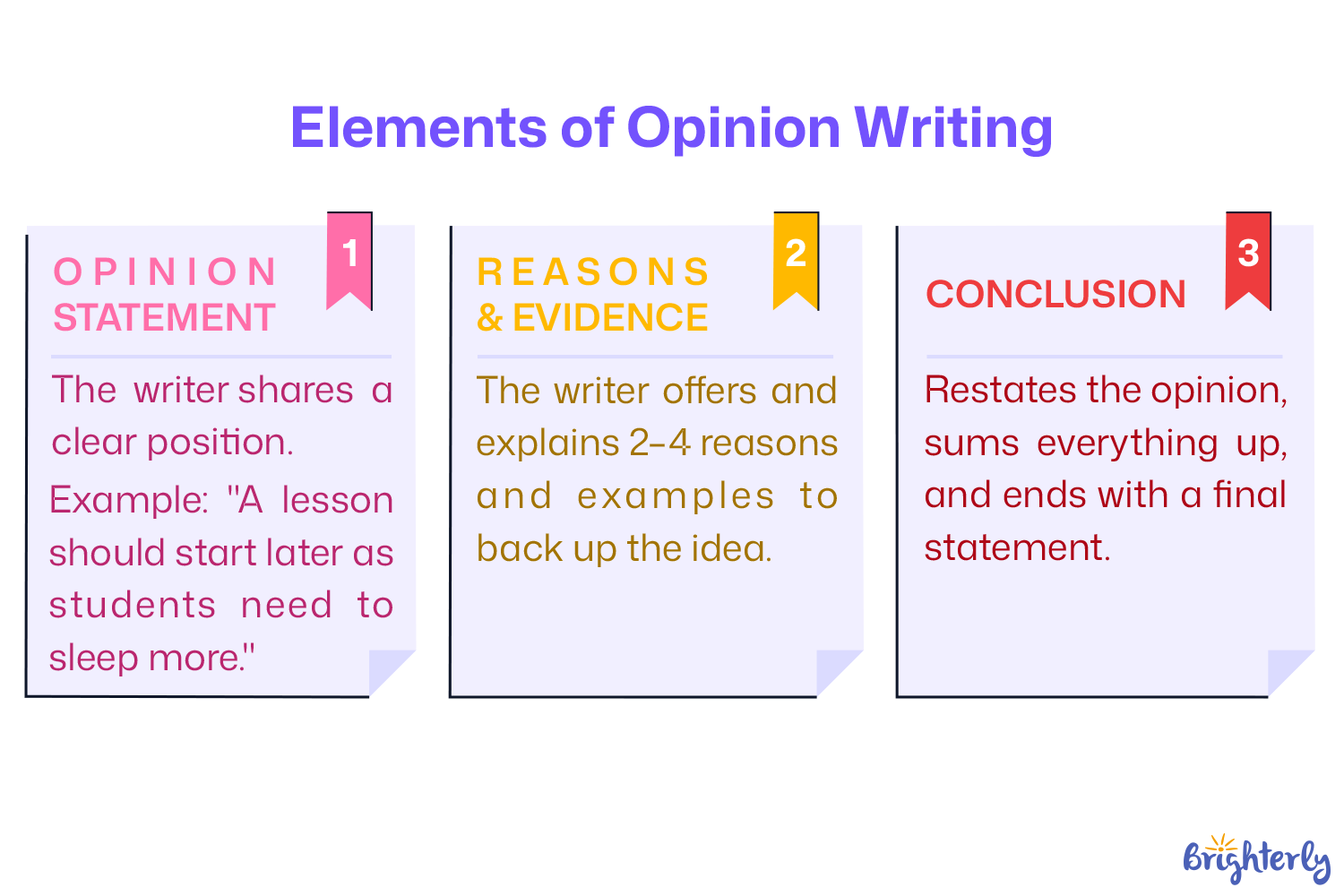
Whether in elementary school or middle school, every opinion piece depends on the three main elements of opinion writing: an intro with a statement, a body with reasons and evidence, and a conclusion.
Explore Brighterly Learning Experience
Learn exactly how Brighterly helps students thrive through expert sessions, online tools, and proven feedback from thousands of satisfied parents
When Do Kids Learn Opinion Writing in School?
Kids learn opinion writing from kindergarten through middle school and then transition to argument writing in high school. Opinion writing is a part of the Common Core State Standards that define the grade level writing expectations of children and set the skills that kids should gradually improve within certain grades.
Opinion Writing in Grades K-2
In kindergarten and first grade, the 2010 standards by the National Governors Association Center (NGAC), in particular, CCSS.ELA-Literacy.W.1.1 requires students to introduce the topic they are writing about, then supply a reason for the opinion, and then offer a sense of closure.
In grade 2, students should start using linking words like “because” or “also” and create a separate section for the final statement.
Note. If you want practice to be less intimidating for a kid, you can resort to the first-grade writing prompts.
Opinion Writing in Grades 3-5
In grade 3, the national standards (NGAC, 2010) set the organizational structure as a primary goal for students. Children in this grade learn to clearly state their opinions, list reasons, and use more advanced linking words.
In grade 4, students focus on using more detail, while in grade 5, they should make reasons more logical and introductions clearer, as well as use linking phrases like “consequently”.


Make sure your child is on track for their grade
Identify gaps and close them with lessons from Brighterly tutors
Opinion Writing in Grades 6-8
In grades 6-8, the standards (NGAC,2010) shift from writing opinion to writing arguments, which is when the students start learning argumentative writing basics.
For instance, the grade 6 standards explicitly require students to learn to
- Write claims and evidence
- Use formal style
For the next grade, the students learn claim and evidence writing more deeply, and recognize opposing ideas or claims. While in Grade 8, the standards push students to set apart their claims and counterclaims using cohesive language and sources.
Opinion Writing in Grades 9-12
In high school, standards determine the transition from opinion writing to full argumentative writing (NGAC, 2010). Upon them, students need to provide precise claims, develop counterclaims and claims in a fair manner, and use a formal and objective tone.
And by grades 11 and 12, they learn to use the strengths and limitations of arguments, considering the audience’s expertise, values, and biases.
Note. If you back and develop this skill of your child early with a creative writing tutor, you can help them maintain confidence during the transition into more formal argumentative writing.
How to Teach Opinion Writing Step by Step
To teach opinion writing step by step, educators and parents should start with the fact vs opinion distinction, then move through structure, modeling, and drafting. Also, giving adequate feedback on the review is quite important for drafting and revision.
Help Students Tell Facts From Opinions
At the beginning, start every opinion writing lesson or activity by checking whether they know the difference between a fact and an opinion. How?
- Show a neutral object, like a lemon or a photo of it.
- Ask them to write what they know.
- Divide the responses into two tables: facts and opinions.
Introduce Opinion Writing Structure
Once the students can share opinions, teach the basic structure of opinion writing. First, practice making a strong opinion introduction, as it’s the basis of everything. Also, back up the explanation with visual cues.
Make learning simpler in the beginning. Remember that claims and counterclaims are for higher grades, so the structure will become more complicated, and a kid needs a decent basis to proceed.
Show Mentor Texts and Examples of Good Opinion Writing
One way to teach good basics and ensure early writing skill development is via scaffolding. You should offer the kids support via modeling and by bringing real opinion writing examples they can use.
For instance, you can share real letters to the editor and have students compare mentor texts on the same task. Comparing texts on the same topic shows students how many approaches exist and gives a model to follow.
Share the Prompt and Rubric Early
For children, starting to write a piece may be hard, especially without a framework. Thus, give the students the writing prompts to help them plan and structure their work.
Also, provide them with a grading rubric before they start the task and create the first draft, not after. Access to prompts and rubrics will help them understand expectations and consider the plan and its rationale.
Lead Brainstorming and Prewriting
When you give the kids the prompt, let them think of ideas and brainstorm how they will approach the student writing process. Provide sentence starters, like “I think… because…,” or share graphic organizers to help them plan. You can brainstorm together, offering your options or modeling your own reasoning out loud.
Teach Each Section Independently
Breaking down writing an essay into pieces makes it easier for students to learn and manage cognitive load. In this regard, you can spend one class modeling strong opinion statements, another on reasons and evidence, and the third one on the conclusion.
Starting from 3rd grade, you can use a writing workshop model, bringing mini lessons, then allowing students to brainstorm and then share their results.
Assign the Rough Draft and Collect Feedback
When students are comfortable with creating each section independently, it’s time for them to combine the sections into the full draft. Show them how to write an essay using words and transitions.
Once they tried to combine all parts, collect the draft, review, and provide feedback. Having a peer around is also a good idea when giving writing feedback for students. There, use the rubric and focus on ideas first.
Guide Revision and Polishing
It’s fair to say that revision is a separate skill in writing. It’s different from drafting, so treat it as a standalone step. Firstly, a student should check their draft against the rubric. The next step is to reassess the reasons. The final part is to fix grammar and make sure the text has good transitions.
Note. Reading aloud and peer reviews are often the best ways for a final revision.
Publish and Present Opinion Pieces
The final step is to give a student’s work to an audience. It’s about closing a loop and showing that opinion writing has a real impact and purpose, not just a grade. There, you can:
- Hang essays in the classroom or at home.
- Submit a strong piece to the newspaper or a competition.
- Simply ask them to read it aloud.
Opinion Writing Activities for the Classroom
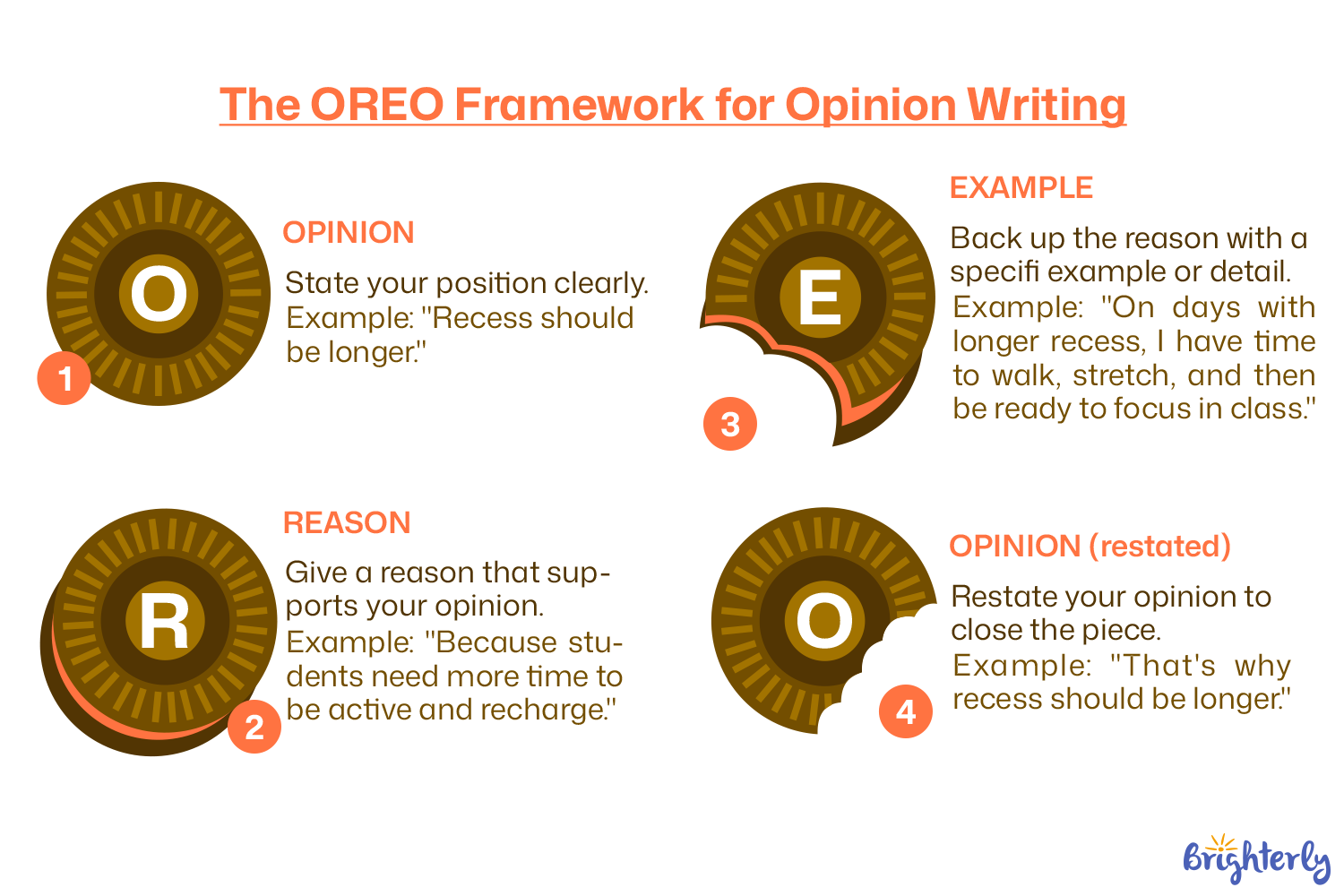
The opinion writing activities include scaffolding techniques like OREO strategy, collaborative brainstorming, or sentence starters, and fun games like taste tests, wars, or a four-corners game where each has a stance to defend.
At the same time, these classroom literacy activities below will be a great support for writing lessons or a part of language arts instruction across grades:
Agree/Disagree Debate Warm-Up
To try it, pose a simple statement that has two sides, for instance, “A lunch break should be longer.” Then, have students move to one side of the room or the other. Ask them the reasons behind the choice. After such a warm-up, it will be easier for them to defend their position in writing.
Fact vs Opinion Sorting Game
Another game is to divide students into groups and give them a set of statement cards. Next, ask them to sort them into two piles, the “fact” and “opinion” piles, and explain why they decided so. You can repeat it with more advanced topics and ideas.
Opinion Writing Anchor Chart Ideas
In a class, you can build an anchor chart with linking words, starters, or phrases organized by grade level. For instance, “because” and “also” are for younger students, and “consequently” is for upper elementary students. Then, organize the practice around this chart.
Common Mistakes When Teaching Opinion Writing
For educators and parents teaching opinion writing, the common mistakes usually refer to the structure, lack of support, going too quickly, focusing on certain things, and generalization. Here are some common instruction mistakes:
- Treating reasons and examples equally.
- Not demonstrating the process first.
- Allowing kids to use many ideas in one piece
- Focusing too much on grammar and spelling in the beginning
- Ignoring vague or weak conclusions.
How to Help Your Child Practice Opinion Writing at Home
To help your child practice opinion writing at home, try to make the process feel natural, fun, and relevant to their interests. What are great strategies to use at home?
- Let them choose engaging topics and practice opinion statements out loud.
- Set graphic organizers at their study place.
- Offer them real-world writing tests, like writing a video game or a dish review.
- Create customized prompts and sentence starters and use them when you go for a walk or on vacation.
Yet, if your kid needs more structured support or has foundational gaps, the personalized essay writing tutoring may be the right option.
At Brighterly, we offer online writing classes where our tutors develop a personalized plan for every student based on their needs, pace, and interests. Besides, we offer feedback and put kids’ confidence first.
Boost your kids' opinion writing
Our tutors identify gaps, create personalized lessons, and build learning habits
Conclusion
In many cases, opinion writing for kids is about building the foundational skills that later transform into high school argumentative writing. They are crucial for kids’ growth, and to teach them to kids, you should start from the basics.
However, if at some point you need support or help, the Brighterly tutoring platform can help not only with 1:1 lessons but also with prompts and worksheets. Book free session to try!
Frequently Asked Questions
At What Age Should Children Start Opinion Writing?
Children can start learning opinion writing around the age of 5 to 6, when they are in kindergarten or 1st grade. They should start by identifying their favorite topic, stating an opinion, and naming at least one reason. So, they first get the basics, and in subsequent grades, they learn more about structure, building sentences, sharing reasons, and using persuasive language.
What Are the 3 Main Parts of an Opinion Piece?
The main parts of the opinion piece refer to the opinion statement in the introduction, the body of evidence and argumentation, and the conclusion. The opinion writing introduction consists of the hook and a sentence that states your position, while the body of the piece is where you present arguments and evidence. Lastly, in a conclusion, you offer your final takeaway and a call to action.
How Long Should An Opinion Piece Be for Elementary Students?
For elementary students, an opinion piece may be a single well-constructed paragraph or a 3-5-paragraph essay of 50-150 words. It all depends on grade level. Besides, the focus should remain on structural elements, not word count. It’s more important to have a clear opinion, reasons, and examples in it.
What Is the Difference Between Opinion Writing and Persuasive Writing?
The difference between opinion writing and persuasive writing lies in the goal, appeals, and focus. The opinion writing focuses on sharing what the writer believes and relies on personal feelings, whereas persuasive writing aims to change a reader’s mind or convince them to take an action. In persuasive writing, a child would use a mix of facts, personal experience, logic, and emotional appeals.
What Opinion Writing Topics Work Best for Elementary Students?
For elementary students, the opinion writing topics that work best are the ones referring to subjects they have strong feelings about. They include school, classroom, food, animals, or pets. Another great way to ignite opinion writing is to use “this or that” topics. The great ones are those that are relatable, specific, and let students draw on personal stories.
What Should an Opinion Writing Rubric Include?
An opinion writing rubric or opinion writing checklist should include five core categories: purpose or stance, organization and structure, evidence and support, mechanics, and word choice or voice. The first category contemplates assessment of the strength of stance, tone, and arguments; the second is about flow, transition, and conclusion. The third and fourth are about the validity of reasons, details, and grammar. The fifth one is concerned with the use of vocabulary.


Khan Academy vs Coursera serve very different audiences. Khan Academy is entirely free and run as a non-profit, built around helping students master core subjects like math and science, along with test prep support. Coursera operates on a freemium model and partners with major universities to deliver professional certificates. If you’re finding it hard to […]

Jun 30, 2026

The 2026 after school programs come in various formats — some are self-paced, others give you real teachers like a trigonometry tutor. Both are effective, but they solve different problems, and picking the wrong one wastes time and money. This guide compares the 13 best after school tutoring programs across approach, subjects, and price. After […]

Jun 30, 2026
Math & reading from 1st to 12th grade
Looking for homework support for your child?

Choose kid's grade

Math & Reading for Grades 1–12
Build real confidence for your child with a Brighterly math or reading tutor.