Story Elements Explained: Definition, Types & Examples 2026
reviewed by Marvi M. Andres
Updated on July 23, 2026

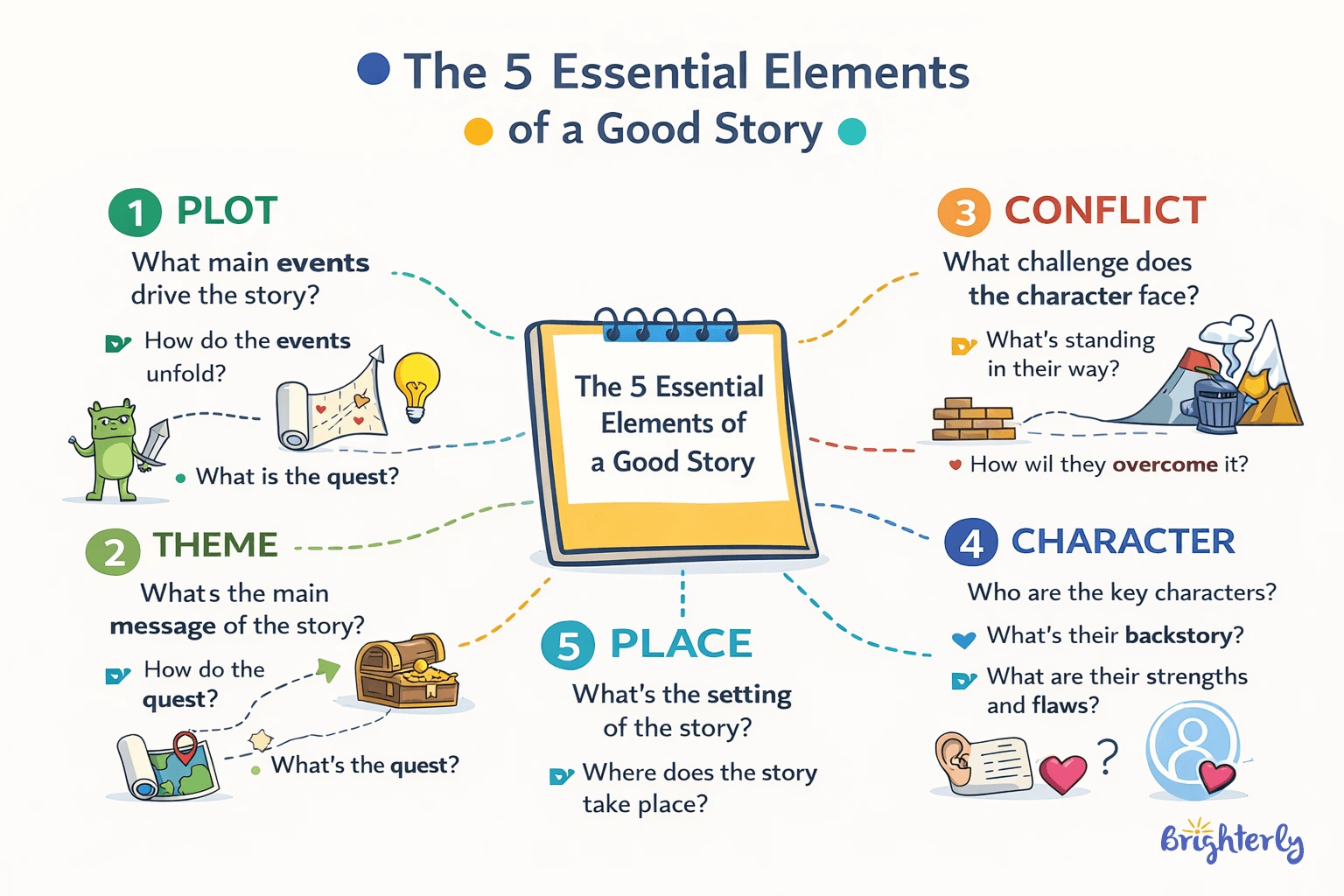
Humans are storytelling creatures. We tell, consume, and enact stories because they are central to who we are. And over time, we also came to understand what makes or breaks a great story: its story elements. Remember all the great stories you’ve heard, read, or watched? One thing they probably have in common is that they follow a specific pattern.
In this article, we are going to look at what are the elements of a story, why they are important, and have a look at some examples of how these elements work in practice.
Key points:
- Every successful story consists of the foundational 5 story elements, which are the plot, the setting, the character, the conflict, and the theme.
- Point of View is an additional 6th story element that shows the lens through which kids read the story.
- Some of these elements have sub-elements, like characters can be protagonists and antagonists, and plot can have an opening and a resolution.
Story elements checklist:
- Plot – Does the story have a beginning, middle, and end?
- Setting – What are the “where” and “when” of the story?
- Characters – Is there a clear protagonist? Do they have personality traits and goals?
- Conflict – What is the problem the character is going through?
- Theme – What’s the big idea/lesson the story tried to convey?
- Point of view – Who is telling the story? Is it a first-person or third-person?
What are the elements of a story?
Point of view and resolution are the additional elements. If you leave one element out, the story will feel flat, like it’s missing something. On the other hand, when implemented correctly, these components can work together to create worlds that draw readers in. These are the elements that in literature provide the structure the plot needs to unfold and for characters to grow.
Why are story elements important, you may ask? The answer is, if you want your child to have a better reading comprehension and be able to understand why some stories work better than others, they need to understand the structure of those stories.
Let’s look at each element in more detail.
Plot
The plot is probably the first thing that comes to your mind when you think of the story. In simple terms, it’s the sequence of events that unfold throughout the story. In other words, it’s the “what happens” of the story.
A good plot has a clear beginning, middle, and end. At the beginning of the plot, we meet the character, after which their adventures start to unfold. But it’s not so simple: the story plot, in its turn, has five elements of its own.
5 Elements of plot structure
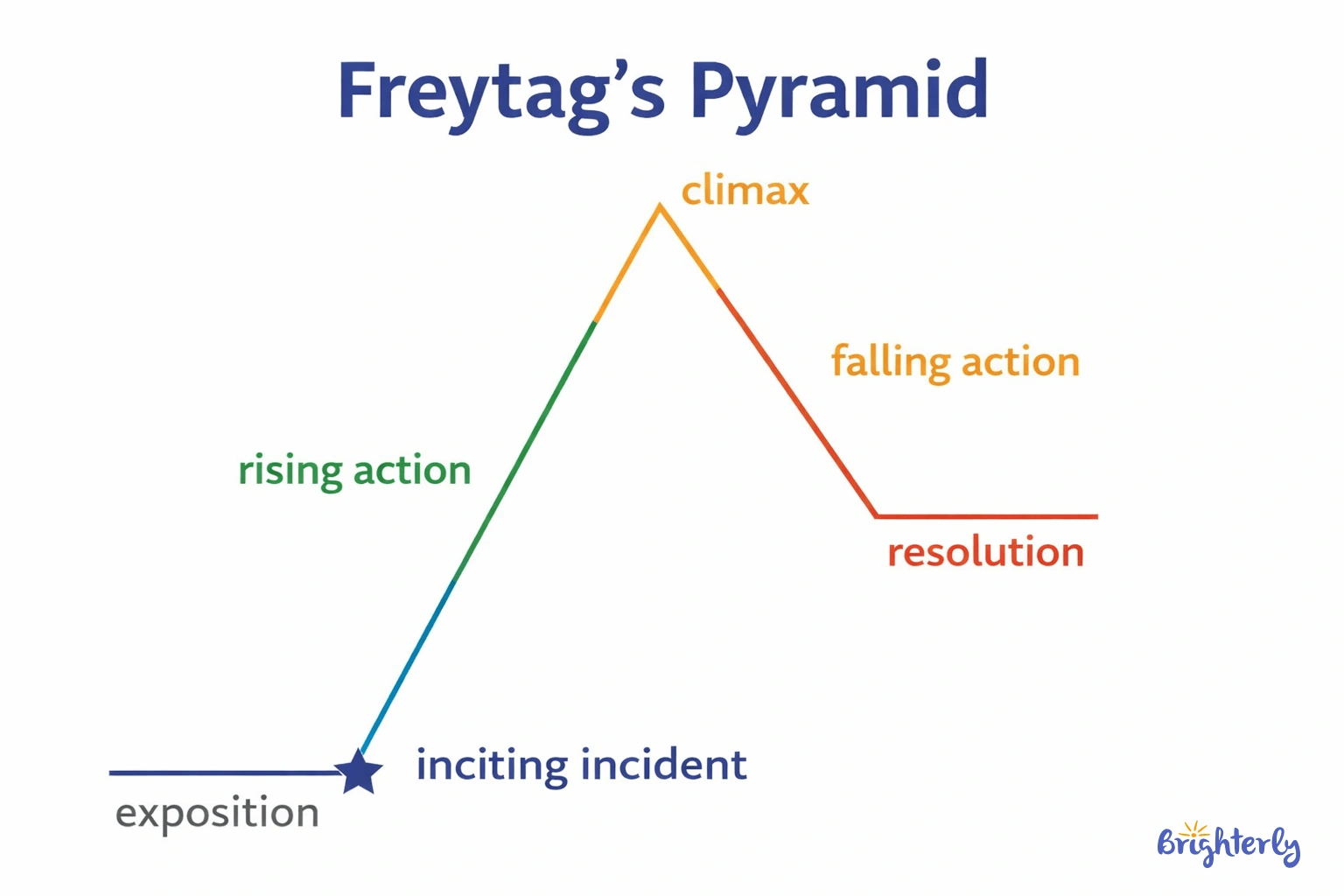
If the plot is the “what happens” of your story, the 5 elements of a story plot are the roadmap that will tell you how to get from the beginning to the end. This arc is known as the Freytag’s pyramid, and most successful narratives follow this to make sure that the tension in the story builds logically, and the readers receive a coherent narrative they will enjoy. Let’s look in detail at the plot elements.
- Exposition is the first element. It’s the setup, where the writer introduces the primary characters, establishes the setting, and the normal world before the actions kick off.
- Rising action is when the story starts to gain momentum. The characters start experiencing a series of events or obstacles, which complicate their lives, leading them towards a turning point.
- Climax is the said turning point. It’s the moment of a major confrontation or highest emotional intensity, when the main character is making a critical decision.
- Falling action is the aftermath of the climax, when the tension begins to lower, and the consequences of the turning point start to play out.
- Resolution is the conclusion of the plot, where the main conflict is resolved for better or worse, and the characters settle into the new normal.
How Brighterly can help kids learn story elements
Reading lessons with professional ELA teachers are among the most effective ways to understand how the parts of a story work.
On the Brighterly math and reading learning platform, your kid can work with reading tutors, who offer them personalized sessions. During the classes, they will go through an interactive, carefully planned reading program to learn to identify story elements and analyze them effectively.
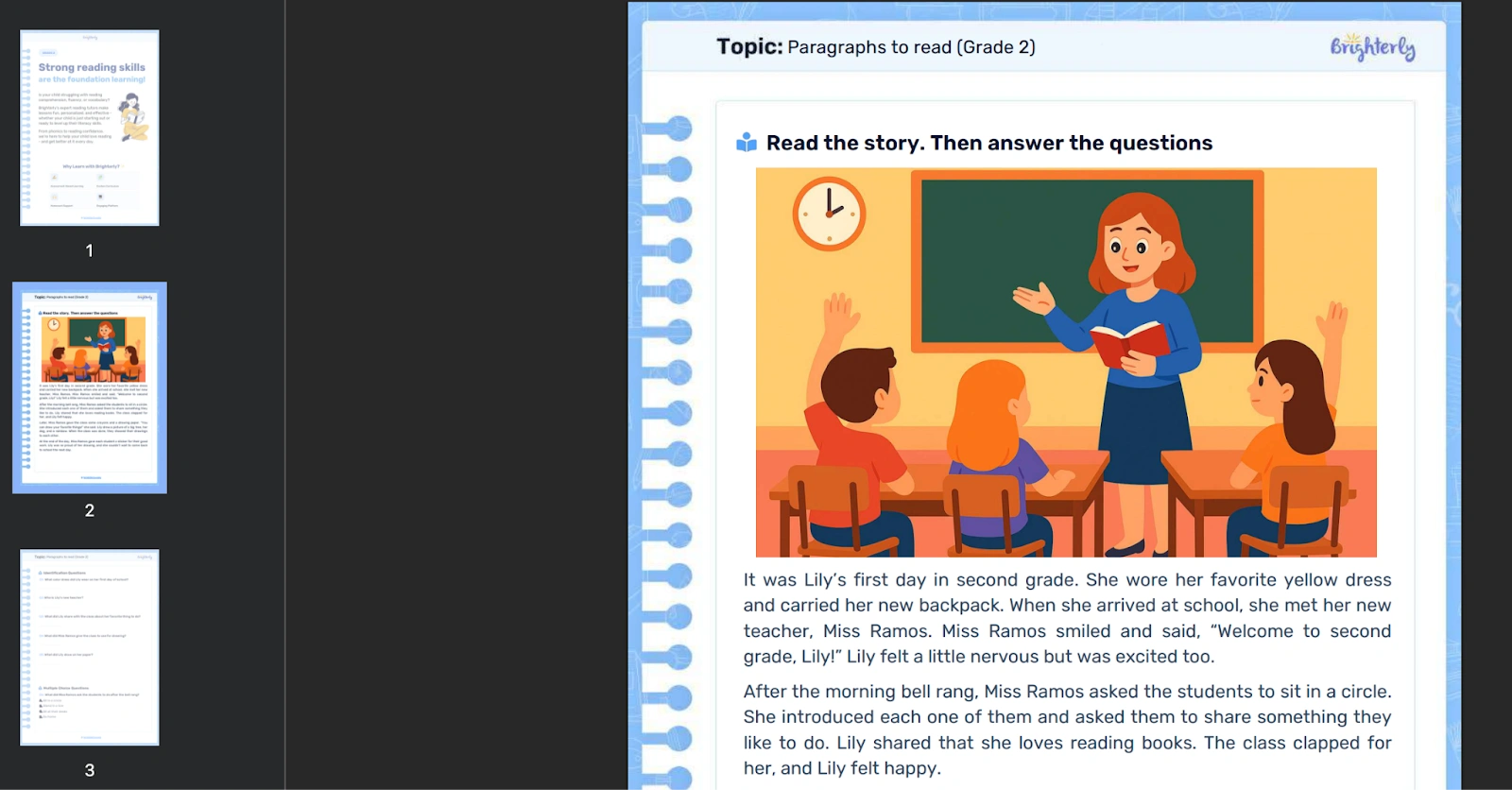
Furthermore, Brighterly also offers customers various free resources, among which are story elements worksheets and reading tests, to give your kid additional interactive reading practice and to check how their reading skills are progressing.
Help your kid explore story elements with personalized 1-on-1 guidance. 
Learn to understand stories better
Setting
The setting of your story is what will decide whether it’s a medieval knight-and-castle type of story, a wizarding school, or a 2000s New York. The setting of your story is the environment where the plot takes place.
A good setting does much more than just describe a landscape. It sets the mood, deciding whether it’s a happy, comfortable, or slightly spooky scene.
If you are looking for a good way to show your kid story elements meaning of a setting, tell them stories with completely different worlds. For example,
- tell about a setting in a dark and cold haunted castle, where a boy wandered into,
- then a setting of a sunny beach or a birthday party in a well-lit room.
Ask them to describe the details of those settings, like candles vs. electric lightbulbs, and talk about how these elements affect the setting.
Characters
If the setting is the stage, the characters are the actors. They are the “who” of the story, and can be people, animals, robots, or imaginary creatures.
Character is the heartbeat of the story, so every story will contain at least one character. They are the ones whose emotions and choices drive the narrative; that’s why all story elements examples have someone who drives the actions of the plot.
Protagonist vs antagonist
Not all characters are the same. Much like the settings can be different, so can the characters.
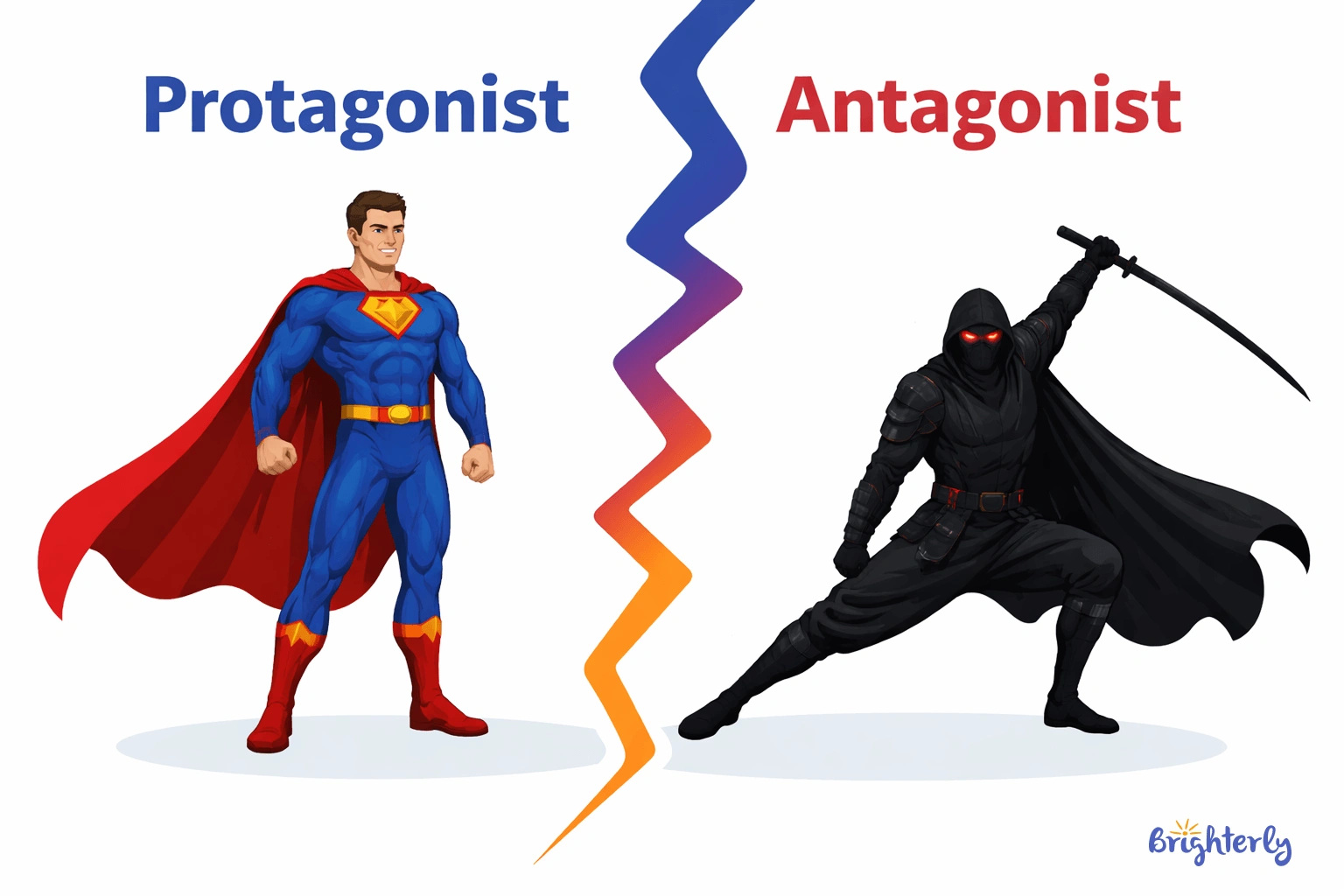
Stories can contain 3 types of characters. The two main types are the protagonist and the antagonist, and you also have the supporting characters.
- The protagonist of the story is the main character. Think of them as the hero of the story. Their actions, growth, or downfall often drive the story. In most cases, children will experience the story through the protagonist’s eyes.
- The antagonist, on the other hand, is the character that drives the main conflict of the story. It’s the force that opposes the protagonist. In many cases, it’s a villain in a cape (think Lord Voldemort in the Harry Potter series), while in others it can be a rival, a corrupt system, a situation, or even an internal struggle the protagonist has with themselves.
- The supporting characters are the ones that fill out the void. They are there, and they do things, and can be a sidekick, a mentor, or be there just to highlight a specific trait of a protagonist.
All of these characters come together to bring parts of story alive and fill it with action, and are all equally important.
When your child is writing a story, developing a character that has motivations and inner thughts is critical if they want the story to connect to the reader on an emotional level.
Conflict
A character in a beautiful setting with nothing to do doesn’t make for a very interesting story. That’s where the conflict, one of the five parts of a story for kids, comes into play.
Conflict is the essential problem or struggle that forces the main characters into action. The conflict, along with the character, drives the story from exposition to resolution.
The story’s conflict doesn’t have to be anything dramatic. While it can be a scary dragon, it can also be a misunderstanding between friends. The most important point is that it drives the characters into action, who then face obstacles until they find a solution.
At the end of the story, the conflict gets resolved, in most stories, for the better: the knight defeats the dragon, and the friends make up.
Theme
The theme of the story is its central idea, the main message that runs through the entire story. You can think of it as the soul of the story. It’s the truth the author is trying to explore and convey to the readers. Unlike the plot, which describes specific events, like a young wizard defeating a dark lord, the theme describes the human experience behind the action, like the power of love.
The themes of the stories are subtle, and the authors very rarely state them directly. When teaching your kids how to read a story with an analytical mind, guide them with questions. Ask them
- What the protagonist learned
- What the story teaches about how people should treat each other
This will help you check their reading comprehension skills, as well as whether they got the main idea of the story.
Point of view
Next in the list is the point of view (POV), and as you may have guessed already, it’s about the perspective of the person who shares the story. This is technically the 6th element. It determines who tells the story and how much the readers will know. When writing a story, choosing a POV is one of the most important decisions your child can make, as the POV is what shapes the reader’s emotional connection to the characters.
When writing a story, there are three primary angles your child can choose:
- The first person, where the narrator is a character in the story. In this case, the readers are limited to only the knowledge of the narrator.
- The second person, when the reader is the protagonist. This one is quite rare.
- The third person, where the narrator is an outside observer. The narrators can, in their turn, know only the thoughts and feelings of one character, or be all-knowing.
Resolution
The last one of elements of story is the resolution. This is the final part of the story where the dust settles, and the reader gets to see what remains. In narrative writing, this is the stage where the author answers the lingering questions and shows how the characters have changed after their journey.
To write a good resolution, kids need to not only tell readers what happened but also provide some sort of emotional payoff. This can be both a happy ending or something bittersweet, but it must feel earned. It’s the moral and emotional conclusion of the theme. The two ways kids can finish up their story are the closed resolution, when the mystery is completely solved, and the open resolution, which leaves some questions to the reader to answer.
Explore Brighterly Learning Experience
Learn exactly how Brighterly helps students thrive through expert sessions, online tools, and proven feedback from thousands of satisfied parents
Story elements examples
Now that you know what the 5 elements of a story are, let’s look at some well-known stories through them.
| Story | Characters | Setting | Plot | Conflict | Theme |
| Cinderella | Cinderella, stepmother, stepsisters, Fairy Godmother, Prince | A fairy-tale kingdom, long ago | Cinderella can’t go to the ball; with magic, she goes and meets the Prince. | She must overcome her family’s cruelty and find happiness. | Kindness and patience are rewarded. |
| Little Red Riding Hood | Little Red, Grandmother, Big Bad Wolf | Village and forest, once upon a time | Little Red goes to visit Grandma, but the Wolf tricks her. | She faces danger from the Wolf’s deception. | Listen to advice and be cautious with strangers. |
| Harry Potter and the Sorcerer’s Stone | Harry, Hermione, Ron, Voldemort | Magical school, the 90s | Harry learns he’s a wizard and faces an evil wizard. | Harry must stop Voldemort (evil) from returning. | Courage and friendship conquer fear and evil. |
Conclusion
As your child is developing literacy and starts to dive deeper into stories they read, understanding story elements definition and how these elements come together to create a memorable and interesting story is critical. This will not only help them understand and better appreciate the stories and novels they read, but also help them become better writers themselves, as they now know how to build worlds that resonate with readers.
If you need a helping hand from experts to teach story elements, Brighterly’s personalized approach makes reading stories fun and easy.
You can book free reading lesson and see how it works.
Frequently asked questions (FAQ)
What are the 5 elements of a story?
The core elements of a story are the plot, the setting, the characters, the conflict, and the theme. These are the building blocks, which, when done correctly, come together to build a story that will guide the reader through the plot, introduce the characters, and conclude the story.
What are the 7 elements of a story?
In addition to the 5 core elements, some authors and professionals count Point of View and the Mood/Tone as the 6th and 7th elements of stories. These are the elements that show which lens the readers see the story from, as well as the emotional atmosphere of the story.
Why are story elements important?
The story elements introduce your child to the ingredients of a story. When even one element is missing, the narrative might feel disconnected, flat, or purposeless. For readers, identifying these elements improves comprehension, while for writers, it provides a roadmap for creating a compelling story.
How can you identify story elements?
To identify the elements, kids need to ask themselves these questions:
- Who is the main person (character)?
- Where are they (setting)?
- What is stopping them from getting what they want (conflict)?
What is the difference between theme and plot?
The plot of the story is the sequence of events that happen from beginning to end. It’s the action your kid sees on the page. The theme is less straightforward. It’s the deeper meaning, the universal message, the lesson the story tries to convey through the plot.



Don’t mistake reading challenges — they aren’t about making reading difficult. In fact, they are the opposite! Reading challenges for kids are all about making the reading fun and even more motivated to think and reflect on literary pieces. In this article, I will take a closer look at what reading challenges are and how […]
Nov 05, 2025
Not sure if Think Academy is right for your child? I’m here to help. Being a math teacher myself, I tried the online platform and read dozens of Think Academy reviews to offer you a comprehensive overview and evaluation. In this writing, I focused on Think Academy’s features, approach to learning, app interface, and value […]

Nov 10, 2025
Math & reading from 1st to 12th grade
Looking for homework support for your child?

Choose kid's grade

Math & Reading for Grades 1–12
Build real confidence for your child with a Brighterly math or reading tutor.