What Is a Neurodivergent Child & How to Support Their Learning
reviewed by Marvi M. Andres
Updated on March 23, 2026
A neurodivergent child faces way more challenges when learning, compared to other kids. That’s why such kids need special attention and additional help to get through their studies. Some parents struggle to provide such support because they simply don’t know their child is neurodivergent. To make sure this doesn’t happen, read this guide on the signs of neurodivergence in children and methods to ensure they still learn successfully.
Key points
- Among the most common signs of a child being neurodivergent are unique communication patterns, sensory sensitivities, and a short attention span.
- As of 2022, approximately 1 in 6 children aged 3–17 were diagnosed with a developmental disability.
- Same year, 10 – 20% of the global population was considered neurodivergent.
- Raising a neurodivergent child means accepting their differences and instead of trying to change them, adapt to their specific neurological needs.
- There are several strategies that have been proven effective when teaching a child with a learning disability.
- Brighterly tutors make sure to take into account your kids’ differences and alter the learning process accordingly.
What is a neurodivergent in children?
Neurodivergent kid means the kid’s brain functions differently, which is why they learn and interact with the world in ways that are considered to be atypical. In general, a kid being neurodivergent implies they are struggling with autism, ADHD, dyslexia, or another neurological condition.
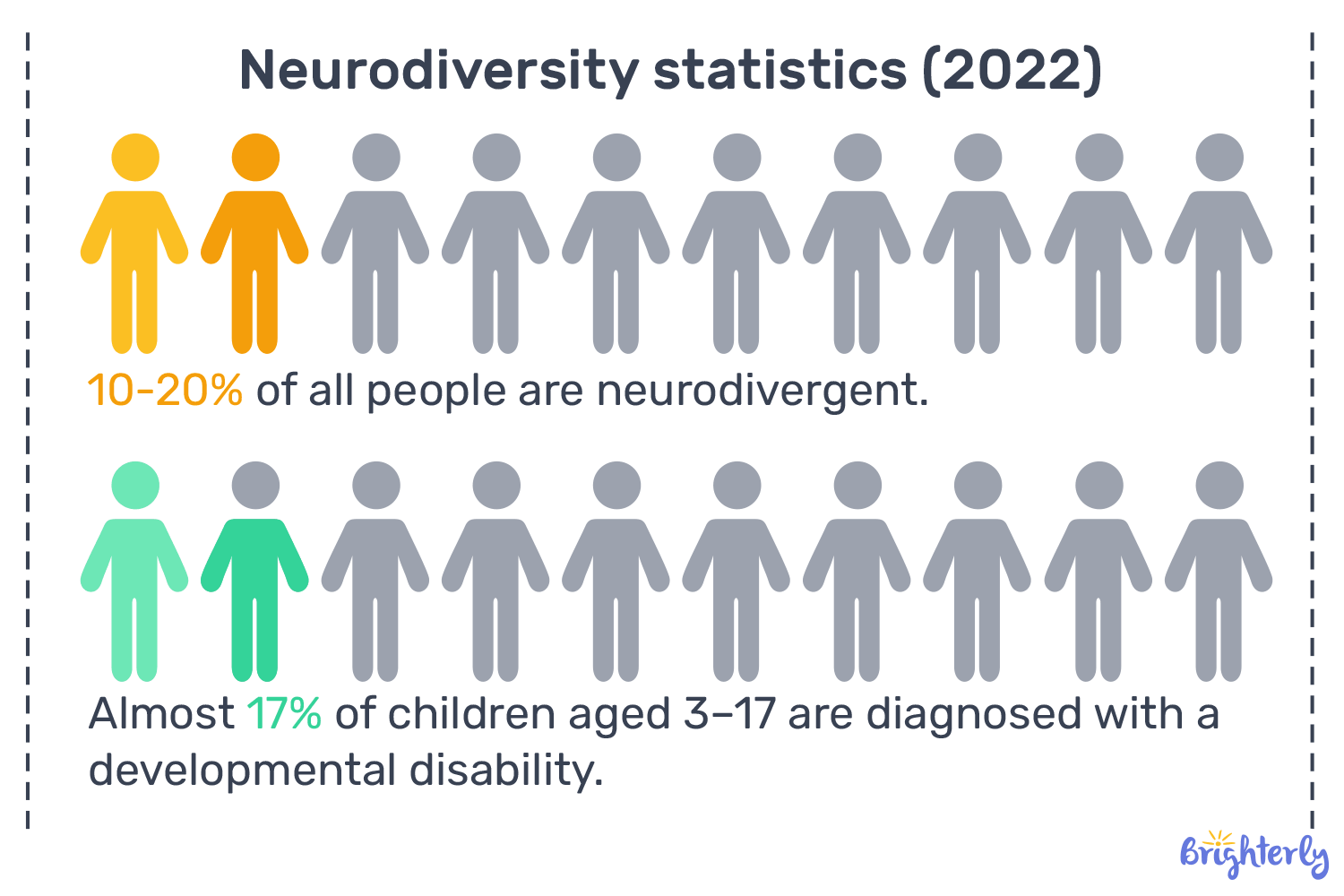
When searching for an answer to a question, “What are neurodivergent children?”, parents may think there are very few of such kids and that neurodivergence is extremely rare. In fact, according to research published in 2022, around 1 in 6 children aged 3–17 are actually diagnosed with a developmental disability. These include both learning disabilities (like dyslexia and dysgraphia) and neurodivergent disorders (like ADHD and autism), which also affect learning.
Another research done the same year claims that 10 – 20% of all people are neurodivergent. That is why it’s so important to know what that means and how to spot the symptoms of your child’s neurodiversity early on. And while we move on to the list of most common neurodivergent conditions, keep in mind that they can be interconnected and a child can show symptoms of several of those at once.
What are neurodivergent disorders?
- Autism Spectrum Disorder (ASD): Affects communication, social interactions, and may cause repetitive actions or a strong focus on one interest.
- Attention Deficit Hyperactivity Disorder (ADHD): Causes hyperactivity, impulsivity, and difficulty with staying focused.
- Dyslexia and Dysgraphia: Affect language processing in reading and writing, respectively.
- Dyscalculia: A math-related neurodivergent learning disability that affects understanding of numbers and mathematical logic.
- Sensory Processing Disorder (SPD): Causes over- or under-response to sensory triggers like light, sound, or touch.
How can you tell if a child is neurodivergent?
Telling if a child is neurodivergent starts with simply observing their behavior during social interactions and studying. Common signs of neurodivergence in children can be different depending on what disorder it is, so for parents wondering, “Is my child neurodivergent?“, here is a table of typical symptoms for the most common conditions.
| Condition | Category/Characteristics | Signs/Symptoms |
| Autism | Social |
– Trouble connecting with others and making friends – Avoiding eye contact – Difficulty understanding jokes or sarcasm – Lack of interest in other people – Speaking way less compared to peers |
| Behavioral |
– Strong interests in certain subjects – Repetitive movements or behaviors – Trouble breaking usual routines |
|
| Sensory |
– Easy overstimulation by sounds or lights – Discomfort with particular fabrics – Seeking physical pressure, like tight hugs or a heavy blanket |
|
| ADHD | Attention and memory |
– Difficulty staying focused (short attention span) – Difficulty remembering things |
| Hyperactivity and impulsivity |
– Staying energetic and active even when tired – Difficulty or inability to sit down and stay still for meals or activities – Being overly talkative – Acting without thinking of consequences |
|
| Dyslexia | Learning and information processing |
– Difficulty remembering or comprehending what they’ve read – Having way more struggles with reading-related schoolwork than peers |
| Behavioral |
– Trying to avoid school – Being frustrated over school because of not being able to cope with the tasks like others |
Source: GoodRx
Note: Keep in mind that even if you see your child matching any of these symptoms, even from different categories, it’s not unusual. Neurodivergence is a wide spectrum, so different kids can experience the same condition differently.
The article in GoodRx also mentions that although neurodivergent children usually face hardships with processing information, in unique cases, these kids can have extraordinary memory, high attention to detail, great problem-solving skills, amazing creativity, etc.
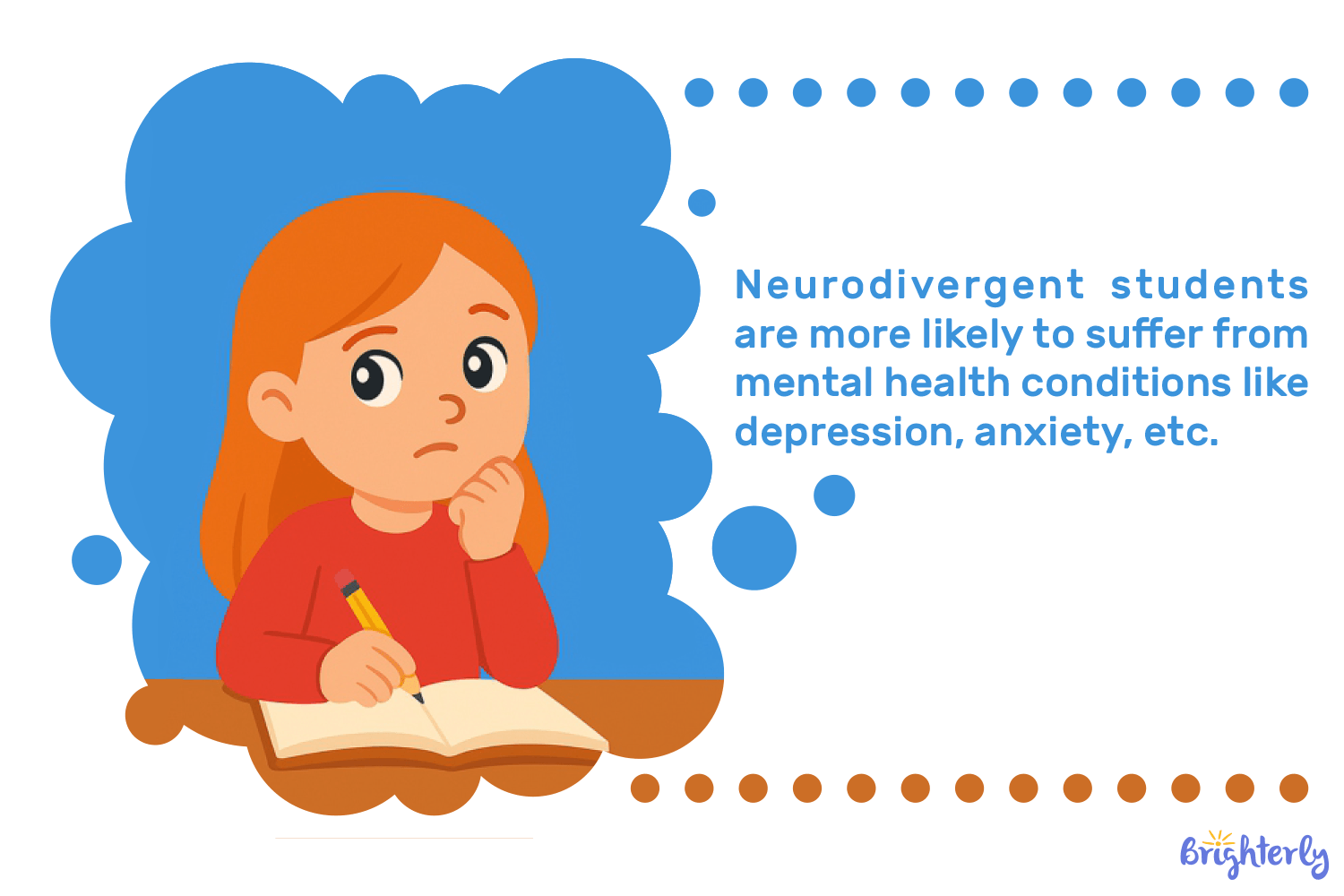
However, there is also research published in 2025 that shows evidence of greater rates of mental health conditions like depression and anxiety, panic disorder, OCD, etc, among students with a neurodivergent condition.
Recognizing neurodivergence in toddlers
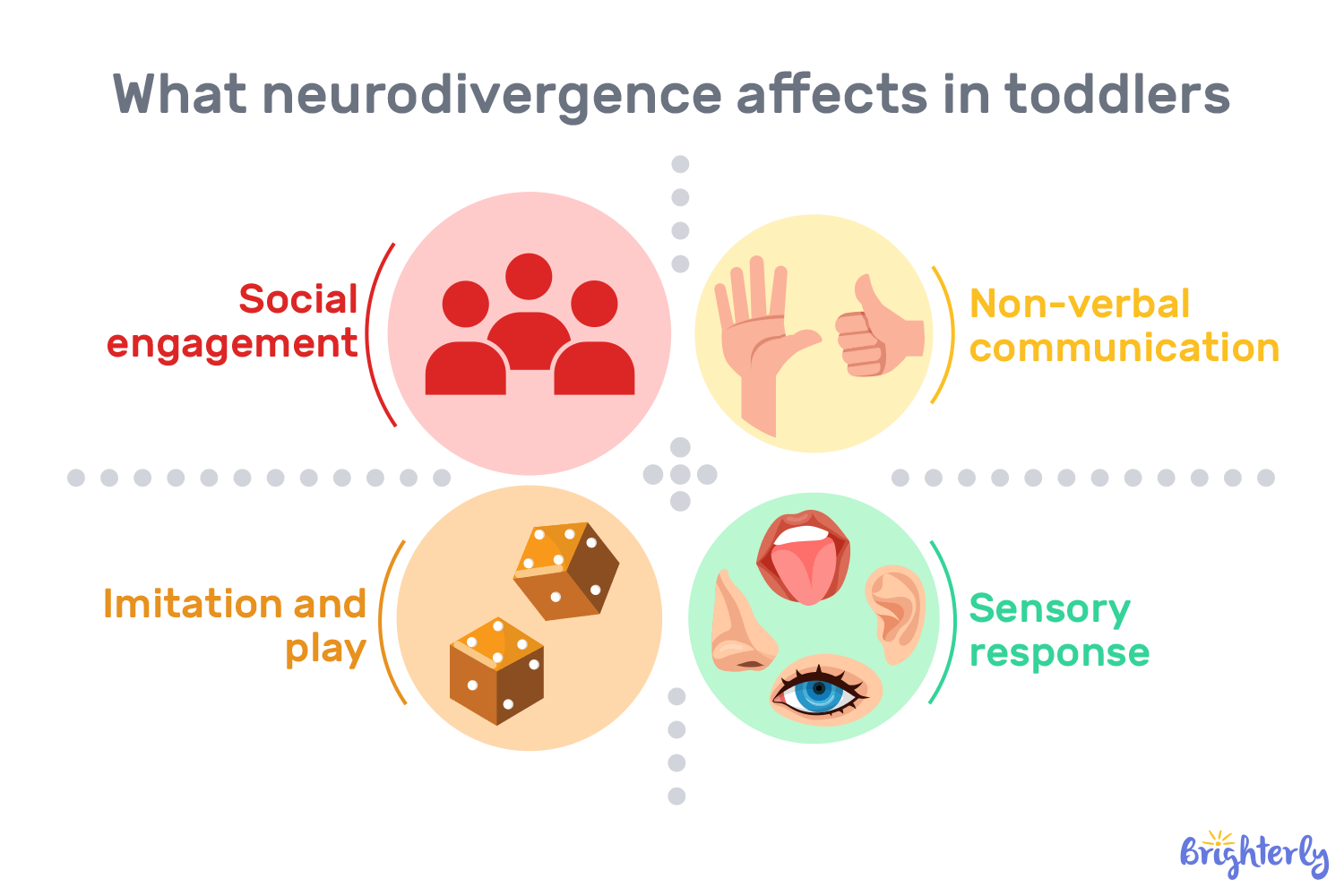
Unlike with older children who already talk and read, noticing the signs of neurodivergence in toddlers can be a little harder. The best way to do so is to keep track of how the child reaches early developmental milestones. And since toddlers are still developing their basic motor and language skills, parents should look for specific differences in behavior rather than just delays in something precise.
Although the symptoms mentioned above are still absolutely relevant for little children too, the Raising Children Network offers a list of specific signs that can be noticed very early on. So, most likely, a neurodivergent toddler will:
- Rarely point to or hold up objects to show you something
- Frequently ignore when their name is called
- Rarely use gestures like waving “bye-bye,” clapping, nodding for “yes”, or shaking their head for “no”
- Rarely smile back at parents and familiar people
- Rarely copy or mimic other people’s actions
- Babble rarely or not babble at all
- Have difficulty understanding simple instructions by 1–2 years of age, like when you ask them to give you a toy they’re holding
- Rarely engage in imaginative play, like pretending to feed a doll
- Be easily upset by loud noises or bright lights than other children
- Only eat food with certain textures or colors, or want to wear the same clothes every day.
The earlier parents identify these signs, the faster they can find out what they can do to ensure supportive and adaptive neurodivergent child parenting. So, now we move on to some popular methods that have proven to be effective when helping such kids with learning.
Parenting a neurodivergent child: How to support learning?
- Working with a qualified tutor
- Using multisensory learning techniques
- Creating a visual schedule
- Creating a sensory-friendly study space
- Breaking one task into smaller ones
- Doing movement breaks
- Gamifying the process
- Explaining the math-language connection
- Including kids’ interests in the curriculum
- Trying the “body doubling” technique
- Teaching how to communicate the needs
- Practicing positive reinforcement
- Use assistive technology
Working with a qualified tutor
The teaching process in a standard school classroom is usually designed to fit the majority of kids. For neurodivergent kids, it’s often hard to keep up. That’s why getting them a tutor who knows how to customize the curriculum to different learning styles can be a great solution.
Professional tutors on Brighterly math and reading learning platform understand that neurodivergence means unique cognitive paths. So, they don’t just teach, but adapt to the child’s needs. First, they identify where the kid is having difficulties and then build a learning program in a way that helps them improve while enjoying learning and not stressing over mistakes.
For parents of neurodivergent students, Brighterly website offers free access to math tests and reading tests for understanding the current level of the child’s knowledge. For easy and fun practicing, there are also math worksheets and reading worksheets, all for grades 1 through 9.
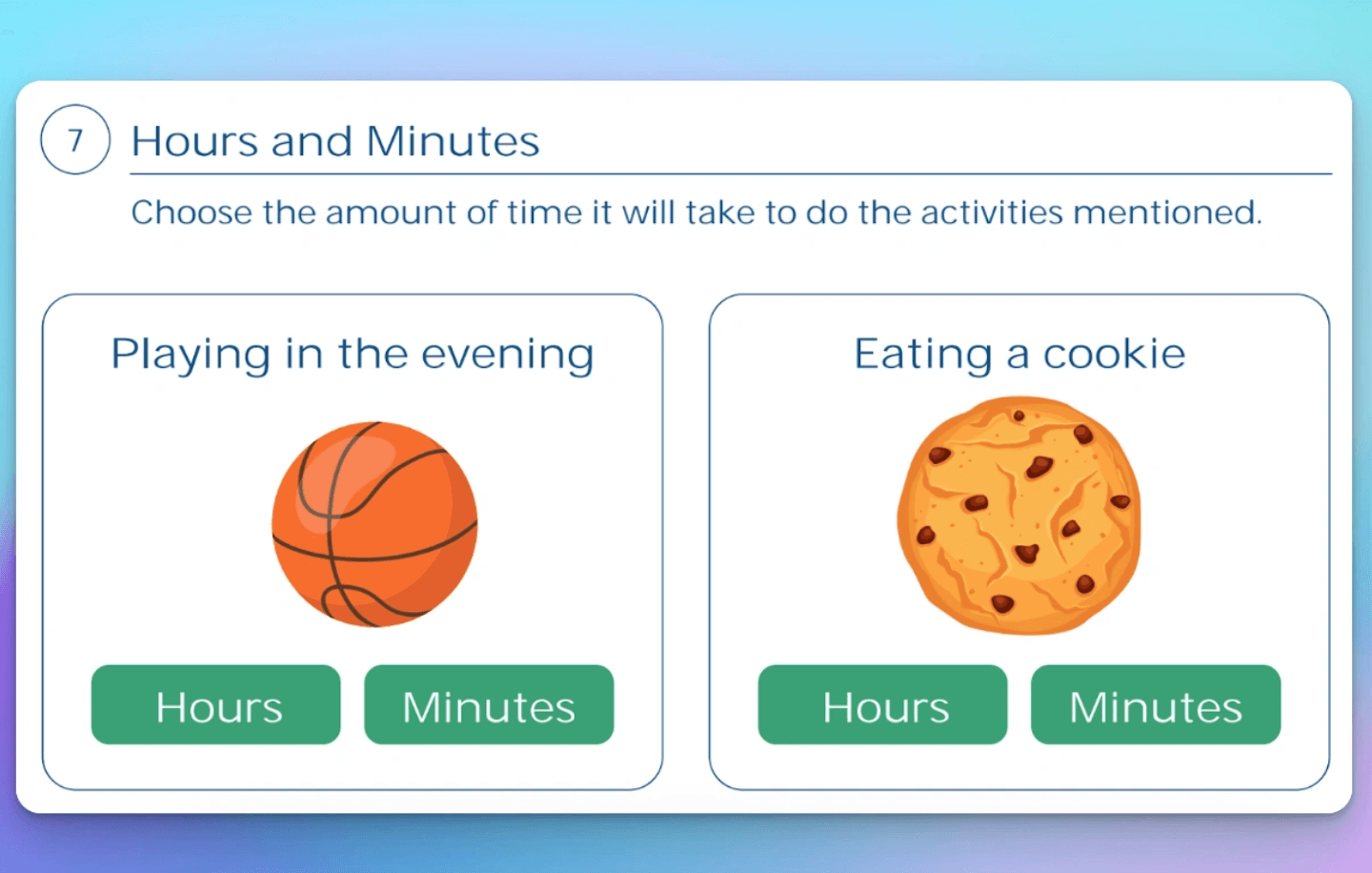
Using multisensory learning techniques
Traditional learning methods like just dictating a text that a kid has to write down with a pen, may not work as they are supposed to with neurodivergent children. That is where adding a sensory technique can help. So, if you’re wondering how to study with ADHD, for example, the things to try include asking a kid to trace words with something like sand or shaving cream, offering them manipulatives to build words with, or including rhythmic movement like clapping or marching into the learning process.
Creating a visual schedule
Having a schedule is good for any child. With it, they don’t have to stress while guessing or predicting what is waiting for them and in what order. For neurodivergent kids, this is of even greater importance, since they often experience extra anxiety when they don’t know what is coming next. Providing them with a schedule, especially one they can always look at, helps reduce the cognitive load on their brain, so they can focus more on learning rather than stressing about the future.
Creating a sensory-friendly study space
Since the neurodivergent child symptoms we’ve covered above include sensitivity to sensory stimuli, the surroundings play a huge role in how they learn. For example, too many bright colors in the room or loud sounds can be too much for them and just overload their brains. So, what you can do is:
- Use dimmable lights or natural light
- Provide noise-canceling headphones
- Offer “fidget” tools to help with hyperactivity caused by sensory overstimulation
- Provide a chair allows for some movement, like a wobble stool.
Breaking one task into smaller ones
Due to their brain working differently, neurodivergent learners often struggle with planning, organizing, and especially starting tasks. Usually it’s when the task is too big, which can be scary and overwhelming for them. A solution could be to break the task into several small ones that can be done step-by-step, which prevents kids from feeling threatened by a big load of work they need to do.
Doing movement breaks
Since one of the signs of a neurodivergent child is hyperactivity, sitting still for learning is often physically impossible for them. For example, according to ADHD statistics, 3.9% of children with this disorder are constantly on the move and fidgety. That’s why it’s best not to force them to sit for an hour straight. Instead, take some little breaks to let them move and let the energy out, like some physical exercises.
Gamifying the process
If you search for the best homeschool curriculum for ADHD, you will notice that many of them usually involve gamified tasks. Gamification can mean the use of points, levels, and rewards to make kids feel extra joy from finishing a task or a test successfully, for example. Besides, it makes a lesson way more fun, which is also important for neurodivergent learners to stay focused.
Explaining the math-language connection
Parents often ask, “Does dyslexia affect math?” Actually, yes. Math requires reading of word problems and keeping track of sequences, and that’s where dyslexia may interfere. Also, according to research published in 2024, 40% of students with dyslexia also have dyscalculia — a disorder mentioned above as the one that affects the ability to understand, process, and remember numbers, math facts, and quantities. So, if your child is struggling with dyslexia and shows problems with learning math, it’s important to explain to them that these are related issues.
Including kids’ interests in the curriculum
Like most kids, neurodivergent children also have their special interests. In terms of learning, it could be specific topics they really like and enjoy exploring. For parents, it’s a great opportunity to use these interests as a tool to make sure the child will actually care about studying. For example, if a kid loves everything related to space, you could use planets to teach fractions or ask them to write a creative story about aliens to practice grammar skills. Basically, an interest can be a bridge between a difficult concept and something a child already loves, which helps reduce anxiety and increase motivation.
Trying the “body doubling” technique
Body doubling is a simple yet effective strategy designed to provide comfort and hence increase productivity in neurodivergent learners. All you have to do is just stay in the same space as the kid while they study. But unlike a tutor or a teacher, you don’t help the kid directly and don’t act as a supervisor. Being a body double means you simply do your own thing nearby, like reading a book. When a neurodivergent student, especially with ADHD, feels the presence of another person focused on something, they basically pick up the same mood. So, the desire to keep studying outweighs the desire to procrastinate.
Teaching how to communicate the needs
Providing learning support to a neurodivergent kid is much easier when you know exactly what they require. That’s why it’s important to teach them to identify and voice their own learning needs. For example, you can help a child create specific scripts for when they feel overwhelmed. It could be something like, “It’s too bright here. Can we go to another room?”, or “I don’t understand what this means. Can you give me an example?” By using such phrases, the kid will learn to understand when they need assistance and how to ask for it, which means they will feel more confident overall.
Practicing positive reinforcement
A neurodivergent child often receives more negative feedback than their peers. Over time, this leads to them feeling helpless and like they’re never good enough. To help them, parents can try to shift the focus from what a kid can’t do to something they are actually good at. For example, praise them when they did well with a task, even if it wasn’t that hard. Such positive reinforcement builds confidence a kid very much needs to handle learning challenges.
Using assistive technology
Neurodivergent behavior in kids makes them struggle with tasks that are simpler for their peers. But there is nothing wrong with providing them extra help to perform these tasks faster and easier. For example, it could be a text-to-speech software for a kid with dyslexia or a graphic organizer for a kid with autism. Don’t be afraid to let a child use a calculator or a spell-checker when they need to. These tools simply help them demonstrate their knowledge without being held back by their learning disorder.

Conclusion
Understanding “What is a neurodivergent kid?” and figuring out how to adapt and help them can be quite uneasy for parents. What’s important to remember is that such kids simply require a different learning path, but are completely capable of achieving academic success. So, the best thing to do is to pay attention to recognizing the signs of neurodiversity early on and provide the necessary support.
If you want a customized approach that takes into account your kid’s learning style, you can try Brighterly reading and math program. Book free lesson today and let Brighterly tutors provide their specialized support!

Reading comprehension games make the reading process more focused, engaging, and productive. Their use allows kids to better grasp the gist and deeper understand the meaning. This article lets you grab 12 interactive reading games to help kids understand what they’re reading. You can use these games in class, at home, or online. Key points […]

Mar 22, 2026
Math & reading from 1st to 9th grade
Looking for homework support for your child?

Choose kid's grade

Math & Reading for Grades 1–9
Build real confidence for your child with a Brighterly math or reading tutor.