What Is Orthographic Mapping? A Parent’s Guide to How Kids Learn to Read
reviewed by Marvi M. Andres
Updated on May 10, 2026
Key Points
- Orthographic mapping is a process that allows us to store words in our long-term memory so that we can easily recognize them and their meaning anytime based on how they sound and look.
- For this process to be successful, a child needs to develop phonemic awareness, grapheme-phoneme knowledge, and vocabulary first.
- The March 2022 report by Middle Tennessee State University states that: “Students with dyslexia benefit from instruction that helps them coordinate phonological, orthographic,
- and morphological word forms”.
- One-on-one lessons with a tutor help children build this understanding faster and easier due to a custom and gamified curriculum.
Orthographic mapping is a cognitive process that turns sounds and unfamiliar letters into instantly recognizable words with meaning. Find out how this process works, when it starts in children, and what activities you can try to support your child when they are going through this mental development stage, essential for overall literacy.
What Is Orthographic Mapping?
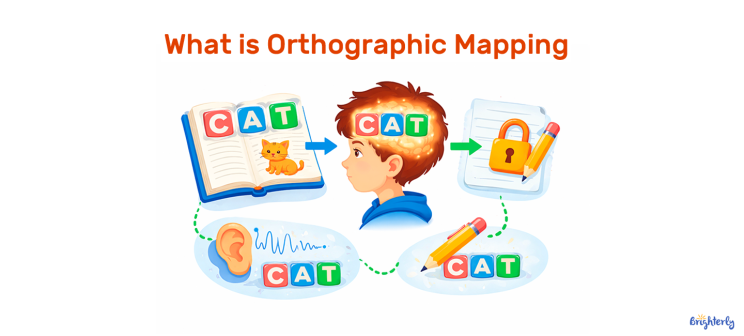
Orthographic mapping is the mental process that allows us to remember and recognize known words by their sounds and looks. Basically, what happens is when we hear or see a word the meaning of which we already know, our brain immediately and effortlessly connects the sequence of letters in this word to the sounds these letters make when combined.
Explore Brighterly Learning Experience
Learn exactly how Brighterly helps students thrive through expert sessions, online tools, and proven feedback from thousands of satisfied parents
How Does the Orthographic Mapping Process Work?
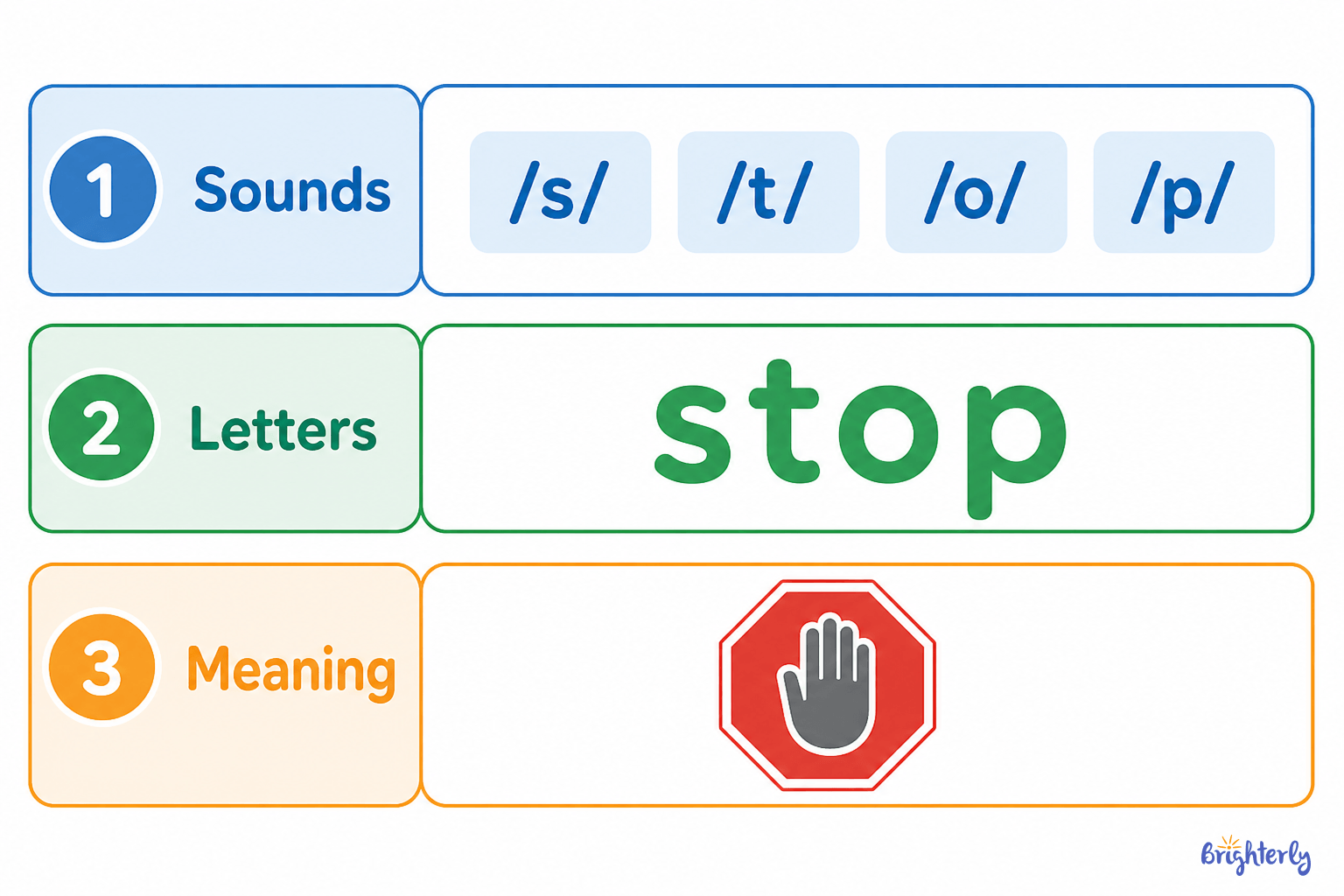
The orthographic processing consists of three stages that happen instantly. First, the brain pulls the word apart into individual sounds, then attaches these sounds to the corresponding letters, and finally connects the word to its meaning already stored in long-term memory.
So, it’s three main components: sound, spelling, and meaning. Here’s what they mean in detail:
- Sound (Phonology): This means phonemic awareness, which is the ability to hear each little sound (phoneme) in a word. It’s also tied to phonological awareness, which is when you develop your ability to connect the heard sounds in a word to its letters.
- Spelling (Orthography): This is the visual part of the process, when you start understanding the grapheme-phoneme correspondence, which means knowing which graphemes (letters or letter combinations) represent which sounds.
- Meaning (Semantics): The core of mapping is knowing the word’s meaning first. It’s the glued base sound and spelling stick to.
Orthographic Mapping Examples: What It Looks Like in Practice
The first example word we can use is “stop”. When hearing it, a child with strong phonemic awareness will immediately hear 4 sounds “/s/ /t/ /o/ /p/”, see how they perfectly fall on the 4 letters, and remember what the word means.
Another example is a word where letters and sound don’t match like a puzzle — “again”. We can see that it’s 5 letters, but If we divide it into sounds, we’ll get “/ə/ – /g/ – /ĕ/ – /n/”, which is only 4. This is how a child learns that two or three letters can merge into particular sounds, which is essential for phonics (decoding) — a process of connecting sounds to letters and letter combinations. When decoding of words becomes automatic, it means they’ve become orthographic mapping sight words.
Note: Sight words are the most common words that kids can recognize instantly by just looking at them, without having to break them down into words and sounds. They are usually simple articles, prepositions, and pronouns.
When Do Children Develop Orthographic Mapping?
Children typically develop orthographic mapping in late kindergarten or early first grade, when they start gaining letter-sound knowledge. In general, by the end of second grade, they have hundreds or thousands of words mapped in their brains. After that, the process just goes on and on, building a vocabulary in long-term memory.
Here’s more detail on how it happens by grade:
- Kindergarten: Kids build phonological awareness and learn basic connections between sound and letters.
- First grade: Kids start mapping words with blends (groups of two-three letters where each letter preserves its sound, like “bl”, “cr”, “str”). Also, that is when they learn a significant amount of high-frequency words, like “the”, “and”, “is”, “of”.
- Second grade: This is when kids can easily map words with multiple syllables and irregular spellings (words where the letters and sounds don’t match directly).
- Third grade and on: At this stage, the mapping process is usually automatic for most kids, and they just keep adding new words to their vocabulary.
Signs That Orthographic Mapping May Not Be Developing on Track
The signs that your child struggles with orthographic mapping are the following: they keep forgetting words they already know, they can’t remember common words where the letters and sounds don’t match directly, and can’t instantly recognize the sight words they have seen many times before.
- Keep forgetting words: A kid constantly fails to remember words they previously knew or have practiced multiple times before.
- Can’t remember common irregular words: A kid struggles to remember common words where the letters and sounds don’t match perfectly, like “again”, for example.
- Can’t instantly recognize sight words: A kid can’t instantly recognize sight words, which makes their reading slow, as they take extra time to decode those words.
Child struggles with orthographic mapping?
Brighterly professionals detect the issues and help a child solve them during one-on-one lessons.


Orthographic Mapping vs. Sight Word Memorization
Sight word memorization implies learning words based on how they look, usually with the help of flashcards. So, the concept is to show kids the same word over and over again to the point they can recognize it immediately. In contrast, the orthographic mapping definition implies that just looking at the word is not enough, meaning that word sounds and meaning matter for better and faster recognition.
| Orthographic Mapping | Sight Word Memorization | |
| Concept | Tying sounds to letters and to the word meaning | Memorizing the visual shape of words |
| Capacity | Unlimited. It’s a natural cognitive process that acts like a universal algorithm that a brain applies when processing words | Limited. It’s not possible to store all the words in visual memory. |
| Result | Permanent, automatic word recognition. | Rote recall, which is prone to guessing. |
Orthographic Mapping and the Science of Reading
The science of reading and orthographic mapping go together because orthographic mapping is an essential process that needs to happen for a child to learn how to read. To voice a written word, a kid needs to recognize its letters, know what sounds correspond to these letters and letter combinations, and recognize which word it is and what it means.
However, this can be a challenge for neurodivergent kids. For example, dyslexia messes with the ability to decode words, which is why orthographic mapping with dyslexia is much harder. Kids with dyslexia usually confuse words and letters that look similar when written, which means they can’t pronounce them right. To check if your child has that issue, you can use our diagnostic reading test.
Get your child professional reading help
Our reading tutors take into account your child’s learning gaps and tailor the program accordingly.
Orthographic Mapping and Dyslexia: What Research Shows
A study published in May of 2021 in Annals of Dyslexia journal truly proves the fact that dyslexia creates difficulties for readers:
- “Dyslexic readers seem to be characterized by a phonological deficit associated with difficulties in implementing an orthographic reading strategy.”
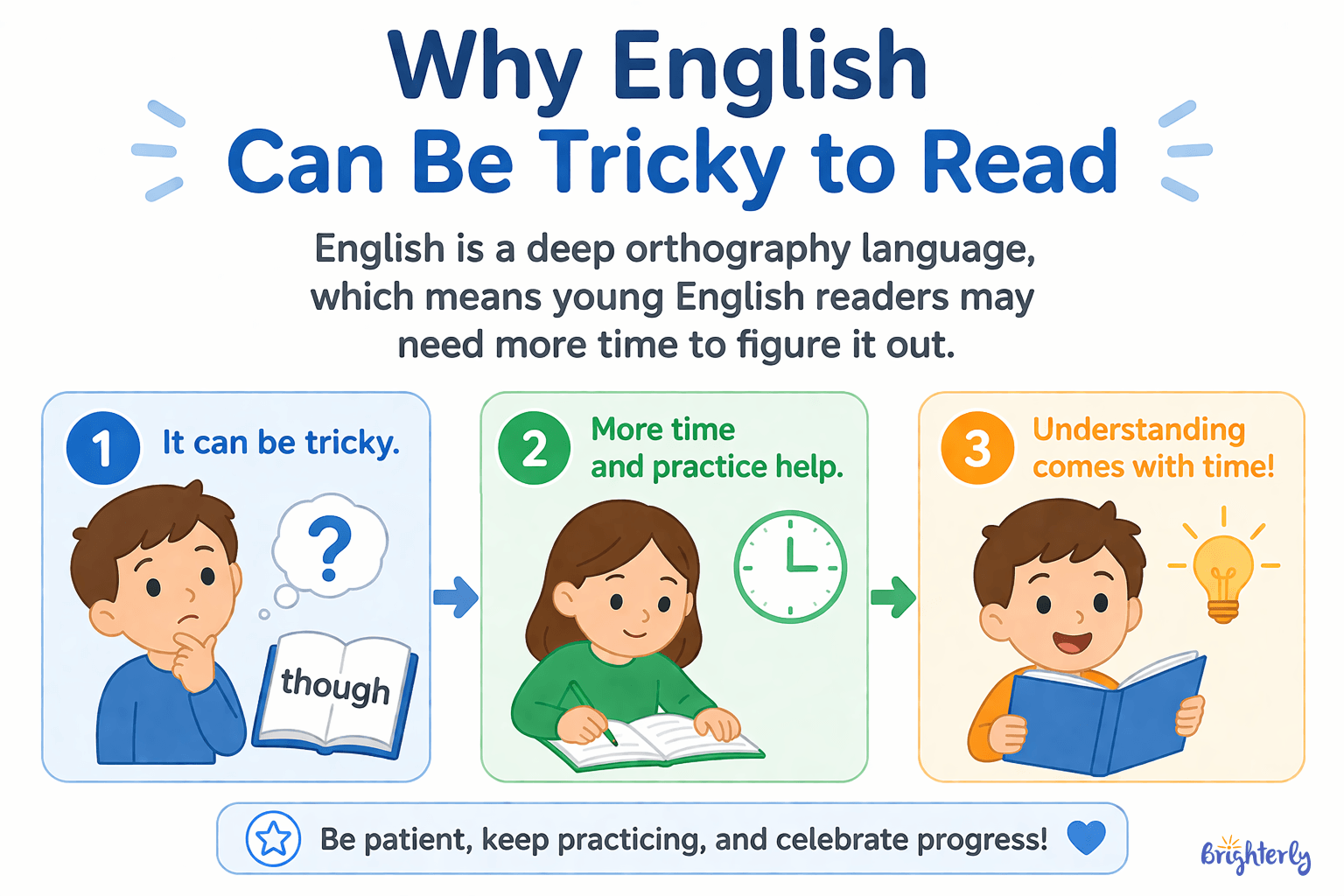
It also claims that a lot depends on the language. If the language is of shallow orthographies (letters mostly match the sounds), it’s easier to read than the language of deep orthographies (words sound way different than what they look):
- “Readers of shallow orthographies exhibit faster word and nonword reading performance, reaching 80–90% accuracy at the end of the first grade, while readers of deep orthographies suffer from delays in accurate decoding.”
Luckily, you can still help kids with dyslexia to make reading easier for them. The March 2022 report by Middle Tennessee State University states that orthographic instructions are part of effective practices that help students with dyslexia:
- “Students with dyslexia benefit from instruction that helps them coordinate phonological, orthographic, and morphological word forms.”
How To Teach Orthographic Mapping at Home?
Among the ways you can use to support orthographic mapping at home are Elkonin boxes, segmenting and blending, heart word method, color-coding letters, and word building. Besides these, you can also use different methods to teach phonics at home, or try phonic games for kids.
- Elkonin Boxes: Draw a grid and ask a child to put each sound they hear in a word into a separate box.
- Segmenting and Blending: Say a word and ask a child to tap on the table or count out loud the number of times that matches the number of sounds in the word.
- Heart Word Method: Write down an irregular word like “said” and ask a child to draw a heart over the irregular part. In this case, it’s “ai”, since it’s two letters making one sound.
- Color-Coding Letters: Ask kids to use different colored markers to mark different sounds so that they visually see the connection between sounds and letters.
- Word Building: Ask kids to build new similar words out of the ones you say, like turn “cold” into “cord”.
If you’ve tried different ways to support your child’s word recognition at home, but they still struggle with orthographic mapping in reading, you can consider getting them a professional tutor. At Brighterly, our educators help K-12 students form sound-spelling-meaning connections during one-on-one lessons. During these learning sessions, the tutor catches and corrects mistakes in real time, helping a kid to build automatic word recognition. This reading comprehension program also aligns with the US state standards, but our professionals tailor it to the style and pace of your child’s learning.

Conclusion
Orthographic mapping is one of the most essential and research-backed cognitive processes for building vocabulary and developing reading skills. This process builds a permanent word library in our brain by connecting sounds, letters, and meanings. To support this process in your child’s development, you can start by trying techniques like Elkonin boxes, segmenting and blending, heart word method, color-coding letters, and word building. And if none of them help, you can consider getting your kid a professional tutor.
Frequently Asked Questions
Is Orthographic Mapping the Same as Phonics?
No, orthographic mapping is not the same as phonics, but they are closely related. Phonics is the instruction that teaches us how sounds look in letters, which is essential for reading and writing. Orthographic mapping is more complex. It’s a mental process, which lets us recognize the words we already know in writing or listening based on their phonics.
Can Orthographic Mapping be Improved in Older Students?
Yes, orthographic mapping can be improved in older students. Although most develop this skill in early elementary school, older students can still work on it. The process can involve going back to the basics, like refreshing the knowledge of phonemic awareness and decoding strategies, before moving on to mapping.
What Role Does Phonemic Awareness Play in Orthographic Mapping?
The role of phonemic awareness in orthographic mapping is to explain to learners how to identify and work with sounds in spoken words. Without the ability to do that, a child can’t connect these sounds to letters, hence can’t form the mental image of what a word looks like, which is essential for mapping.
How is Orthographic Mapping Different from Memorizing Words by Sight?
Memorizing words by sight relies on visual memory exclusively, meaning the kids learn to remember and recognize how the words look. Mapping goes beyond that, relying not only on how the words look, but also on how they break into sounds and what they mean.
How Many Times Does a Child Need to See a Word before it Becomes a Sight Word?
A child typically needs to see a word from 4 to 14 times for it to become a sight word. However, this varies depending on the child and how they learn. Gifted and fast learners may only need to see the word just a couple of times before remembering it, when struggling kids or those with dyslexia may need to see it as much as 40 to 200 times before their brain captures it in their memory.
What are the Three Components of Orthographic Mapping?
There are three components that define orthographic mapping: phonology (the sounds of the word), orthography (the word spelling), and semantics (the meaning of the word). Mapping can only be considered successful when the brain links all three of these components together.



Debates help children develop critical thinking and public speaking skills, but finding the right debate topics for kids is not always easy. This guide gives you 80+ ideas to hold productive, engaging discussions at home or school – sorted by grade. Choose questions that match your child’s grade, knowledge, and interests. What Are Debate Topics […]
May 10, 2026

Investing in an early reading program is a big step, and you’ve likely narrowed your search down to Reading.com vs Hooked on Phonics. To help you decide which one justifies the subscription cost, this review covers the age-specific levels, lesson structures, and refund policies for both platforms. Hooked on Phonics vs Reading.com: Quick Comparison Brighterly […]

May 11, 2026
Math & reading from 1st to 12th grade
Looking for homework support for your child?
Choose kid's grade

Math & Reading for Grades 1–12
Build real confidence for your child with a Brighterly math or reading tutor.