Adjective Worksheets
Updated on October 21, 2026
Adjective worksheets help students in Grades 1–4 recognize and use words that describe nouns. Brighterly’s printable activities give children practice finding adjectives in sentences, choosing descriptive words, expanding simple sentences, and working with comparative and superlative forms.
Understanding adjectives strengthens both grammar and writing because students learn how specific details can make sentences clearer and more expressive. For a broader introduction to word types, see Brighterly’s guide to parts of speech for kids.
Adjective Worksheets PDF: Examples
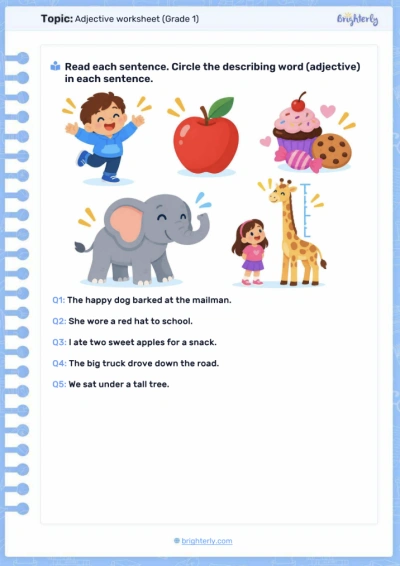
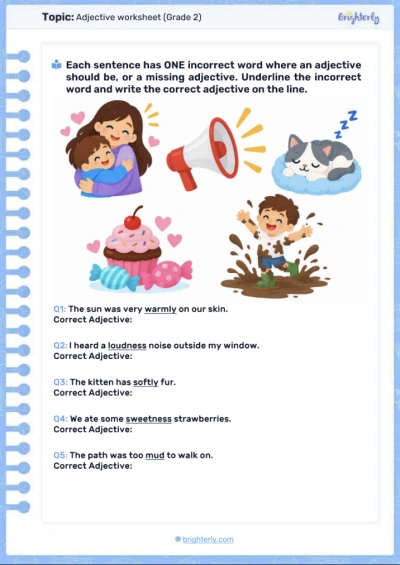
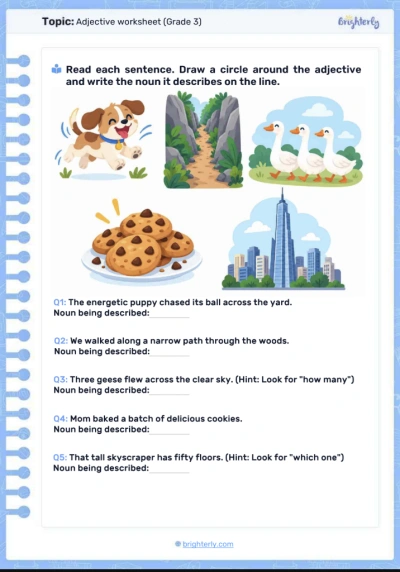
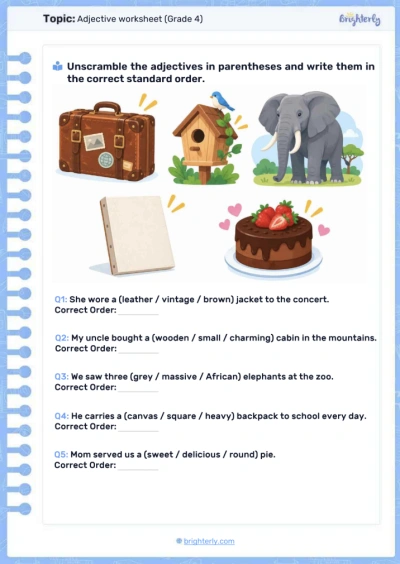
Brighterly’s adjective worksheets progress across Grades 1–4, from identifying simple describing words to choosing more precise adjectives and comparing nouns.
For example:
big → bigger → biggest
The adjective big describes one noun, bigger compares two, and biggest compares three or more.
Adjective Worksheet [Download for Free]
Download Brighterly’s free adjective worksheets for Grades 1–4 for classroom, homework, or independent grammar practice. Students can identify adjectives, connect them with nouns, choose descriptive words, and practice comparative forms.
Students can apply descriptive language in longer sentences and compositions through Brighterly’s online writing classes or get targeted grammar support from a grammar tutor.


Help your child reach their full potential!
Answer a few quick questions about your child’s learning, and we’ll recommend next steps.
What Is an Adjective?
An adjective is a word that gives more information about a noun or pronoun. It can tell readers what something looks like, feels like, how many there are, or which one is being discussed.
For example:
- red ball
- three books
- happy child
- large backpack
In each example, the adjective adds information to the noun.
Types of Adjective Practice
Identify Adjectives in Sentences
Students read a sentence and find the word that describes a person, place, animal, object, or idea.
For example:
The fluffy dog slept on the rug.
The word fluffy describes the dog, so it is the adjective.
Match Adjectives With Nouns
Matching activities help younger students understand that adjectives modify nouns. Children might pair words such as cold with ice or bright with sun.
Choose the Best Describing Word
Students choose an adjective that fits the meaning of a sentence. This moves beyond simply identifying grammar and requires them to think about vocabulary and context.
Expand Simple Sentences
Adjectives can turn a basic sentence into a more informative one.
The cat sat on the chair.
can become:
The small gray cat sat on the wooden chair.
This activity connects grammar practice directly with stronger writing.
Comparative and Superlative Adjectives
Comparative adjectives compare two people, places, objects, or ideas. Superlative adjectives compare three or more.
For example:
big → bigger → biggest
small → smaller → smallest
fast → faster → fastest
More advanced elementary students can practice recognizing when a sentence requires the base, comparative, or superlative form.
Why Adjective Practice Matters
Strengthen Descriptive Writing
Adjectives help students add useful details instead of relying only on simple nouns and verbs. This makes stories and informational writing more specific.
Build Vocabulary
Students encounter new ways to describe size, appearance, color, feelings, quantity, and other characteristics.
Improve Reading Comprehension
Recognizing adjectives helps readers understand how authors describe characters, settings, objects, and events.
Understand Parts of Speech
Learning how adjectives modify nouns helps students understand how different word types work together in a sentence. Brighterly’s parts of speech worksheets these relationships with kid-friendly examples.
Develop Stronger Grammar Skills
Adjective practice fits naturally alongside nouns, pronouns, and verbs. Students can continue with Brighterly’s pronoun worksheets and verb tense worksheets.
Other worksheets
- Parts of speech worksheets
- Pronoun worksheets
- Verb tense worksheets
- Grammar worksheets
- Punctuation worksheets
Frequently Asked Questions
What Skills Do Adjective Worksheets Practice?
Adjective worksheets help students identify describing words, connect adjectives with nouns, choose words that fit a sentence, expand simple sentences, and practice comparative and superlative forms such as big, bigger, and biggest.
What Grades Are These Adjective Worksheets For?
These adjective worksheets are designed mainly for Grades 1–4. Younger students begin by recognizing simple descriptive words, while older elementary students work with more precise vocabulary and comparative and superlative adjectives.
What Is the Difference Between an Adjective and a Noun?
A noun names a person, place, thing, or idea, while an adjective describes or gives more information about a noun. In the phrase “blue bicycle,” bicycle is the noun and blue is the adjective describing it.

Math & reading from 1st to 12th grade
Looking for homework support for your child?

Choose kid's grade

Math & Reading for Grades 1–12
Build real confidence for your child with a Brighterly math or reading tutor.