Punctuation Worksheets
Updated on October 21, 2026
Mastering correct punctuation is essential for building strong writing and reading comprehension skills. Practicing punctuation rules helps students structure sentences clearly and express complex ideas effectively.
Punctuation Worksheets PDF: Examples
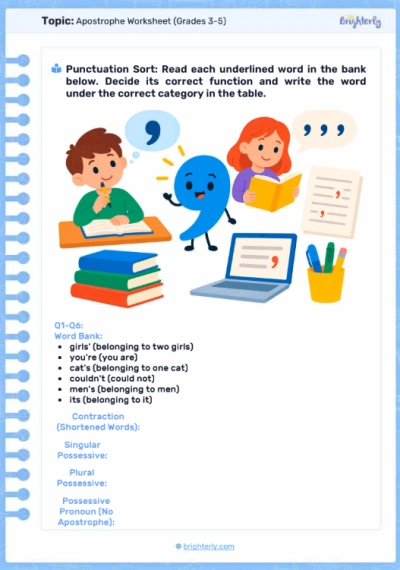
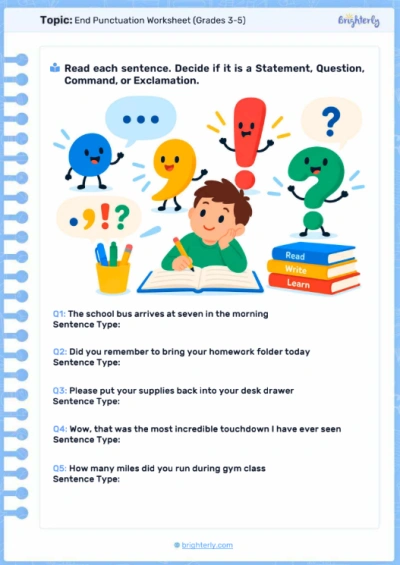
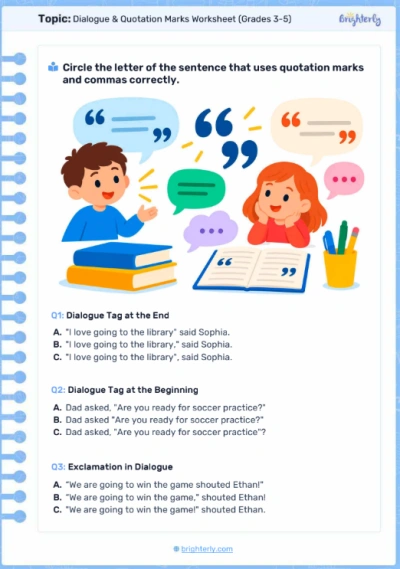
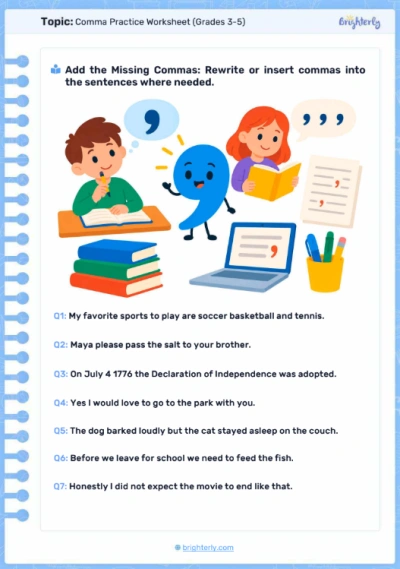
Brighterly’s punctuation worksheets focus on four practical areas: apostrophes, end punctuation, commas, and quotation marks in dialogue. Students identify missing marks, correct sentences, and apply punctuation rules in context.
If your child needs extra help, you can contact our grammar tutor to fill in the gaps and misunderstandings.


See how polished your writing skills are
A quick quiz can reveal which reading and language skills need practice
Punctuation Worksheet [Download for Free]
Download Brighterly’s free punctuation worksheets for Grades 3–5 for classroom, homework, or independent writing practice. The printable PDFs give students focused exercises with common punctuation rules.
For wider grammar practice, students can also explore Brighterly’s grammar worksheets.
Punctuation Rules Covered
Apostrophes
Apostrophes can show possession or mark missing letters in contractions.
Examples:
- Maria’s book shows that the book belongs to Maria.
- Don’t is a contraction of do not.
Students practice deciding where an apostrophe belongs and how its placement changes meaning.
End Punctuation
Students learn to choose a period, question mark, or exclamation point based on the purpose of a sentence.
- Examples:
- We finished the project.
- Did you finish the project?
- What a great project!
Recognizing sentence purpose helps children punctuate their own writing more accurately.
Commas
Comma practice helps students separate items in a list and organize information within a sentence.
For example:
- We packed pencils, notebooks, markers, and paper.
Students can pair punctuation practice with capitalization worksheets to strengthen overall sentence mechanics.
Quotation Marks in Dialogue
Quotation marks show the exact words spoken by a character. Students also practice using commas and end punctuation correctly with dialogue.
For example:
- “I finished my homework,” Maya said.
This skill becomes increasingly important as students write stories and longer compositions.
Why Punctuation Practice Matters
Punctuation helps readers understand where ideas begin and end, which words belong together, and how a sentence should sound. A missing comma or quotation mark can make an otherwise correct sentence confusing.
Regular editing practice also teaches students to notice their own mistakes. Brighterly’s article on common writing mistakes explains how punctuation, capitalization, spelling, and sentence structure can be checked during proofreading.
Students can apply punctuation alongside vocabulary, grammar, and comprehension skills in Brighterly’s reading tests.
Benefits of Punctuation Worksheets
Build Clearer Sentences
Students learn how punctuation separates and organizes ideas, helping them write sentences that are easier for readers to follow.
Improve Editing Skills
Correcting missing or incorrect punctuation encourages students to reread sentences closely and identify mechanics errors.
Support Grammar Practice
Punctuation works alongside sentence structure and parts of speech. Students can reinforce these connections with parts of speech worksheets.
Strengthen Everyday Writing
Students use punctuation when writing stories, reports, responses, emails, and other classroom assignments. Repeated practice makes correct punctuation more automatic.
Brighterly’s guide on how to get better at writing also emphasizes regular writing and proofreading practice.
Other worksheets
- Capitalization worksheets
- Grammar worksheets
- Parts of speech worksheets
- Reading and writing worksheets
Frequently Asked Questions
What Punctuation Skills Do These Worksheets Cover?
These punctuation worksheets cover apostrophes, end punctuation, commas, and quotation marks in dialogue. Students practice identifying the correct mark, adding missing punctuation, and editing sentences so their meaning is clear.
What Grades Are These Punctuation Worksheets For?
These punctuation worksheets are designed mainly for students in Grades 3–5. The activities reinforce elementary writing mechanics while gradually introducing more complex sentence and dialogue punctuation.
How Can Punctuation Worksheets Improve Writing?
Punctuation worksheets help students recognize where sentences end, separate ideas correctly, mark dialogue, and show possession or contractions. Repeated practice also develops proofreading skills, helping students identify punctuation mistakes in their own writing.

Math & reading from 1st to 12th grade
Looking for homework support for your child?

Choose kid's grade

Math & Reading for Grades 1–12
Build real confidence for your child with a Brighterly math or reading tutor.