Prefixes and Suffixes Worksheets
Updated on October 21, 2026
Learning how word parts function is key to expanding vocabulary and reading comprehension. Using targeted prefixes and suffixes worksheets helps Grade 3 students break down complex terms and understand new word meanings with ease. Each worksheet includes a complete answer key, so students can check their own work and identify which prefixes or suffixes need more practice.
Prefixes and Suffixes Worksheets: Examples
These worksheets ask Grade 3 students to identify prefixes and suffixes within words, determine how they change a word’s meaning, and build new words by adding the correct word part. Each worksheet includes a complete answer key, so students can check their work and see which prefixes or suffixes need more practice.
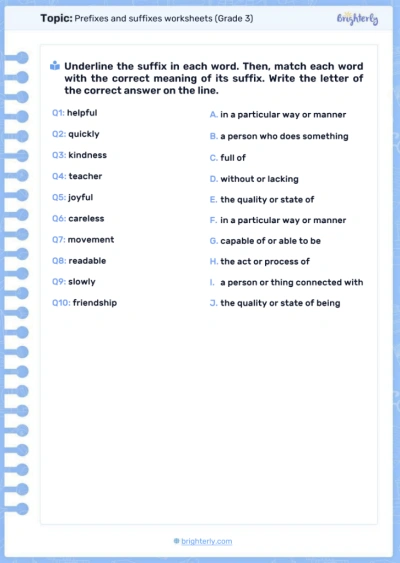
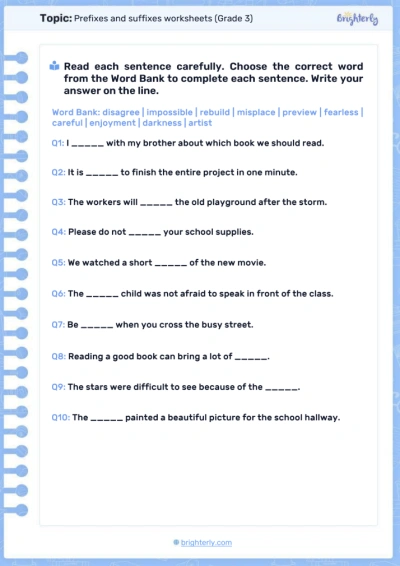
Download Prefixes and Suffixes Worksheet PDFs
Access our free collection of printable PDF worksheets designed to help students master root words, prefixes, and suffixes through engaging practice exercises.
More vocabulary worksheets
Strengthen language arts skills further with additional practice resources focused on word study, context clues, and foundational reading skills.
- Homophones worksheets
- Homonyms worksheets
- Multiple meaning words worksheets
- Shades of meaning worksheets


Help your child reach their full potential!
Answer a few quick questions about your child’s learning, and we’ll recommend next steps.
Benefits of Prefixes and Suffixes Worksheets
Builds Independent Vocabulary Skills
Working with prefixes and suffixes empowers young learners to decode unfamiliar vocabulary independently by analyzing how affixes alter base word meanings.
Strengthens Reading Fluency and Spelling
Practicing common prefixes like un-, re-, and dis-, alongside frequent suffixes such as -ful, -less, and -ly, builds a strong foundation for reading fluency and spelling accuracy.
Improves Reading Comprehension
As students recognize structural patterns in words, their comprehension of grade-level texts improves significantly, allowing them to grasp nuanced meanings without constantly relying on a dictionary.
Enhances Writing with Precise Vocabulary
Regular practice with targeted worksheets also enhances writing skills, enabling students to construct more descriptive sentences using precise vocabulary choices.
Flexible for Any Setting
These printable exercises provide structured reinforcement ideal for classroom instruction, small group activities, homework assignments, or targeted reading intervention.
Prefixes and suffixes also support vocabulary and word recognition. After practicing them, use our 3rd grade reading test to check your child’s broader grade-level reading skills.
Frequently Asked Questions
What Grade Are Prefixes and Suffixes Worksheets For?
Prefixes and suffixes are a core Grade 3 reading skill, where students learn to use common affixes as a clue to the meaning of a new word.
What Are Some Examples of Prefixes and Suffixes?
Common prefixes include un- (undo), re- (redo), and dis- (disagree), which usually come before a base word and change its meaning. Common suffixes include -ful (helpful), -less (careless), and -ly (quickly), which usually come after a base word and often change its part of speech.
How Do Prefixes and Suffixes Help with Reading Comprehension?
Recognizing a prefix or suffix lets a student break an unfamiliar word into smaller, familiar parts instead of guessing or skipping it. This makes it easier to figure out a word’s meaning from context, without stopping to look it up every time.
Do These Worksheets Include an Answer Key?
Yes. Every prefixes and suffixes worksheet includes a complete answer key, so students can check their own work and see which prefixes or suffixes need more practice.
Is There a Difference Between a Prefix and a Suffix?
Yes. A prefix is added to the beginning of a base word (like re- in rewrite), while a suffix is added to the end (like -ed in walked). Some words can have both at once, like unhelpful, which uses the prefix un- and the suffix -ful.

Math & reading from 1st to 12th grade
Looking for homework support for your child?

Choose kid's grade

Math & Reading for Grades 1–12
Build real confidence for your child with a Brighterly math or reading tutor.