Homophones Worksheets
Updated on October 21, 2026
Homophones worksheets help students in Grades 2–4 distinguish between words that sound the same but have different spellings and meanings. Brighterly’s printable activities give children practice choosing the correct word from pairs and groups such as there, their, and they’re; to, too, and two; or hear and here.
Understanding these sound-alike words strengthens vocabulary, spelling, reading comprehension, and writing accuracy because students need to use sentence context to decide which spelling makes sense.
Homophones Worksheets PDF: Examples
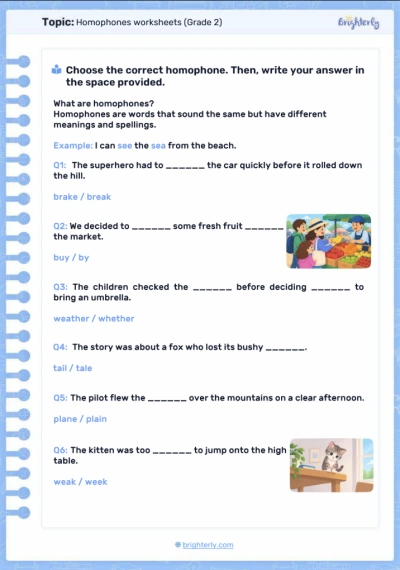
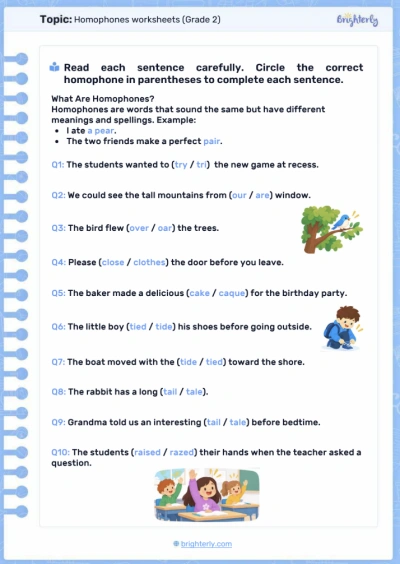
Brighterly’s homophone worksheets use sentence-completion and word-choice exercises to help students understand how context changes which sound-alike word should be used.
Instead of memorizing isolated pairs, children practice reading the whole sentence and selecting the spelling that matches its meaning.
After practicing sound-alike words, students can try Brighterly’s 2nd grade reading test to check vocabulary, word choice, reading comprehension, and other language skills in context.
If spelling and vocabulary remain challenging, a vocabulary tutor or spelling tutor can provide targeted practice based on a child’s current gaps.


Help your child reach their full potential!
Answer a few quick questions about your child’s learning, and we’ll recommend next steps.
Homophone Worksheets [Download for Free]
Download and print Brighterly’s free homophones worksheets for Grades 2–4. Students can use the PDF activities at home or in class to practice frequently confused sound-alike words through sentences and contextual exercises.
For broader word-learning practice, explore Brighterly’s vocabulary worksheets or spelling worksheets.
What Are Homophones?
Homophones are words that have the same or very similar pronunciation but different meanings and usually different spellings.
For example, two is a number, too can mean “also” or “excessively,” and to is commonly used before a noun or verb. The words sound alike, so students need meaning and context to select the correct spelling.
Common Homophones for Grades 2–4
| Homophone | Meaning or Use | Example |
|---|---|---|
| there | refers to a place | The book is over there. |
| their | shows possession | The students finished their work. |
| they’re | means “they are” | They’re reading a new story. |
| to | used before a noun or verb | We went to school. |
| too | means “also” or “more than needed” | I want to come too. |
| two | the number 2 | She has two pencils. |
Other common pairs include hear/here, right/write, one/won, and flower/flour.
How to Choose the Correct Homophone
Because homophones sound alike, students cannot rely on pronunciation alone. They need to read the entire sentence and think about the meaning.
For example:
They’re putting their bags over there.
All three words sound alike, but each has a different job. They’re means “they are,” their shows possession, and there refers to a place.
Encourage children to substitute a definition or expanded form when they are unsure. If “they are” fits the sentence, for example, they’re is the correct choice.
Benefits of Homophones Worksheet
Improve Spelling Accuracy
Homophone practice helps students notice that words with identical sounds may require completely different spellings. This can reduce frequent errors in everyday writing.
Parents looking for additional spelling strategies can also read Brighterly’s guide on how to help kids with spelling.
Build Vocabulary
Students learn not only how words are spelled but also what each word means and how it functions within a sentence.
Strengthen Context Clue Skills
To select the correct homophone, children must consider the meaning of the complete sentence. This encourages them to use context rather than focusing on a word in isolation.
Support Reading Comprehension
Recognizing which meaning is intended prevents confusion when students encounter homophones in stories, instructions, and informational texts.
Improve Writing
Students who understand frequently confused words can communicate their ideas more clearly and make fewer word-choice errors in sentences and longer writing assignments.
For a more playful way to reinforce spelling and vocabulary, Brighterly’s word games for kids include activities that strengthen word recognition, spelling, and vocabulary.
Homophones vs Multiple-Meaning Words
Homophones sound alike but have different meanings, such as right and write. Multiple-meaning words use the same written word for more than one meaning. For example, bat can refer to an animal or a piece of sports equipment.
Students ready to practice how context changes a word’s meaning can continue with multiple meaning words worksheets.
Other worksheets
- Multiple meaning words worksheets
- Spelling worksheets
- Vocabulary worksheets
- Prefixes and suffixes worksheets
- Shades of meaning worksheets
Frequently Asked Questions
What Are Homophones?
Homophones are words that sound the same or very similar but have different meanings and often different spellings. Examples include to, too, and two; there, their, and they’re; and hear and here.
What Grades Are These Homophones Worksheets For?
These homophones worksheets are designed mainly for students in Grades 2–4. Younger students can begin with common word pairs, while older elementary students can practice frequently confused groups such as there, their, and they’re in more complex sentences.
How Does a Homophone Worksheet Improve Spelling?
Homophones worksheets require students to use sentence meaning to choose between words that sound alike. This helps children remember the correct spelling for each meaning and reduces common word-choice mistakes in their own writing.


Math & reading from 1st to 12th grade
Looking for homework support for your child?

Choose kid's grade

Math & Reading for Grades 1–12
Build real confidence for your child with a Brighterly math or reading tutor.