1st Grade Shapes Worksheets
Updated on October 10, 2026
1st grade shapes worksheets help students move beyond simply naming geometric figures and begin describing how shapes are alike and different. Brighterly’s printable worksheets give first graders practice recognizing 2D and 3D shapes, comparing their attributes, drawing figures, and identifying shapes in different positions and sizes. Students can review basic shapes in math before starting the activities.
1st Grade Shapes Worksheets PDF: Examples
Brighterly’s 1st grade shapes worksheets introduce geometry through visual activities involving circles, triangles, squares, rectangles, cubes, spheres, and other familiar figures. Students practice identifying shapes by their properties instead of relying only on a familiar picture.
For example, a triangle still has three straight sides and three corners when it is rotated, while a square keeps four equal sides even when it appears in a different position.


1st Grade Shapes Worksheet [Download for Free]
Download and print Brighterly’s free 1st grade shapes worksheets for geometry practice at home or in class. The activities can help students review shape names, compare defining attributes, distinguish between 2D and 3D figures, and strengthen early spatial reasoning.
If your child still needs practice simply recognizing or tracing basic shapes, start with the easier shapes worksheets for kindergarten before moving to Grade 1-level comparisons and properties.
If your child can name shapes but struggles to describe or compare their properties, a 1st grade math tutor can provide personalized support with early geometry and other first grade math skills.


How strong are your child’s shape skills?
A quick quiz can reveal which shape skills need more practice
Other Worksheets
- 2D and 3D shapes worksheets
- 3D shapes worksheets
- Triangle worksheets
- Rectangle worksheets
- Parallelogram worksheets
- Shape tracing worksheets
Students ready to compare flat and solid figures can continue with 2D and 3D shapes worksheets. These activities help learners distinguish shapes by features such as flat faces, edges, vertices, and whether the figure is two- or three-dimensional.
For broader shape practice, explore Brighterly’s shapes worksheets collection. It includes resources for basic shape recognition as well as more advanced geometry topics for later grades.
Students can also use 1st grade math worksheets to practice shapes alongside addition, subtraction, place value, counting, money, and other first-grade skills.
Benefits of Shapes Worksheet for 1st Grade
- Describe shapes by their attributes
First graders begin paying attention to the properties that define a shape. They can describe a triangle by its three sides and three vertices or recognize that a rectangle has four sides and four corners.
Focusing on attributes helps students recognize a figure even when its size, color, or orientation changes.
- Compare different 2D shapes
Worksheets give students opportunities to compare shapes rather than study each one separately. They may notice that squares and rectangles both have four sides, while triangles have three, or compare which figures have equal-length sides.
This type of comparison helps children build geometry vocabulary and understand relationships between different figures.
- Recognize shapes in different orientations
A shape does not change its identity when it is turned or moved. A triangle pointing downward is still a triangle, and a square rotated onto one corner is still a square.
Seeing figures in different orientations prevents children from associating a shape with only one familiar position.
- Compare 2D and 3D shapes
First graders can begin distinguishing flat figures from solid objects. A square is two-dimensional, while a cube is three-dimensional; a circle is flat, while a sphere is solid.
Brighterly’s 3D shapes worksheets give students additional practice recognizing solid figures and connecting them with familiar objects.
- Compose larger shapes from smaller shapes
Students can explore how simple shapes combine to create new figures. Two triangles may form a rectangle or square, while several smaller shapes can be arranged to create a larger picture.
These activities encourage children to think about how geometric figures fit together rather than seeing every shape as an isolated object.
- Connect shapes with real-world objects
Geometry becomes easier to understand when students recognize shapes outside a worksheet. Windows can resemble rectangles, traffic signs may contain triangles, balls resemble spheres, and boxes can represent rectangular prisms.
Ask your child to identify both the shape and one defining property when they spot examples around the home or outdoors.
How to Use 1st Grade Shapes Worksheets
Begin by asking your child to name the shapes on the page and describe at least one property of each figure. Instead of accepting only “triangle,” ask questions such as “How many sides does it have?” or “How is it different from a rectangle?”
Next, compare two shapes and ask what they have in common. Students can count sides and corners, identify curved or straight boundaries, or decide whether a figure is 2D or 3D.
After completing the worksheet, reinforce the concept with physical objects. Ask your child to find a real-world example of a rectangle, cube, sphere, or another shape and explain how they recognized it.
Children who still need more basic drawing practice can use shape tracing worksheets, while those ready for broader Grade 1 practice can continue through the full 1st grade math worksheets collection.
Frequently Asked Questions
What Skills Do 1st Grade Shapes Worksheets Help Students Practice?
1st grade shapes worksheets help students practice recognizing, naming, describing, comparing, and drawing 2D and 3D shapes. They also reinforce properties such as sides, corners, faces, and the differences between flat and solid figures.
What Shapes Do First Graders Learn?
First graders work with familiar 2D shapes such as circles, triangles, squares, and rectangles and begin exploring 3D figures such as cubes, spheres, cones, and rectangular prisms. They also learn to describe and compare important shape attributes.
How Are 1st Grade Shapes Worksheets Different From Kindergarten Shapes Worksheets?
Kindergarten practice focuses more heavily on recognizing, naming, tracing, and drawing basic shapes. In Grade 1, students build on those skills by comparing attributes, identifying shapes in different orientations, distinguishing 2D and 3D figures, and composing shapes.
Do Brighterly 1st Grade Shapes Worksheets Include 2D and 3D Shapes?
Brighterly’s Grade 1 shape resources include opportunities to work with basic geometric figures, and related worksheets provide focused practice comparing 2D and 3D shapes. Students can use both types of activities to strengthen early geometry skills.
Are Brighterly 1st Grade Shapes Worksheets Free to Download?
Yes. Brighterly offers free printable 1st grade shapes worksheets that parents and teachers can use for classroom activities, homework, geometry review, and additional practice with shape recognition and properties.


Struggling with Geometry?
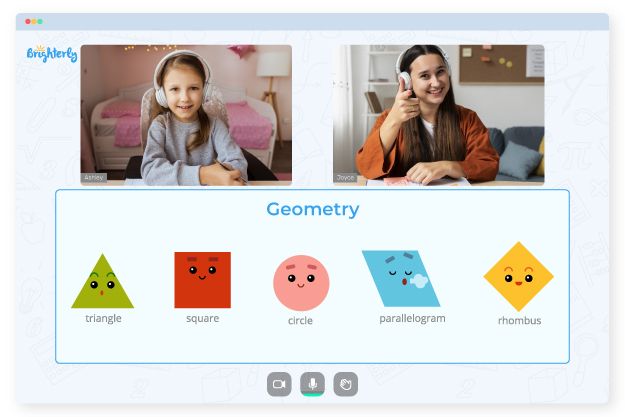
- Does your child have trouble understanding geometry?
- An online tutor could be the answer.
Choose kid's grade

Is your child having trouble with geometry? Consider starting lessons with an online tutor.
Book FREE lesson