
Angle Relationships Worksheets
Updated on September 4, 2026
Angle relationships worksheets help students identify and calculate unknown values using the precise rules governing complementary, supplementary angles, vertical angles, and corresponding angle pairs. These resources provide essential practice for mastering the properties that emerge when lines intersect and when parallel lines are crossed by a transversal. A geometry tutor can help students move from simply naming angle types to confidently setting up and solving the algebraic equations those relationships create.
Download Angle Relationships Worksheet PDFs
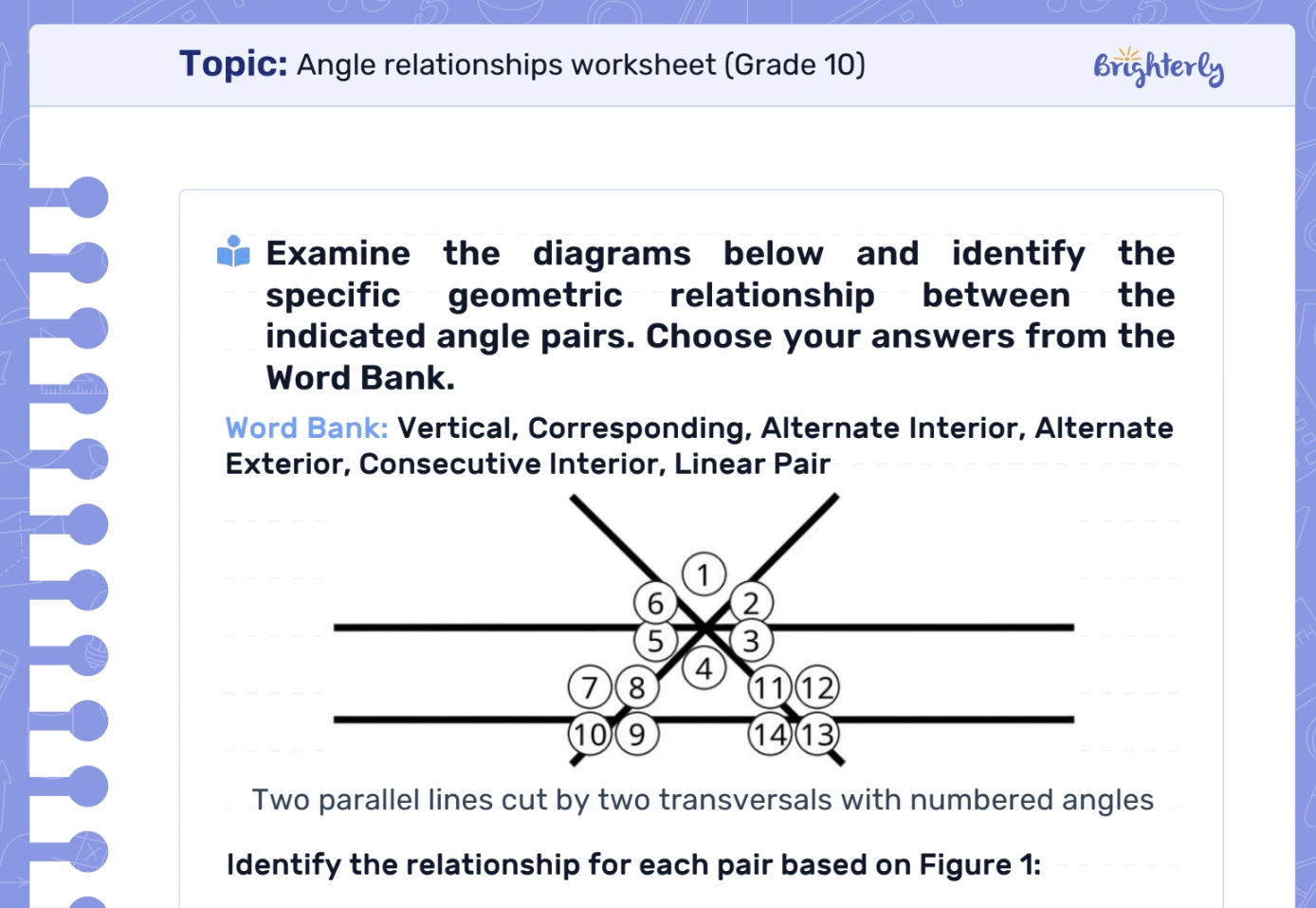
Access our collection of high-quality printable documents designed to reinforce understanding of geometric proofs and algebraic calculations built on angle-pair properties.
More angles and geometry worksheets
Deepen your mastery of angle relationships with these related resources — covering complementary and supplementary pairs, angle classification, transversal diagrams, and foundational point-line-angle geometry.
- pairs of angles worksheets
- types of angles worksheets
- measuring angles worksheets
- parallel lines and transversals worksheets
- points lines planes and angles worksheet answer key


Help your child reach their full potential!
Answer a few quick questions about your child’s learning, and we’ll recommend next steps.
Benefits of Angle Relationships Worksheets
Using angle relationships worksheets builds the logical foundation required for advanced high school geometry. Students move beyond simple visual identification and apply rigorous mathematical evidence to solve for variables using properties of complementary, supplementary, and vertical angles. By engaging with complex diagrams involving parallel lines cut by a transversal, learners practice identifying corresponding, alternate interior, and consecutive interior angles to construct and solve algebraic equations. This analytical approach is crucial for developing the deductive reasoning necessary to write formal two-column proofs — a cornerstone of tenth-grade mathematics. Consistent practice helps students recognize geometric patterns in multi-step figures, improving their ability to justify each step with specific theorems like the Linear Pair Postulate or the Vertical Angles Congruence Theorem. These spatial and logical skills prepare students for success in STEM fields where understanding the interaction of forces and angles is vital.


Math & reading from 1st to 12th grade
Looking for homework support for your child?

Choose kid's grade

Math & Reading for Grades 1–12
Build real confidence for your child with a Brighterly math or reading tutor.