Inverse Functions Worksheets
Updated on October 21, 2026
Inverse functions worksheets develop a student’s ability to reverse mathematical operations — swapping input and output values to undo what a function does.
These exercises cover the algebraic method of exchanging x and y and solving for the new dependent variable, as well as graphical analysis using the line y = x as an axis of symmetry.
Understanding inverse functions is one of the conceptual turning points in high school math, bridging algebraic manipulation with the deeper function analysis required in pre-calculus.
Inverse Functions Worksheets: Examples
Finding an inverse function means swapping x and y in the original equation, then solving for the new y. For example, to find the inverse of f(x) = 2x + 3, swap the variables to get x = 2y + 3, then solve for y: y = (x − 3)/2, so f⁻¹(x) = (x − 3)/2.
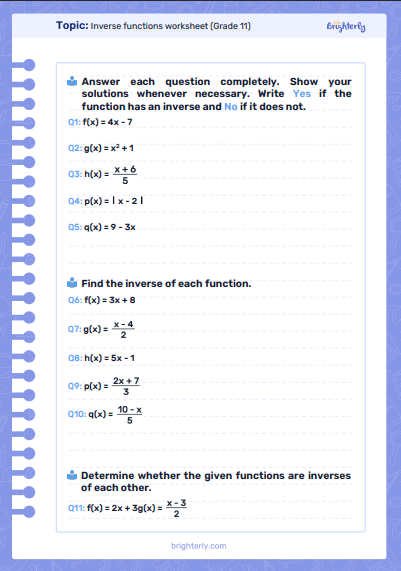
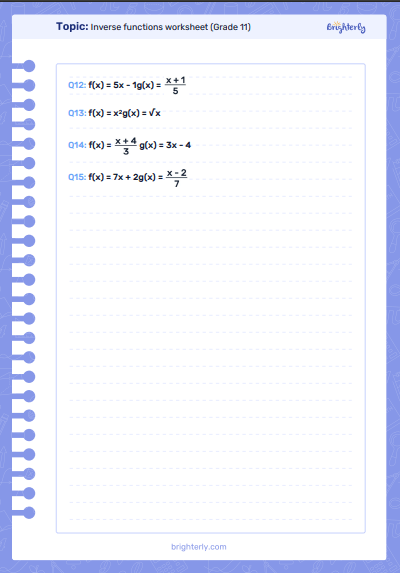
Download Inverse Functions Worksheet PDFs
Access our comprehensive collection of printable PDF documents designed to help learners practice algebraic and graphical methods for finding inverse functions.
More functions worksheets
Explore related function topics with these resources covering exponential and logarithmic relationships — the most important inverse function pair in Algebra 2 — alongside broader algebraic equation practice that reinforces domain and range reasoning.
- Solving exponential equations worksheets
- Logarithmic worksheets
- Algebra 2 worksheets
- Equations and inequalities worksheets
- Graphing linear inequalities worksheets
- Domain and range worksheets
- Composite functions worksheets


Help your child reach their full potential!
Answer a few quick questions about your child’s learning, and we’ll recommend next steps.
Benefits of Inverse Functions Worksheet
Builds Mastery of Inverse Operations
Utilizing inverse functions worksheets provides students with a structured way to master the critical skill of inverse operations, which is a cornerstone of higher-level algebra and pre-calculus.
Strengthens Understanding of Domain and Range
By working through various problems, learners strengthen their understanding of the relationship between domain and range, specifically how the output of a primary function becomes the input for its inverse.
Builds Algebraic and Graphical Fluency
Practicing the algebraic steps of swapping x and y variables and isolating the new dependent variable builds procedural fluency and algebraic confidence. These worksheets often include graphical exercises that reinforce the concept of symmetry across the line y = x, helping students visualize how functions and their inverses reflect one another.
Prepares Students for Logarithmic and Exponential Relationships
Mastering these concepts is essential for succeeding in advanced topics such as logarithmic and exponential relationships, where inverse operations are used to solve complex equations.
Helps Assess Function Classification Skills
For teachers and parents, these worksheets serve as an effective assessment tool to identify whether a student can determine if an inverse relation is itself a function by applying the one-to-one function test.
Builds Real-World Analytical Thinking
Engaging with these materials ensures that students develop the analytical thinking skills necessary to navigate reversible processes in both academic settings and real-world mathematical modeling.
Frequently Asked Questions
What Grade Is Inverse Functions For?
Inverse functions are a core Algebra 2 skill, typically covered in Grades 10–11.
How Do You Check If Two Functions Are Inverses of Each Other?
Substitute one function into the other: if f(g(x)) = x (and g(f(x)) = x), then f and g are inverses of each other.
Do These Worksheets Include an Answer Key?
Yes. Every inverse functions worksheet includes a complete answer key with full step-by-step solutions, so students can check their work.


Math & reading from 1st to 12th grade
Looking for homework support for your child?

Choose kid's grade

Math & Reading for Grades 1–12
Build real confidence for your child with a Brighterly math or reading tutor.