
Unit Circle Worksheets (Grade 12)
Updated on September 7, 2026
Unit circle worksheets give students practice labeling angles in both degrees and radians, recalling (cos θ, sin θ) coordinates at the 16 standard positions, and evaluating sine, cosine, and tangent directly from the circle without a calculator. Students work through exercises covering all four quadrants, converting between degree and radian measures, and identifying reference angles for non-standard positions. Students who struggle to recall exact coordinates for all 16 standard positions typically see faster improvement working with a precalculus tutor who can teach quadrant-based memory strategies alongside pattern recognition.
Download Unit Circle Worksheet PDFs
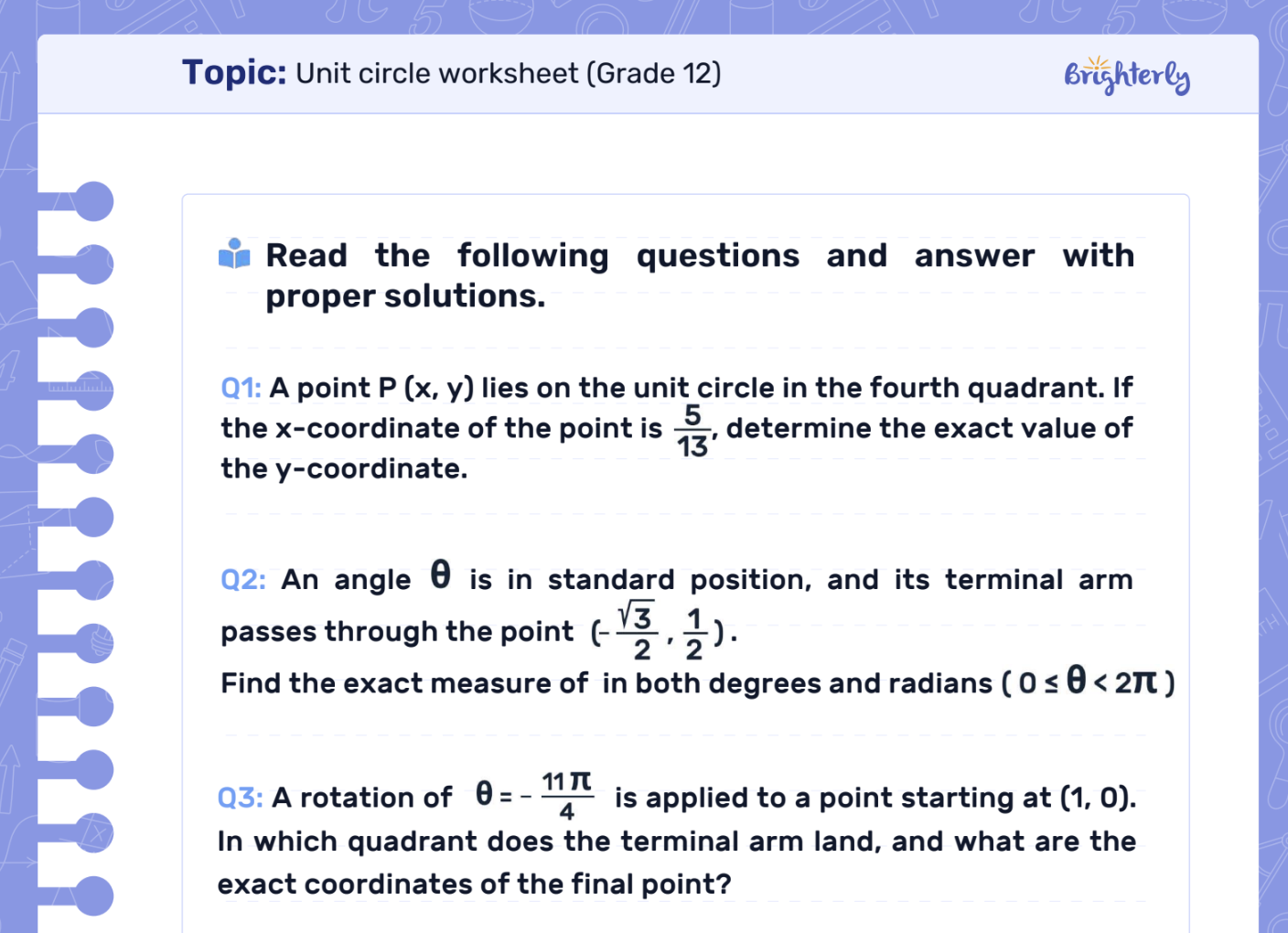
Access our collection of printable PDF resources designed to help you practice labeling angles, evaluating exact trig values, and converting between degree and radian measures.
More trigonometry worksheets
Build on your unit circle knowledge with these related resources covering special triangle angle values, radian and degree conversions, and core trig function practice.
- unit circle printable
- trigonometry worksheets
- 45-45-90 and 30-60-90 triangles worksheets
- special right triangles worksheets
- measuring angles worksheets


Help your child reach their full potential!
Answer a few quick questions about your child’s learning, and we’ll recommend next steps.
Benefits of Unit Circle Worksheets
Working with unit circle worksheets builds the exact-value fluency that precalculus and calculus depend on. Students practice recalling sin, cos, and tan at key angles — 30°, 45°, 60°, 90°, and their equivalents in all four quadrants — without needing a calculator, which is the unit circle‘s primary purpose in higher mathematics.
These worksheets reinforce the conversion between degrees and radians, helping students fluently move between angle measurement systems. This is essential for calculus, where radian measure is used exclusively in differentiation and integration of trigonometric functions.
Identifying exact coordinates also reinforces the Pythagorean identity sin²θ + cos²θ = 1 through repeated application rather than memorization, which prepares students for verifying trigonometric identities and simplifying complex expressions.
Regular practice with the unit circle reduces cognitive load when students encounter inverse trig functions and polar coordinates, since both rely on the same coordinate and angle relationships learned here.


Math & reading from 1st to 12th grade
Looking for homework support for your child?

Choose kid's grade

Math & Reading for Grades 1–12
Build real confidence for your child with a Brighterly math or reading tutor.