Colon vs. Semicolon: The Difference Every Student Should Know
reviewed by Laila A. Lico
Updated on July 10, 2026
Key Points: If your child is struggling to remember how to use a colon and semicolon, they’re not alone. In fact, mixing up these two punctuation marks is one of the most common writing mistakes that children (and adults!) make. This article breaks down what exactly a colon and semicolon are, how to use them correctly, and what rules are key to remember so your child can elevate their formal writing skills. A colon (:) is used to introduce information. Colons can be used to introduce a list or information that explains, clarifies, or expands on the sentence that came before it. You will most commonly see a colon used to introduce a list, but that’s not the only way to use it. When you want to explain or expand on a sentence, you can place a colon before the extra information. You can think of a colon as a way of telling the reader “here’s what I mean.” One key rule to remember is that a colon can only be used if the phrase before it is an independent clause (complete sentence). Let’s take a look at an example: She had one ambition: to become a professional athlete. In this example, the words after the colon expand on the complete clause before it. Simply put, the second sentence explains what her ambition was. Use Tip for Usage Example Introduce a list The phrase before the colon must be an independent clause, but the phrase after doesn’t have to be. For our camping trip, we packed several essential items: a tent, sleeping bags, a flashlight, and food supplies. Introduce an explanation, example, or clarification. Think of the colon as being shorthand for “because” or “that is.” Maya was excited for one reason: her grandparents were coming to visit. Time/ratios Place the colon between the hours and minutes or two sides of a ration. The meeting starts at 9:30 a.m. The recipe requires a 2:1 ratio of flour to sugar.
Seeking personalized support for your kid?
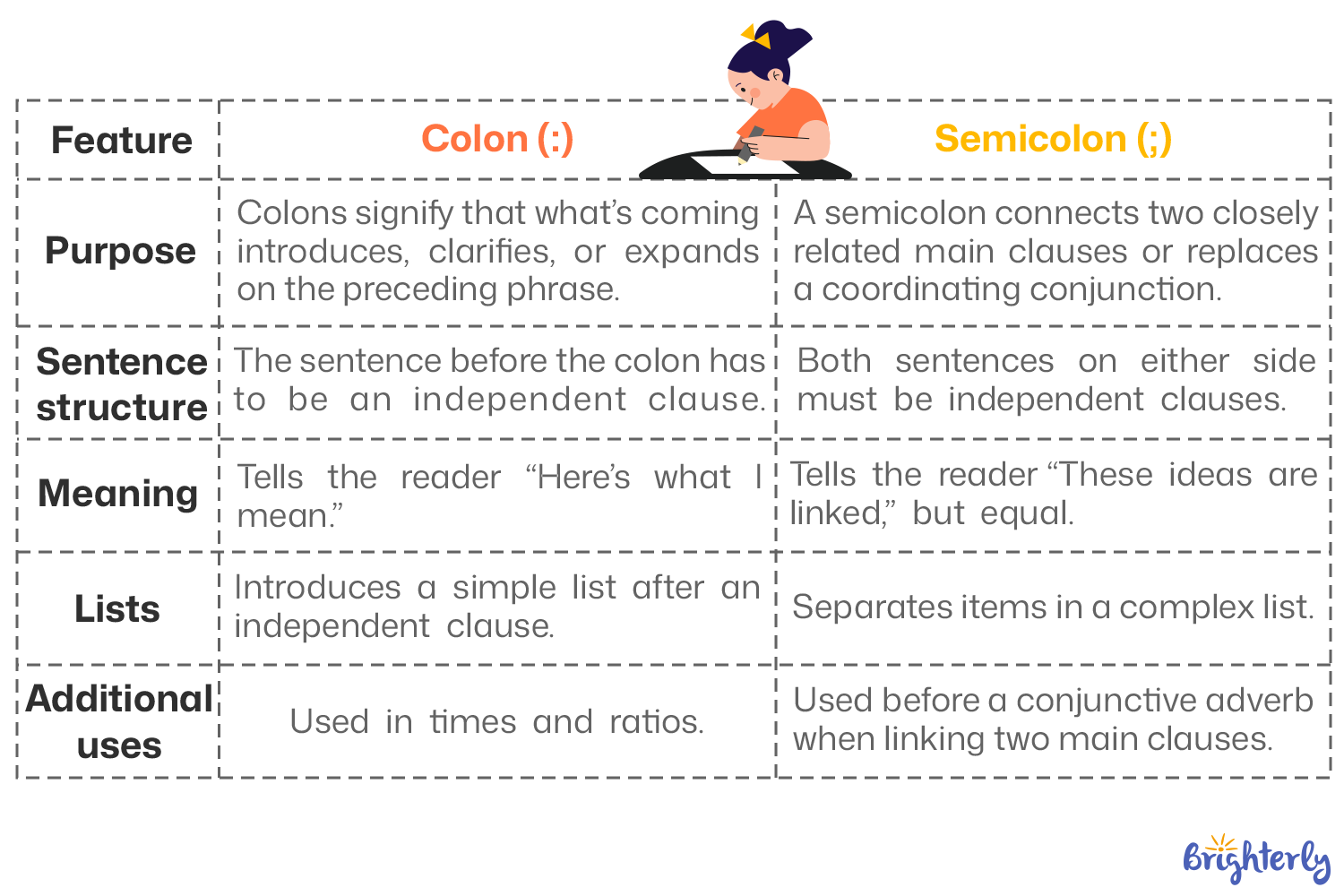
Learn how our all-in-one reading program improves your child’s fluency, comprehension, and grades. Explore Brighterly Learning Experience Learn exactly how Brighterly helps students thrive through expert sessions, online tools, and proven feedback from thousands of satisfied parents A semicolon (;) joins two related but independent clauses together, helping the reader to see the connection between the ideas while creating a stronger pause than a comma. One uses a semicolon (;) between two independent clauses that are closely related. This might sound similar to how one uses a colon, but there are some key differences. When using a semi-colon to connect clauses, both the clauses before and after it must be independent, standalone, complete thoughts that are related. Have a look at the example below: I wanted to go to the cinema; my friends wanted to stay home. Both sides of the semicolon are independent clauses, but they are closely related (same situation but different preferences). You can also use a semicolon when you need to separate items in a list that already contains commas: The panel includes Dr Smith, cardiologist; Dr Patel, neurologist; Dr Lee, surgeon; and Dr Brown, anesthesiologist. Our trip includes stops in Lyon, France, for two days; Florence, Italy, for a week; and Vienna, Austria, for 4 days. Use Tip for Usage Example Linking related sentences Semicolons can replace a period between two sentences to more effectively join them. The team practiced every day; their hard work paid off during the tournament. Replacing a conjunction (and, for, but, yet, as, so, when, after, because) Not using a semicolon in this instance is still correct, but the semicolon creates a stronger link between the ideas. Tom practiced the piano every day; his skills improved quickly. Separating complex list items If the items contain commas, place a semicolon between each complete item. I have lived in Paris, France; Berlin, Germany; Tokyo, Japan; and Madrid, Spain. Use a semicolon with a conjunctive adverb (however, otherwise, therefore, consequently) The conjunctive adverb should always come after the semicolon, and a comma should follow it. The weather forecast predicted sunshine; however, it rained all afternoon. The key difference between a colon and semi colon is how they connect ideas and the grammar rules they have to follow. A colon introduces information, and the clause before it needs to be a complete sentence. A semicolon links related ideas, and both clauses on either side must be complete sentences. Feature Colon (:) Semicolon (;) Colons signify that what’s coming introduces, clarifies, or expands on the preceding phrase. Example There was only one problem: the car wouldn’t start. A semicolon connects two closely related main clauses or replaces a coordinating conjunction. Example It was raining heavily; we decided to stay indoors. The sentence before the colon has to be an independent clause. Example He had one goal: to pass the test. Both sentences on either side must be independent clauses. Example The museum was closed; we decided to visit the park instead. Tells the reader “Here’s what I mean.” Example “There was only one explanation: the teacher must have forgotten.” Tells the reader “These ideas are linked,” but equal. Example: “She studied all night; she still felt unprepared for the exam.” Introduces a simple list after an independent clause. Example We packed everything we needed: clothes, snacks, and a map. Separates items in a complex list. Example The course covered grammar basics, such as nouns and verbs; sentence structure, including clauses and phrases; and punctuation, such as commas and semicolons. Used in times and ratios. Example The train will arrive at 11:30am. Used before a conjunctive adverb when linking two main clauses. Example The roads were covered in snow; therefore, the school was closed. 1.You’re introducing a list, and the clause before the colon is a complete sentence. 2. The second part of the sentence explains, clarifies, or expands the first part. The colon conveys the message “Here’s what I mean” as the information that comes after the colon is used to explain or elaborate on the information before it. 3. Introducing a quotation. When you want to include a famous quote or quote from a text, you can use a colon to introduce the quote as long as the phrase before the colon is a complete clause. 1. You need to separate items in a complex list. If the items in a list already contain a comma, then using a semicolon improves writing clarity. 2. You want to link two related but independent clauses. You can use a semicolon to join two complete sentences that are closely related in meaning, but neither expands on nor explains the other. 3. You want to replace a conjunction (and, but, or so) when linking related but independent clauses. 4. You’re using a conjunctive adverb, however, therefore, nevertheless, and consequently, when they join two independent clauses. According to Purdue University, a comma splice (also called a run-on) occurs when two independent clauses are joined together using a comma and no coordinating conjunction. Incorrect: I was hungry, I made a sandwich. Correct: I was hungry, so I made a sandwich. Correct: I was hungry; I made a sandwich. Rule: Connecting two full sentences with only a comma and no conjunction (so, but, and) creates a comma splice. This is because a comma is not strong enough to hold together two independent clauses; you need something else, like a semicolon. Note: The easiest way to learn about comma splices and other tricky punctuation rules is by practicing with grade-appropriate writing worksheets or by following Brighterly’s reading program. These curriculum-linked resources and online spelling tutors can help your child improve their descriptive writing and grammar skills quickly and stress-free. Incorrect: We visited several European cities; London, Paris, and Rome. Correct: We visited several European cities: London, Paris, and Rome. Rule: A semicolon is never used to introduce a list; instead, you can use a colon if the phrase before the list is a complete clause. Incorrect: Because it was raining; we stayed inside. Correct: Because it was raining, we stayed inside. Rule: Both sides of the semicolon must be independent main clauses. This means that you can’t use a semicolon if one side is not a complete sentence. In this example, “Because it was raining” is a dependent clause (not complete) and therefore a semicolon won’t work.
Is your kid reading at their grade level?
Take Brighterly’s diagnostic reading test to see where your child stands today. Colons and semicolons may look similar, but they have very different roles. Use a colon to introduce a list or to expand on or explain what has come before it. Use a semicolon to connect two related, complete sentences that are equal. Worksheets, interactive quizzes, and specialist middle school reading tutors can help your child to master this tricky but essential punctuation skill. In general, no. Semicolons and colons serve different purposes and are not interchangeable. However, in some cases, either would be grammatically correct, but the meaning would shift slightly. For example: Rosie is upset; Ian is laughing. The semicolon links two related ideas without suggesting cause. They might both be happening during a board game, but one isn’t responsible for the other. Now compare: Rosie is upset: Ian is laughing. The colon tells us that Ian’s laughing explains Rosie’s upset. In this example, the difference in colon vs. semicolon use is subtle, but it’s there. Yes, in the world of punctuation, a semicolon is considered stronger than a comma. That means it can be used to hold together two complete sentences where a comma can’t. It also creates a stronger ‘pause’ for the reader. In most cases, no, you don’t capitalize after a colon unless it is followed by a proper noun or you’re starting a quotation. However, some style guides, like APA format, do want you to capitalize after a colon if it begins a complete sentence. Don’t use a semicolon to introduce a list, connect unrelated or incomplete clauses, or where there is already a conjunction. Semicolons can be used in complex lists where the items are already separated by commas. The purpose of using a semicolon in a list is to make it clearer to the reader which items are grouped together. Students typically learn how to use semicolons and colons during English lessons in middle school. An easy way to see if your child is ready to learn how to use colons and semicolons is by testing their reading level. Children reading at a 5th or 6th grade level are typically ready to learn how to use colons and semicolons in their writing. Teachers explain how semicolons connect clauses in a compound sentence and they will likely use colon vs semicolon examples and worksheets to help students master this tricky skill. No, a colon should not begin a sentence. Instead, it follows a complete clause and introduces related information such as a list or explanation. When using a colon the key rule to remember is that the words before the colon must form a complete sentence and the words after must inform, explain, or clarify what came before. The #1 rule for using semicolons is that they connect two closely related, but independent clauses. A semicolon can also be used before a transitional phrase or word such as “however” or “nevertheless” when linking related ideas. A semicolon should never be followed by a conjunction such as and, but, or so, nor should it be used before an incomplete sentence. The clauses on either side should be related but equal. Neither clause should exist solely to explain, expand on, or clarify the other. Fun summer school math activities are at-home designed tasks for a child that help them improve math skills, clear basic math concepts and prevent summer slide during the summer vacation. These can be done through field trips, cooking and baking, family activities and math games, like Jeopardy, Bingo and Monopoly, to make them more enjoyable […] Jun 19, 2026 Missing two or three topics, in math especially, creates a chain of gaps that quietly builds into a significant lag. Kids rarely confess they need help. Fortunately, there are subtle “litmus tests” or signs that your kid needs tutoring that show up long before the report card does. Here are seven worth paying attention to. […] Jun 24, 2026
What Is a Colon? Definition and Rules
3 Ways to Use a Colon — with Examples


What Is a Semicolon? Definition and Rules
4 Ways to Use a Semicolon — with Examples
Colon vs. Semicolon: Key Differences at a Glance
Colon and Semicolon Rules
Purpose
Sentence structure
Meaning
Lists
Additional uses
When to Use a Semicolon vs Colon: Quick Decision Guide
Use a Colon When…
Use a Semicolon When…
Common Mistakes Students Make with Semicolons vs. Colons
Mistake 1: A Comma Splice
Mistake 2: Using a Semicolon Before a List
Mistake 3: Using a Semicolon to Connect Incomplete Sentences
Conclusion
Frequently Asked Questions
Can You Use a Semicolon Instead of a Colon?
Is a Semicolon Stronger Than a Comma?
Do You Capitalize the First Word After a Colon?
When Should You NOT Use a Semicolon?
What Is a Semicolon Used for in a List?
How Do Students Learn Semicolons and Colons in School?
Can You Start a Sentence With a Colon?
What Is the #1 Rule for Using Semicolons?
What Should Never Follow a Semicolon?



Math & reading from 1st to 12th grade
Looking for homework support for your child?

Choose kid's grade

Math & Reading for Grades 1–12
Build real confidence for your child with a Brighterly math or reading tutor.